


What We Know
In watches, few complications carry the romance of a world timer. A single display that brings all the cities of the world together. It’s as evocative as it is practical, and long one of the most coveted formats, especially among vintage collectors. Case in point: a Patek Philippe ref. 2523 with a South American cloisonné enamel dial heads to Phillips this spring with an estimate north of CHF 5,000,000. Add in the enduring appeal of stone dials, and you’re firmly in grail territory—making the idea of getting all of that, with a mechanical movement, for under $1,500 feel almost improbable. Yet that’s exactly what Baltic has done with the Heures du Monde.



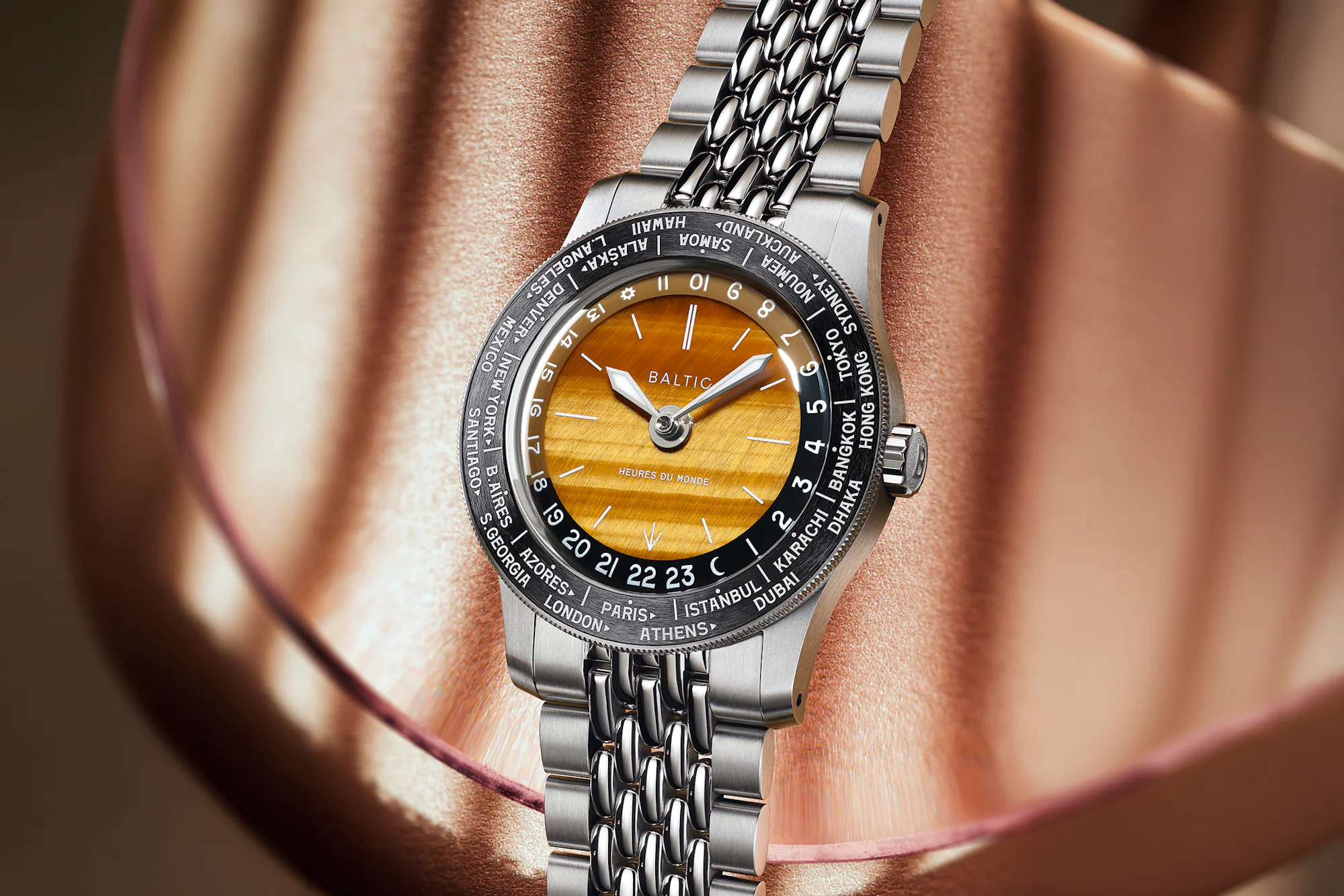
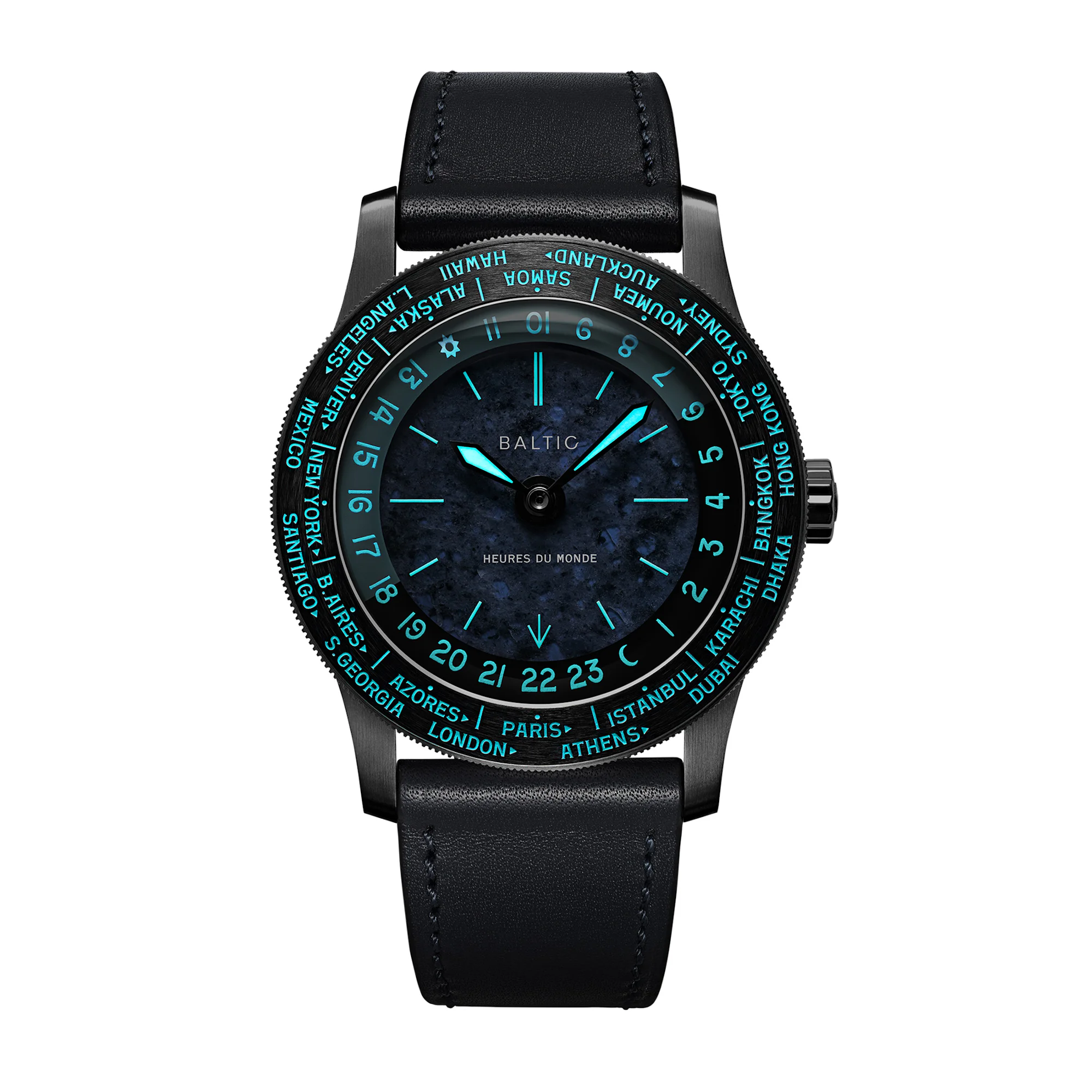
In a more vintage-sized 37mm by 11.3mm (9.3mm not counting the glass) 316L stainless steel case, offered with labradorite, tiger eye, or sodalite dials, and powered by a Soprod C125 GMT movement, the new Baltic Heures du Monde looks stunning. The case decoration is relatively reserved, featuring brushing and drilled lugs. But the world time bezel, with 24 major cities for each time zone, is made of ceramic and features Super-LumiNova BGW9, matching the lume printed on the dial and used on the polished sword hands.
Then, for the world time function, the 120-click bezel can be rotated to match the appropriate time zone. The 24-hour disc has a light or dark section (for day or night) matched to the central dial color. The Soprod C125 is essentially a “caller” GMT, so the GMT disc is the movable feature, not an independent hour hand. Generally, you would set your local time, then you can rotate the bezel to align your home time zone with the 6 o’clock arrow. Finally, pull the crown out to the correct position, and you can align the 24-hour disc to match the appropriate hour in that home time zone, allowing you to reference the time anywhere in the world (at least for full-hour offsets).
Other features of the watch include a double-domed sapphire crystal, stop-seconds for the movement (though you wouldn’t know because the watch doesn’t feature a seconds hand). For this new release, only 200 of each piece will be available at first, each individually numbered, before a later launch of a permanent collection. The Baltic Heures du Monde retails for €1,300 on an Italian calf leather strap or €1,360 on either a beads of rice bracelet or a steel flat link bracelet.
What We Think
Stunning. Absolutely stunning. If you’re someone who, like me, spends a lot of time thinking about vintage watches, wishing I had the money to buy all the great and historically significant pieces in watchmaking history, you’ll know that world time watches are among the world’s most coveted. Yes, there are other ways to get your vintage fix (ask our friend Adam Victor, who knows a lot about good world times and has studied the Louis Cottier archives), but getting the best of the vintage feeling with an affordable price point is hard to beat. Unfortunately, I was unable to go Hands-On with this watch ahead of launch, but you can be sure I’ll try to do a story when the wider commercial release comes out.

The Basics
Brand: Baltic
Model: Heures du Monde
Diameter: 37mm
Thickness: 11.3mm (9.3mm without the crystal)
Lug-to-Lug: 45mm
Case Material: 316L Stainless Steel
Dial Color: Sodalite (blue), Labradorite (grey-blue), and Tiger’s Eye
Indexes: Printed luminous
Lume: Super-LumiNova® BGW9 on the ceramic bezel, hands, and dial
Water Resistance: 100m
Strap/Bracelet: Italian calf leather strap, or steel Beads of rice bracelet, or steel Flat link bracelet

The Movement
Caliber: SOPROD C125 GMT
Functions: Hours, minutes, 120-click worldtime bezel, stop second
Power Reserve: 42 hours
Winding: Automatic
Frequency: 4Hz
Jewels: 25
Chronometer Certified: No
Additional Details: Sapphire crystal with double dome and internal anti-reflective coating
Pricing & Availability
Price: €1,300 on a leather strap and €1,360 on a metal bracelet
Availability: Now via Baltic’s website
Limited Edition: 200 pieces per model. Each watch is individually numbered on the case back from 1 to 200. These watches will become part of the permanent collection at a later date
For more, click here.