

It was a big deal last year when news broke that Audemars Piguet would be joining Watches and Wonders, many years after the brand left the previous iteration of the fair, SIHH, after 2019. So there’s no doubt that many eyes will be on the brand as it makes its grand entrance at the show, and which watches will be making their grand debuts. Some easy guesses seemed to have been snuffed out by the brand’s past few moves.

The RD#5 movement introduced last year (L) and the controversial Neo Frame introduced earlier this year (R).

Photos by Mark Kauzlarich
Could it be a cutting-edge research-and-development piece? No, since CEO Ilaria Resta announced that last year’s mind-blowing RD#5 would be the conclusion of the series. Could it just be the new place for the AP to release its annual Q1 novelties? Probably not, since this February already saw the announcement of a whopping almost twenty new releases for the brand, and it’s reported that AP plans to stick with their “AP Social Club” event to announce their main novelties each year. So what could Watches and Wonders bring? Well, it turns out Audemars Piguet is looking to subvert expectations by announcing something entirely different: a new program called Audemars Piguet Atelier des Établisseurs that seeks to produce extravagant, highly individualized timepieces with some of the best craftspeople in the industry.
About Établissage
The concept of établissage (and établisseurs) is integral to the history of Swiss watchmaking. In the 18th, 19th, and even early-to-mid 20th centuries, long before the industry sought to signal value through the idea of “in-house” and vertical integration, Swiss watchmaking was quite decentralized, relying on an entire network of individual suppliers, specializing in producing parts ordered by etablisseurs, where final assembly would occur. It’s also a system inherently tied to the land, as Jura farmers in cold winters would turn to working on watch components for an additional source of income. As a result, a rich web of craftspeople, from casemakers to dialmakers and everything in between, would flourish in areas like the Vallée de Joux, and you would see incredible examples of small-run handmade watches.

‘Grosse Pièce’ – Audemars Piguet’s Most Complicated Pocket Watch, which sold for a record-breaking price to the AP Museum last year. It’s also one of the most thoroughly-documented examples of AP’s établissage work in history.
The Industrial Revolution obviously changed a lot about the landscape, and began the shift towards larger-scale watch production that would result in the ever-increasing value of “in-house.” However, while the industry remains heavily reliant on external suppliers today, this consolidation posed—and continues to pose—an existential threat to the niche ecosystem of independent artisans and specialist component makers who once defined haute horlogerie behind the scenes.
It appears that Audemars Piguet, with its prominent messaging about a non-stop progression in the vertical integration of its watchmaking, is subverting itself by creating a new program that seeks to revive this traditional way of working and the support of specialist talent across the industry. What this means, in the context of the brand’s new program: highly complex designs that prominently feature various métiers d’art, with a unique level of transparency and credit for every name that has touched the watch, and extremely limited production. There isn’t a push for new movement development for this program in the strictest sense of the term; rather, existing mechanical movements are used as bases (in some cases, even shaped) for the designs, with an added level of finishing and sometimes added functionality on top. The on-site work is carried out in the Audemars Piguet Museum, fully on display to the visiting public, and the projects are managed by the brand’s heritage department.


Musée Atelier Audemars Piguet. Photo by TanTan Wang
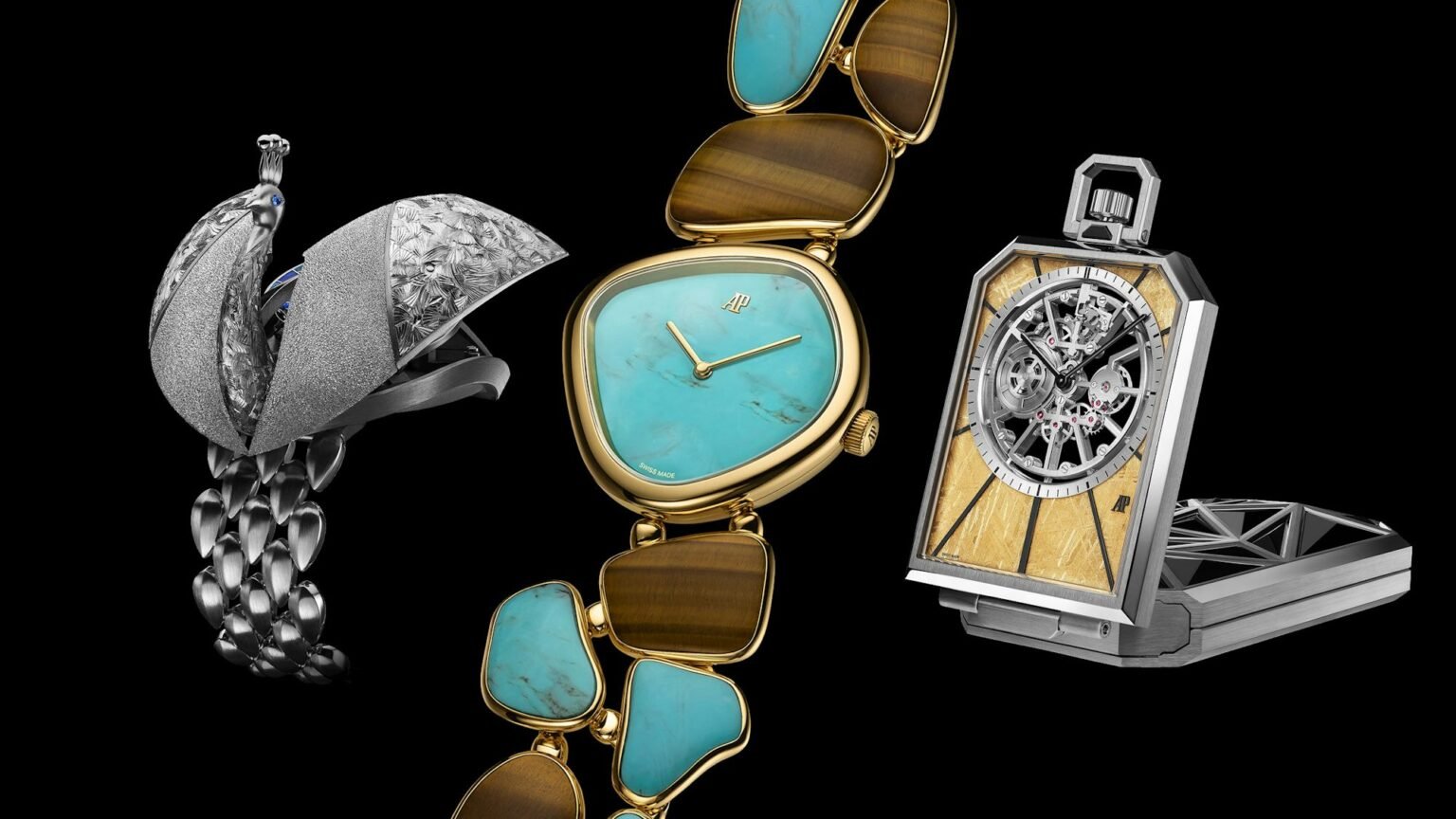
The brand credits the birth of this program to a conversation between Resta, a few months into her tenure at AP, and Heritage and Museum Director Sébastian Vivas as they looked over the sheer diversity of AP’s older designs. This prolific design catalog was in no small part thanks to the agile way établissage defined production, and it seems that this new program is an attempt to revive this more agile approach to output. The new program heavily involves the brand’s Heritage department and debuts three new models: the Établisseurs Galets, the Établisseurs Peacock, and the Établisseurs Nomade.
What We Know
Établisseurs Galets

The first of the three creations announced at Watches and Wonders is the Établisseurs Galets, conceptualized by independent designer Xavier J. Perrenoud, which pays tribute to the pebbles of the Lac de Joux, a lake near AP’s Le Brassus headquarters. In this watch, a completely asymmetrical bracelet, crafted by Genevan jeweler Nadia Morgenthaler, consists of pebble-shaped gold links of varying sizes, connected via tiny ball joints.
These gold links are inlaid with semi-precious stones in the Cossonay workshops of Mario Senape—this first version pairs yellow gold with turquoise and tiger’s eye stones. Perhaps the most impressive detail here is that the stones are all shaped, with not a single flat edge or surface in sight. A jeweler’s clasp with two safety pins and a spring blade is integrated into the bottom of the bracelet, and highly stylized removable links are also set with stones.


The bracelet leads to the center asymmetrical oval-shaped case, with a design credited to and crafted by Théo Massouatis and Pablo Brenlla in Geneva. It houses a matching turquoise stone dial on the front and an exhibition caseback on the reverse.

The movement seen through the caseback is the revival of AP’s first in-house movement, the Calibre 3090. This version is specifically Calibre 3098, modified by watch movement constructor Arthur Gallezot to achieve its unique shape, with bridges also redesigned to resemble the soft curves of pebbles. Movement blanks are produced by Johann Rochat, and Luca Soprana, a very familiar name on this site, is in charge of the finishing that includes light frosting of the bridges and prominent anglage. Finally, Aline Gagneux of the Atelier des Établisseurs is credited for assembly and final adjustment of the calibers.
Five variations offering different stone combinations will be available in 2026, and only a few can be made per year.
Établisseurs Peacock
Next up is an absolutely gnarly watch, one that pushes the boundaries between sculpture and watch in a way that feels very exciting. Designed by Kenan Géraud, who works at Audemars Piguet, the closed position of the Établisseurs Peacock almost resembles a beetle on the wrist. But thanks to a clever secret-opening system designed by the legendary Giulio Papi, upon activation, the peacock’s head rises, revealing its plumage, and the wings unfold sideways, leaving room for the enameled dial to tilt forwards, with a window for the current (dragging, not jumping) hours.


The bird itself consists of a curved, multi-part case with dramatic wings crafted in the workshop of Adrian Altman, each comprising a hammered and an engraved portion. The bracelet is crafted entirely at the Musee Atelier Audemars Piguet by jeweler Ywan Kunzle, who forms and finishes each link and fixes them together with hidden gold wires. Finally, the gold dial is made by Vincent Michel in Saint-Imier and carved into small compartments, which are further hand-engraved by Guy Froidevaux in La Chaux-de-Fonds. Froidevaux is also the engraver for the head and neck of the peacock itself. When the dial leaves these hands, it goes to Peseux-based Vanessa Lecci, who champlevé-enamels each of these compartments in different shades.

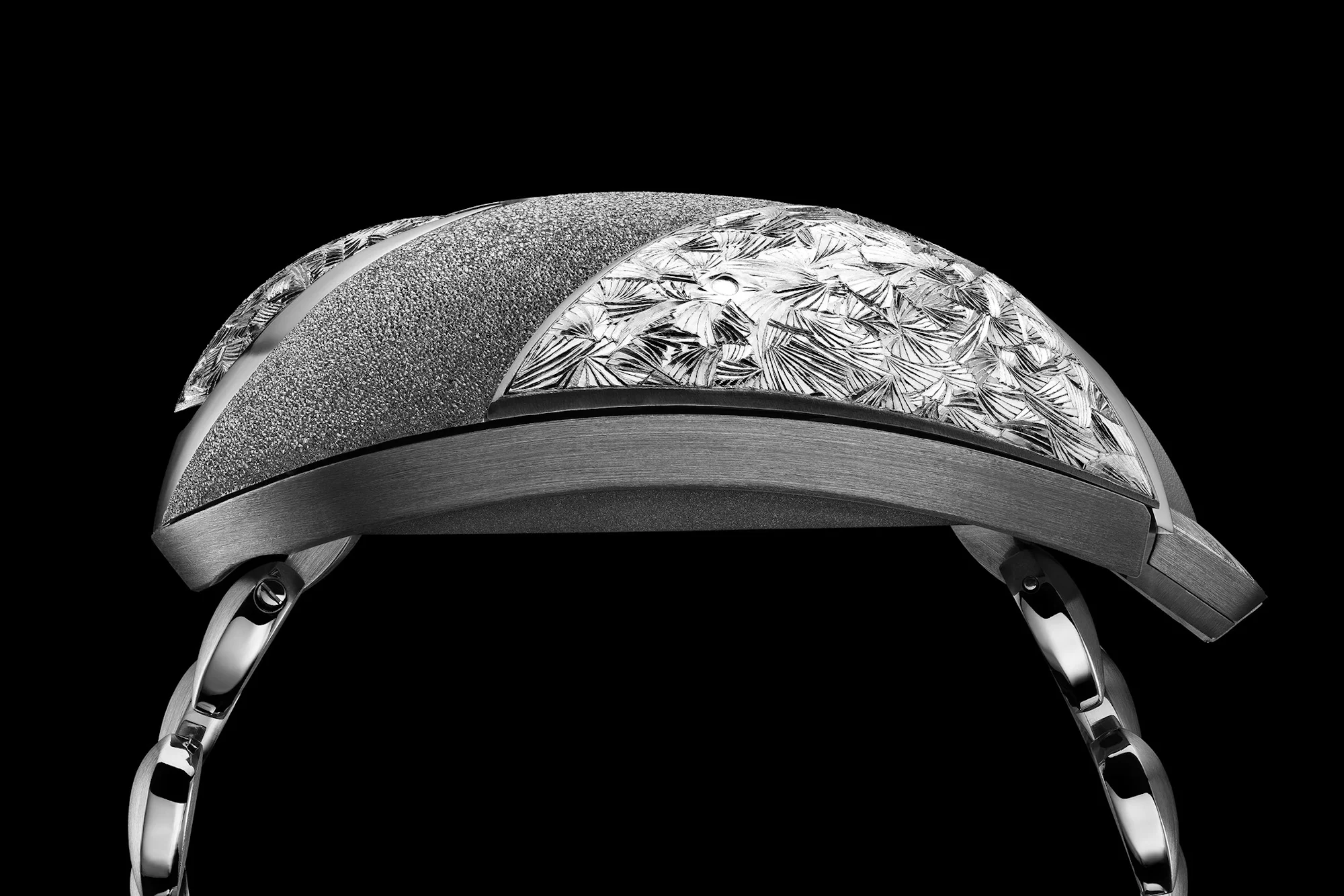
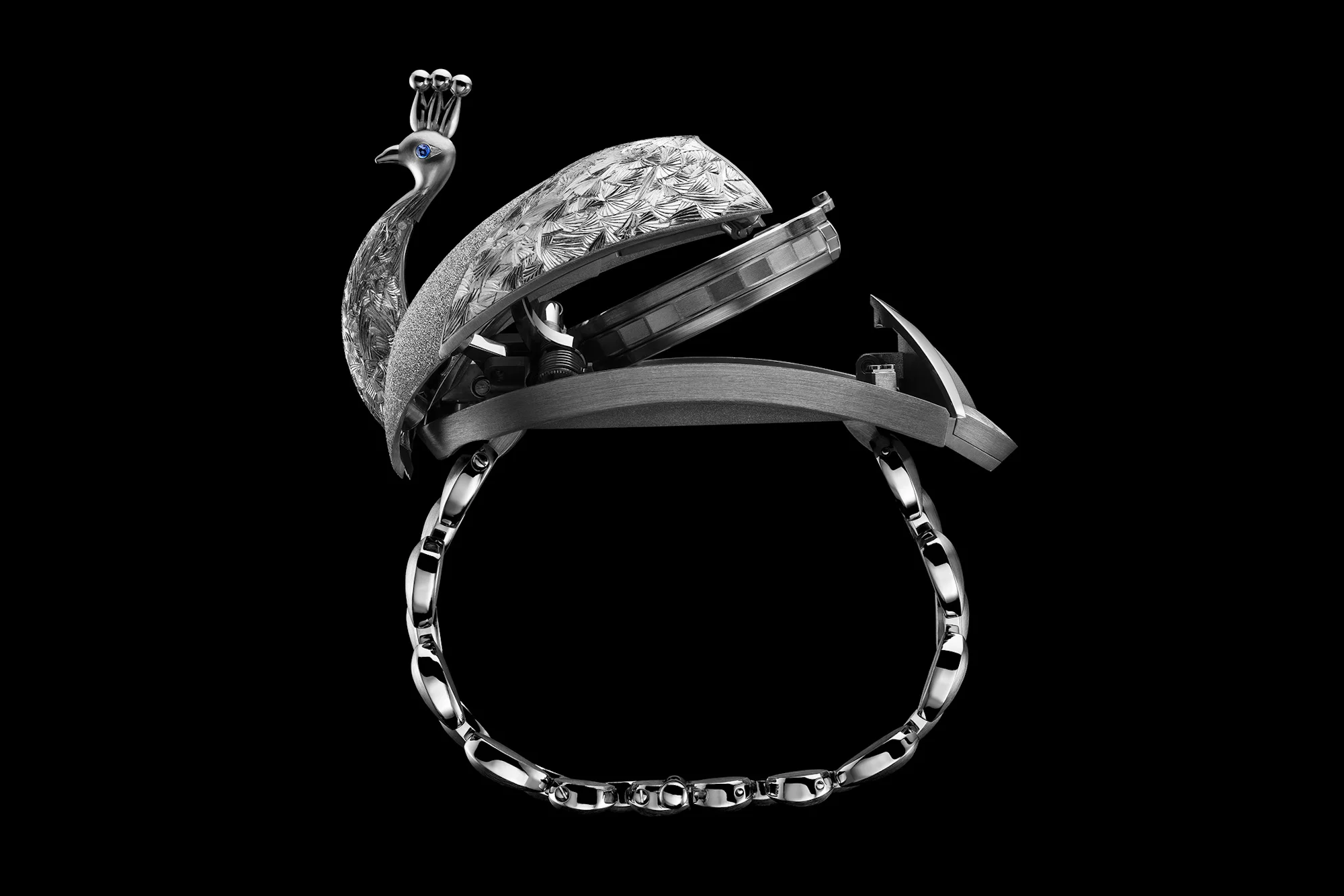
Audemars Piguet says that three variations will be available in 2027.
Établisseurs Nomade

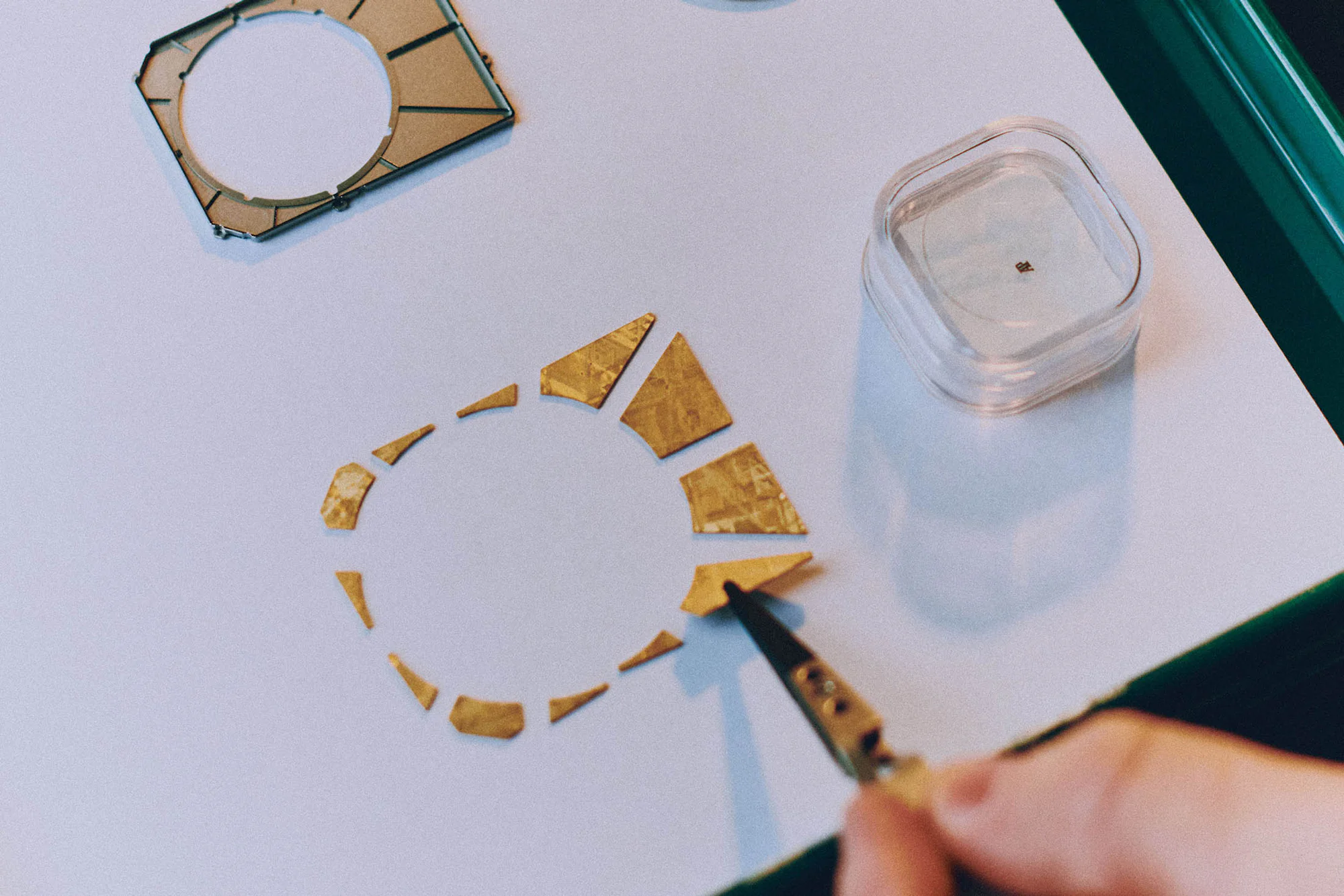
The third and final entry in this series—which the brand emphasizes is only the beginning—is the unique pocket-slash-table clock, the Ètablisseurs Nomade. Designed by Ludovic Python, it combines an ultra-modern exterior with a gorgeous caliber, decorated and finished in a very traditional way, for a great example of how broad this new program can be in its approach to watchmaking. In its default closed state, the 68mm-by-42mm case is designed to fit in a small pocket, showing only the dramatically faceted, stone-inlaid exterior, which is tied to a 30 cm titanium chain.
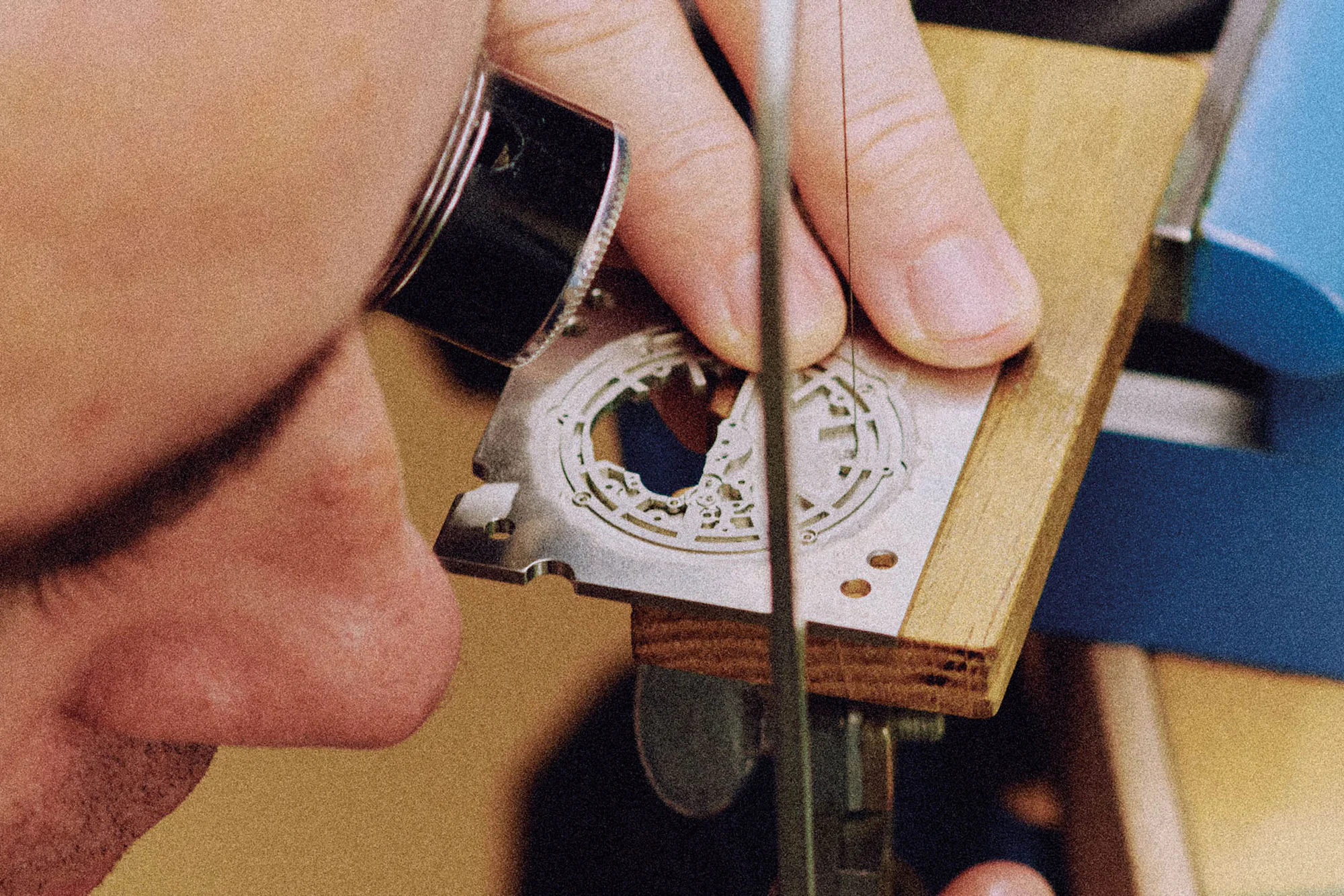
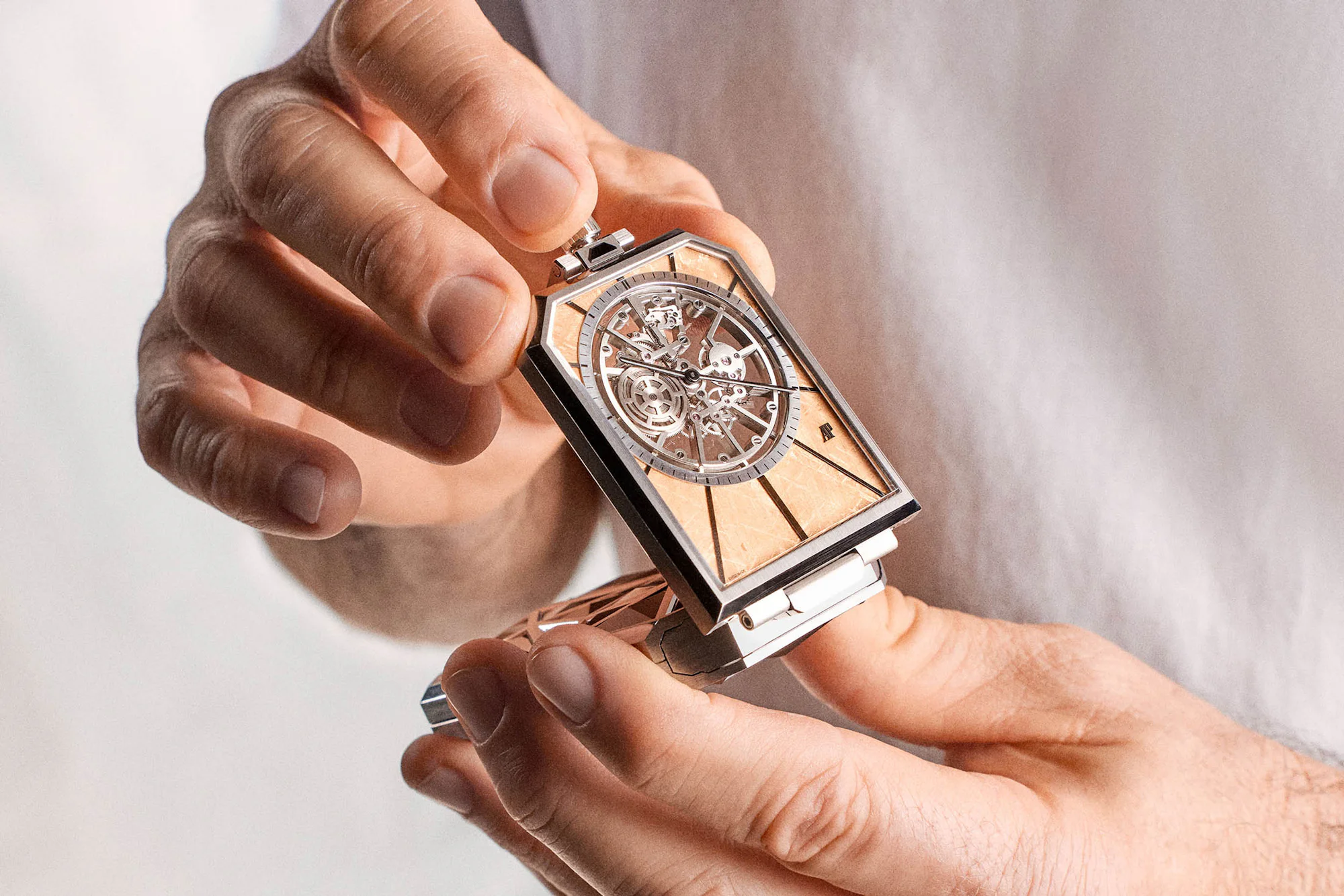
But at the push of two buttons, the watch slides open to reveal an inner case, which can further articulate so that the piece can become a desk clock. The inner case holds sections of meteorite that frame the dramatically skeletonized Calibre 7501, based on the AP Calibre 7121 introduced for the new generation 16202 Jumbo back in 2022. But this openworking isn’t the same as the kind found in the openworked Jumbos currently in the catalog—more material is removed, and the remaining bridges also act as the lines of the hour markers. The decoration here is cut by a specialist using a hacksaw, or bocfil, then finished for one of the more dramatic (in its negative space) skeletonizations from a brand known for openworked movements. In addition, this Calibre 7501 rearranges the position of the gear train, escapement, and keyless works for a more symmetrical effect.
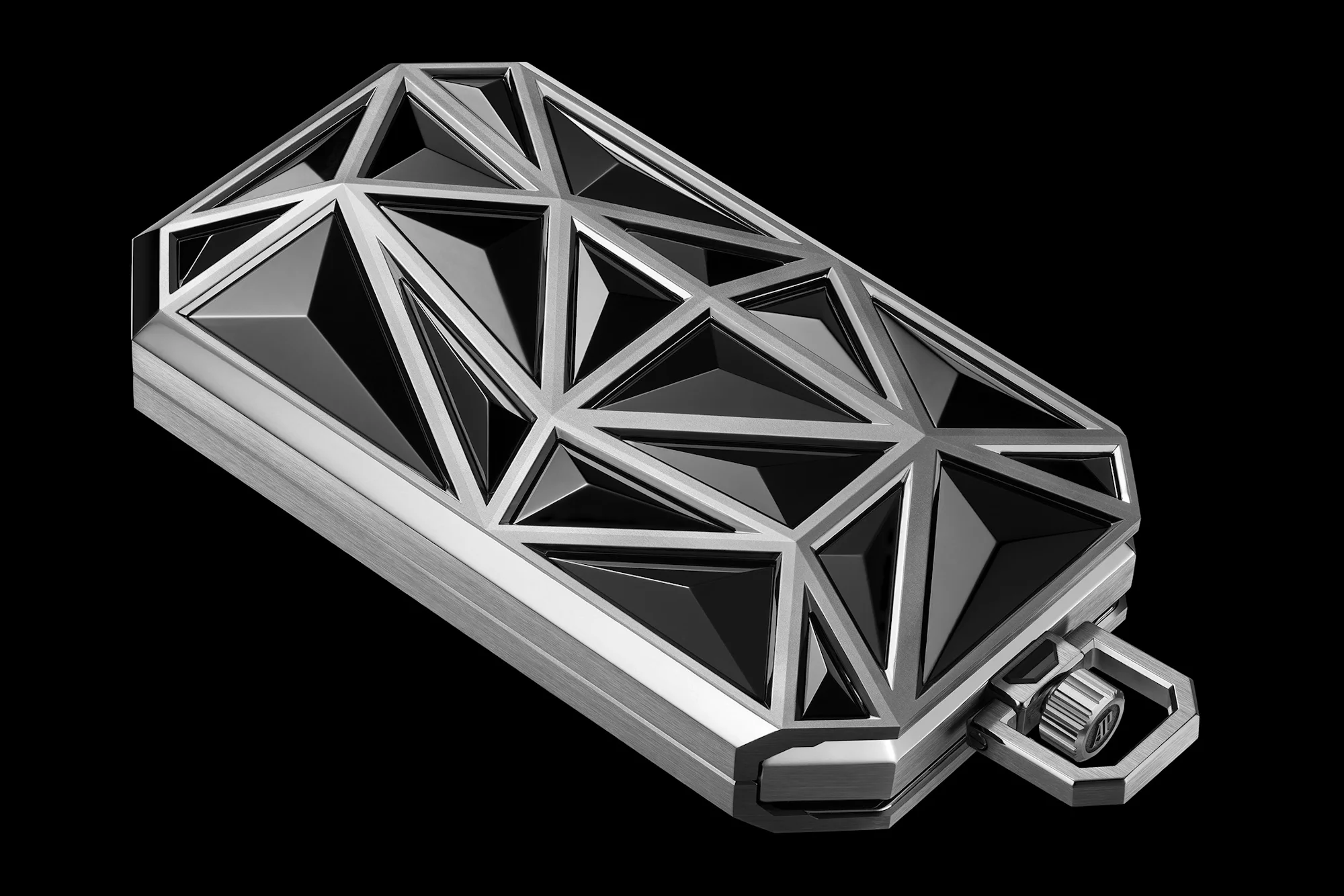


As expected, there are many names once again credited in this project, including Emmanuel Desuzinges for the casing structure and pivoting system, Mario Senape for the stone setting (a name also tied to the Etablisseur Galets), Alexis Bernard for the sapphire crystals, and Jérôme Besançon for the anglage. It’s important to note that these are just some of the many names that Audemars Piguet openly credits for each of these projects, and the full list is on their website. It’s an unfamiliar feeling to see this level of transparency from a brand so large and secretive in many other regards.
AP has said that the Atelier plans to produce around 15 of these pieces over several years, and five variations with different combinations of stones will be available in 2026.
What We Think
A lot is going on here, in an announcement that will surely catch many people by surprise.
There is the aspect of seeing uniquely interesting handmade stuff that feels so different from anything else the brand is doing. It feels antithetical to projects like the AP [Re]Master series, in the sense that the ideas coming from the Atelier de Etablisseurs are theoretically completely new, or at the least aren’t strict revivals of the brand’s past catalog. And while I’m not sure how much of this is intentional, this new program certainly fits into a strategy to remind the public that Audemars Piguet is much more than just the Royal Oak. To me, while the Établisseurs Galets may be the most wearable of the three designs, the Peacock is the absolute showstopper. Not something I could ever imagine wearing, mind you, but cool objects d’art nevertheless.

We’ve already seen other brands take the path of radical transparency by giving credit for the craft to the hands that work it, and most often that lie in the independents with annual production numbers in the double or triple digits. MB&F is one of the brands that comes to mind that embraced this from the start, disclosing every single supplier and craftsperson involved with the making of its radical designs. On a much smaller scale, Ludwig Oeschlin’s brand Ochs und Junior prominently gives credit to its partners, down to the suppliers for its sapphire crystals. And most recently, Simone Brette (who spent time at MB&F) has been the talk of the collector circuit with his Chronomètre Artisans watch, which lists every single artist and supplier that brings his watch to life—it’s in the name of the watch, after all.
What Audemars Piguet is doing with this new Atelier, and with its way of “reviving” this Etablissage system, I think, is showing that a behemoth like itself is able and willing to explore a creative mentality that often is something lost in a company of its standing and size. Just from the limitation of production for these Établisseur pieces, the pieces coming out of the atelier are not going to change all that many lives. But it’s the message that’s more important here, as a sort of halo project from the brand that lies in a very different space from its more movement-based research and development watches, for example.
The transparency is also extremely refreshing to see from an extremely polished brand. It’s a nice recognition that elevating the humans behind the exploration and execution of this unique work doesn’t take away anything from the brand; rather, it’s a necessary need to remind people just how personal high-end craftsmanship should feel. The brand is keeping quite a lot about this program open, no doubt to see first how the commercial response might be. So I think it’s safe to say that we’ll all have to stay tuned to explore and understand more of this once it rolls out.
For more on the Audemars Piguet Atelier Des Établisseurs, visit the brand’s website.