

This story is a special presentation from Hodinkee Japan, written and illustrated by Masaharu Wada, the Deputy Editor-in-Chief for Hodinkee Japan.
For a young brand to revisit roughly 98 percent of the movement components in a GPHG-winning watch after receiving the award might ordinarily sound like cause for concern. But when I visited Fam al Hut’s workshop in Taicang, Jiangsu Province, China, I came away feeling almost the opposite. More than anything else, that fact seemed to capture exactly where the brand stands today.

A large industrial elevator takes you to the second floor, where the doors open onto a long central corridor. To the right, behind glass walls, designers and engineers gather around technical drawings. To the left is a production floor lined with five CNC machines and other machine tools. Farther inside are a prototyping room, a finishing department, a clean room for movement assembly, a quality-control room, a stockroom, and even a dedicated room housing a femtosecond laser machine.


Not everything is made here. Cases and sapphire crystals, among other components, still come from outside suppliers. What Fam al Hut has built, however, is an environment in which it can control the design, prototyping, machining, assembly, testing, and continued development of its movements. For such a young independent brand, the scale of the operation was far beyond what I had expected.

Fam al Hut was founded in 2024. The following year, its debut watch, the MARK 1 Möbius, won the Audacity Prize at the Grand Prix d’Horlogerie de Genève (GPHG). For a young Chinese independent to win a GPHG prize with its debut watch was enough to make the international watch community take notice.
But winning an award does not mean the watch is finished. For Fam al Hut, if anything, it marked the beginning of serious development. Even its award-winning watch remained open to improvement, with the team continuing to revisit the design in pursuit of something better. And that, as I would discover, was precisely why it needed this workshop.
What Exactly Is The GPHG-Winning Möbius?
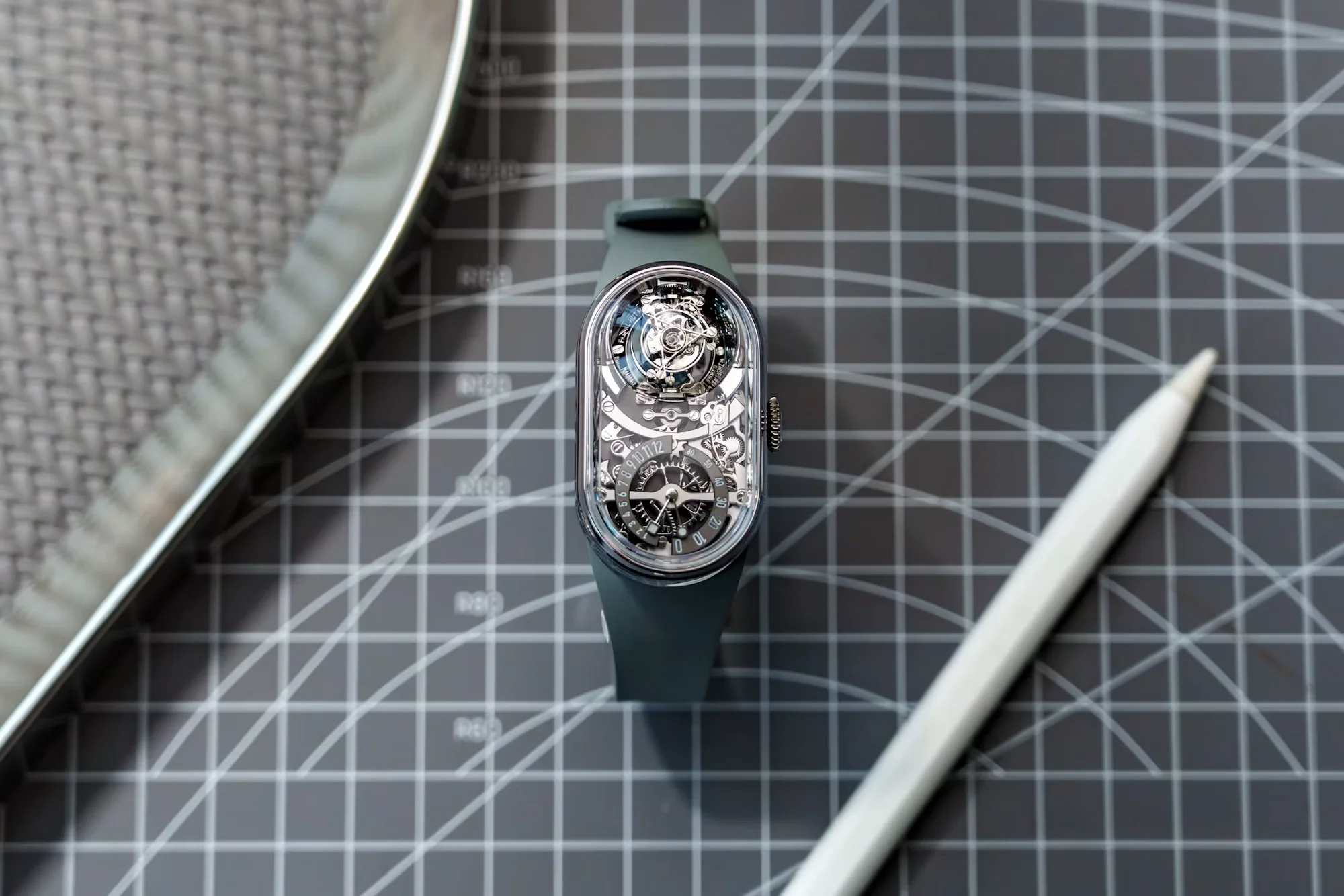
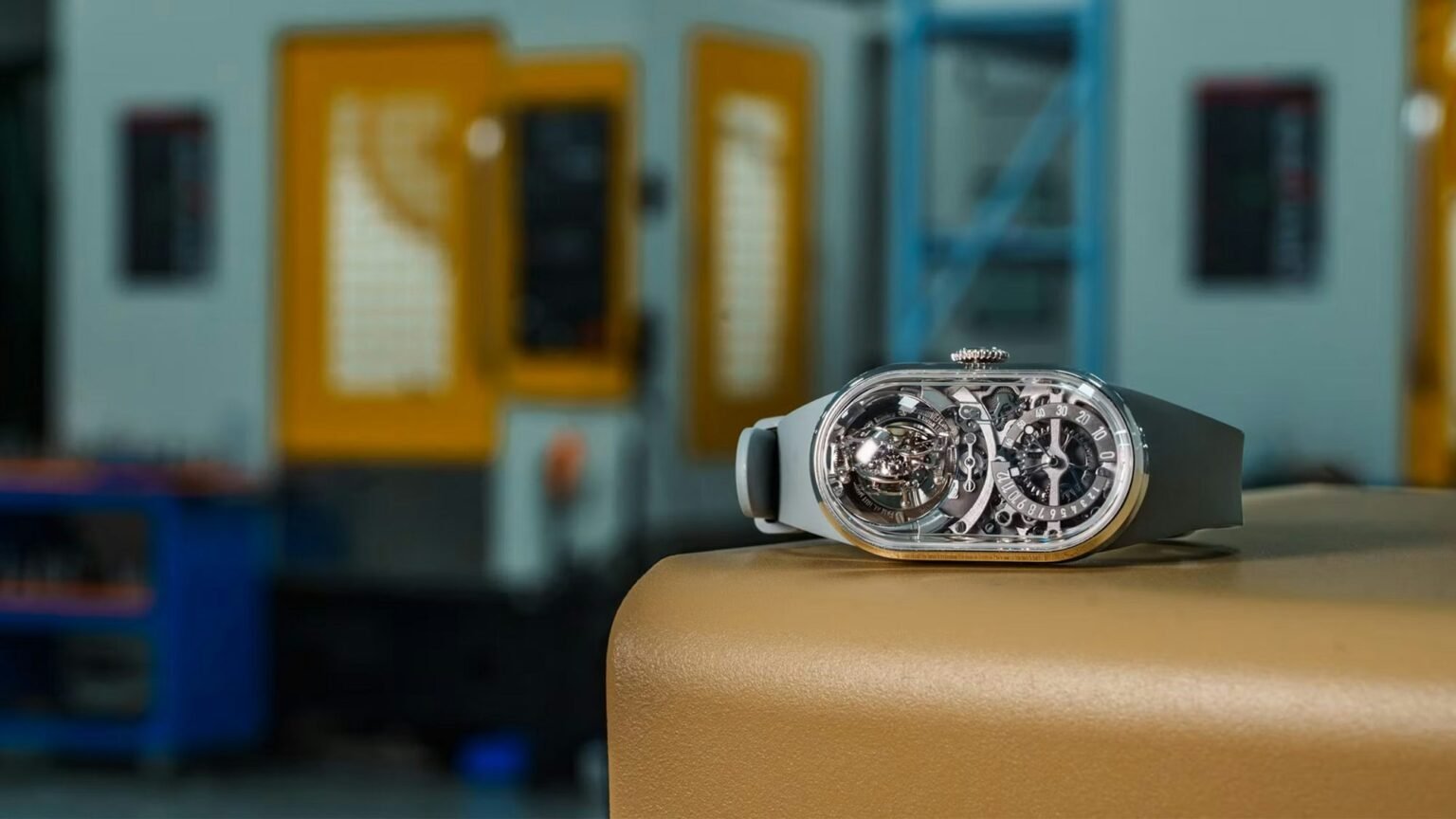
Before getting into the workshop itself, it is worth taking a closer look at the watch that put Fam al Hut on the international map: the MARK 1 Möbius. Its case measures 42.2mm by 24.3mm. In photographs, the lugless, capsule-shaped case can appear larger than it really is, and perhaps even a little challenging to wear. In person, that impression changes immediately. The moment I put it on my wrist, I found myself saying, almost involuntarily, “It’s small.” It feels remarkably compact.
At its thickest point, the watch measures approximately 17mm, but deep concave sections are carved into the sides of the case. Rather than simply trying to hide the thickness, the architecture uses light and shadow to give the watch a visually lighter presence.
“Small watches look good,” says co-founder and designer Xinyan Dai. That preference explains why compactness remained a priority despite the complexity inside.


The lower half of the display features two retrograde indications for the hours and minutes, while an in-house bi-axis tourbillon occupies the upper half. Rather than a conventional dial, the watch presents the movement itself as a three-dimensional structure. The two retrograde hands snap back to their starting positions at the end of their respective arcs and begin their journeys again. The bi-axis tourbillon likewise rotates on two cycles, one of 60 seconds and the other of 90 seconds.
The name “Möbius” comes from the Möbius strip, the continuous one-sided surface with no discernible beginning or end. Co-founder Lukas Young told me that the idea was to express the cyclical nature of time through both the display and the mechanics.

The futuristic case and openworked architecture give the watch an unmistakably contemporary character. Look more closely, however, and the bridges are carefully beveled, while the movement incorporates finishing rooted in traditional haute horlogerie. What makes the watch interesting is the way its avant-garde design and classical techniques coexist without one overpowering the other.
That does not mean Fam al Hut sees the Möbius as a watch that began with styling. Its approach is what Dai describes as “engineering first.” “We start with engineering first,” he told me. “Once we know the complication works, then we start to design it and make it beautiful.” The mechanism comes first. Once it works, the question becomes how to make that structure beautiful. At Fam al Hut, design does not compete with engineering. It is a way of bringing out the beauty already present in the mechanics.
From China, With Ambitions For World-Class Haute Horlogerie
Lukas Young is neither a watchmaker nor an engineer. He began as an enthusiastic watch collector. The turning point came while he was working in Switzerland and visited Baselworld. In 2013, on his first trip to the fair, Young wandered away from the main halls occupied by the major brands and into the area populated by smaller independents. There he met Swiss independent watchmaker Daniel Nebel.
Nebel was making components himself and assembling watches in a small basement workshop. The sight of a watchmaker creating watches largely with his own hands, far removed from the scale of the major maisons, left a lasting impression on Young.

Baselworld 2013.
After returning to China, Young began introducing Chinese collectors to independent brands from Switzerland and Germany, including Daniel Nebel. He was not simply bringing watches into the Chinese market. He was helping introduce the culture of independent watchmaking itself. Over time, that work led him to a question. China already had an enormous manufacturing base supporting watch brands around the world, from cases and dials to movements and components. And yet there were still relatively few Chinese haute horlogerie brands with international recognition.
“Then why don’t we make one ourselves?”
The idea behind Fam al Hut began there: to use one of the world’s great manufacturing bases to create a Chinese haute horlogerie brand capable of competing on the international stage.

Xinyan Dai, one of Fam al Hut’s co-founders and the creative force primarily responsible for its design.
Fam al Hut emerged from the meeting of two different perspectives: Young’s eye as a collector and Dai’s sensibility as a professional designer. Their goal was not simply to make something unusual. They wanted to create watches that could feel futuristic while respecting traditional watchmaking and remaining comfortable on the wrist.

NGC 6188, the emission nebula also known as “The Fighting Dragons,” was photographed by Lukas Young. His previous work often took him to the Southern Hemisphere for extended periods, where astrophotography became a hobby. Those experiences also helped inspire Fam al Hut’s star-derived name.
The name Fam al Hut traces its origins to Fomalhaut, one of the brightest stars in the southern night sky. In an industry dominated by giant maisons, Young saw a parallel between independent watchmakers quietly pursuing their own philosophies in small workshops and a brilliant star shining alone against a dark sky.
Inside The Manufacture

Fam al Hut’s workshop is in Taicang, an industrial city not far from Shanghai. There is little outside the building to suggest the polished world of haute horlogerie. But step out of the large elevator onto the second floor, and that impression changes quickly. Taicang is humid for much of the year, so most of the equipment has been installed upstairs to protect precision machinery and components from moisture.

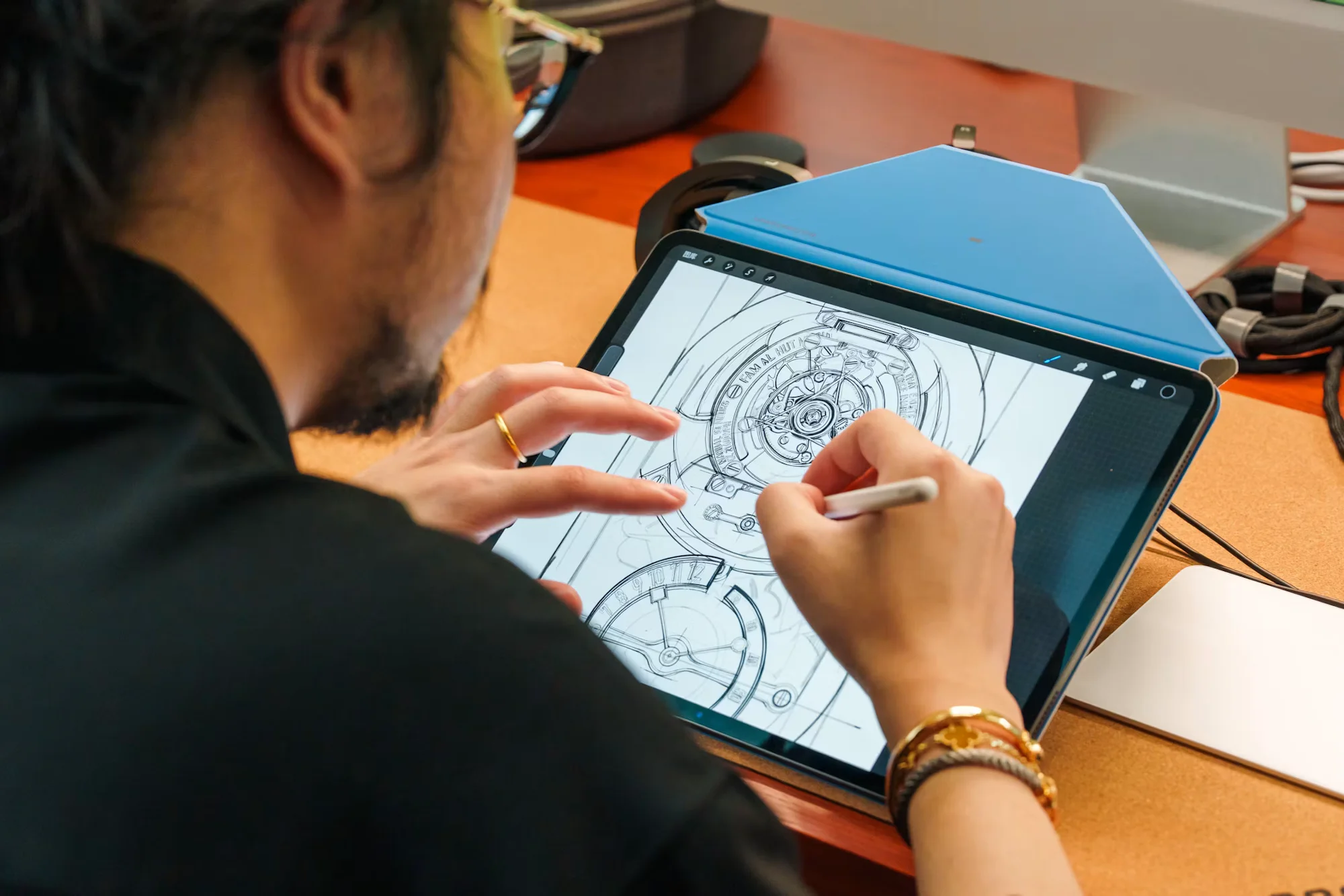
On the right side of the central corridor is the design and engineering area. An open space for meetings and breaks sits at the front, with Dai’s desk farther inside and the movement designers seated alongside him. Machining and prototyping take place directly across the corridor, allowing feedback from the manufacturing side to reach the designers almost immediately.

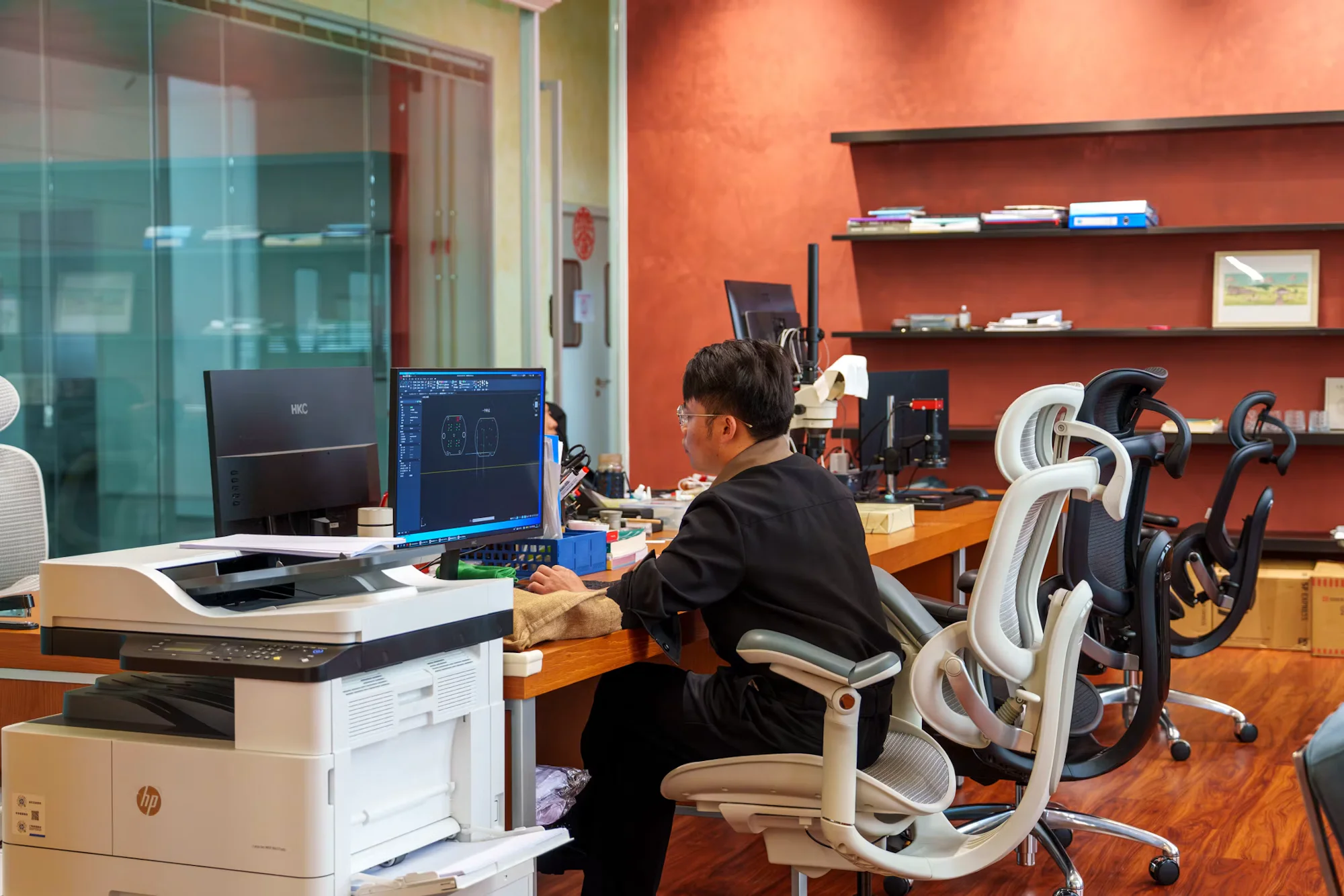
Throughout my visit, I repeatedly saw staff members gather around the designers’ desks to discuss technical drawings. Feedback from prototyping and machining could be brought back to the design team and incorporated into the drawings when necessary. The physical proximity between design and manufacturing translates directly into speed of development.
The production floor contains five CNC machines along with a variety of other machine tools. An adjacent prototyping room also houses traditional lathes. The team first produces and evaluates prototypes there before moving successful designs into CNC machining.


A ping-pong table, a distinctly Chinese touch, gives the team somewhere to unwind.

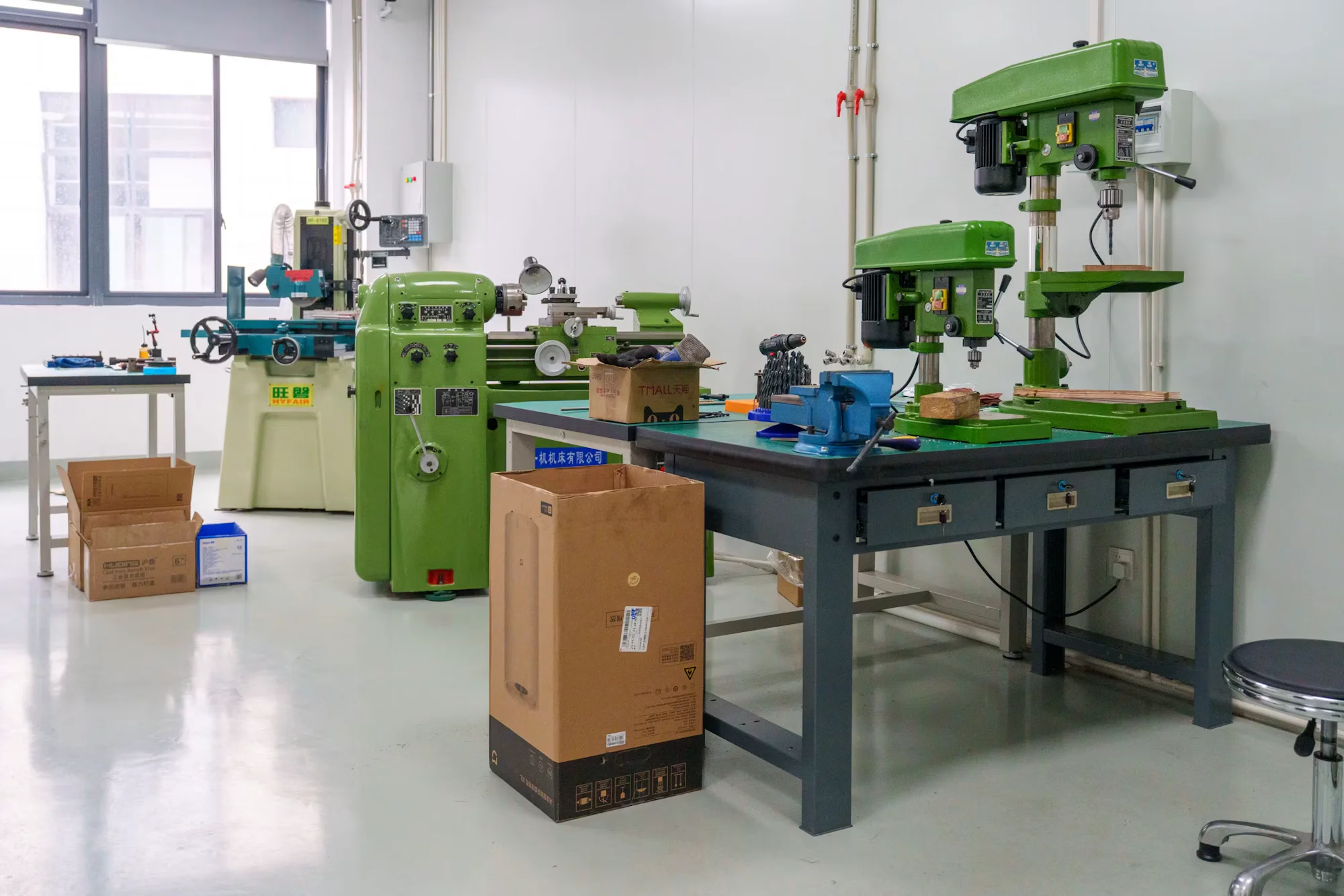
What was equally interesting was the amount of unused floor space. Despite already having substantial equipment in place, the workshop clearly leaves room for future expansion. It did not feel like a facility designed around a fixed endpoint, but rather one intended to evolve as development and production grow.


The finishing department employs six people working on cases and movement components. The department is led by someone who previously spent around seven years finishing jewelry for a major international high-jewelry maison. Fam al Hut hired him not for his previous watchmaking experience but for his polishing skills.
Traditional tools, including boxwood, sit on the workbenches. Even amid all the advanced machining technology, there remains an acknowledgment that certain aspects of high-end finishing still depend on skilled hands.

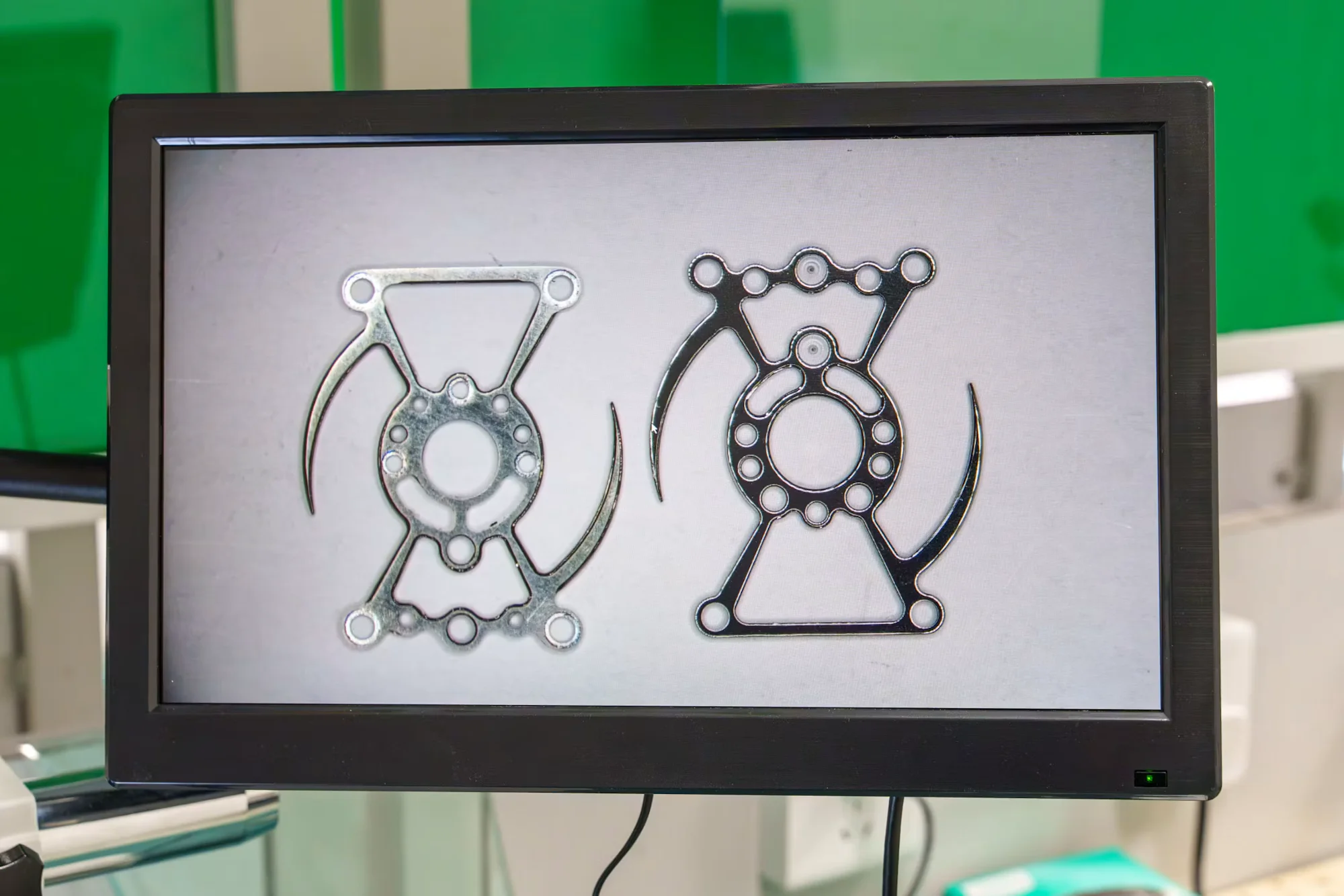
Before and after: an unfinished component on the left and the same part after black polishing on the right.
The clean room where the watchmakers assemble movements is reached through a small antechamber. Before entering, you pass through an air shower to remove dust from your clothing. Four watchmakers are employed here, though only one was working in the room on the day of my visit. There was none of the animated discussion I had heard in the design area, nor the sound of machine tools from the production floor. It was so quiet that this room almost seemed to operate on a different sense of time from the rest of the workshop.


The most tightly controlled area was the dedicated room housing the femtosecond laser machine. Access is restricted by facial recognition to authorized personnel.
A femtosecond laser uses ultrashort laser pulses on the scale of femtoseconds – one femtosecond is one quadrillionth of a second – to perform extremely fine material processing. Because material can be removed before significant heat spreads to the surrounding area, the technology enables machining of extremely fine geometries with high precision, including forms that would be difficult to achieve with more conventional laser processes. Equipment capable of this kind of machining is also extremely expensive. Young showed me components that had actually been made using the machine.
They were so small that their forms were difficult to make out with the naked eye, even when resting in the palm of a hand. Some featured structures finer than a human hair. Only when viewed through a microscope and enlarged on a computer monitor could I properly appreciate the detail.


Fitting a bi-axis tourbillon and retrograde mechanisms inside a case as compact as the MARK 1 Möbius is not simply a matter of shrinking components. Those tiny parts must also be machined to extremely high tolerances and assembled reliably. Investment in a femtosecond laser therefore helps make the unusual architecture of the MARK 1 Möbius possible.


Finished components and movements are individually inspected in the quality-control room. Beyond it is a stockroom with a large controlled-storage unit designed to protect components from humidity. The CNC machines and femtosecond laser naturally attract attention, but the less glamorous details matter too. Fam al Hut is attempting to build an entire environment around watchmaking, right down to how finished parts are stored.
Even The Award-Winning Watch Isn’t The Finished Product

After touring the workshop, I asked Young a straightforward question: Why would a brand this young invest so heavily in equipment and people? His answer surprised me. “We didn’t originally plan to have our own factory.”
At first, like many young brands, Fam al Hut outsourced the production of components and movements. But problems soon emerged: rising prices, being pushed down in suppliers’ production queues, and the speed at which quality issues could be addressed. They knew the watch they wanted to make, but they did not have enough control over the process to make it consistently.
“We couldn’t control it,” Young told me. So they decided to make it themselves.

According to Young, Fam al Hut has invested several million dollars in establishing the workshop. Buying machines, however, was the easier part. Finding people was much harder. Today, roughly 20 people work at the facility. Many were educated through a WOSTEP-affiliated watchmaking program established jointly by Shanghai University and the Swatch Group. What stayed with me most was how closely the designers, machinists, and watchmakers worked together despite having clearly defined roles. They can design, prototype, test, and improve within the same organization.
The clearest illustration of why that matters is the evolution of the MARK 1 Möbius. “The MARK 1 we’re making now is almost a completely different watch from the one that won the GPHG,” Young told me with a slight smile.

The MARK 1 Möbius fitted with the newly redesigned movement.
The MARK 1 Möbius is fitted with the newly redesigned movement. The watch looks largely the same from the outside. Inside, however, the team has evaluated and refined the operation of the retrograde displays, the stability of the bi-axis tourbillon, durability, and ease of assembly, making improvements piece by piece. Winning a GPHG prize was a major achievement for the brand. But Fam al Hut did not freeze the award-winning watch as a finished object. If it could become a better watch, the team was prepared to redesign it, remake the parts, and assemble it again.
The ability to make that choice is, I think, the real reason Fam al Hut wanted a workshop of its own. The people gathering around drawings at the designers’ desks. The proximity between prototyping and machining. The investment in CNC machines and a femtosecond laser. None of it is there simply to make a finished watch. It is there to create an environment in which the watch can continue to improve.

The previous movement architecture above and the redesigned version below.

Of course, visiting the workshop alone does not prove Fam al Hut’s long-term quality or reliability. The real judgment should come after MARK 1 Möbius watches reach collectors’ wrists and have had years to prove themselves. At the end of my visit, I asked Young what single message he would give to Japanese watch enthusiasts. He thought for a moment.
“Be yourself.”
Not to retrace the history of the giant maisons. Not to imitate someone else’s success. But to make the watches you genuinely want to make, according to your own philosophy. From the day Young encountered independent watchmaking at Baselworld, to choosing a name inspired by Fomalhaut, to making the early decision to invest heavily in a workshop, it all seems to lead back to those two words. Fam al Hut’s challenge, however, has only just begun. The first thing I want to see is the extensively revised MARK 1 Möbius completed and delivered to collectors with the level of quality the brand is aiming for. That will be the first major test of whether everything I saw in Taicang translates into a watch collectors can rely on.
And once it has accomplished that, what kind of watch will Fam al Hut make next? Those are the two things I am most interested in seeing now.

For more information on Fam al Hut, visit the brand’s official website.