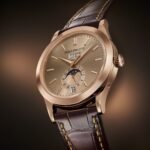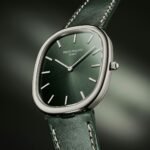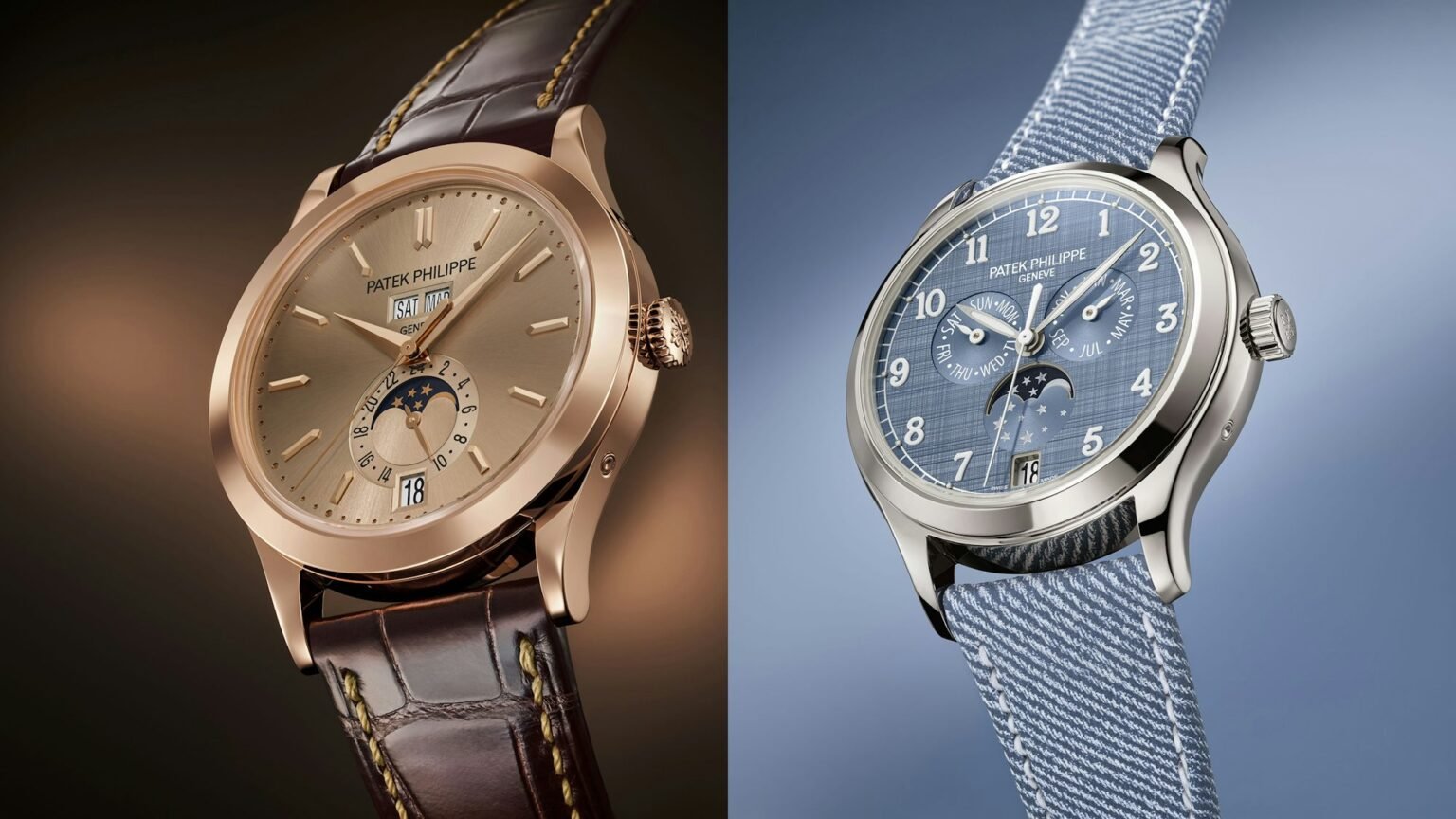


It is, yet again, a year of big anniversaries, including the 50th for Patek Philippe’s iconic and much-coveted Nautilus. But one that flew under the radar for many people is the 30th anniversary of the annual calendar movement. To celebrate, the brand has introduced two new references, the 5396R-016 and 4946G-001.


For years, the watch world was largely relegated to simpler date, day-date, or complete calendar complications—ones that required at least monthly interaction—or to complex perpetual calendars that handle day-and-month adjustments for you (at least for about 100 years, as long as the movement is kept running). That probably would have been enough for most people. What is the middle ground between simple and complex, and does anyone even need it?

Reginald “Pete” Fullerton, Jr.’s Universal Tri-Compax, a chronograph with a complete calendar.
Patek Philippe certainly needed the annual calendar, a fact that we’ll dig into in a moment. Instead of a perpetual calendar movement that automatically adjusted for the length of every month—skipping ahead in the short months (April, June, September, and November)—including February and kept track of those weird Julian calendar quirks called leap years (which have been mucking things up since 45 BCE), Patek made a calendar that does most of all that. In fact, it does everything except for the last two bits. Instead, you have to adjust your watch once a year, in February, regardless of Julius Caesar and his 365.25-day calendar year.

A shot of the steel Patek ref. 1518 with perpetual calendar and chronograph that sold for $17.6 Million last fall at Phillips, the highest price ever paid for a vintage wristwatch.
Luckily, customers appreciated the solution found in the middle ground. And the creative way to fill a gap in the brand’s product lines wasn’t just a hit for Patek Philippe, who pioneered the Annual Calendar—most of the other major brands would at least experiment with following in Patek’s footsteps.
Why the Annual Calendar?
The answer to “why” is very simple. All credit to James Stacey, whose story on the ref. 5035—the first annual calendar—more than set the stage for this follow-up. In short, what do you do when you’re Patek Phillipe, still shaking off the bruising of the quartz crisis, when you have a price chasm between your most outstanding simple watch and your iconic perpetual calendar? You get creative to fill the gap.
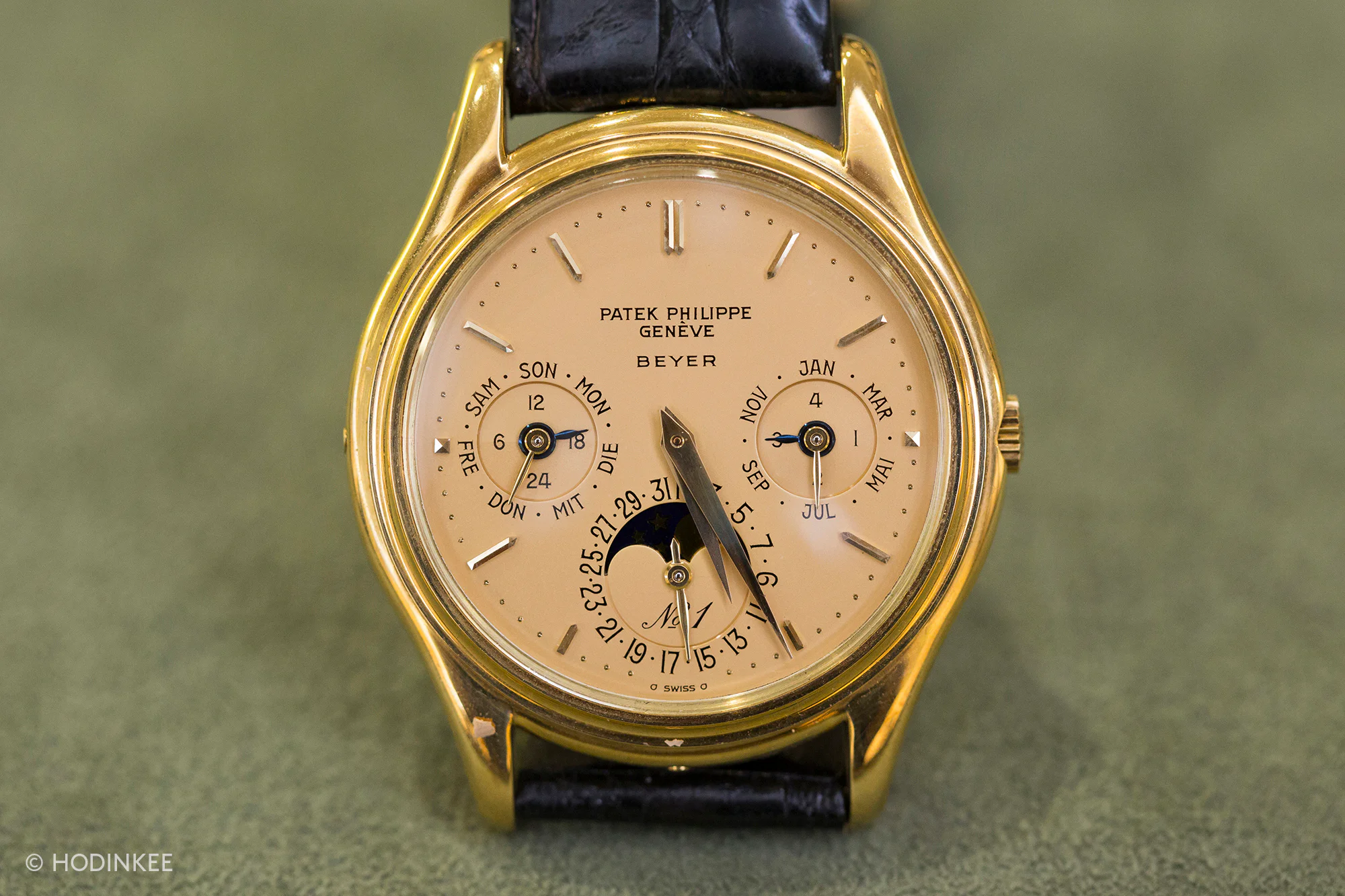
Patek Philippe ref. 3940 for 225th anniversary of Beyer Chronometrie, and the first ever Patek ref. 3940 ever made.
“So, in the early ’90s, Patek Philippe looked at its lineup and saw something of a hole between the roughly $9,000 it charged for a basic Calatrava and the $45,000 it asked for a perpetual calendar like the 3940. As such, Patek’s leadership decided it needed a practical complication that didn’t cost as much as a perpetual, in looking to fill that space in their lineup, so they created something brand new – an annual calendar wristwatch,” the story from 2022 tells us.

A Patek ref. 3960 made in 1989 in a limited edition of 150 pieces to commemorate the 150th anniversary of Patek Philippe. Photo courtesy Phillips.
It’s as simple as that. If Patek could fill the cost gap, they’d draw in more customers (this was the era before massive waitlists, after all). Customers would also save on servicing costs in the long term, since an annual calendar (should, in theory, and would, in practice) has fewer parts and less wear and tear. The brand had also contended with the lack of demand for more expensive watches by cutting production of its best complications to reduce supply and protect brand equity. But it wasn’t the product that was the problem, so much as the price.
The Technical
If you think back to 1996, this was the time before everyone was “in-house” crazy. Brands used the tools they had at their disposal, and proudly, to innovate. Even if that did mean going outside the walls of their own company. As mentioned in Collectability’s in-depth on Patek Philippe’s annual calendars, the remit for the movement (set out by Patek’s engineering department) was actually taken to final-year students at the Geneva School of Engineering to problem solve, with the remit of working ground-up from a simple calendar wristwatch as the base, rather than deconstructing the mechanism of the perpetual calendar.

The caliber 315 S QA, as shown in an image from the brand’s patent.
In fact, the differences were quite remarkable. Most perpetual calendars use a system of racks, cams, and jumper springs to determine when to advance dates. The resulting movement relied solely on wheels and pinions, as shown in the following diagram from Europa Star. Building on the simple calendar, it’s understandable that the watch would use a clearer date in an aperture at 6 o’clock. The result was the caliber 315 S QA (quantième annuel), with the filed patent credited to Cedric Fague and Philip Barat. Both got jobs at Patek for their efforts, and Barat became a fixture of the yearly technical presentations at Watches & Wonders while Fague was a movement engineer as recently as 2024.
In the longest 31-day months, the calendar mechanism works in a simple daily cycle. A date finger mounted on the 24-hour driving wheel pushes the 31-tooth date wheel forward by one step every day. This date wheel then transfers motion through a gear train to the calendar’s daisy wheel. The daisy wheel moves the date ring, allowing the correct date to appear on the dial.

A breakdown of the 5035’s Caliber 315 S QA © Europa Star
Hidden beneath the date wheel is a 12-pointed month star wheel. The date wheel also drives this component, completing one full rotation over the course of a year. A small pinion on the star wheel moves the month hand on the dial, ensuring the display advances cleanly from one month to the next. This all seems quite intuitive, but we haven’t gotten to the challenge yet.
Short months—April, June, September, and November—require the calendar to jump directly from the 30th to the 1st. This adjustment is controlled by a calendar program wheel that sits on the same axis as the date wheel and the month star wheel. The programme wheel has five rounded teeth, one for each short month, including February. At the end of a 30-day month, one of these teeth activates a rocker cam, which briefly positions an advance cam in the mechanism. As the 24-hour wheel continues to rotate near midnight, this cam adds a second push to the date wheel, skipping the 31st and moving the display straight to the 1st. There is still the safety issue that happens with perpetual calendars, and it is not eliminated by the annual calendar. The date changeover starts near midnight but takes four hours before all parts are fully advanced and “safe” to adjust.

An image of the 5035 from 1996 © Europa Star
The new annual calendar ref. 5035, with which the brand launched the caliber 315 S QA, featured hallmarks of a top-quality Patek Philippe: an elegant case, a well-finished movement, and added complications and reliability. It, however, introduced a new visual language. Form follows function, as they say, and the gear train’s location necessitated a more triangular dial layout, with a date window at 6 o’clock, which, while more symmetrical, somehow doesn’t feel quite as elegant as the ref. 3940, which was trying to undercut. It also, somewhat surprisingly, required 44 more parts than its perpetual calendar counterpart (324 total), and partially because of that, it was larger as well (37mm by around 11mm, compared to 36mm by 9mm for the 3940).

A Patek Philippe ref. 5036 in white gold from 2002, with a salmon dial that has tropicalized to burgundy. Photo courtesy Phillips.
But at CHF 18,300 at launch (versus the CHF 44,700 ref. 3940), it was a triumph in accomplishing everything Patek wanted in terms of simplicity and affordability. Two years later, Patek would offer another option, with the ref. 5036. That model, measuring 39mm across, featured moonphase instead of a 24-hour dial at 6 o’clock, and feels a lot more “Patek”, but then also featured a power-reserve indication floating near the 12 o’clock indices (decidedly un-Patek, in my opinion).
Notable Patek Annual Calendar Models

A Patek Philippe ref. 4936A (yes, that’s stainless steel) with Mother of Pearl dial and diamond bezel, made in 2008. Photo courtesy Sotheby’s.
While other brands would pick up where Patek set the groundwork, it’s worth looking at the various ways that Patek expanded its collections with the annual calendar. Instead of a full “reference points,” I’ll keep this overview to my favorite (or most important) models. On that note, it’s probably worth mentioning the ref. 4936 (marketed for women, with a mother-of-pearl dial and double diamond bezel) just for continuity’s sake. Visually similar to the ref. 5036, this follow-up was launched in 2005 and featured the caliber 324 S QA LU, which allowed a slightly smaller 37mm case.

A Patek Philippe ref. 5135P from 2008. Photo courtesy Antiquorum.
That movement was launched with the ref. 5135 Gondolo Calendario in 2004, a rounded rectangular case with three apertures from 10 to 2 o’clock, a moonphase, and a 24-hour display. It’s a stunning watch, honestly (though it would have been better without the 24-hour indication, in my eyes—though that was essential to the movement’s safety). The caliber had several improvements, including improved wheel-tooth geometry, a higher beat rate (now 4Hz), a more efficient winding system, and improved balance.

Patek Philippe ref. 5960A, one of the best watches of the era and best buys on the secondary market.
I would argue, however, that the most impressive annual calendar achievement from Patek came from another first for the brand. The first-ever in-house chronograph made by Patek Philippe wasn’t issued as a standalone, but rather as the caliber CH 28-520 IRM QA 24H, an annual calendar flyback chronograph movement released in the 2006 reference 5960. With the brand’s silicon balance called “Spiromax”, the brand went back to its roots, of some sort, understanding that the combination of calendar and chronograph is quintessential for the brand. These watches, with apertures placed like those in the 5135, created a super sporty design and present a really great buying opportunity on the secondary market—with a white dial and steel bracelet, the watch runs around $50,000.

A wonderful Patek ref. 5396G from 2009 that was sold by, of course, Collectability. This is a really great dial treatment that has an unusual signature layout and rare modern sector dial. Photo courtesy Collectability.
I’m also partial to Patek’s next offering, the ref. 5396, which launched in 2006. As evidenced by its XX96 reference number, this watch featured a Calatrava-style design that reminds me of some of these early ref. 96 models with sector dials and their calendar-style ref. 96 counterparts. The unfortunate 6 o’clock date window remains, but the caliber 324 S QA LU 24H/303, with its 347 parts, now shows the day of the week and month in the windows, just like the fan-favorite ref. 3448. This model (and movement) is still being made today, and has trended more toward that ref. 3448 dial design, with bullet markers and dauphine hands. Aside from that early design, it’s worth looking at the ref. 5396/1G-001 (a bracelet on a complicated Patek is a great value), the ref. 5396G-012 with luminous hands and Breguet numerals, made for Tiffany & Co. There’s also the ref. 5396R/1-001, which featured a dark brown dial and rose gold bracelet to match the case. The bracelet versions trade similarly around $50,000.

The Caliber 315 S IRM QA LU SI with the Spiromax balance spring (at left). visible around 1:30 on the movement near the balance wheel (around 11:45).
But the story of Patek and annual calendars would be nothing without mentioning the Advanced Research project. You might be surprised to learn (if you didn’t already know) that the basis for Advanced Research came through a collaboration between Patek, Rolex, the Swatch Group, Ulysse Nardin, and the Swiss Center for Electronics and Microtechnology. The group held a patent (from 2005 to 2022) for making silicon hairsprings, which helped Patek start their first Advanced Research movement in 2005, the 315 S IRM QA LU SI.

The Advanced Research ref. 5250. Photo courtesy Patek Philippe.
The movement was cased in the ref. 5250, a 39mm white gold watch with a silver vertically grained dial, blackened bullet, Arabic numeral hour markers, luminous hands, and a layout similar to the 5036, limited to 100 pieces. More importantly, the movement used a silicon-based escape wheel. The ref. 5350 followed a year later, with a 39mm case in pink gold, a grey dial with rose-gold indices, a Spiromax balance spring (based on Silinvar), and an unusual magnifying caseback, limited to 300 pieces. Finally, the brand pulled out the old-school favorite combo of platinum and salmon for the ref. 5450 launched in 2008and was changed to the Pulsomax escapement, which used an escape wheel and lever made of Silinvar.

The awesome Patek Philippe ref. 5326G.
A number of advancements would follow, including the first-ever annual calendar minute repeater (the ref. 5033 in 2007), a Nautilus in 2010 (the ref. 5726), and an Aquanaut ref. 5261R, and the first-ever regulator wristwatch from Patek, the ref. 5235 in 2011. I’m personally partial to the ref. 5326G, which was released at Watches & Wonders in 2022, blended the hobnail midcase and brown/grey textured dial with a travel time display and sportiness, making it look like a kind of complicated field watch. The caliber 31-260 PS QA LU FUS 24H featured some of the innovations set forth in the Advanced Research watches, with Gyromax balance and Spiromax balance spring. If there were one annual calendar from the brand I would want to own, it would probably be the ref. 5326G.
Who Followed
Other brands quickly picked up on the benefits of making a usable, affordable yet still complicated and helpful calendar. In fact, it seems nearly every brand took a shot at their own. Instead of doing an even more comprehensive reference, we’ll stick to the highlights.

From our Hands-On with the A. Lange & Söhne Saxonia Annual Calendar In Platinum.
The two most notable mentions for most collectors are A. Lange & Sohne’s offerings and the Rolex Sky-Dweller, which is often overlooked as an annual calendar because of its unusual and simplified design. In 2010, Lange launched the Saxonia Annual Calendar, featuring a micro-rotor Sax-O-Mat caliber and a big date display that has become the brand’s signature. In 2017, they followed up with the 1815 Annual Calendar, which (although I’m sure they’d loathe the comparison) has a dial layout that strongly reminds one of the ref. 3940 with a very Germanic approach. The watch, like many Langes, was a bit larger than other annual calendars on the market (40mm) but only 10.1mm thick thanks to its hand-wound movement.

From our Week on the Wrist with the Rolex Sky-Dweller in stainless steel.
The Sky-Dweller is an icon in its own right. I wasn’t a part of the watch space (or at least not friends with the right people) when the Sky-Dweller was the watch that collectors were fighting to get. But it makes a lot of sense. In keeping with a lot of the brand’s classic dressy design codes—the fluted bezel, soleil-finished dial, Oyster bracelet—but with a massive 24-hour subdial for a second timezone, date window with cyclops, and the ingeniously hidden month indication (a small dot in an aperture near the 12 hour markers), it’s a pretty masterful design that works as well now as it did when it was introduced in 2012.
Extra points for creativity: Rolex turned the bezel into a functional part of the complication with the patented Ring Command. Rotate the bezel counterclockwise one click and you can use the crown to set the date and month. A second click allows you to set the local time. The third click sets the reference (second) time zone.

IWC, Panerai, Omega, and F.P.Journe all make or have made annual calendars. So has Audemars Piguet. Rather than an exhaustive list, I’ll leave it up to you to explore how far the complication has spread. But one last important watch needs to be imported out. The Ochs und Junior Annual calendar uses a very impressively concise 5-part addition to the base ETA 2824-2 to do what many brands spend years and hundreds of parts to accomplish. However, the display is not nearly as intuitive as that of Patek’s pieces, nor is the piece finished to the same level. It’s apples and calendar oranges, but still worth calling out.
The New Annual Calendar Reference 5396R-016 and Reference 4946G-001
For all the reasons mentioned previously, the Patek Philippe ref. 5396 has become a mainstay and, to some extent, a pillar of the brand’s identity over the last 20 years. If you walk past or into a Patek Philippe boutique, there’s a good chance that you’ll see a ref. 5396 hanging as a wall clock somewhere—a sign of how important the model has become to represent the brand. The launch of the ref. 5396G-017 in 2024 was arguably the best the model has ever looked, with a blue sunburst dial and diamond indices. Now it gets a rare but classic treatment with a rose gold case and matching sand-beige sunburst dial.

That tone-on-tone dial is slightly reminiscent of the fabulous doré dial Beyer-signed ref. 3940 that launched the legendary model and the ref. 5396R/1-001, although a bit lighter than the latter example. Unlike the 3940, the 5396 has a more modern finish: a sunburst dial, faceted obus-style applied hour markers, faceted dauphine-style hands, and a snail finish on the 24-hour sub-dial. Expectedly, the watch still has the two apertures for month and day of the week above the center post, with the date at 6 o’clock and the moonphase aperture.


The movement, as it has been for the last 20 years, is caliber 26-330 S QA LU 24H, with stop-seconds and automatic winding. It features a stop-balance for the central seconds hand, but all calendar functions must be set using the pushers in the case. As I’ve argued before, if a movement is working well and reliably, there’s no need to update it, though this movement could maybe use a bit of a boost in the future. The movement, with a central winding rotor, runs at 4Hz with a Gyromax balance and Spiromax balance spring, but has a somewhat anemic 45-hour power reserve. The watch is finished to the brand’s high standards and features the Patek Philippe seal.

Patek Philippe’s ref. 4946G follows on from the ref. 4946R that was released at last year’s Watches and Wonders. With three small subdials located close to the central dial post and a date window at 6 o’clock, the new ref. 4946G features a blue-gray dial with a “Shantung” pattern that contrasts with the white-gold case.

Inside is the Caliber 26-330 S QA LU that was first launched in 2023 with the ref. 5261R-001 Aquanaut, the first annual calendar in the collection. Many of the specifications are the same because the movement’s framework is very similar. There’s the 4Hz beat rate, 45-hour power reserve, central 21k gold winding rotor, and Patek Philippe seal that the brand certifies for precision, finishing, and lifetime serviceability.


The white gold case measures 38mm by 11.23mm and has 30m of water resistance. Time is set by the crown (and pulling out the crown also serves as a stop-seconds function), while the case-located correctors at 10 o’clock, 4 o’clock, 2 o’clock, and 8 o’clock set the remaining functions (day of the week, date, month, and moonphase, respectively). The watch comes delivered on a strap with light blue calfskin leather with a denim pattern and contrasting white stitching (a bit lighter than the other denim-patterned watches Patek has had a penchant for recently) and an 18k white gold prong buckle. The 5396R-016 is priced at CHF 54,000, and the 4946G-001 is priced at CHF 48,900.
For more on the Patek Philippe ref. 5396R-016 and ref. 4946G, visit the brand’s website. Thank you to Everywatch.com and Collectability for their research and references on this subject.