
I’d like to think I am a bit of a movement nerd. Not in the sense of knowing all of the technical attributes (actually, I wish I knew more there), but rather about what movements are on the market from the major suppliers. Hand me a watch, even with a complication, and I can probably tell you what movement it has in a matter of seconds (assuming it’s mechanical) by the positioning of the hands, complications, rotor bearing, etc. So, last fall, when I was handed a prototype of a new chronograph by Wolbrook and, upon seeing the dial, realized I had no idea what movement it had, my interest was piqued.

The watch was the Wolbrook Jetflyer, which I have since had the opportunity to spend more time with. An extension of the French brand’s proven line of tool dive watches based on vintage models, the Jetflyer is their first foray into mechanical chronographs. As the name suggests, the Jetflyer is not meant as a “dive” chronograph, but rather as a pilot’s, though that’s largely semantics, as there are a lot of overlaps in design language (and the WR is 100m). I’ll get back to the particulars of the design, because what really stands out is the movement.
Hands-On: the Wolbrook JetFlyer and the New Jeambrun PS6402 Automatic Chronograph Caliber
Stainless Steel
Jeambrun PS 6402
Mattte Black
X1 Super-Luminova
Domed Sapphire
Leather or Bracelet
100m
38 x 46mm
14.3mm
20mm
Screw-down
36-month
$845
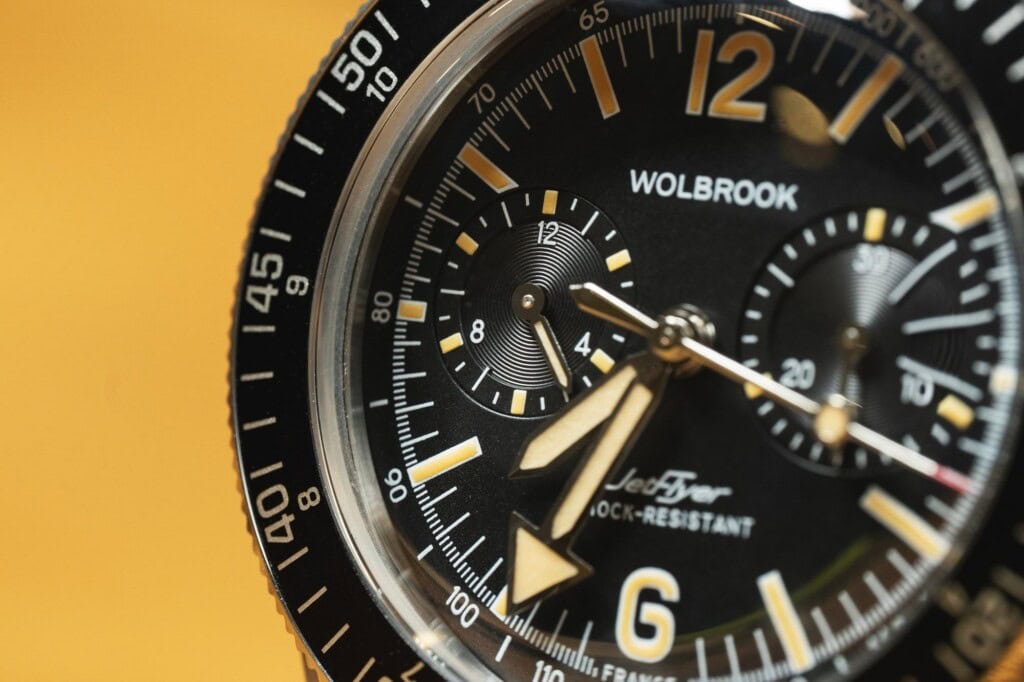
The make of a mechanical chronograph is particularly easy to decipher, as there aren’t many options on the market, most these days coming from Sellita, and occasionally La Joux Perret, Seiko, ETA, and Seagull, the latter of which is in decline due to new ordering restrictions from the company (MOQ is 10,000 movements). At a glance, from the dial side, they all can seem similar (Seiko is the easiest to spot as the seconds sub-dial is at 3, which is uncommon). But this Wolbrook had a funky detail that immediately ruled out all those options: the sub-dials aren’t centered on either the dial’s horizontal or vertical axis. Rather, while positioned near three and nine, they are slightly above the horizontal axis.

Baffled, I immediately inquired as to the caliber, which turned out to be something entirely new: the Jeambrun PS 6402. If you haven’t heard of Jeambrun, I can’t blame you; I hadn’t either, and for good reason. Jeambrun was a French movement manufacturer that existed in the mid-20th century. While it appears their calibers were used by a handful of companies, such as Elgin, they didn’t last long, and little information is available on them. The PS 6402 is the product of a new company that has revived the historic, if esoteric, name, helmed by Wolbrook watches.
The follow-up question, then, logically, is how does a movement manufacture pop up overnight (seemingly) with a new caliber, let alone an automatic chronograph? And the answer is: with a little help from friends, specifically, the Chinese movement manufacturer Peacock. Having existed since 1957, Peacock is a respected and major player in the Chinese market, though less present in the US and European markets than Seagull. With that said, Atelier Wen uses a Peacock movement in their Perception line (they refer to it as the Dandong SL1588), and Peacock has recently made some waves with their Witness Tourbillon models.

As for the PS 6402, it’s a movement that was specced for Jeambrun, manufactured by Peacock, and supplied as an ebauche. The movements are then assembled, regulated, and tested in France by the newly formed Jeambrun company. Thus, allowing Jeambrun to enter the movement game with an already proven platform, avoid the immense expense of developing a caliber from scratch, add some of their own value through assembly and regulation, and, more importantly, create a new caliber with some level of French provenance. As the French indie scene is one of the strongest globally and has emphasized local assembly and manufacturing, Jeambrun is well-positioned to supply a niche market.
Aside from the who and the where, the PS 6402 also has some appealing features. It’s an automatic column-wheel chronograph with 41-jewels, hand-winding, a frequency of 28,800 bph, and a power reserve of 55-hours. A dual-register layout with elapsed minute and hour counters at three and nine, respectively, they have foregone active seconds entirely. The movement features an “Armure de France” finish, a signature design of Jeambrun’s interlocking hexagons laser-etched into the plates, as well as blued screws and a column wheel, a black-plated rotor, and a skeletonized balance bridge. Overall, it’s an attractive movement.


In use, the winding and the pusher action stand out. Handwinding, though not required, offers a pleasing resistance and sound. The starting press requires an appropriate amount of force, first giving slightly before snapping down with a satisfying pop. It’s not as hard as some cam-lever chronographs, and not as mushy as some column-wheels. Pausing the chrono is the same, and the reset is just a little bit lighter. It’s definitely a feeling that suggests quality.
The case of the JetFlyer highlights another appealing quality of the PS 6402: its 6.5mm height. Similar Sellitas and La Joux Perrets are 7.9mm, and the Seiko NE88 is 7.62mm. That might not sound like much, but for case heights, it goes a long way. The Jetflyer measures a reasonable 38mm x 46mm x 12.1mm to the top of the bezel, and 14.3mm to the top of the domed sapphire. Sure, that isn’t breaking any records, but it puts it in fairly normal sports watch territory. The mid-case is also only 37mm, making it feel even a little more compact than a 38mm.

And that’s perhaps the greatest strength of the JetFlyer design. It’s an automatic chronograph built on a medium-sized vintage diver platform that just feels normal. So often, mechanical chronograph versions of existing three-hand watches feel overly bulked up to accommodate the movements. This looks and feels exactly how you’d expect; it just happens to also be a chronograph.
The rest of the design follows suit. Wolbrook didn’t take any radical departures from their normal design language, they just amended it to fit the complication. As such, the dial features large lumed markers at the hour positions, with “12” and “6” numerals, which balance the sub-dials. It’s subtle, but the sub-dial at three is actually a bit larger than the sub-dial at nine for that “big-eye” look, though in all black, it’s not immediately obvious.

The bezel features a 120-click unidirectional mechanism with a good feel and only a tiny bit of back play. With that said, I think a bi-directional 60-click could have been a better choice given that it’s meant more as a pilot’s watch, and the bezel insert features two indexes: a 60-unit elapsed counter, and a 12-hour index. The dial also features a tachymeter on its very outer edge, which was perhaps unnecessary, though it doesn’t look bad.
The JetFlyer wears well, especially for an automatic chronograph. The size is comfortable on my 6.75” wrist, especially in diameter and length. As I said, the height is impressive for what it is, though it does stand a bit high off the wrist as the caseback comes past the bottom of the lugs. This would also make wearing the JetFlyer on a passthrough strap a bit unwieldy. Overall, it’s a solid, slightly chunky, tool watch that isn’t trying to trick you into thinking it’s anything else, and, in the end, it’s quite wearable.

So what does a new, automatic, column-wheel chronograph that is manufactured in China but assembled in France cost? Unsurprisingly, and yet still excitingly, $845 on leather. That’s a great price that puts it in step with Seagull ST19 chronographs, and far below Swiss options, which generally start around $2k. As a package, the JetFlyer is a great value and an enjoyable design. While not a big departure from their three-hand divers, the case and dial language work well, making it a solid addition to the brand’s growing, price-minded catalog.
And regarding the Jeambrun, as the Seagull ST19 is no longer a viable option for most brands, Swiss options are very expensive, and the Seiko NE86/88 have also increased in price; it is potentially a great new option. That said, it would be smart for them to offer a manual version as well. I do hope they get uptake with more brands, French or otherwise, as projects like this could add some needed movement diversity for indies. Wolbrook