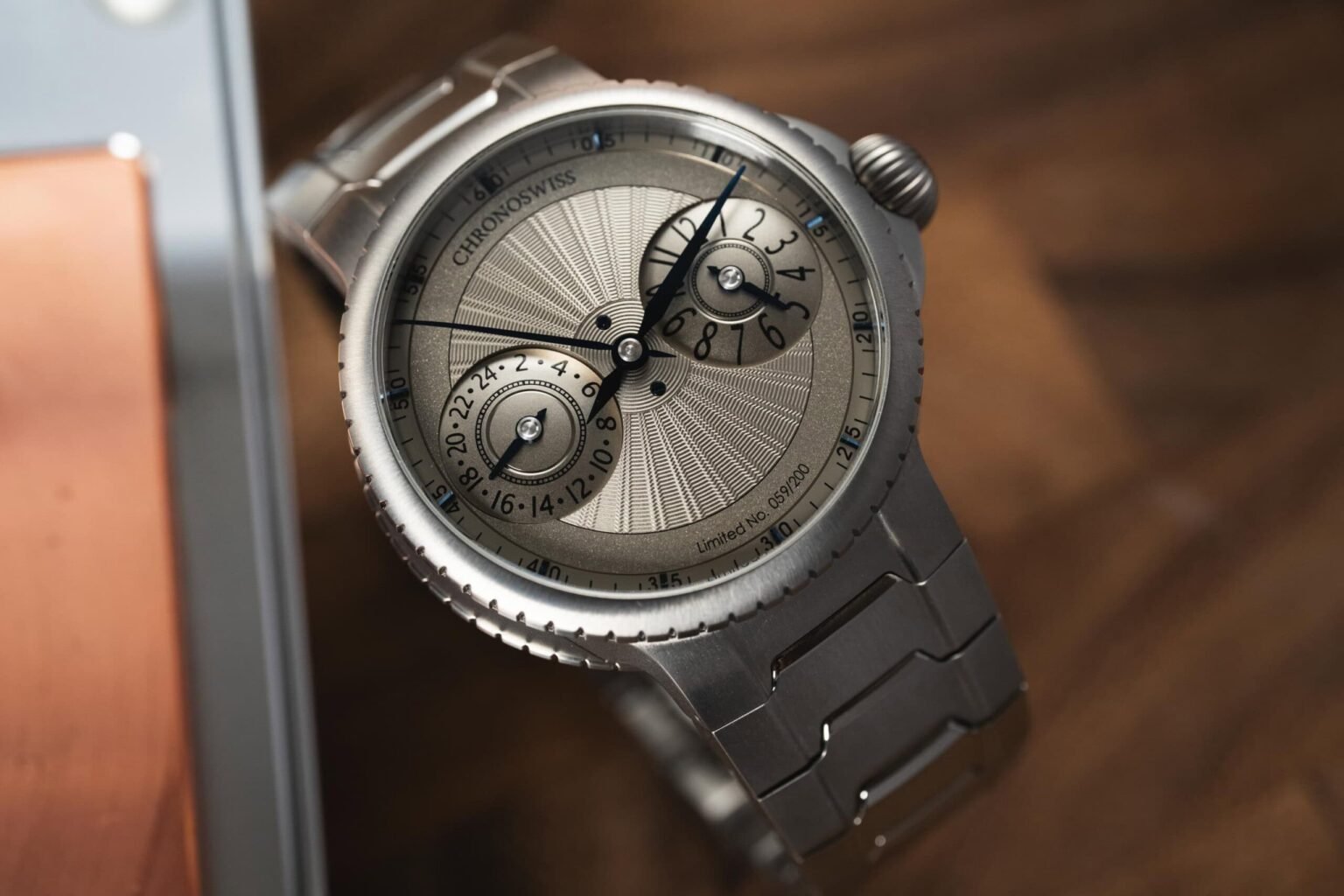


I love the experience of a truly unique watch. A watch that, despite doing what the rest of them do, for all intents and purposes, is still unlike anything you’ve strapped to your wrist. This goes beyond the dial to the case, bracelet, time-telling, movement, etc. It doesn’t have to encompass all of those things, but when it does, it reminds you that there is still creativity in the watch world. The Chronoswiss Pulse GMT is one such watch.
It’s almost hard to describe the Pulse GMT. It’s something between an integrated-bracelet sports watch and a conceptual neo-futurist travel thingamajiggy. Frankly, had I been told it was a prop from *Gattaca* or another stylized sci-fi film, I might have believed it. Its lines are fluid and complex, except when they aren’t, touching on biomorphic forms while also speaking to the traditional inspirations the brand was founded on. It’s not an easy watch to digest at a glance, presenting conflicting forms, and yet it works. Well, for me it does, but I like weird watches. And regulators. And weird regulators.

Starting with the case and bracelet, though integrated, there is a merging of two concepts. Ignoring the bracelet entirely, the central case measures 41.4mm x ~48mm x 13.6mm to the top of the slightly domed sapphire crystal and draws from the brand’s historical DNA, but mutates it substantially. The coined-edge bezel and caseback become notched instead. Less ornate but still textural, it gives more diver than pocket watch. The mid-case is tall and cylindrical, flat on the left side, but with a pronounced crown guard on the right that integrates the giant onion crown.
Ok, I need to take a moment to discuss this crown. Modern Chronoswiss has made the oversized onion crown something of a signature element. You’ll find it across nearly all of its watches, and while I get the throughline to the original designs, it’s really cumbersome. Including the crown, the Pulse GMT is 47.2mm wide, and it can dig into your wrist. I also find the crown a little difficult to pull out, though admittedly it is very nice to grasp when winding.

While the head of the watch clearly speaks to the brand’s history in a new light, the bracelet is purely modern. Featuring scale-like links that taper smoothly from just over 23mm to 18mm, the traditional feel disappears, making way for a sculptural, organic aesthetic. It seems like it shouldn’t work, yet it does. And while the bracelet literally integrates, becoming flush with the mid-case, it doesn’t simply become the case, as with so many other watches in this genre, preserving a semblance of the straight lugs found on Chronoswiss’s more traditional designs.
The case and bracelet are made from grade 5 titanium and are almost entirely blasted to a smooth gray finish. The only breaks from the matte surface are polished bevels running horizontally across the bracelet links. It’s a strange but appealing way to finish the Pulse. The muted surface works well with a design that is already dramatic. That said, I could see people thinking it’s a little under-finished for a watch at this price, which we’ll get to later.


The dial, also utterly different, somehow merges the conceptual elements of the case and bracelet into something weird and wonderful. Inspired by the Chronoswiss Tora models, which were dual-time regulators with the same layout, the Pulse GMT features central minutes and seconds, local hours at three, and a 24-hour dual-time/GMT display at nine. It’s an irregular regulator: the minutes and seconds are on the same axis, the hour is at three rather than the standard nine, and, of course, there is an independent 24-hour dial. Functionally, normal time reading is as easy as on any other regulator. Dual-time, however, is a little trickier, as the 24-hour hand doesn’t set the way you might expect.
Typically, on a caller GMT, the 24-hour hand jumps in hour increments. On a flyer GMT, the local hour hand jumps. What’s consistent is that they stay aligned with the minutes. The Pulse GMT hand doesn’t jump; rather, it glides like a normal hour hand, disconnected from the minutes altogether. While this makes it usable for those rare time zones that differ by less than an hour, if you don’t set it at the top of the hour to get it exactly lined up, you might end up a little off the desired time difference.

That aside, the dial is nothing short of stunning. It’s a truly sculptural design with essentially no flat surfaces. The main dial, split into three regions, starts with a matte outer ring featuring a minutes/seconds index that mixes black print with small, heat-blued appliqués. One step in is a buffer ring with a beautiful blasted finish and subtle sparkle. Both areas are dark gray, almost matching the tone of the titanium case.
The inner area features rose-engine-turned guilloché in a brighter silver tone. Rather than the curved arcs often seen in this type of pattern, straight radial lines kink subtly on either side, creating two semi-rotations per hour. They almost look like an EKG. At the center, rather than descending into infinity, the pattern switches to concentric circles with heat-blued screws that appear to hold the decorated plate in place. I love this detail. It adds a unique matter-of-factness. They aren’t trying to hide how it’s made, which, combined with the dark, matte tonality, gives the dial a surprising industrial appeal.

At three and nine are large sub-dials for the 12- and 24-hour indexes, respectively. These cut through the two innermost regions, stopping just before the outer ring. In a very atypical move, the sub-dials are convexly domed, creating a sudden shift in geometry and depth. They appear to be separate pieces sitting within cutouts in the larger surface. Through those cutouts, you can see that the dial thickens toward the center due to its overall domed shape, creating deeper shadows on the inside of each sub-dial. It’s complex, but striking.
The minute hand is a long, heat-blued alpha shape with a matching counterweight. The seconds hand is similar but much thinner, reducing the risk of accidental misreading. Both curve downward at their tips to follow the dial. The sub-dials feature miniaturized versions of this design, fully curved to flow over the surfaces below. The hands are impressive in their own right and feel like they truly belong to the design.

The Chronoswiss Pulse GMT is powered by the caliber C.6002, a variant of the brand’s proprietary C.6000 movement, co-developed with La Joux-Perret. An automatic, it features a frequency of 28,800 bph, a 55-hour power reserve, a tungsten rotor, hacking, hand-winding, dual-time, and a regulator layout. It is ruthenium-plated for an appealing dark gray tone, with radial Côtes de Genève emanating from the center, some skeletonization, and machine-polished bevels on both the internal and external edges.
It’s an attractive movement with a modern style that suits the watch. It’s also fairly wide, measuring around 30mm or slightly larger through the caseback window, filling out the case nicely. Perhaps my favorite feature, however, is the winding feel. Yes, it’s automatic, so there is little need to wind it by hand, but it feels great. The movement features a long click, like many manual movements, providing the same audible and haptic satisfaction. It’s another small link to traditional watchmaking in an otherwise very modern watch.

On the wrist, however, some of the elements that give the Pulse GMT its identity also work against it. It’s fairly large and reads thick because of the straight sides, though it remains light thanks to the full titanium build. The bracelet, while attractive, doesn’t flex much, resulting in a cuff-like feel that I could see not suiting all wrist shapes. It’s a lot of metal. The crown adds noticeably to the width as well, which I find annoying. Perhaps the whole package is meant to feel sporty, but for some reason, my mind doesn’t want it to.
Aesthetically, it reads more futuristic than classical next to clothing, thanks to the monochromatic titanium-gray palette. It’s striking, certainly, and while not “loud” per se, it will draw attention simply because of its unusual form. I find the overall look intriguing, though I’m unsure if its novelty would eventually wear off.
The Chronoswiss Pulse GMT, as reviewed, is priced at $20,300, a price point oddly rife with options. On the indie side, there are Kudoke and Garrick for hand-finishing, Ressence and Ming for exotic design, and Armin Strom for movement nerdery, among many others. In the mainstream, there is no shortage of options either, including some in precious metals. The watch I find most aesthetically relevant, however, is the Bvlgari Octo Finissimo, which is actually $16,600 in matte titanium for the 37mm model at the time of writing.

That is all to say that if you’re shopping at this price, there’s a lot of competition and, depending on what you’re looking for, perhaps better value. The Pulse GMT stands out for its looks and unique GMT regulator display, but it also feels a little unrefined on the wrist. It could be thinner, perhaps a little more compact, and have a bracelet with more flex for comfort. I like the matte exterior aesthetically, as it’s unexpected given some of the more classical elements, but case finishing is also one of the things one can admire on a five-figure watch. On the Pulse, it doesn’t stand out as exceptional, even if that restraint is intentional.
As an individual watch, then, the Pulse GMT leaves me somewhat conflicted. As a statement about where Chronoswiss is headed, I find it much easier to embrace. The modern incarnation of the brand has focused on bombastic colors and textures, and while done well, they didn’t always feel in the spirit of the company founded in 1988 by Gerd Rüdiger Lang, which was so rooted in the aesthetics of classical horology. Now, to be fair, the brand has a license to do whatever it wants, but the Pulse line feels like a happy balance between traditional and modern avant-garde. My only hope is that it also gives rise to non-integrated designs and watches that are closer to, if not in, the high four figures. Chronoswiss
Hands-On: the Chronoswiss Pulse GMT
Grade 5 Titanium
Chronoswiss x La Joux-Perret cal. 6002
Dimensional gray w/ Guilloche
no
domed sapphire
integrated bracelet
100m
41 x 48mm
13.6mm
mm
Push-Pull
Yes
$20300
The post Hands-On: the Chronoswiss Pulse GMT appeared first on Worn & Wound.