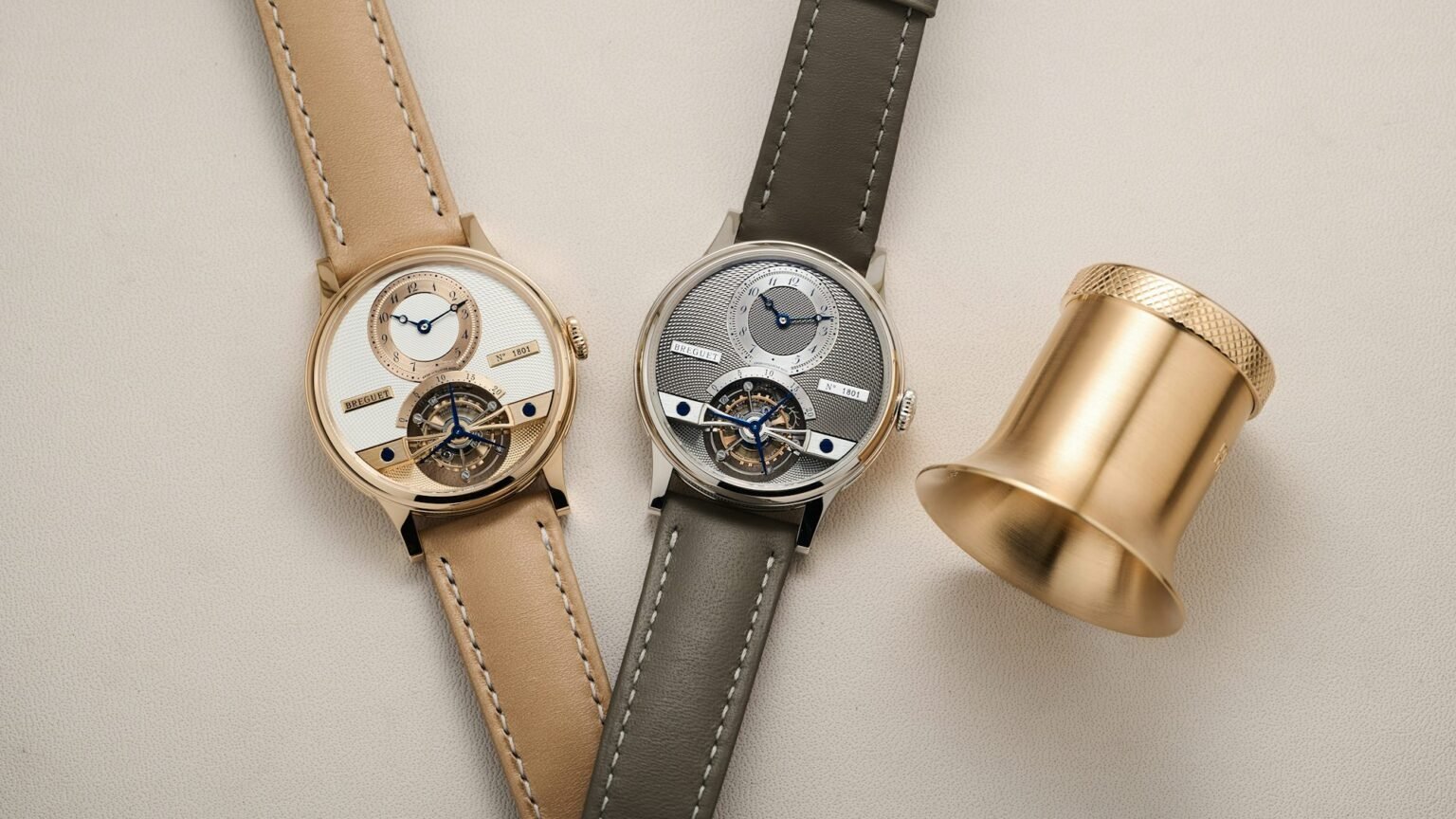


If there was a way to celebrate the 225th anniversary of Breguet patenting the tourbillon, re-launching a version of the brand’s iconic ref. 3350 was the obvious crowd-pleasing option. There was always something charming about that original tourbillon from the 1980s, but there were some downsides too. The new ref. 7357 is Breguet’s best effort to solve those downsides, modernize, and give buyers what they say they’ve wanted for a long time. At a true-to-vintage 35mm diameter by 9.2mm thick (43mm lug-to-lug), with 30m of water resistance, it’s the same but different. In a lot of great ways.

For those not in the vintage or neo-vintage space, Breguet created an all-time great watch when Daniel Roth (prior to his own brand) worked for Breguet and modified a Nouvelle Lemania ébauche into a compact and impressive tourbillon wristwatch. You can see an original platinum ref. 3357 example below (the quick successor to the 3550). The tourbillon bridge design is different between these generations (both front and rear).
The guilloché pattern, finishing, and even the movement-side treatment are different, with a very neo-vintage hand engraving on the earlier example. That watch would forge the future of the Breguet brand and, after Breguet’s then-owner, Chaumet, went bankrupt, push Roth to found his own brand, where the tourbillon became a focal point.


So let’s look at those changes a bit more closely. First things first, the new 7357 is, by no means, a budget option. Coming in at $184,800 in Breguet gold and $203,300 in platinum, these are high-priced, limited-production pieces. As you’ll see later, when compared to the rest of the market, they’re not out of line. But it’s not much more than the predecessor 5357 cost at launch in 2017 (okay, 25% more, but still, it’s a whole heck of a better watch). The treatment in Breguet gold (the brand’s proprietary alloy similar to Honeygold for Lange or Sand Gold for AP) extends from the case to the bridge, plates, tourbillon cage, dial ring, and nameplates, while the Breguet gold dial is treated with an opaline finish. The platinum version is platinum across the board, but with an anthracite finish.
The dials have a Clous de Paris guilloché pattern at the center of the chapter ring and a barleycorn pattern around the edge, radiating from the center of the one-minute tourbillon. The circular brushed areas for the indications have pad-printed and beautifully raised Breguet numerals, but they almost look painted. The track for the tourbillon only goes up to 20, as the cage holds three hands that rotate around once every minute to show 20-second intervals. As a whole, it’s wonderfully three-dimensional while still being compact.


The biggest change to the dial is getting rid of the top-to-bottom symmetrical bridge on the 3350 and 3357 that held the tourbillon cage. Now, the shape of the bridge curves with the dial and the case, and settles in. To be honest, I can’t tell if I like this more or less—it’s a nostalgia issue—but it certainly makes a lot of sense, so I can’t argue.

If you were planning to flip the watch over to get a look at some Côtes de Genève, well then you don’t know French watchmaking (made in Switzerland, to be fair). The new rear treatment is the unique guilloché called “Dent de Vaulion,” for the name of the mountain that overlooks the Vallée de Joux where Breguet is headquartered. I actually hiked part of the Dent (tooth) a few months ago. Not so much named after the mountain itself; it’s that when you’re on top of the mountain, you can look down to see the Lac de Joux and the rippling pattern created by the wind on the lake. It’s actually pretty well done, having seen that pattern myself. It’s also a testament to Breguet’s ability with guilloché, as one of the few brands with the technical skill to create a new pattern.
The bridge is horizontally brushed at the back, instead of this thin little part of the mainplate holding the rear of the cage like on the original model. The edge of the movement features the text “Brevet du 7 Messidor An 9” and “Tourbillon 225e Anniversaire.”


It’s not just aesthetics, though those are basically all that you could tell has changed in an hour-long experience. There is a big change under the hood, with 41% new parts, though the base of the movement is still the caliber 558.1T at its heart. That means the revamped caliber 187 doesn’t change some basic things, such as the 2.5Hz beat rate. The watch is manually wound, and the experience of winding it is quite nice, but not a main selling point, per se. However, the watch does have an improved 60-hour power reserve and better antimagnetism, featuring a Breguet Nivachron balance spring and a silicon pallet lever.

The biggest change, I’d say, is the new lug profile of the 7357. It’s also the one people have been most vocal about requesting. One of the biggest critiques of older Breguets is that the long, thin, straight lugs made the watch sit very flat on the wrist and weren’t the most comfortable wearing experience. These changes began with the GPHG-winning Souscription piece, which launched last year. Now, with new downturned lugs that slope into the case (soldered into the case on production models, though not on these prototypes), if you were complaining about the old “Empire-style” lugs, then your prayers have been answered.
The change, since the Souscription, is the fact that the brand brought back the iconic coin-edge midcase. Look, I’ll be honest. I am 100% in the minority here, but I thought the change to the Souscription was my least favorite part of its launch. The lugs were what made it feel like a vintage “Empire” Breguet, and that’s the best callback you could ask for. Changing the lugs and the coin edge was a bridge too far. Does the watch wear better? Undoubtedly. But to quote Celine Dion, “I walk the shoe, the shoe don’t walk me.” The watch was more “Breguet” with the other lugs. I miss the good old days.


This is an interesting case study in commercial watchmaking in the modern era. We are obviously in a bubble in our world of watch readership, and even more so when it comes to people who have looked longingly at a 3350 or 3357 and thought “man… why don’t they make things like this anymore?” When brands do, they overshoot, make a watch that’s too big, or overdone, or lacks the romance of the original. The benefit to the brand (not so much the customer) is that it’s demonstrably newer. It’s not the same thing. You’re not cross-shopping a vintage Breitling Datora with a new one. There’s no overlap. But what happens when you do essentially the same thing, but better?

Well, you end up with the 7357, which is a killer watch. It’s the kind of watch that makes me fall in love with the idea of wearing a gold watch, even if I keep swearing to myself I’d never be comfortable with the idea. It’s something that feels like it’s been there the entire time. Is that the best for a pop of marketing pizzaz? No. But we need brands that are okay with not reinventing the wheel or screaming at the top of their lungs. That kind of hype chasing is—for a lot of people, I’d imagine—starting to feel like a race to the bottom. The Breguet can sit quietly alone at the top.

The Competition
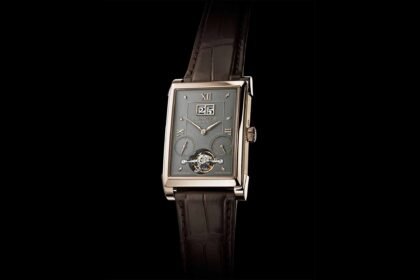
Daniel Roth Tourbillon

The Daniel Roth Tourbillon in platinum. Photo by TanTan Wang.
It’s funny how the tourbillon has become more common in sports watches than in dress watches—or at least that’s what it seems most people are buying. The Royal Oak. The Overseas. There are fewer and fewer tourbillon dress watches, and the first non-Breguet option that comes to mind is Daniel Roth’s recent options. Now available in rose gold and platinum (the yellow gold was souscription-only).
The new Breguet is small, but the Roth (which we’ve pointed out shares a progenitor) is only 38.6mm x 35.5mm as well, and identically 9.2mm thick. The wearing experience is totally different, however, with the rectangular/elliptical shape that feels smaller on the wrist than a round watch. It would be interesting to put these head-to-head. The price of the Roth in platinum (the most recent release) is around $230,000, which is about $25,000 more than the Breguet. I do think that the Roth will be harder to get, as well, but that’s just a gut feeling.
Vacheron Constantin Traditionnelle Tourbillon

Vacheron’s Traditionelle Tourbillon is one of my other picks for a few reasons. What it lacks in compact size (at 41 mm by 10.4mm), it makes up for by being a peripherally wound automatic watch. That makes it more practical in some respects, though I don’t know how bothered an owner of a manually-winding dress tourbillon will be at having to wind and set it every wear. The movement is shared with the Overseas version, where the automatic winding somehow makes more sense. Another benefit (necessitating a bigger movement) is the longer three-day power reserve. The price for both the rose gold and platinum models is “On Request.” After requesting, the price is actually $173,000 in rose gold and $200,000 in platinum, making the watch a winner (by a few thousand dollars) in that regard.
The Original Breguet 3350/3357
This is the obvious comparison to make and the one where a buyer will have the hardest decision to make. There are no two ways about it: buying an original 3350 or 3357 is comparatively a lot cheaper and gets you an original piece of history. As of writing this, I could find three 3350BA (yellow gold with closed caseback) for sale for less than $70,000 and the 3357 for even cheaper, around $50,000.

That’s Daniel Roth’s design for Nouvelle Lemania, in a 1980s case with the hand engraving on the movement, for about a third the price of the new one. The plusses for some are the downsides for the others: the case is the traditional straight-lugged Breguet design that the brand has recently gone away from. I like it, but it wears very flat on the wrist. The new watch has a more comfortable case for most, better accuracy and power reserve, longer service intervals, and just more modern construction and water resistance. For a lot of people shopping at the six-figure price range, these positives will probably be convincing enough for the ref. 7537.
Final Thoughts

There’s no denying that Breguet has made a lot of improvements here. That shouldn’t be any surprise; there’s a lot of new energy in the brand over the last two years. Sticker shock might be troublesome, but that’s a problem every brand is facing over the past few years, and one not helped by the strength of the Swiss Franc versus the dollar, a problem that no brand can fix and no brand is happy with. But you have to applaud Breguet for going back to its roots and making a very intellectually faithful version of the brand’s original tourbillon, with the upgrades that collectors have been begging for. They are the buyers, after all, and while a lot of brands reject feedback, it seems Breguet trusts theirs enough to know that the buyer is, at least in this case, always right.
For more on the Breguet Classique Tourbillon ref. 7357, visit the brand’s website.