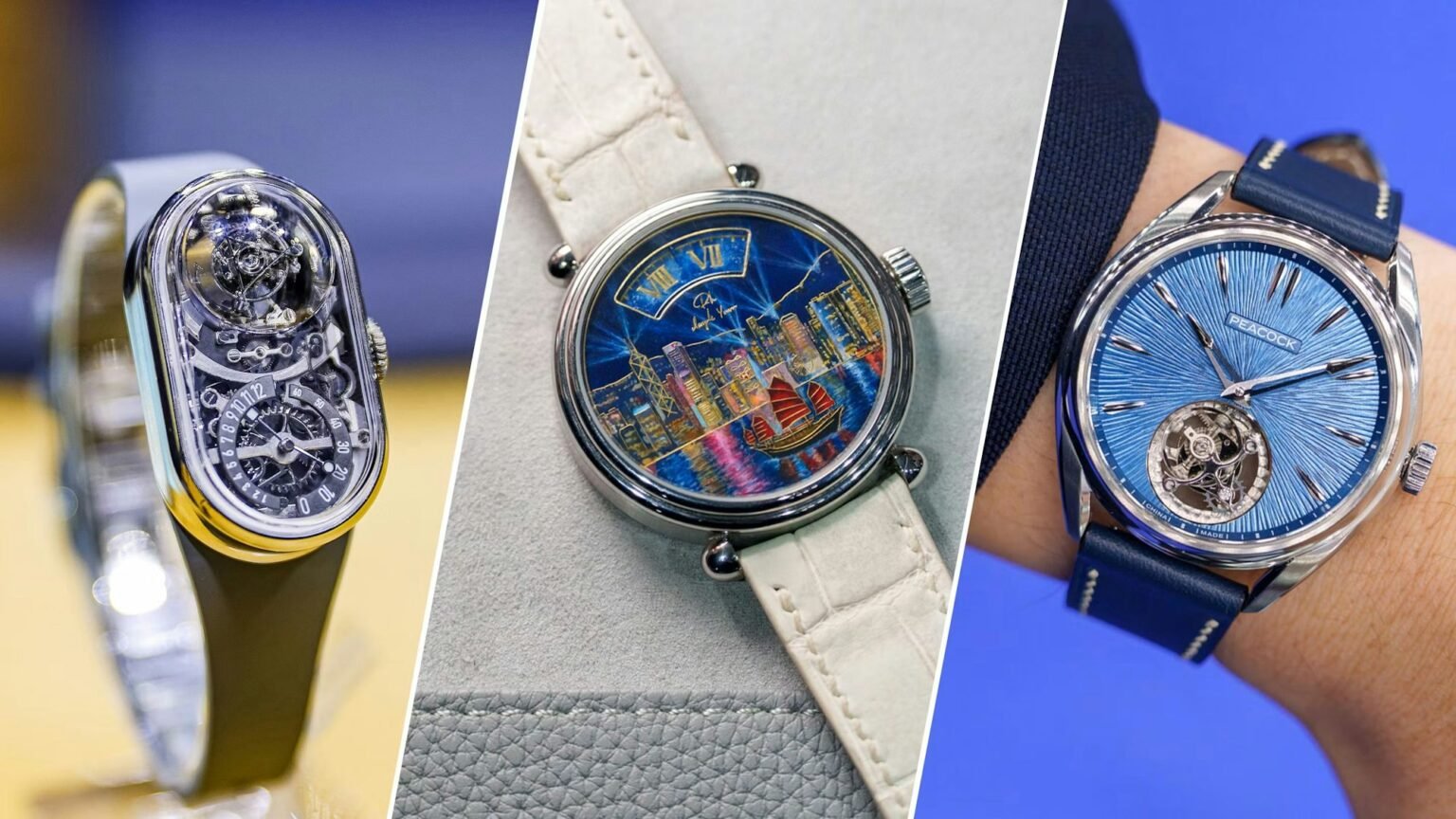


- What Is Shenzhen Watch Week?
- Watch Plaza: An Invitation-Only Space
- A Symbol of Manufacturing Strength
- A Symbol of Creativity
- China’s High Watchmaking Comes of Age
- A New Wave of Independent Watchmakers in China
- From Watch Repairer to Independent Watchmaker: Qian GuoBiao
- Chinese Aesthetics in Miniature: Langle Yuan
- An 18-Year-Old’s Vision for Independent Watchmaking: Ricky Hong
- Another Side of Chinese Watchmaking: Kubernet
- Where Chinese Watchmaking Stands Today
Shenzhen Watch Week is China’s premier annual event dedicated to the watch industry. More than just a trade show, it brings together established brands, independent watchmakers, suppliers, and manufacturers, offering perhaps the clearest snapshot of where Chinese watchmaking stands today. For anyone interested in understanding the industry beyond its reputation as “the world’s factory,” there are few better places to start.
There are surprisingly few opportunities anywhere in the world to experience so many Chinese watch brands under one roof. Switzerland has Watches & Wonders and Geneva Watch Days, while Japan hosts brand presentations, watch fairs, and events such as Tokyo Watch Week. But an exhibition devoted almost entirely to Chinese watchmaking is something quite different.
In recent years, brands such as Behrens, CIGA Design, and Fam al Hut have begun attracting international attention, winning prestigious awards, and demonstrating that China is capable of far more than manufacturing for others. Yet outside China, it remains virtually impossible to see these brands together or experience their watches firsthand.


That is why, when I received an invitation to attend Shenzhen Watch Week, I wanted to see for myself what is happening in Chinese watchmaking today. Watches made in China are, of course, nothing unusual. Many of the world’s leading brands—including Swiss manufacturers—rely on Chinese suppliers for cases, dials, bracelets, hands, movement components, and countless manufacturing processes. Working in the watch industry, it is impossible not to recognize that today’s global watch business depends heavily on China’s supply chain.
Yet when people hear the phrase “Chinese watch brand,” what comes to mind? For many enthusiasts, the answer is still “inexpensive watches” or even “copies.” Those perceptions remain surprisingly common.


I was no exception. I had long respected China’s manufacturing capabilities, but when I thought about Chinese watch brands themselves, I tended to associate them primarily with industrial production rather than creative watchmaking. Of course, I was already familiar with brands such as Behrens and CIGA Design, and I had watched Chinese brands gain recognition at the Grand Prix d’Horlogerie de Genève (GPHG). Even so, I had never had the opportunity to experience firsthand the broader direction in which Chinese watchmaking was moving.
In that sense, this trip was about far more than visiting a watch exhibition. It was an opportunity to test my own assumptions—and perhaps to reconsider what “Made in China” means in the world of watchmaking today.
What Is Shenzhen Watch Week?
Held annually in June in Shenzhen, Shenzhen Watch Week is China’s largest event dedicated to the watch industry. It brings together not only watch brands but also independent watchmakers, movement manufacturers, component suppliers, and companies specializing in every aspect of watch production. More than a consumer-facing exhibition, it serves as a comprehensive showcase of China’s entire watchmaking ecosystem.

The event takes place at the Shenzhen Convention & Exhibition Center in Futian, one of the city’s largest public exhibition venues.

The expansive exhibition halls are filled with booths from watch brands, suppliers, and manufacturers from across China’s watch industry.
When I asked Jerry, Head of PR & Media Relations, Shenzhen Watch Week, what makes the event different from other watch fairs, his answer was immediate. “It’s not an exhibition—it’s a platform.”
Shenzhen is home not only to watch brands, but also movement manufacturers, component suppliers, independent watchmakers, and virtually everyone involved in the process of making watches. Because all of these people are here, we want to create a place where the future of the watch industry can be discussed across borders, disciplines, and perspectives.
– Jerry, Head of PR & Media Relations, Shenzhen Watch Week

A display showcasing luminous carbon fiber cases.

An exhibit by a supplier of watch testing equipment, including timing machines.
Walking through the exhibition, it quickly became clear what he meant. The event was about far more than the latest mechanical watches. Alongside new timepieces were manufacturers of cases, hands, and dials, as well as companies showcasing high-precision CNC machinery, advanced materials, smart wearables, and even AI-powered healthcare devices. Together, they illustrated the breadth of technologies and businesses that make up today’s watch industry.

Movement suppliers were well represented throughout the exhibition.
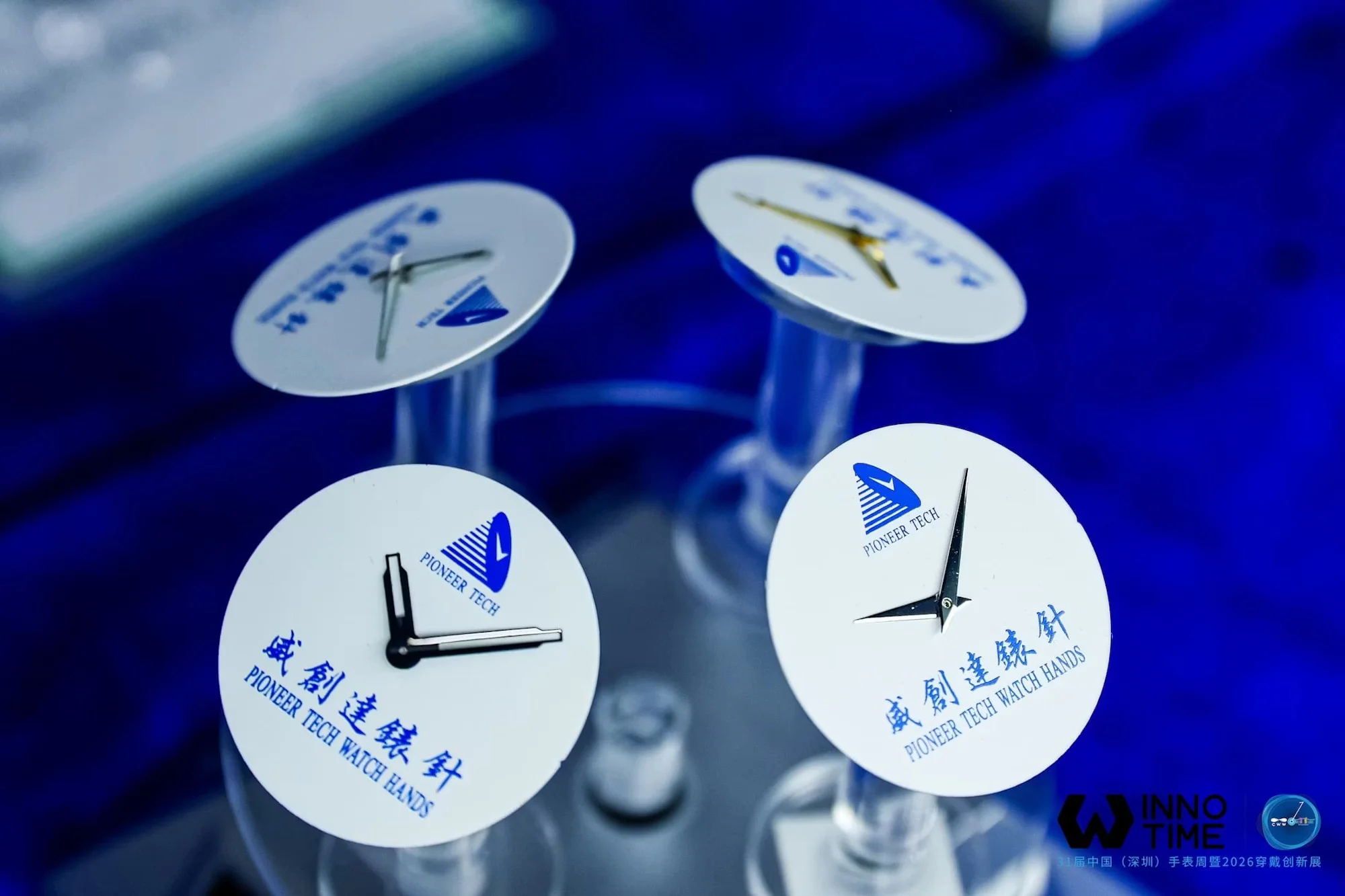
From hands to virtually every other watch component, the show brought together suppliers from across the entire watchmaking ecosystem.
Whereas watch fairs in Japan and Switzerland are largely centered on brands and new product launches, Shenzhen Watch Week presents something much broader: the watch industry itself. From manufacturing and design to materials and emerging technologies, the event offers a comprehensive view of the ecosystem behind modern watchmaking. It struck me as an exhibition that could only exist in Shenzhen, a city at the heart of one of the world’s largest watch manufacturing and supply chain networks.
The international presence was equally striking. Alongside Chinese brands were global names such as Jacob & Co., underscoring the growing importance of the Chinese market. Seeing international brands looking toward China and Chinese brands looking outward to the world—sharing the same exhibition floor—made it clear that Shenzhen Watch Week is evolving into far more than a domestic trade fair. It is becoming a genuine platform for international exchange.
Watch Plaza: An Invitation-Only Space


Originally, however, Shenzhen Watch Week was not the reason for my trip to China.
The primary purpose of my visit was to tour the workshop of Fam al Hut, the recipient of the Audacity Prize at the Grand Prix d’Horlogerie de Genève (GPHG). The brand’s founder had personally invited me to visit its atelier in Taicang, Jiangsu Province, where I was scheduled to see firsthand how its watches are designed and manufactured.
Before I arrived, however, they gave me one piece of advice. “If you’re coming to China at this time of year, it would be a shame to miss Shenzhen Watch Week. If you want to understand Chinese watchmaking today, that’s where you should go first.” That recommendation ultimately brought me to Shenzhen.

Taking the advice of one of China’s most exciting independent watch brands, I rearranged my schedule and made my first visit to Shenzhen Watch Week. Looking back, it was absolutely the right decision. What I encountered there was not simply a single brand, but a snapshot of Chinese watchmaking as a whole—its current state, its momentum, and its ambitions.
And nowhere was that better encapsulated than at Watch Plaza, an invitation-only area reserved for industry professionals and special guests. Stepping out of the main exhibition halls and into Watch Plaza, the atmosphere noticeably changed. It felt less like a showcase for new product launches and more like a place where people gathered to discuss the craft of watchmaking itself.
Alongside finished watches, manufacturers were developing their own movements, and independent watchmakers were working in small teams. Together, they created a space that offered an unfiltered glimpse into the current state of Chinese watchmaking.


Of course, Watch Plaza was not exclusively about Chinese brands. Yet there was no question that they were its defining presence.
During our conversation, Jerry shared a perspective that stayed with me: “For many years, watches made in China were often associated with being inexpensive or copies. But over the past decade, many Chinese brands have begun developing their own inventions and creating watches inspired by China’s own culture and design heritage.”
At the time, I wasn’t entirely convinced. But as I made my way from booth to booth, his point gradually became clear. What surprised me most was not China’s manufacturing capability—I had already known about that. It was the creativity beginning to flourish on top of that foundation.
A Symbol of Manufacturing Strength
Peacock and Sea-Gull: The Foundation of China’s Watch Industry

It is impossible to talk about Chinese watchmaking without mentioning Peacock. Founded in 1957 in Dandong—one of the historic centers of China’s watch industry—the company has grown into one of the world’s largest manufacturers of mechanical movements.
Although the Peacock name is still relatively unfamiliar to many enthusiasts outside China, the company is far more than a watch brand. In addition to producing watches under its own name, it supplies movements to brands across China and around the world, including customers in Switzerland and Hong Kong. Today, Peacock stands as one of the defining pillars of China’s watch industry.

In recent years, however, Peacock has been placing increasing emphasis on high-end mechanical watchmaking. One collection that particularly caught my attention was the Divine Craft, featuring the company’s own ultra-thin flying tourbillon movement.
At first glance, the dial appeared to have a beautifully executed sunburst finish. But a closer look revealed something entirely different.
Radiating from the center were countless fine lines. They were not guilloché, but individually engraved by hand using a traditional technique known as micro-chasing. More than a thousand strikes are required to complete a single dial, and even the slightest mistake in force or angle can ruin the entire piece.
The result is a dial that feels more like a work of craftsmanship than an industrial product. It was difficult to reconcile this level of artisanal finishing with my preconceived image of Peacock as simply a large-scale movement manufacturer.


Turning the watch over revealed Peacock’s in-house Caliber PAX9610A, an ultra-thin movement measuring just 3.5mm in height, visible through the sapphire caseback. It features traditional decorative finishes, including perlage, Côtes de Genève, and chamfered edges, yet the watch is priced at $4,899.
This is not a watch intended to compete with the finest Swiss tourbillons. But it is difficult not to be impressed that Peacock has produced such a well-executed, in-house flying tourbillon at this price point.
What struck me most about Peacock was not the familiar notion of “cheap watches made in China.” Instead, it was the balance between technical capability and affordability that China was uniquely positioned to achieve. A manufacturer with Peacock’s scale and vertically integrated production can deliver a watch of this level at a price that would be difficult for many others to match. That manufacturing scale may well be Peacock’s greatest competitive advantage.


Sea-Gull, meanwhile, is perhaps the best-known Chinese watch brand in Japan. Like Peacock, it has a long history as a movement manufacturer, and at the exhibition, I had the opportunity to see a prototype of its newly developed hand-wound movement.
The case and dial design carried a distinctly 1970s aesthetic. While charming in its own way, the vintage styling felt somewhat pronounced by today’s standards and may divide opinion among contemporary collectors. But once I turned my attention to the movement, my impression changed.
Its architecture and finishing reflected decades of accumulated expertise as a movement manufacturer. I found myself thinking that if Sea-Gull were to pair this level of movement craftsmanship with a more contemporary approach to case and dial design, it could appeal to far more enthusiasts—not only in China, but in Japan as well.


Peacock and Sea-Gull alone are enough to demonstrate the depth of China’s watch industry. Here are manufacturers capable of designing and producing their own movements and supplying brands worldwide. And, of course, they are far from the only movement makers in China. It is this extraordinary manufacturing base that has become the country’s greatest strength in watchmaking.
Yet what left the strongest impression on me was not the foundation itself, but the new generation of brands emerging from it. No brand embodied that transformation more clearly than Behrens.
A Symbol of Creativity
Behrens and the Rise of Watches That Could Only Come From China

Founded in 2012, Behrens is an independent watch brand named in tribute to Peter Behrens, the pioneering German industrial designer. Over the years, it has received multiple nominations at the Grand Prix d’Horlogerie de Genève (GPHG), establishing itself as one of China’s most internationally recognized independent watchmakers.
Yet Behrens is not defined by its awards. Its real appeal lies in the way it reimagines the watch itself.
Most wristwatches tell the time with hands. Behrens starts by questioning that convention. Using rotating discs, three-dimensional rollers, and even display mechanisms inspired by rotary engines, the brand rethinks one of watchmaking’s most fundamental questions: how should time be displayed? At Behrens, the mechanism itself becomes the design.

Orion One displays the hours and minutes using two rotating barrels positioned at the bottom of the case. A central seconds hand occupies the middle of the dial, while a power reserve indicator sits above it. Not visible in this photograph is a date display on the right-hand side, making the watch as practical as it is unconventional.
In fact, this was not my first encounter with a Behrens watch.
At Watches & Wonders last year, a collector from China noticed my interest and took the watch off his wrist, insisting that I try it. It was the Ultra Light 11G. As its name suggests, the watch weighs an astonishing 11 grams (head only). But remarkable as its weight was, what impressed me even more was its construction.

The movement is built directly onto the caseback, which serves as the movement’s mainplate, while the entire assembly is gently curved to follow the contour of the wrist.
Using the caseback as the mainplate is not unprecedented—ultra-thin watches from brands such as Piaget and Bulgari employ similar construction. But I have never seen that concept taken a step further by shaping the entire case to improve ergonomics and wearing comfort.
This is more than an exercise in making a watch lighter or thinner. It is a rethinking of what a wristwatch can be from the ground up. To me, that spirit of questioning convention is what makes Behrens so compelling.
Returning to the brand’s booth this year, I found that philosophy had only become even more ambitious.

KWH, created in collaboration with independent watchmaker Vianney Halter.

The caseback also incorporates a moonphase display.
Its collaborations with independent watchmakers such as Konstantin Chaykin and Vianney Halter are a perfect example. Behrens is no longer attracting attention simply as a Chinese brand, but as an independent watchmaker in its own right.
Jerry shared a similar observation: “There was a time when very few people outside China had the opportunity to see Chinese watch brands. Today, more and more visitors see watches from brands like Behrens and CIGA Design and are genuinely surprised, saying, ‘I had no idea this was made in China.'”
After spending time with the watches myself, I understood exactly what he meant.
Until relatively recently, many Chinese brands either emphasized their Chinese identity through overtly local design cues or looked to established international brands for inspiration. Behrens feels different. There is little about its watches that seems overly concerned with where they come from.

Ace of Heart, created in collaboration with Konstantin Chaykin.
If the brand name were hidden, I doubt many people could identify the country where this watch was made. And perhaps that is the new stage Chinese watchmaking is beginning to reach.
Rather than attracting attention because of its country of origin, the watch wins people over on its own merits. Only afterward comes the realization: “Wait, this is from a Chinese brand?”
Looking at Behrens, I couldn’t help wondering whether the day will come when the qualifier “Chinese brand” is no longer necessary at all—when these watches will simply be judged alongside the world’s best for what they are.
China’s High Watchmaking Comes of Age
How Fam al Hut Is Redefining Independent Watchmaking

In fact, visiting Fam al Hut was the primary reason I came to China in the first place.
The name may still be unfamiliar to many readers. But among those who closely follow independent watchmaking, it has quickly become one of the most talked-about young brands in the industry.
The reason is simple: the Grand Prix d’Horlogerie de Genève (GPHG).
In 2025, Fam al Hut’s debut watch, the Möbius Mark I Bi-Axis Tourbillon, won the Audacity Prize, instantly putting the brand on the international watchmaking map. The Audacity Prize recognizes originality and bold thinking—watches that challenge established conventions and push the boundaries of contemporary horology. For a Chinese brand to receive this distinction marked a significant milestone, not only for Fam al Hut but for Chinese watchmaking as a whole.

Ever since I first learned about the brand, I had wanted to see one of its watches in person. Opportunities to do so, however, have been few and far between. This trip finally gave me that chance. The first surprise was its size. From photographs, I had imagined a much larger watch. On paper, the case measures 42.2mm by 24.3mm and 17.4mm thick. Yet in the hand, it feels remarkably compact. Even at its tallest point, it wears far smaller than the dimensions suggest.
The case itself has a soft, elongated oval profile—one that, somewhat unexpectedly, reminded me of a capsule.


Within that remarkably compact space, Fam al Hut has packed a bi-axis tourbillon alongside two retrograde displays for the hours and minutes. Holding it in my hand felt less like wearing a wristwatch and more like holding a miniature kinetic sculpture built around a complicated movement.
The design is equally distinctive. Much of today’s independent watchmaking still gravitates toward classical round cases and traditional dial layouts. Fam al Hut belongs to neither camp. Its case design, display architecture, and overall proportions feel unlike anything from Switzerland, Germany, or even Japan.

There is little about the watch that feels borrowed from an existing watchmaking tradition. Instead, it possesses a design language that is unmistakably its own.
Looking more closely at the movement, however, reveals another side of the brand. The bridges and individual components are finished with traditional techniques, including hand-beveling, reflecting a deep respect for the fundamentals of mechanical watchmaking. In other words, while the design philosophy is strikingly modern, it is built upon a foundation of traditional craftsmanship. That, to me, is where Fam al Hut differs most significantly from Behrens.
If Behrens has expanded the possibilities of what a Chinese watch brand can be through innovative engineering and unconventional design, Fam al Hut appears to be taking the next step—venturing into the realm of true high watchmaking.
Its point of comparison is no longer other Chinese brands. In terms of both ambition and price, its real competitors are the world’s leading independent haute horlogerie brands.

After spending time with the watch in person, I found that the label “Chinese brand” mattered surprisingly little. What I had in front of me was not simply a Chinese watch, but a serious, independent, high-end watchmaker. Of course, this is the brand’s very first creation. There is still room for refinement in the finer details. Even so, the level of maturity—from its engineering and design to its finishing and overall creative vision—was remarkable. More than once, I found myself forgetting that this was a debut watch.
My visit did not end at the exhibition. I was also fortunate enough to spend time at Fam al Hut’s workshop in Taicang, Jiangsu Province, where I saw firsthand how the brand approaches every stage of watchmaking, from design and machining to assembly. That visit deserves a story of its own. Rather than trying to cover everything here, I wanted this article to serve as an introduction to the brand. I’ll take a closer look inside the workshop in a future article.
Of course, not every brand at Shenzhen Watch Week was moving in the same direction. Some watches drew heavily on the aesthetics of vintage Chinese timepieces, while others unmistakably echoed the designs of well-known international brands. That was precisely why Fam al Hut stood out so clearly. What I saw was not a watch trying to look “Chinese.” It was an independent high-end watchmaker with the ambition to stand alongside the world’s finest practitioners of haute horlogerie.
If there was one conclusion I took away from this trip, it was not that Chinese watchmaking has changed overnight. Rather, it is that a new generation of brands has begun to emerge—brands that are clearly capable of driving that change.
A New Wave of Independent Watchmakers in China

While brands such as Behrens and Fam al Hut are taking Chinese watchmaking onto the global stage, what left the deepest impression on me were the watchmakers themselves. In recent years, independent watchmakers have attracted more attention than ever before, becoming one of the most exciting forces in contemporary horology. That movement is now unmistakably taking root in China as well.
I have previously had the opportunity to experience the work of Chinese independent watchmakers such as Logan Kwan Lao and Qin Gan, and have long admired both their technical ability and their distinctive artistic vision. Although neither was exhibiting at Shenzhen Watch Week this year, I instead encountered a new generation of watchmakers poised to shape the future of independent watchmaking in China.
From Watch Repairer to Independent Watchmaker: Qian GuoBiao
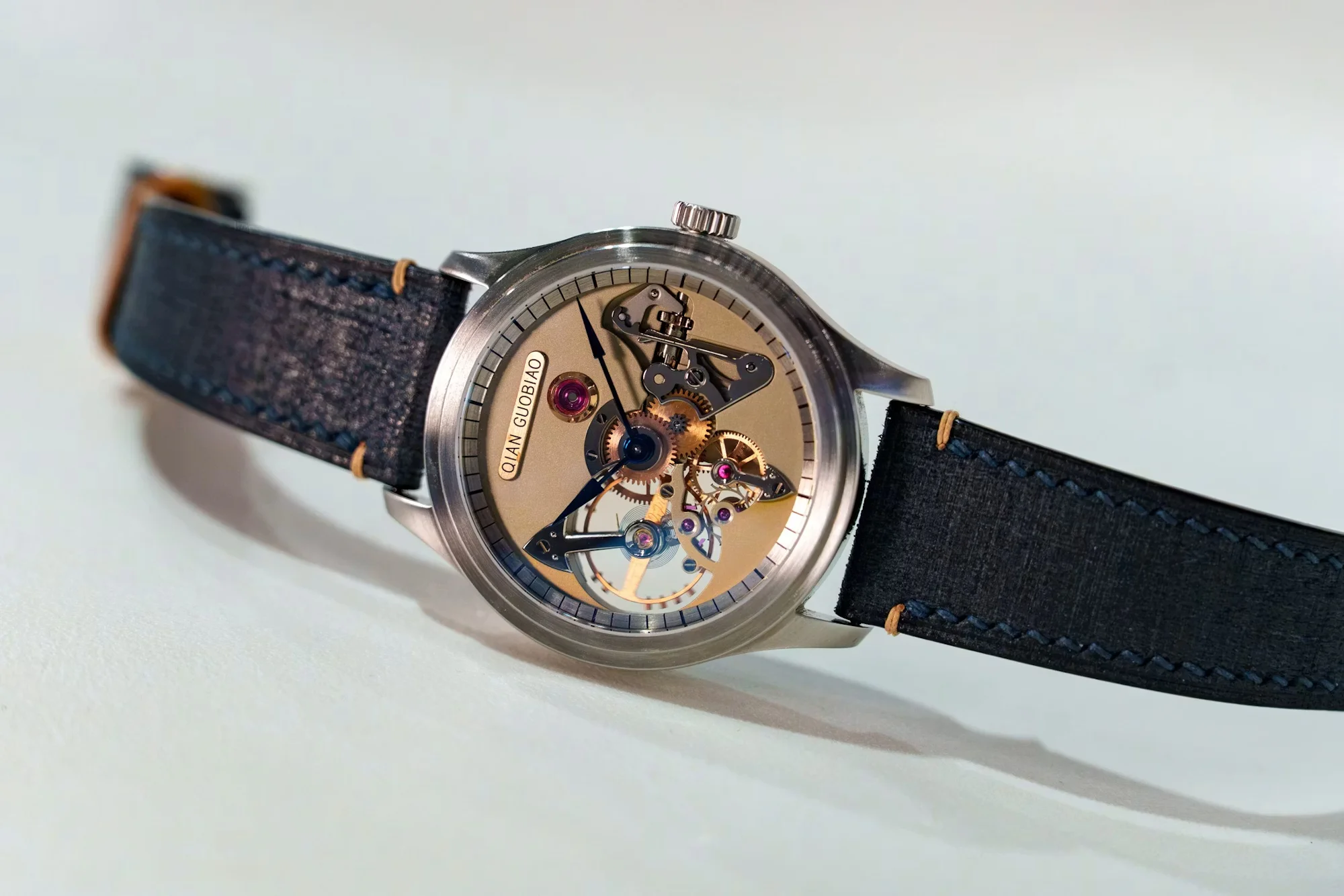
AB-05 Skylight Original & Sun.
The first watchmaker I want to introduce is Qian GuoBiao, who is based in Dongguan, Guangdong Province. Before becoming an independent watchmaker, he spent many years repairing and servicing mechanical watches. Many independent watchmakers come from watchmaking schools or established manufacturers. Qian’s path was different. After working on countless watches and gaining an intimate understanding of their construction, he eventually began designing watches of his own.
What struck me most about his work was the way he chose to reveal the movement. Components that are traditionally admired through the caseback—the gear train and wheels, for example—are brought boldly to the dial side, allowing the mechanics themselves to become the design.

FACING THE SKY 2.0
Skeletonized watches are hardly uncommon today. Yet Qian’s work feels different. Rather than pursuing visual spectacle, his watches seem intent on revealing the inherent beauty of mechanical construction itself. Perhaps that perspective could only come from someone who has spent years disassembling, repairing, and rebuilding countless timepieces.
In 2018, he completed his first tourbillon, further establishing himself as one of the leading figures in China’s independent watchmaking scene. In recent years, that reputation has increasingly been reflected in the collector market as well.

Facing The Sky 2.0 Workshop Prototype (No.00)

In 2026, his prototype, Facing The Sky 2.0 Workshop Prototype (No.00), achieved CHF 102,000 (approximately US$125,000) at a Marteau & Co. auction—a record price for a watch by a Chinese independent watchmaker. Another creation, the Reference AB-03 Double Balance Wheel, also attracted significant attention, selling for US$51,250 at Heritage Auctions.
Auction results, of course, are not the sole measure of a watchmaker’s significance. Even so, these sales represent an important milestone, demonstrating that Chinese independent watchmakers are beginning to earn serious recognition from collectors around the world.
Chinese Aesthetics in Miniature: Langle Yuan

If Qian GuoBiao is a watchmaker who expresses himself through mechanical architecture, then Langle Yuan is one who expresses himself through craftsmanship. The moment I saw his work, my attention was immediately drawn to the dial. Looking at it through a loupe revealed an astonishing level of detail. Layer upon layer of enamel is applied over intricately engraved reliefs. Every line is extraordinarily fine, yet full of confidence and energy. Rather than looking at a watch, I felt as though I was looking at a miniature painting.
His subjects are remarkably diverse. Among his best-known works is the Furinkazan series—named after the phrase “Wind, Forest, Fire, Mountain”—alongside dials inspired by Chinese cities and dynamic depictions of horses. More recently, he has also begun creating bespoke pieces featuring clients’ beloved dogs and cats.


What I found particularly fascinating was that his work goes far beyond simply painting miniature scenes. To achieve the precise colors he envisions, Yuan repeatedly experiments with different enamel mixtures, refining the composition until it matches his ideal. The resulting palette is vivid yet never ostentatious, carrying a softness and quiet elegance. Rather than showcasing technical virtuosity for its own sake, every decision seems guided by a commitment to harmony across the entire composition. That sense of restraint is, to me, one of the defining qualities of his work.
China has a long and distinguished tradition of craftsmanship. Yet few watchmakers have succeeded in translating that heritage so naturally into the language of the modern wristwatch. Looking at Langle Yuan’s work, I was reminded that “Chinese identity” in watchmaking is not defined by obvious motifs such as dragons or Chinese characters. Instead, it lies in elevating the country’s craftsmanship and aesthetic sensibility into something timeless on the wrist.
An 18-Year-Old’s Vision for Independent Watchmaking: Ricky Hong

Project Tourbillon 01.42.

18 in 18.
Among all the watchmakers I met, perhaps the biggest surprise was Ricky Hong, an independent watchmaker from Hong Kong. When he told me his age, I had to ask him to repeat it. He was just 18 years old. Looking at the watches displayed in front of him, it would be nearly impossible to guess that they were the work of someone so young.
Hong began making watches in his early teens. He started by customizing G-SHOCK watches before progressing to assembling complete timepieces of his own. From there, he went on to design his own cases and dials, and eventually taught himself movement modification and finishing as well.

Ricky Hong.
Our conversation revolved almost entirely around gears, mainplates, finishing, and movement architecture. He spoke passionately about how each component had been manufactured and why he had chosen a particular construction. Listening to him, it was impossible not to see him as a genuine independent watchmaker.
One of his recent creations, Furinkazan 18 in 18, was developed in collaboration with Langle Yuan, whose work I introduced earlier.
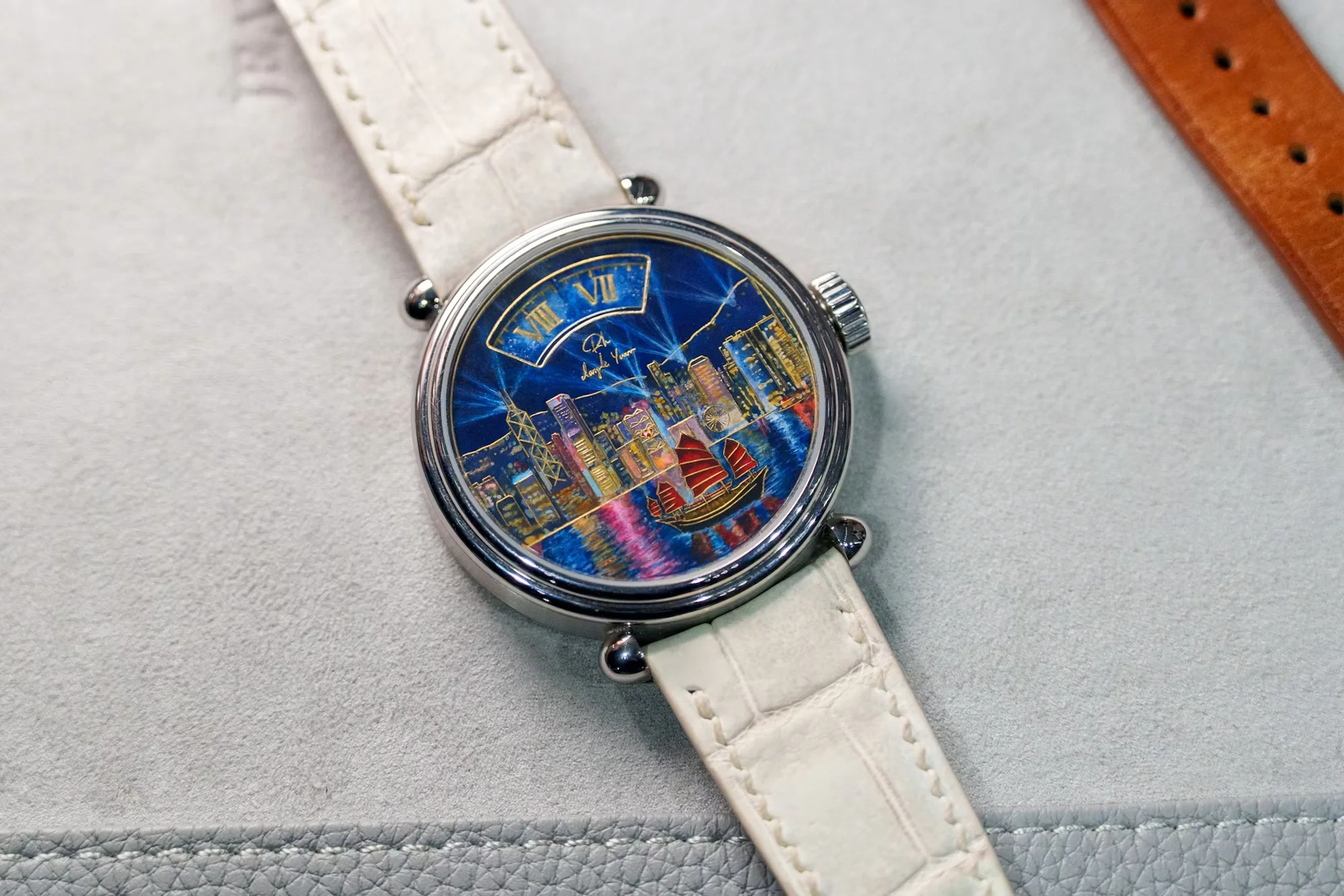

Seeing these young watchmakers collaborate so naturally to create a single watch gave me the sense that a genuine community of independent watchmakers is beginning to take shape in China.
“I still have so much to learn,” Hong told me. Yet despite that humility, he continues to push himself, taking on ever more ambitious challenges in design, machining, and movement construction. His journey is only just beginning. But if, ten years from now, someone were to ask me to name the watchmakers who define Chinese independent watchmaking, I have little doubt that Ricky Hong would be among them.
Another Side of Chinese Watchmaking: Kubernet

Eternal Night Secular Perpetual Calendar Desk Clock.
Another brand that left a lasting impression on me at Watch Plaza was Kubernet. It stood apart from the brands I have discussed so far for one simple reason: it is not a watchmaker, but a maker of clocks.
Among watch enthusiasts, clocks rarely receive the same attention as wristwatches. Yet that also gives them a unique freedom. Unconstrained by the format of a wristwatch, clockmakers can pursue mechanical ideas on an entirely different scale. Kubernet’s Eternal Night Secular Perpetual Calendar Desk Clock was a perfect example of that philosophy.

The base alarm clock on which the project was built.
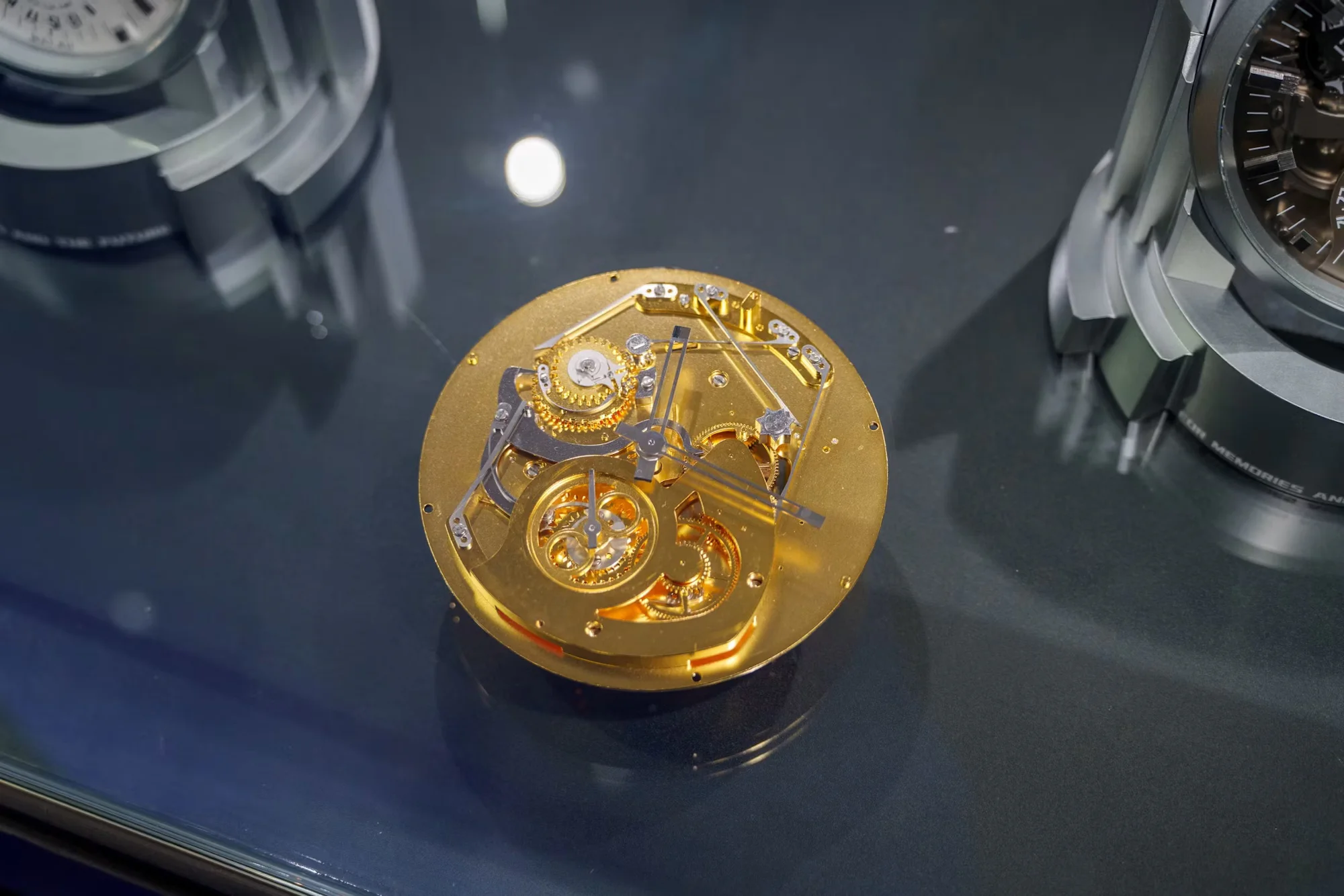
The movement incorporates a patented gear mechanism.
If you’re picturing a traditional desk clock, however, Kubernet quickly defies those expectations. On display were several variations, ranging from skeletonized models that boldly expose the movement to more conventional versions with dials. Beneath their different appearances lies an extraordinarily ambitious mechanical concept.
At the heart of each clock is a mechanical alarm clock movement originally developed by the Shanghai Watch Factory in 1979. More remarkably, these are new old stock (NOS) movements that had never been used. While most makers would simply preserve such vintage movements as they are, Kubernet has chosen a far more ambitious approach, extensively re-engineering them from the ground up.

What impressed me most was its perpetual calendar. Many perpetual calendars still require manual correction in centuries that are not divisible by 400—such as 2100. Kubernet’s clock, however, automatically accounts not only for 2100, but also 2200 and 2300. In other words, it fully incorporates the 400-year cycle of the Gregorian calendar into its mechanism.
Even more remarkably, the date, day, month, and moon phase all jump instantaneously within roughly two seconds. It was a reminder that innovation is not only about developing entirely new technologies. Reinterpreting a movement designed nearly half a century ago through a contemporary engineering lens—and creating something genuinely new in the process—is another form of innovation. To me, that too represents one of the defining strengths of Chinese watchmaking today.
Where Chinese Watchmaking Stands Today

Toward the end of my visit, Jerry shared a thought that stayed with me: “Misconceptions aren’t necessarily a bad thing. In fact, they often spark curiosity. They make people stop and ask, ‘So what’s the real story?'”
When I heard those words, it struck me that they perfectly captured the purpose of this trip. I came to China driven by a simple question: What is happening in Chinese watchmaking today? By the time I left, my perception had changed profoundly.
Before visiting Shenzhen, I saw China’s watch industry primarily as the world’s factory. That perception was not wrong. But alongside that manufacturing strength, I discovered a new current—one that is unmistakably beginning to reshape the future of Chinese watchmaking.


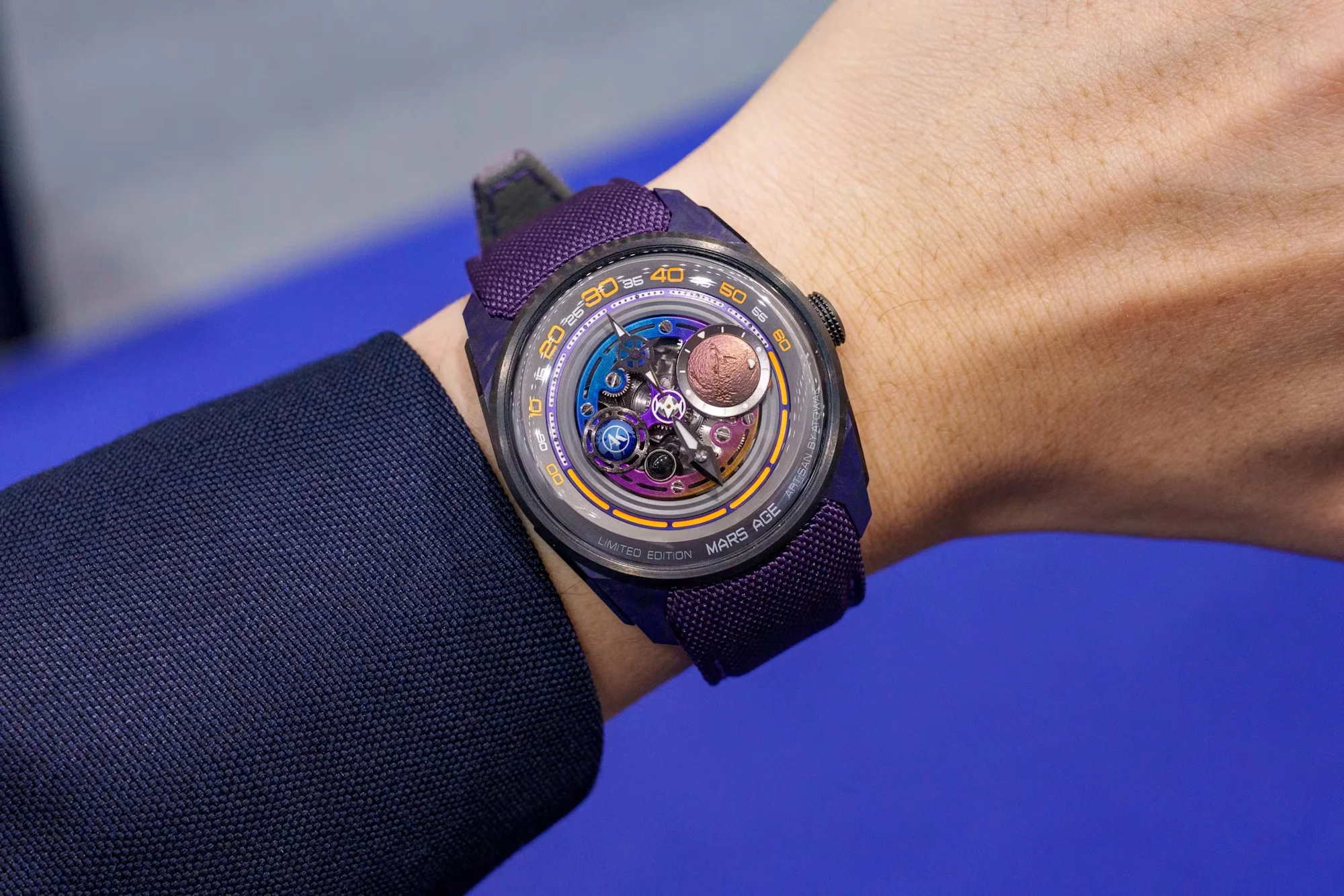
Behrens has already begun to transcend the label of a “Chinese brand,” earning recognition simply as an independent watchmaker on the global stage. Fam al Hut is pushing even further, venturing into the realm of true haute horlogerie. Meanwhile, watchmakers such as Qian GuoBiao, Langle Yuan, and Ricky Hong are each translating their own philosophies and aesthetic sensibilities onto the small canvas of a watch, exploring entirely new forms of expression.
What united them was not an ambition to create “Chinese” watches. Nor were they trying to emulate someone else’s work or rely on the identity of being a Chinese brand. They were simply striving to make the watches they genuinely wanted to create—and to express that vision in their own voice. More than anything else, that was what stayed with me after this journey.

China remains one of the world’s great manufacturing centers for watchmaking. But upon that formidable industrial foundation, a new generation of brands and independent watchmakers is steadily emerging—one defined by its own philosophy, craftsmanship, and aesthetic vision.
What I witnessed in Shenzhen was not the finished product. It was the moment when a new watchmaking culture began to take root on top of what the world has long known as “the world’s factory.”
Perhaps, looking back a few years from now, this will prove to have been a turning point. Shenzhen certainly possessed that kind of energy. At the very least, the 2026 edition of Shenzhen Watch Week fundamentally changed the way I think about Chinese watchmaking.
The next time I return to Shenzhen, I look forward to seeing just how far that transformation has progressed.