

I know there’s all sorts of consequential stuff happening, and the GPHG winners are announced tomorrow, but we’re currently witnessing an exceptional musical run. I mentioned Twisted Teens in August, at which point they’d released their second excellent album of the year, but today sees the release of The Holy Cross Tigers, their incredible third album of 2026 and Sub Pop debut. Please note that the quality isn’t dropping across releases, and please also note this is the band’s fourth album total. If you’re not listening to them, you really, really should, even if you don’t think dirty swamp punk’s your jam.
Scorekeeping last week’s pick, the Universal Genève regulator jump hour sold, the Baladin remains available, and the Royce diver and BWC chronograph both auction tomorrow.
Strays

It would be heretical not to start by noting this extraordinary Audemars Piguet calendar being offered by Eric Wind, and while the watch is sensational, that caseback engraving’s one of the best I’ve ever seen. This Angelus Chrono-Datoluxe deserves a fair bit more attention, as does this Chopard Quartz dual time. If you were curious about what has to be the strangest Swatch ever made, allow me to nominate the Swatch Light Tree with, according to the listing, working Christmas lights. This Zenith El Primero ‘TV’ isn’t flawless—observe the scratches on the crystal—but the case and original bracelet look very good, the chrono pushers are covered by a large rocker plate which just looks cool, and it’s powered by the 3019 movement. Finally, this Longines Stirrup is fantastic. Does it seem wise to have a watch that seems secured to the strap at only one lug? No. Does it look great anyway? Absolutely.
André Beyner/Maurice Grimm Prototype
It’d be hard to overstate the horological significance of this prototype made by André Beyner and Maurice Grimm. I didn’t even know this watch existed until last week, and now I can’t help but conclude it belongs in the upper echelons of grail watches.

You know the Delirium, the quartz watch that was, on its release in 1979, the thinnest watch on the market. Beyner and Grimm designed that watch’s movement and cracked the code for thinness by making the case itself part of the movement. After its release, they set out to make an automatic version, with the project operating under the name Delirium Vulgare (vulgar there used in its Latin sense, i.e., of the masses). You read that correctly: the quartz watch—priced into the five figures on its release—was the luxury object, and the automatic would be the more approachable one.
This watch is one of the prototypes Beyner and Grimm made of their ultra-thin tourbillon, and to call it rare would be comic. Another prototype was auctioned by Phillips in 2016 for CHF 30,000 (which feels pathetically low), and there are pictures of another prototype in this SJX article, but that one’s different from the one up for auction now. Given its rarity, it’s hard to know how to adequately vet the actual watch. It doesn’t look pristine, but it still presents in phenomenally good shape (even if the weight—that rectangular-ish shape at the top of the dial—lacks the etching seen on the Phillips example). The shield logo beneath 12—recognizably the symbol of Beyner’s and Grimm’s former employer—was broken at some point, obviously, but the case looks fine, and the seemingly textured bracelet is incredible.
However, whoever ends up with this isn’t buying it because of the watch’s flawless appearance. This specific watch, this actual prototype, seems from here an almost perfect representation of where watches ended up going at the highest and lowest ends of the market.


Consider the lower end first. The architecture of this prototype is a relative of the Delirium, specifically in how it integrated the movement into the watch’s caseback. The watch Ebauches SA eventually utilized as a perfect encapsulation of integrating the movement into the caseback? Swatch.
Swatch watches were introduced in 1983. Also introduced in 1983? The first Casio G-Shock. Feel as you wish about either brand, but it’s inarguable that the contemporary sub-$500 market is dominated by those two, and a compelling case can be made that those two companies basically created (and strongly fostered) that market.

On the high end, it’s fair to ask what ever became of this movement. It’s a prototype, but of what? Look again at the watch, and note the tourbillon in the lower right. Now imagine rotating the movement 180˚, and you’ll understand where the Audemars Piguet 25643 came from, the world’s first serially produced automatic self-winding tourbillon, introduced in 1986.
Many compelling threads and forces have led to higher-end watches holding the cultural position and monetary value they now have, but one of those threads starts with the AP 25643. Not only did that watch raise Audemars Piguet’s profile, but it was, again, the first serially produced tourbillon wristwatch. Ever. Such a development would have happened eventually, of course, but this prototype is literally what started it all.

My apologies for going long on this, but this is a monumentally significant watch that deserves tons of attention. The fact that one watch has a foot in the highest and lowest end of contemporary watches blows my mind and, at least to me, makes this prototype a sort of ur-text of current horological culture. With a €40,000-80,000 estimate, this auctions on the 10th.
Yema Yachtingraf Regate

This is one of the nicest examples of this watch I’ve seen in a while, and while I don’t think there’s much that watch-obsessed people universally agree on, I hope one of them is the excellence and superiority of digital and/or rotating disc counters on chronographs. There aren’t many examples to choose from—the Breitling 765 digital, Aquastar Regate, and Memosail come to mind—but the later Yema Yachtingrafs execute the rotating counter impeccably.
Yema made a shocking variety of Yachtingrafs over the model’s lifetime—at least seven iterations from 1966 to 1970 —with changes to the dial, case, and movements. This one, variously called the “White Ship,” “White Sail,” or Type Six, dates to the end of the line, 1969-70, and is powered by a modified Valjoux 7733.


This example looks in excellent condition overall. One hallmark of the later models is the use of crown guards, and the stainless steel 39mm case on this one seems unlikely to have been polished. There’s some spotting on the running seconds dial at 9, but the lume looks great, as does the rotating bezel. Yes, too, by the by: the chronograph hand’s arrow tip is supposed to have no lume.
Whoever out there knows, feel free to note in the comments what the patent pending at the bottom of the dial is about—I presume it was for the timing mechanism itself, but I haven’t been able to figure it out for sure. This watch has an estimate of €2,500-3,000 and sells on the 10th of November in France.
Seamaster Recife

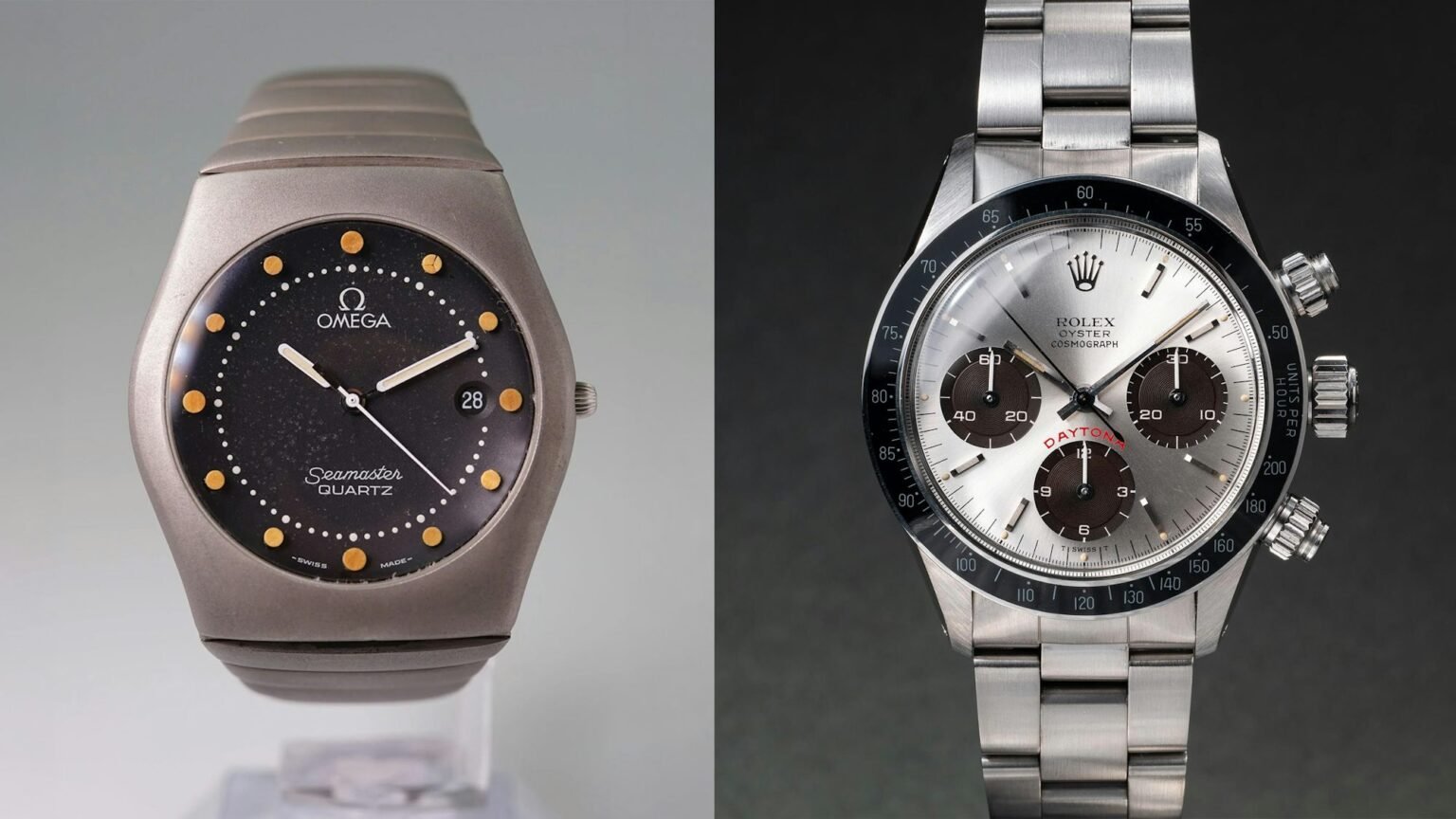
Take the names off the dial, and I’m not at all confident this Omega Seamaster Recife would merit much attention. Past the curious integrated bracelet, it’s a fairly basic, 35mm steel watch with a quartz movement. However, when you consider that it’s an Omega, and that it was one of their releases in one of their flagship models, things get a bit more interesting.
Released in 1984, the Recife rolls up with the same vibes as the ‘Teutonic’ Speedmaster (which Omega calls the ‘German Version’) and the Mariner III. Don’t for a moment think this watch was a one-off, either: there was also an (even rarer) Seamaster Recife with a rotating bezel.


Recifes weren’t made in huge numbers and therefore don’t come up all that often, so I’m covering this example despite the spotting on the dial. That said, the lume is glorious, the pictures show the watch seems to be running, and while the listing notes that there’s wear to both the bracelet and case, nothing looks too terrible.
I find my fondness for 1980s Omegas increasing by the week, and this watch is a good example of why. While it doesn’t offer the classic beauty you’d get from a 1960s Seamaster, there’s something incredibly sweetly desperate and dorky about this thing, evidence that Omega was really, seriously trying to find a way to make watches that’d catch the broader public. With an estimate of €200-500, this seems to have no bids as of now and will auction tomorrow, the 7th.
Daytona 6263, Tropical Subdials, 1981

Remember that scene in High Fidelity when Rob lists, among his all-time track-one-side-ones, Nirvana’s “Smells Like Teen Spirit” and Barry gives him grief for being too obvious? Manual-wind Daytonas feel like that, to me. Who wouldn’t pick one on any short list of great watches?
And yet this Daytona—available from Tropical Watch—has me in its snares. With all due respect, nothing inherent about the watch has neutralized my resistance. While the Valjoux 727 is nice enough, and Rolex certainly modified it, it’s not leagues better than the V72 in plenty of other chronographs. The case looks sensational, as does the (later) bracelet, but, again, it’s all just so much. We can go down the list and do this with each attribute of the watch, up to and including those beautifully lightly tropicalized subdials, the aged lume, and the impossibly crisp printing on the flawless dial.


The problem is, like any good watch, the Daytona’s way, way more than the sum of its parts, and all my attempts to dismiss this watch fail every time I zoom in on the pictures. It’s just perfect, somehow. I know. I’m too obvious. I have no rebuttal.
Available for $133,850, the thing is incredible, and were my financial position wildly different, I’d be eyeing this for one of my favorite humans, who was born in 1981. As is, I really hope whoever snags this adores it.