

Wherever you are in the world, whether you’re working off a tryptophan hangover and/or excess turducken calories, happy Friday, and congrats on making it through November. Prepare for the season accordingly; best of luck to all of us.
Scorekeeping last week’s picks: the Movado Calatrava and Universal Genève Polerouter remain available, the Seiko 6159-7001 sold for €2,200, and Loupe This’s Tudor 79090 went for $11,550.
Strays

If you’re flush and shopping for a holiday gift for someone who already has just about everything, consider a Patek Philippe Nautellipse and/or a Patek 5070J. Also, has anyone heard anything about this designer, Gérald Genta? Seems like he made some pretty nice stuff. This 18k IWC ‘Skinny’ Ingenieur is impossibly hot, as is this vintage black-dialed chronometer-grade Omega Seamaster, and this Rolex Explorer II Ref 16550 is as good a primer as any regarding cream rail dials, for those looking for lessons. We can probably all agree that the numerals on a watch’s dial shouldn’t matter quite as much as they do, but then there are simple watches like this Nicolet, with numerals that wouldn’t look out of place in Barcelona’s Gothic Quarter. Equally fantastic is this Melik Mido, and while the first-generation Deep Blue from Favre Leuba is superior, this colorful second-gen iteration on a signed NSA bracelet is pretty wonderful. If you liked that early IWC Aquatimer from a few weeks back, here’s a white-dialed version, and if white-dialed divers are your jam, I cannot recommend this Zenith diver from the 1990s enough, which, yes, looks quite a bit like the flagship diver made by another company Zenith was then providing movements for. I wish I knew enough about vintage Blancpain to feel comfortable recommending this Air Command; it certainly looks wonderful and correct, but I just don’t know enough, and given that they go for six-figure sums, I’m confused (and worried away) by the low estimate. Finally, I’ve done a miserable job highlighting Gallet chronographs, which is silly, given their excellence, and to ameliorate for that lack, here’s a pair of Multichrons—a white three-register one, and a black two-register version—both worth a further look.
Zenith Pacific

Most weeks I end up torn about including some watch here on BAL or keeping it unexposed so I could, in theory, bid on it. The delusion unfolds the same way every time. I find something very cool, and within maybe twenty seconds I’m convincing myself to cobble together some (often absurd) amount of money for a watch I often didn’t know existed minutes prior. Eventually, I write it up because I’m a professional and/or I already have too many watches.
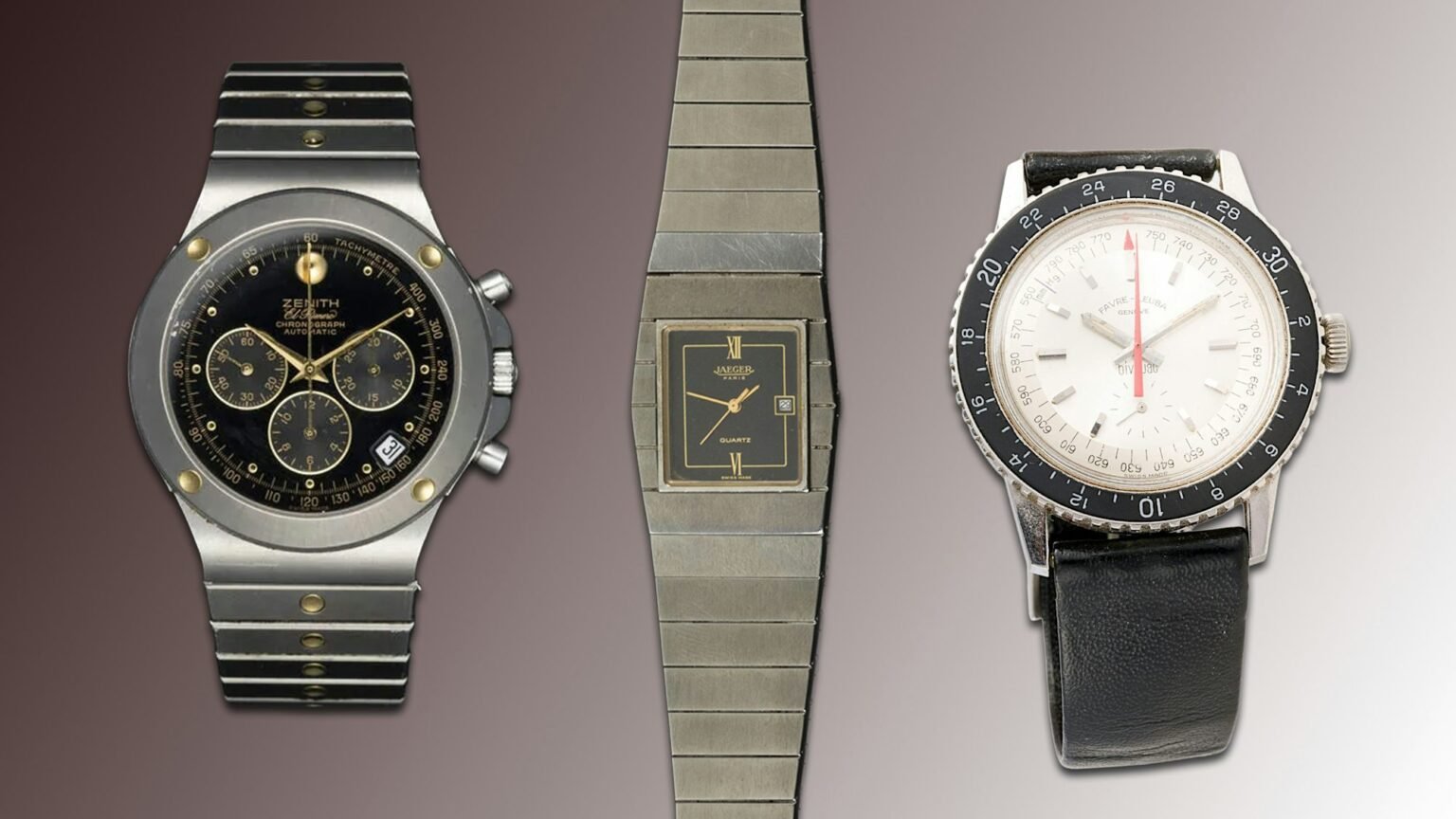
Although its future and mine will not (for now!) intersect, this Zenith Pacific is the watch I was most loath to include in this week’s BAL. The reference was made from 1989-91, which means this watch was introduced when the Berlin Wall stood and the USSR existed, and production ceased only after the former had been torn down and the latter dissolved (coincidence?). And to be clear, this watch was a Big Deal on its release: in 1991, its MSRP was 20% higher than the first-gen Zenith DeLuca, and it was the most expensive stainless-steel chronograph Zenith offered at the time. Also, for those interested, this model’s one of the first from Zenith to feature the curlicue filigree on the terminal ‘o’ in El Primero, if you’re into that sort of thing.
This watch’s paternity should be abundantly clear: it’s a chronograph take on Movado’s ‘Museum’ watch. If there’s much to quibble with in terms of design, it’s the watch’s emphasis on said paternity. The thing’s lousy with gold discs not only on the dial, but on the bezel and stuck into each link of the integrated bracelet. Enough already, Zenith.
If you can get over the overreliance on gold dots, however, there’s much to love here. The case is 40mm without crown, the crystal’s sapphire, and the dial, once you get past the gold, is pretty gorgeous, with ridged subdials, gold printing, and lume-free hands. Unsurprisingly, the watch is powered by Zenith’s cal 400 (the descendant of the 3019PHC), a high-beat automatic column-wheel chronograph that’s as good as they come.
The kicker on this specific example is that it’s new old stock, according to the listing, and comes with its original warranty (though not the box, seemingly). The pictures are fairly convincing—the thing looks immaculate. Auctioning next Tuesday, on the 1st, there’s no estimate, but the bidding starts at €2,200.
Favre Leuba Bivouac

Unless I’m mistaken, it’s been a decade since one of these was covered here, which feels like long enough to bring it up again. Let’s be clear from the jump, too, that even without the incredible complication, this Favre Leuba Bivouac is a banger with a clean 40mm stainless steel case, a good manual-wind movement, a pristine dial and hands, and a rotating bezel in excellent shape. There are two of these available on Chrono24, neither of which looks to be in as good condition as this one. Bivouacs don’t show up all that often, and they’re worth calling out when they do, because the complication is honestly staggering.
The Bivouac’s red hand is spring-loaded and moves based on air-pressure shifts detected by the aneroid barometer (aneroid means no liquid). At the edge of the dial, you can see an mmHg (millimeter of mercury) scale, which is the metric barometric scale (if you grew up in the States with a barometer on the wall, you’re likely used to inHg, or inches of mercury). Ignore the details for now; for our purposes, you only need to know that the red hand moving to the right denotes falling pressure, while the red hand moving to the left (at least to just shy of the 10 o’clock marker) denotes rising pressure. For those whose adventures take them no further than, say, batting cages or a bike ride in the (flat) Midwest, this watch’s barometric feature likely offers little more than a general weather forecast. When the air pressure drops, things are getting worse (more turbulence/storms). When the air pressure rises, it’s getting better (clearer/calmer).
But then there’s also the external rotating bezel, which allows this watch to serve not merely as a barometer but as an altimeter. The key fact to bear in mind is that the numbers on the rotating bezel are measuring meters (times 100). What this means is that if you were about to commence some vertical climb, you could rotate the bezel so that the red pressure hand was pointed to the 30, and you could then, as you climbed, track the altitude change by reading where the red hand pointed on the bezel, given air pressure decreases as you climb. Not only that but, while climbing, if the red hand started moving more than you were climbing, you’d have a heads-up about inclement weather moving in.
It feels a little silly to go on and on about these complications, simply because the likelihood of this (or any) Bivouac being used as intended is awfully remote, but it is just so cool. With no estimate and an opening price of €1,000, it will auction next Thursday, on the 3rd of December.
Jaeger ‘Midas’

Unfortunately, I can offer little more about the condition of this Jaeger “Midas” beyond the pictures. Does it run? No idea. What wrist size will the integrated bracelet accommodate? Also no idea. In the third picture in the listing, did the auction house really just set the bare watch’s dial/hands on some surface to photograph the movement? Sure looks like it.
What I can offer is some confidence that this is a Jaeger ref 114.100.54, an early-80s thin quartz model that got its nickname from a Rolex model from around the same time period. Like all but the most esoteric watches, this Jaeger hasn’t gone unnoticed—here’s a write-up, which notes that “some sources” estimate only 200 of these were made.

Notably, this watch was also made with Cyma and Bucherer badging, but past that, there’s really not much to say. This thing is 100% the beneficiary of the Rolex King Midas having picked up quite a bit of steam and attention over the last decade, and it’s easy to imagine an alternate universe in which this thin quartz watch from the early 80s is totally forgettable, banal as shredded wheat.


Which is very much me saying: this watch stopped me because of its familiarity, though I couldn’t tell you how much my ongoing interest is authentic and intrinsic versus mere curiosity at a curio. It is, absolutely, a great-looking watch, and from the bad pictures, the dial and hands look great, as does the 27mm case and bracelet. The good news is that, even if the (likely ETA) movement is trashed, a drop-in replacement is neither too hard nor dear to source. The €50-100 estimate is pure comedy—a Cyma example sold at auction in 2024 for 240 GBP—but it’ll be interesting to see where things end up when it auctions on the 2nd.
LIP Stop

It seems safe to say none of us is hankering to revisit too much about April 2020, but perhaps one way you distracted yourself from the generally crummy everything right then was this article by Mr Stacey. For those disinclined to click through, it’s a Just Because piece on his gold-plated Buren MinStop, and is, unsurprisingly, an excellent read.
As the article makes clear, Buren wasn’t alone in using the Durowe movement—Hamilton, Vulcain, Vantage, and gobs of smaller and more forgotten brands made similar models. And, of course, there’s the French brand LIP, which made this delightful example.

Let’s pause and acknowledge the excellence of a watch with a model name “Stop,” given stopping’s literally the antithesis of going, which presumably you want your watch doing (though I’m all for antithetical watch names, and if any brand wants to release a diver called “Leaky” or “Ingress,” I’ll be first on the list). Without the parking-meter complication, the watch is ho-hum: chrome-plated, 35mm, manual-wound, with a cracked crystal and lugs that could, at best, be described as “there.” The hour markers are staid, and there’s only the merest bit of lume at the ends of the hands.
But then there’s the huge rotating black timing disc, which tracks elapsed minutes and, in fact, runs whenever the watch is running. The way it works is that depressing the pusher at 2 resets the black disc to zero, letting you time anything less than an hour. I remain steadfast in my belief that most of us, most of the time, use our watches as my kids use fidget spinners. In my own case, the ratio governing the times I’ve engaged a chronograph for fun vs utility is something like 10,000:1, ditto rotating bezels.

However, don’t let (lack of) utility keep you from this watch. It is, in the best way, an interesting and clever watch that, in its way, attempted to solve a then-contemporary problem. If you’ve ever found yourself excited about 3/6/9 minute hash marks on a chronograph’s minute totalizer, which marks supposedly existed to remind the wearer about the cost of long-distance calls, this watch is for you. With an estimate of €200-300, this auctions next Thursday, December 3rd.