

Happy Friday, everyone, and I hope you’re all staying busy during summer’s dog days, perhaps seeing The Odyssey or reading about Milsubs (please note I’m including that not because I have any dog in that fight, just found it interesting). Scorekeeping last week’s picks: the Hermès Caleche sold, the Angelus chronograph passed, the Rolex GMT Master II SARU remains available, as does the Bulova White Princ. The Goldberger collection auctions tomorrow.
Strays

Photo courtesy Weiss Auctions.
If you’re into impossible projects, here’s a decent-looking Heuer 3647T that’s missing its outer seconds track. If you know your Carreras, you know that track’s actually a tension ring, and you likely also know it’s gonna be quite a search indeed to find another, but here at BAL, we scoff at impossible projects. If you’d prefer to chase your own vintage Tudor Ranger rather than buy one of the ones highlighted two weeks back, have at it. For the completist who’d like every last horological oddity, I present this Pigeon Timer. I’m including this Movado M90 not because it’s without flaw, but because it’s already been bid up to $3750 at the time of writing, which seems high for what’s likely mostly a parts watch (that dial can’t be original, right?). Please, experts, weigh in in the comments.
Finally, here’s a wonderful Omega Ranchero. A few weeks back I highlighted an Omega Railmaster (there’s another of those up this week, too). I’m highlighting each of them simply because they’re so often in brutal condition that they deserve mention when they pop up (even when, in the case of the Railmaster, they come on a Rolex bracelet), onto the show.
Universal Genève Unisonic-Sub
An early box I’d argue is important to check on one’s Watch Collecting Journey (everything is a journey now) is the Huge Vintage Diver. I’m not talking about my beloved skin divers, nor the standard Seamaster/Sub fare, but the Real Huge Guys. You know what I mean: the 1000M and 2000M rated Jenny monsters, the Zodiac Super Sea Wolfs, the Aquadives which tell the time and your depth. Please understand that I’m not arguing that, once you’ve tried such models, you must stay in that lane: such watches demand serious commitment (if only because they’re so big you’re gonna bang ’em into everything unless you make a concerted effort not to). But I’d argue you do owe it to yourself to find out just how big a Watch Person you are.

Photo courtesy Plus Ultra.

Photo courtesy Plus Ultra.

Photo courtesy Plus Ultra.
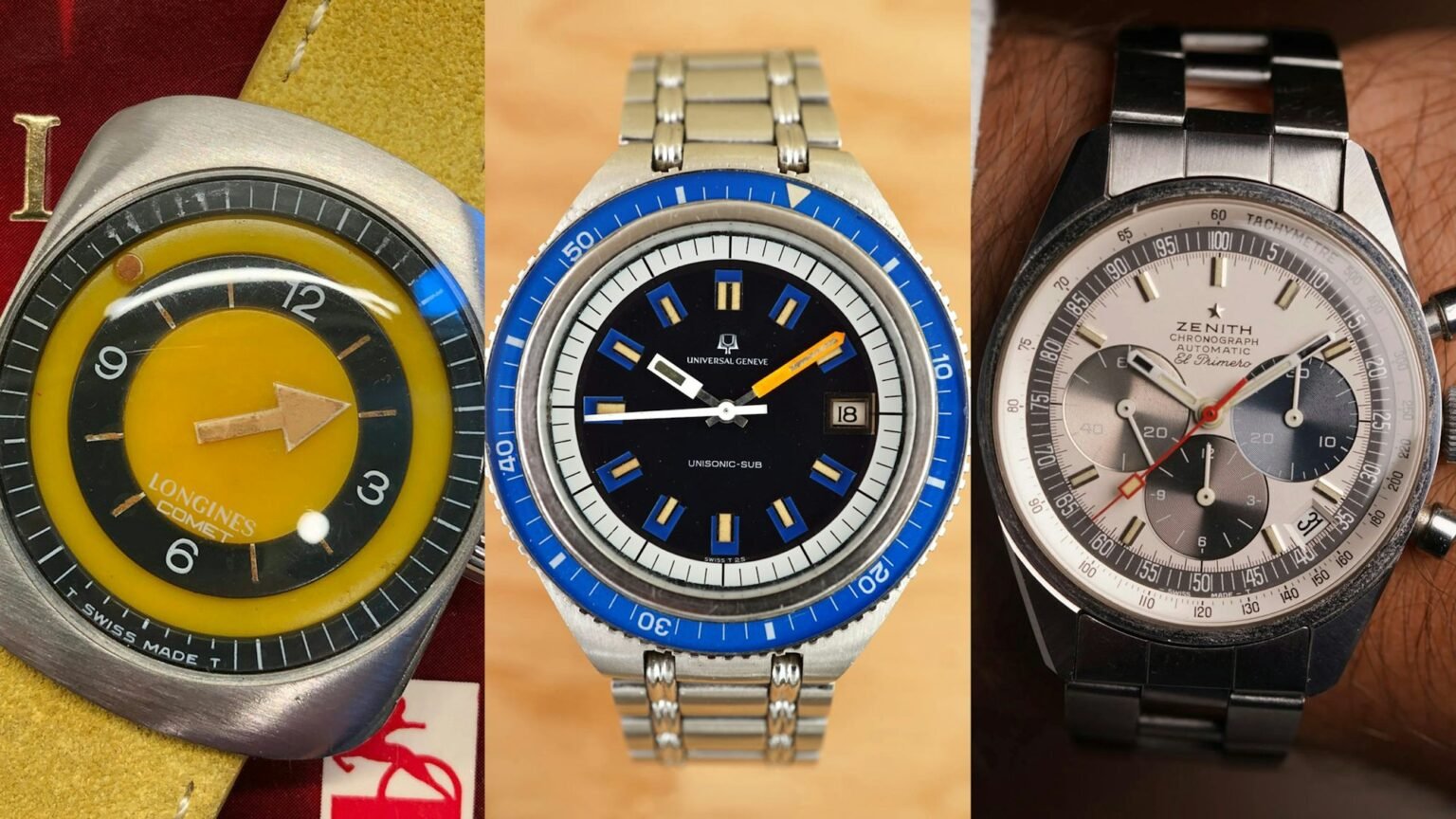
For instance, consider this full-set Universal Gèneve Unisonic-Sub. It is a lot of watch at 43mm, and yes, it’s powered by a tuning-fork quartz like you’d find in old Accutrons, meaning it’ll plow through batteries at best and, at worst, require befriending a watchmaker capable of working on such movements. But if you can get past that, this thing looks like a joyful beast.
You’ve got the bright blue of the bezel, the blaze-orange hands (with, yes, darkened lume) which pop excellently against the black dial, that huge tetradecagonal ring over the bezel, and a Gay Frères bracelet. Also, again: box and papers. True, it’s tonneau-shaped, which may take some getting used to, but the payoff’s presumably equally immense. To the degree that most watches offer some measure of cosplay, there’s something really pleasurable about strapping on a watch that, at least in my own case, can handle more than I can. The good folks at Plus Ultra have this watch available for CHF 3,800. Consider the gauntlet thrown down.
Longines Comet
Here’s a watch overwhelmingly deserving of some love and attention. You’re looking at a Longines Comet, which is a recognizably late-60s/70s take on the classic “mystery dial” you’ve probably seen dozens of examples of. These watches aren’t really mysterious at all; they’re simply attempting to transmit the current time in very slightly different ways. In the classic mystery dials from the 50s, there were transparent rotating discs with single dots or markers to indicate the hour and minute.

Photo courtesy #WatchCo.

Photo courtesy #WatchCo.

Photo courtesy #WatchCo.
This Longines Comet, on the other hand, uses a big arrow at the center to point to the hour, and a small lumed dot on the outer track to show the minutes. Even with that data, however, the first hundred or so times you consult your watch are likely to mystify you a bit; it takes real and intentional work to train yourself to read time in a way that’s only very slightly different from how you were (if you’re like me) taught in school to read it.

I’ll gladly note the Comet is mostly vibes. The manual Longines Cal 702 powering it is fine but nothing exemplary. The case either charms you or doesn’t with its curved rectangularity (though the example on offer looks to be in great shape). The star of the show, of course, is the bright dial, and please note that Comets came in red and a greenish-blue as well. No, I cannot find solid numbers or data on whether there’s any increase in rarity for each color. All I can say is that this yellow one seems like it’d be a watch that, if not inure you from crummy moods, at least act as a bright distraction. Hashtag Watch Co. is offering this full-set Longines for $2,450, which is maybe a tad high, but I can’t find another one with box and papers on offer, either.
Omega Seamaster ref. 2576 with Breguet Numerals
The great folks at Jones Horan strike again, this time with a drool-worthy Omega 2576 with Breguet numerals. The 2576 was introduced in 1949, meaning this example, with a 12M serial, is only a year into the model’s existence, which fact merits mention simply because of how incredible it looks.

Photo courtesy Jones and Horan.
The lume is radium, hence there being no T marking at the bottom. Typically you’d expect some burn on the dial if the hands had sat motionless for years, so presumably this watch’s been worn regularly enough to prevent that (or the hands have been relumed, though the write-up doesn’t note that, and Jones Horan’s pretty scrupulous about noting things like that). The dial itself, with the applied Breguet numerals, is just gorgeous. Yes, if you want to be a psycho (raises hand), this is the earlier-style Seamaster script, and, yes, some of us (raises hand again) believe the coat hanger S that was introduced a bit later in the 1950s is far superior, but oh well. Sometimes you cannot (despite Yo La Tengo’s promises) have it all.

Photo courtesy Jones and Horan.
This watch is really as nice an example as you could hope to find. You can see the Omega symbol at the center of the crystal, the screw-down caseback lacks any serious dings, and while the listing says the case has been lightly polished, I’d at least pause with that detail. If you’re looking for a reason to skip this, that’d be the reason. However, it’s worth acknowledging that 2576s—typically with their Beefy Lug construction—did, in early iterations, have skinnier lugs, and from the pictures, the case looks generally fine (it’s certainly not shiny, which is the worst fate a vintage Seamaster can suffer). All of which is to say that, sure, perhaps the case has been a bit polished, but what I see in the listing wouldn’t prevent me from being interested. This goes up for auction on the 30th, with a $400-700 estimate. If it stays in that range, it’d be foolish not to pursue this watch.
Porsche Design Chronograph 1
Here’s a fun outlier. You’re certainly familiar with the Porsche Design Chronograph 1: it’s a celebrated model that’s been reissued, offered as a limited edition, featured in classic movies, etc. They’re also so easily recognizable—PVD-coated with the classic 7750 layout—you can ID them at a glance. Which is what makes this particular version, on auction through Goodwill, such fun. The hint that it’s not quite the standard fare is that the subdial at 12 measures 24 hours, and, from there, your eye might drift to the white lollipop hand in the center stack. That white hand, Baller, is a minute counter, meaning this is one of the later, post-1975 models, powered by the Lemania 5100.

No, this example’s not perfect, and there’s wear on the case and bracelet, which has caused some of the PVD coating to come off. And yes, the crystal should be replaced. But if you can get past those facts, you have the chance to own a legendary watch that’s still relevant with a design that’s as contemporary as they come. I could be doing my math wrong, but I’m fairly sure this auction ends around 9pm next Tuesday, and the watch has been bid up to a nice $333.33 as of this writing.
Zenith El Primero A386
I’ve tried to include watches from Mr. Wind in the past, and lord only knows if this’ll stick around till Friday when this posts, too, but it’s too good an example to pass up.

Photo courtesy Wind Vintage.
This is, of course, the (very objectively stated) Most Beautiful Chronograph Ever Made, the Zenith El Primero A386. Zenith’s El Primero is a sort of choose-your-own-adventure watch in terms of what you want to get most excited about. Do you want to own and wear a watch featuring a movement that not only came perilously close to extinction, but which helped Rolex move from manual-wind chronographs to automatics? Do you want a watch with one of the first automatic chronograph movements developed, and the only Swiss one to use an integrated movement (i.e., not relying on a module)? Do you want a high-beat chronograph? Any of those are solid reasons to hanker after a Zenith El P.
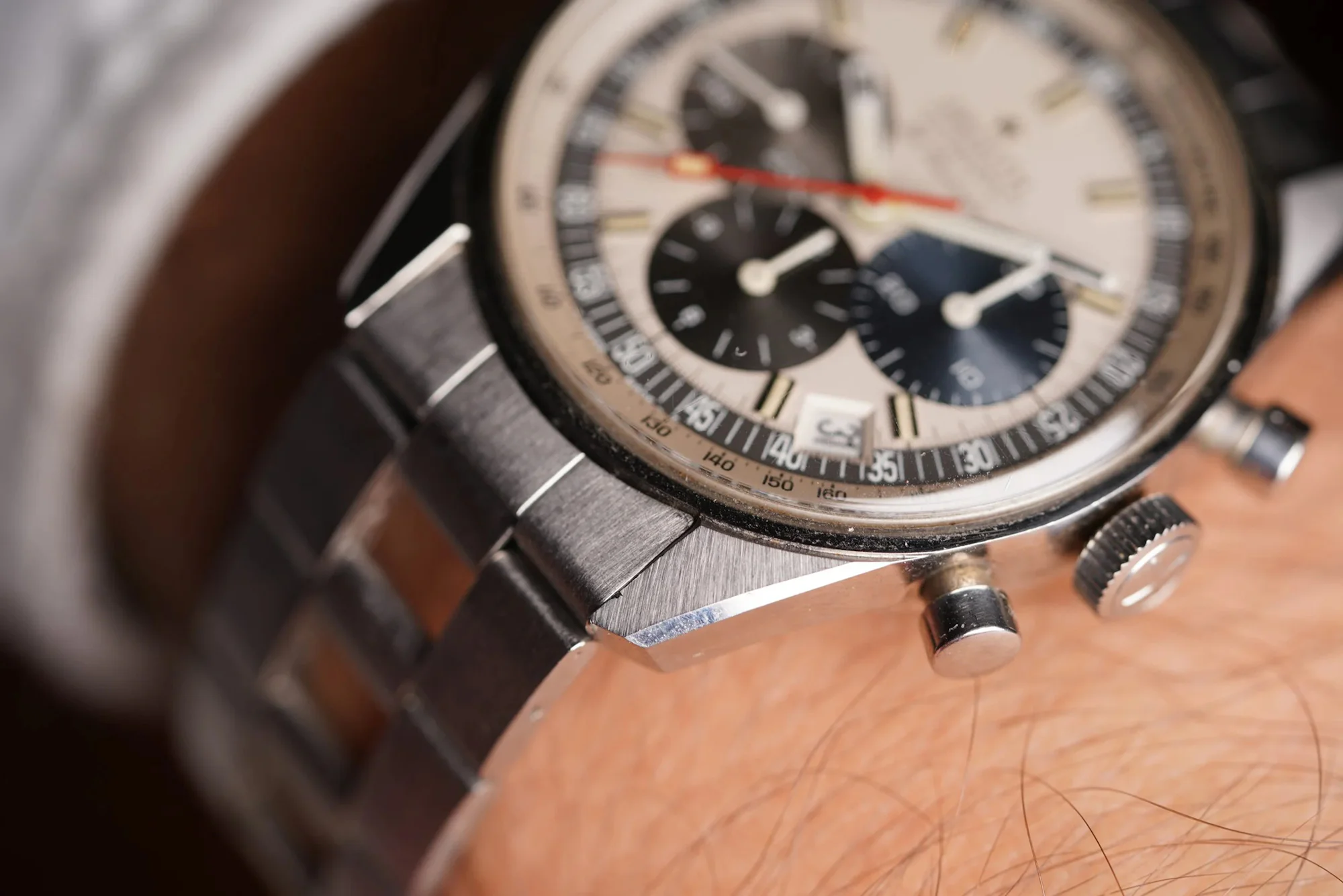
Photo courtesy Wind Vintage.

Photo courtesy Wind Vintage.

Photo courtesy Wind Vintage.
In this particular example, you’re getting what looks to be a time-capsule A386. Look at those bevels, look at the brushing, sigh at the flawlessness of that dial. And of course there’s the original Gay Frères ladder bracelet. Mr. Wind is offering this watch for $29,000, which is somehow both a lot and not all that much, given that the watch looks like it’s seen precious little roughness over its last almost 60 years. And if you’re not quite ready for such a splashy plunge, perhaps this A3817 in need of quite a bit of help (crystal, pushers, crown) could be of interest.