

Congrats on conquering another week, even if this one felt particularly expensive with the loss of Sonny Rollins. I know jazz is probably supremely uncool, but man oh man, if you’ve not had any experience listening to old Sonny stuff, pull up his classic The Bridge and dive on in (and, yes, his time out, alone, practicing sax on the Williamsburg Bridge, lent the album its title).
But you’re not here for that sort of cultural enrichment. Let’s get to the real stuff. Scorekeeping earlier picks, the Hamilton RAF from two weeks back sold for €1,600, which is a cheering result. Last week’s Omega Marine Chronometer went for CHF 2,000, the Marvin “Ocean Chief” sold for $1,000, the Zenith 2000 for £3000 hammer (£3720 including fees), and Rare Bird’s Jaeger-LeCoultre Étrier sold as well.
Strays

Photo courtesy GALERIE DES VENTES D’ORLEANS.

Photo courtesy Craft + Tailored.

Photo courtesy Bonhams.
Here’s a beautiful Zenith Respirator on its original Zenith-signed NSA bracelet for all you square-cased Ballers to start things off. The Dennison ALD Dual Time seemed to scratch an unsuspected itch for a lot of folks, and certainly there are excellent vintage examples of double-dialed watches, but if you happen to find yourself hooked on the idea that more=better regarding dials, boy oh boy is this 18k gold Chopard with its four separate dials for you (with, yes, four separate manual-wind movements, for the fidgeters among us). Girard Perregaux alarms look fantastic for eschewing the typical fourth hand for setting the alarm, and this example seems to be in excellent condition. Bonham’s Hong Kong auction this week has quite a few delectable options, chief among them a Skipperera and this Audemars Piguet 25720BA Star Wheel. Finally, there’s absolutely nothing not to love about this understated white-gold Vacheron 7390, a watch that looks both like nothing special and like something someone could wear every single day and probably never get tired of.
Universal Genève Polerouter Super
The Universal Genève Polerouter needs no introduction or hype here—you’ve read about the vintage versions (and perhaps have downloaded the app), and you’ve certainly read about the recent relaunch of the brand, which, of course, included new Polerouters. Obviously, there are not only many specific Polerouter references, but there are whole other subcategories, as well—specifically the Polerouter Sub (first in a super-compressor case, then a symmetric case with bezel, then the asymmetric case with bezel). The point is, a Polerouter is more than just lyre lugs and dauphine (or, if you’re really lucky, broad arrow) hands.

Photo courtesy OXIO.
While the Polerouter III presumably has fans, allow me to draw your attention to this two-tone Polerouter Super. If you’ve not seen these before, you might think it looks like a loutish, gym-bro cousin of the original Polerouter. Sure, it’s still powered by the UG microrotor cal 69 movement, and it retains the trapezoidal date window (and if you’re really far gone, you can note that UG, like Rolex, had open-9s on their date wheels). But that’s really it in terms of familial similarity, and in place of the elegant, curvy grace of the originals, the Super sports a tougher silhouette with straight brushed lugs that all but declare it a sport watch.
Interestingly, the biggest change between standard Polerouters and Supers isn’t even visible: introduced in 1965, the Super line followed the Sub and apparently had a depth rating of 300m (a fact that feels like it would’ve been prudent to advertise somewhere on the watch itself). The details of what makes this model so protected from water ingress involve old patents and a man named John Simon (about whom you can read more here).

Photo courtesy OXIO.
This particular example has almost certainly had its crown replaced—the original correct one is huge and would’ve been gold—and the dial isn’t perfect, but Supers also come up irregularly enough that they’re worth calling out when they do appear. The case looks to be in fairly good shape, with evident brushing on the lugs, and unfortunately, despite asking for pictures of the movement and caseback, I never heard back from the auction house. I can’t guess what this goes for—bid up to €160 at the time of writing; it’ll go up on the 30th of May—but the last all-steel one I saw, which auctioned a few months ago, went for over $2,000.
Movado Artist Edition, The Bill Time

Photo courtesy Rapp Auktionshaus.
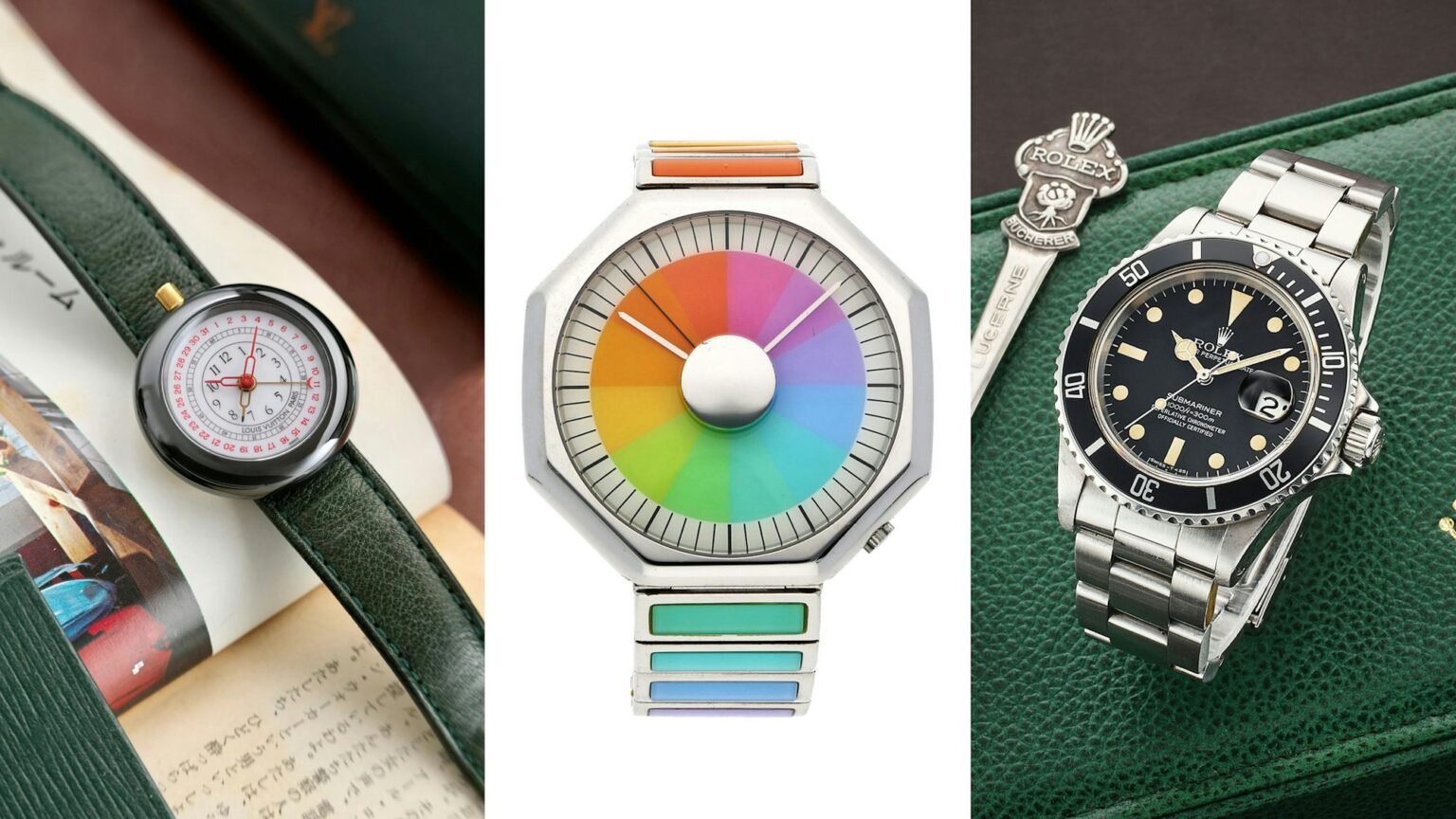
This watch—a Movado “Bill Time” designed by the artist Max Bill—feels right on the edge of being too much. Too loud, too colorful, too weird-looking. But then the thing about a watch being too anything is so tricky and loaded that it’s hard to even know how to talk about it. Like, isn’t a Rolex 116506 with a full pave dial also a bit much? Note “too much” isn’t inherently a criticism—plenty of folks like Gwar, after all—but how does one even adjudicate? Or is there simply no way to address any of this objectively, and everything ultimately devolves into Justice Potter’s I-know-it-when-I-see-it?

Photo courtesy Rapp Auktionshaus.
Max Bill, of course, had designed watches before this 1993 collab with Movado; his first designs were for Junghans in the 1960s. His past work makes this Movado all the more compelling, as you’d be hard-pressed to come up with something less kin to an industrially pure Junghans than this wild explosion of color. However, with a bit more digging, you’ll discover Bill also collaborated with Omega in 1987, and that strangely bifurcated watch—almost mullet-like, with business in the front, party in the back—certainly gives hints at what he’d do with Movado.

Photo courtesy Rapp Auktionshaus.
Made in 1993 in an edition of 99, with a 44mm sterling silver octagonal case and matching bracelet, this watch is A Whole Lot (as in: those color bars in the bracelet are all enamel). The thing’s so excessive and loud and specific it almost feels like a Hendrix song, something that’s better to experience than attempt to describe. Still, it’s not like it’s messy or unclear: the dial’s got twelve colors to align with the hour markers, and I presume we can all tell at a glance which hands are transmitting which data, regardless of the big silver blob at the center.
The question then is who this watch is for. I couldn’t begin to guess, but I’d love to know who looks at this watch and immediately thinks, “Hell yes.” Do you jam on incredibly colorful watches, of which fewer than 100 were made to begin with? Do you go rhapsodic over full-set specialty watches so esoteric they don’t come to market often? Christie’s auctioned one in 2005 that went for over $5,000, and Antiquorum sold one in 2015 for CHF 12,500. This is all to say: we’ll all find out together when this watch, currently bidless and coming as a complete set with papers and case, auctions on June 4th.
Rolex Submariner Reference 16800

Photo courtesy Bonhams.
Writing about a Rolex Submariner anywhere, much less at Hodinkee, feels a bit like trying to write about Bob Dylan, or the Yankees, or Levi 501s. What more needs to be said about such a legend? Which is a bit of a drag, because when something becomes so culturally ingrained, it’s oddly even harder to see and talk about. I can think of few watches written about, lusted after, and analyzed more than Rolex Submariners, and so it is with more than a little trepidation that I offer this Reference 16800 for your consideration this week.

Photo courtesy Bonhams.
A transitional reference, the Rolex 16800 is, for my money, the best vintage Rolex around. Introduced in the late 1970s as the successor to the 1680, the 16800 looked remarkably similar, and while the differences between the models were somewhat subtle, they also felt definitional. Specifically, the 16800 introduced a sapphire crystal, Rolex’s first quickset date movement (cal 3035), a new water resistance rating up to 300 meters/1,000 feet, and a unidirectional click bezel. You’ll note that, aside from new materials (ceramic bezel, 904L steel instead of the 316L of the 16800), a different case shape, and improved movements, the current Submariner Date, Reference 126610LN, sticks to the same template established by the 16800: water resistant to 300M, 120 click bezel, sapphire crystal.
Coming with its original box and Bucherer-signed Rolex spoon, this watch will be auctioned on the 31st. It is, yes, Just Another Rolex Sub, but the 16800 sure seems like one of the best options out there.
Rotary Compressor Diver
Best known for their Aquaplunge (and the various other iterations of that model from other companies), Rotary is a bit like Movado in that, while it didn’t go under during the quartz crisis, it certainly spent a long time in the dreaded Mall Watch hell.

Photo courtesy Ashley Waller Auctioneers.
If you’re in the mood for it, this week sees this Rotary super-compressor up for auction, though I can’t be sure it’s an actual ESPA-cased super-compressor, given it lacks the telltale cross-hatched crowns. However! This watch has a starting price of £350, currently has no bids for an auction that starts on the 30th, and it allows us a chance to attempt a minor resurrection of watches I’ve seen billed as bin watches in the past, i.e., watches that seem less designed and more assembled from whatever’s available.
This Rotary, for instance, obviously looks quite familiar. The auction doesn’t list this watch’s size, but a safe bet is that it’s 36mm, like most super compressors of that era. And that hour hand: you’ve seen that before, right? It’s all but identical to the hour hand on an Aquastar 1701. The second hand, interestingly, is also almost identical to a Tradition compressor from the same time period (Tradition was the brand name Sears used for their in-house watches). The rest of the dial (aside from the badge) looks like so many other super-compressors of the time.
Generally, we praise watches that look like themselves, that are distinct, design-focused, thoughtful, and that’s great, but the pull of a watch like this is that it’s entirely common, almost anonymous in its way. This, I’d argue, is worth, if not celebrating, at least enjoying: there’s something almost relieving about watches that feel casual, almost slapped together, made with whatever’s on hand. It takes the pressure off, makes the whole thing feel less fussy.
Regardless, this thing looks just fine, and while it’s nothing special, it’s nonetheless a seemingly cool example of a mid-century model. And if the Rotary doesn’t do it for you? How about this Mulco Escafandre with a silver dial instead?
Louis Vuitton Monterrey II “LV2”
A series of essays I’d like to read would be a full accounting, from watch people, about the models they initially didn’t like or respond to. I don’t mean the watches that elicited a bored meh; I’m talking about the stuff that led to a sort of immediate internal recoil.

Photo courtesy Goldfingers Vintage.
I first came across the Louis Vuitton Monterey II “LV2” on Instagram, maybe six years ago, and the watch immediately led me to turn off my phone and head elsewhere. Just gross, the whole thing: crown on the top, faultlessly smooth pebble case, that weirdo dial, and those big, dumb hands (the best way to dislike something is blindly, foolishly). And then, like so many other things I disliked from the jump, I’d return to it, trying to piece together what I didn’t like about it.

The simple truth was that I disliked the watch because it simply looked so different. While the watch isn’t loud (like the Movado above), it’s not trying to look like a recognizable watch. It is totally and completely itself. We are, of course, all allowed our own personal tastes, but it’s the height of churlishness to dislike anything just because it looks so distinct.

However anyone feels about the LV Monterey hardly matters at this point: as Ms. Crawford noted in her coverage of the revival of the Monterey, the OG—both I (with world time, moonphase, date, and alarm) and II (alarm and date only)—has so ascended to a place in culture that it’s unignorable, being worn on big-name wrists and leading to the model itself being relaunched (this time with everything done in house, instead of relying on IWC quartz movements and help with ceramic cases). This particular example appears to be in extraordinary shape, with only modest signs of wear, comes with the box and papers, and is available for $12,995 from Goldfingers Vintage. While that price seems extravagant, it’s worth noting that Loupe This sold one in August of last year for $13,000.