

June’s upon us, everyone, and while technically it’s still spring, let’s all agree to go ahead and round up to summer right now. You’re salivating for beach time, or checking the market for pointers about what to do regarding the SpaceX IPO, or you couldn’t care about either, and your full attention is on what seems likely to be a wildly excellent NBA finals. Regardless of where your attention’s generally pointed, let’s look at some watches together before you’re whisked off to full weekend mode.
Scorekeeping last week’s picks, the Universal Geneve Super went for a mere €550, the Movado for CHF 2,600, the Rotary Compressor for £350, while the Rolex Submariner Ref 16800 somehow sold for only $60,000 HKD ($7,655). The Louis Vuitton Monterey II also sold.
Strays

Photo courtesy FauveParis.
No-name skin divers will always get under my skin, and this week there’s this sweet-looking Allaine. Or are you after an overwhelmingly 1980s quartz perpetual calendar from Corum? As you wish. How about an extraordinarily clean manual-wind Seamaster dress watch? Get it. Someone, please bid on this and *also* pay once you’ve won: this Autavia has popped up thrice over the last two months, and certainly one of you has a soft spot for modular chronograph movements that’ll lead your favorite watchmaker to curse you, right? A Heuer triple calendar in 14k gold, perhaps? Ta da. A fantastic Jaeger-LeCoultre? Have at it. Finally, I don’t know if this Omega Speedmaster 145.022 is actually NOS, but it sure looks like it comes close.
Platinum Cartier Pocket Watch with European Watch and Clock Co. Movement
Let’s start with the movement on this Cartier platinum pocket watch. It looks nice, but E.W. and C Co. Inc. badging doesn’t automatically make a ton of sense. So maybe you google “Cartier platinum pocket watch” and get here, which helps to make clear that the movement’s by the European Watch and Clock Company, which leads to a fresh search, which leads you here, where you discover, right from the jump, “The European Watch and Clock Co began in the 1920s as a joint venture between Cartier and Edmund Jaeger, of the Jaeger-LeCoultre firm, leaders in innovative watch movement manufacturing. Although Cartier continued to work with other movement manufacturers, many of their top-line items featured EWC movements, created within the Jaeger-LeCoultre factory in Le Sentier, Switzerland.”

Photo courtesy Hotel des Ventes Giraudeau.
No, I’m not including this (or any) pocket watch to impress Mark or to try to prove my bona fides or join his crusade (tho I do, very much, like pocket watches, and if there’s any fairness in the universe, I’ll feature nothing but mid-century marine chronometers in their gimbaled wood boxes in some future BAL). I’m including this watch because it’s a glorious example of excellent horology from a century ago and is the sort of thing every serious watch person cares about.

Photo courtesy Hotel des Ventes Giraudeau.
The dial’s not perfect—there are minor marks from wear—but it’s in awfully excellent shape for being 100 years old. Plus everything’s correct, ie the hands and dial are clearly original to the watch, and the case looks to be in great shape. This watch feels like a fascinating throwback to a time when objects were not only luxurious but also rare and—it’s a dirty word now, but shouldn’t be—privileged.
I am sure this makes me a bad person, but I believe both a) that we should all work to make the world more fair and equitable, and b) if, in that more equitable and fair world, you do happen to, through talent/drive/initiative/whatever, have access to extraordinary goods, they should be like this Cartier pocket watch. This Cartier is like the antithesis of a hype watch, and I’d argue its lasting appeal has to do with the fact that it’s lovely and refined and excellent simply because such pursuits are worthy in and of themselves. With no bids at the time of writing, this beauty goes up for auction on the 10th of June.
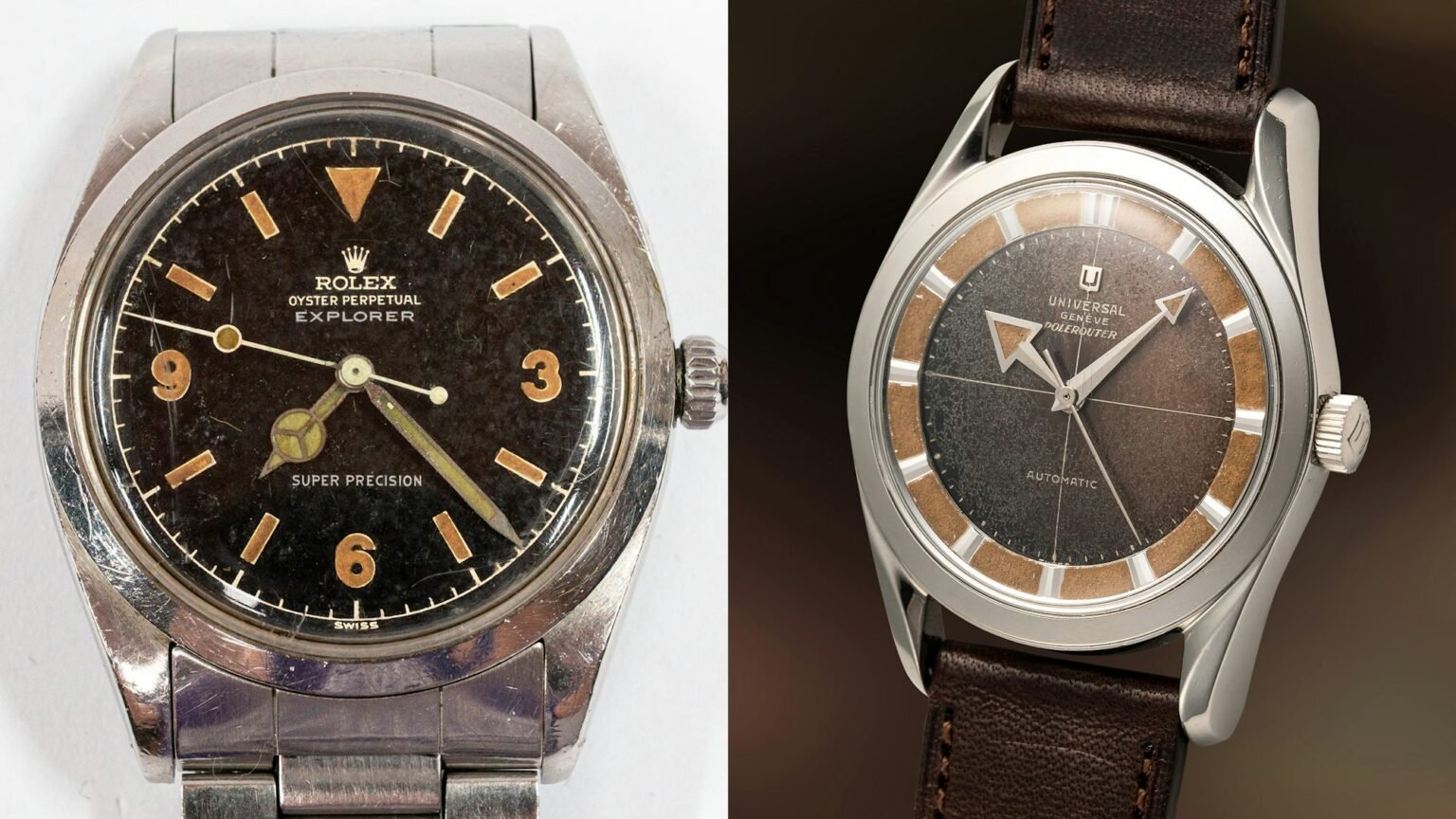
Gilt Chapter Ring Rolex Explorer 5504
My hesitation in including any Rolex watches stems entirely from the fact that they’re so frequently messed with, so let’s get it out of the way, from the jump, that this Explorer sure seems likely to have had its hour and minute hands either replaced or relumed at some point, which may be reason enough not to consider this for most Serious Collectors. However, nothing else about the watch sets off any has-been-messed-with alarms: the watch is pleasingly scuffed, and the lot is part of an auction out of Wiltshire in which watches are decidedly not the primary focus.

Photo courtesy Henry Aldridge & Son Limited.
Meaning you have a chance at a gilt-dial Rolex that’d usually sell for well into the five figures. With a model as legendary as the Explorer, there’s little I could note that most of you aren’t already familiar with, but, as a refresher, the 5504 is the non-chronometer-rated little sibling of the 6610 first-generation Explorer. Worth noting, however, is that while the 6610 used the much older cal 1030, the 5504 Explorers used the then-new cal 1530 movements, and, like them or not, there are few more significant calibers from the 20th century than the Rolex 15XX lines.

Photo courtesy Henry Aldridge & Son Limited.
Enough history lessons: either the watch strikes you as beautiful, or it does not. Again, the case has plenty of wear but doesn’t, to these eyes, seem to have been polished (simply because, if it’d been polished, it’d look less worn, no?). Yes, the lume on the dial has retracted on the hour plots and numerals, but that’s a common trait on this model. The Super Precision designation on the dial was Rolex’s way of noting the watch featured the new 1530, and while the bracelet model isn’t listed, the 258 end links look authentic. The fact that this comes with a box and papers is just a bonus. This 68-year-old beauty goes up for auction on the 6th and has no bids as of this writing.
Choose Your Own Imperfect Adventure: Gruen Techni Quadron or Tudor Ranger II
From Eppli Auktionhaus, you have your choice of two watches, which are each a) uncommon and b) not without aesthetic issues. First is this Gruen Techni-Quadron, which you have a few different options for appreciating. There is, most simply, the fact that it’s lovely, and yes, the dial looks its 100 years of existence, but it’s still original and classic and lovely. Another option for appreciating the thing is to recognize the Techni-Quadron as the state-side sibling of the Rolex Prince (about which you can read more here). Neither method of appreciating the watch is better or worse.

Photo courtesy of Eppli Auktionshaus.
Second is this Tudor Ranger II, a watch which I have just hopelessly loved for more than a decade now. We’re all familiar with the Ranger, but the Ranger II obviously never got the love and attention of the first one, and for plenty of good reasons: it’s bulkier and less elegant, the Pete Rose to the Lou Gehrig of the original (stretching the metaphor, but you get it). The Ranger II’s legacy lived on briefly when Tudor introduced the North Flag, which also had an integrated bracelet, a huge arrow hour hand, and similar numerals at 6 and 12. While the watch still exudes its thick-house glory, the dial’s got quite a mark on it near the 9 marker, where the black finish seems to have fallen off.
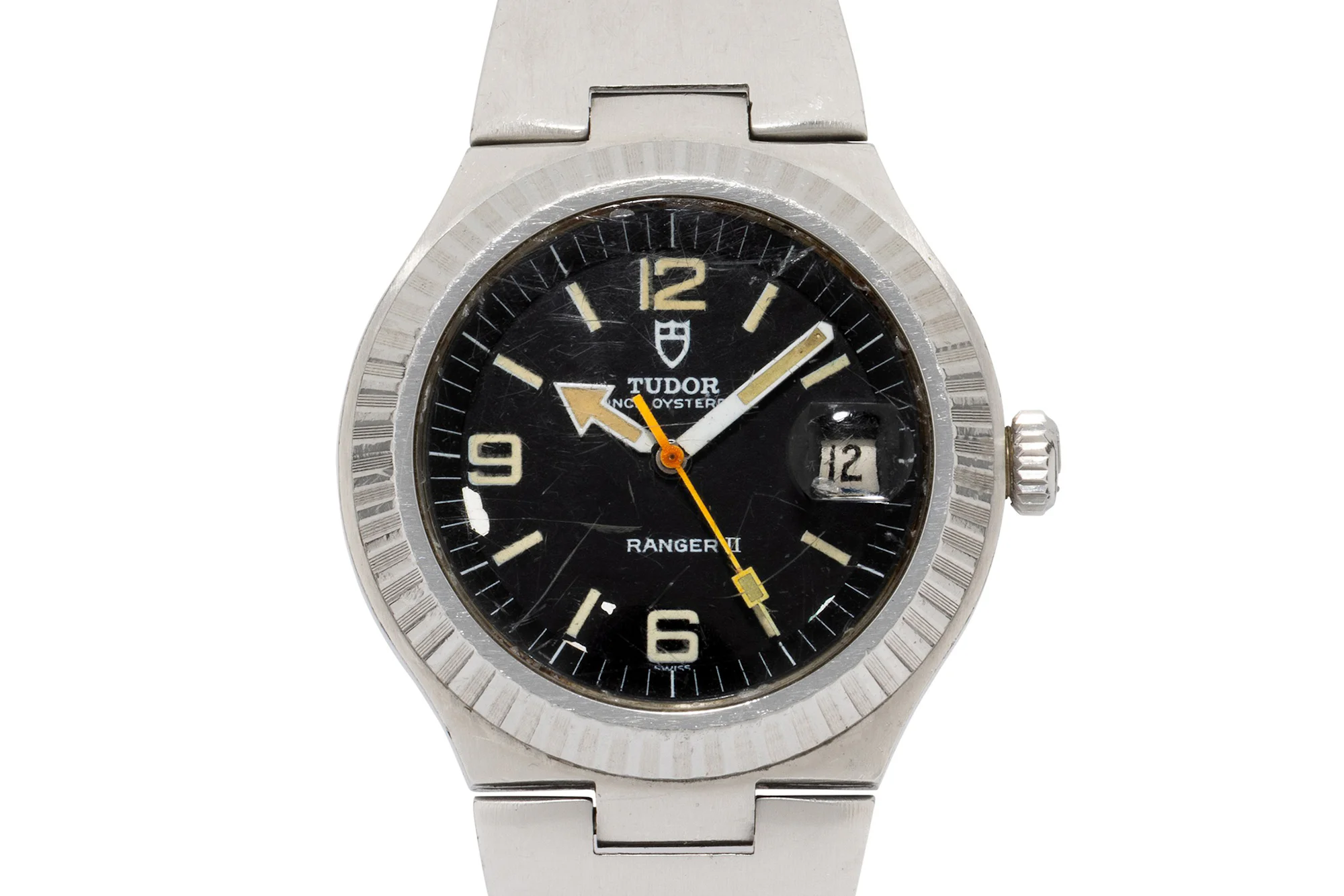
Photo courtesy of Eppli Auktionshaus.
These watches couldn’t really be more different—a 1920s dress watch that ended up being adopted by doctors, a 1970s sport watch that never really found much of a devoted audience—but, again, they’re both uncommon enough (and overshadowed by a more prestigious, better-known relative) to merit at least acknowledging them. Both go up for auction tomorrow, the 6th of June.
Omega Railmaster Ref 2914-2
The upcoming Hess Fine Auction is lit. First there’s this Sigma Big Red Daytona, or if that’s not quite your speed, consider this Milgauss, which has one of the best looking dials I’ve seen and which lot, when auctioned, will ultimately mostly answer the question “how much is a vintage Milgauss bezel worth?” (A glorious 6541 with bezel, though without a dial that’s gone as deliciously tropical as this, sold at Phillips in 2023 for over $2M). Beyond those two, there’s a Vacheron 6395 Disco Volante, a gilt 1675, and plenty more to blow your mind.

Photo courtesy Hess Fine Art.
However, this Railmaster kept grabbing and keeping my attention. Certainly, you know your history, and so are fully aware that in 1957, Omega released the 2913 (Seamaster), 2914 (Railmaster), and 2915 (Speedmaster), which models they rereleased in 2017 on the 60th anniversary. While I haven’t seen full production numbers, my understanding is that the Railmaster line had by far the fewest models made, meaning any decent 2914 is orders of magnitude less common than a Seamaster or Speedmaster. Plus stress decent in that preceding sentence, Baller: Railmasters, for any number of complicated reasons having to do with radium and time and whatever else, often come to market looking quite grungy indeed.

Photo courtesy Hess Fine Art.
And while this example isn’t flawless—there looks to be some rust on the dial behind the hour hand—it is true, with not only original dial and hands, and a decent-enough case, but it comes on an Omega beads of rice bracelet with a sliding clasp.
Universal Geneve Polerouter Broad Arrow
Watches of Knightsbridge is up to its usual badassery, its catalog stuffed with phenomenal options including a Blancpain Aqua Lung, a Poor Man’s Camaro, an Explorer-dial Sub, an issued CWC chronograph, one of the sexiest IWCs I’ve seen in a while, a Breitling Long Playing Ref 815, a Wittnauer Electro-Chron, and a lights-out Heuer 2444N.

Photo courtesy Watches of Knightsbridge.
However, for my money, the one to watch is the Universal Geneve Polerouter Broad Arrow. Yes, I’ve written too frequently about Polerouters for the last few weeks, and I’m sorry; this will be the last one covered. Let’s start by addressing why you should not bid on and/or purchase this watch. The first argument against it is that it has a bumper movement, which is the fussiest, most fragile, and least efficient movement you can get. You really, really should not, in most circumstances, buy watches with bumper movements if your goal is to own a watch that runs well and keeps time reliably.
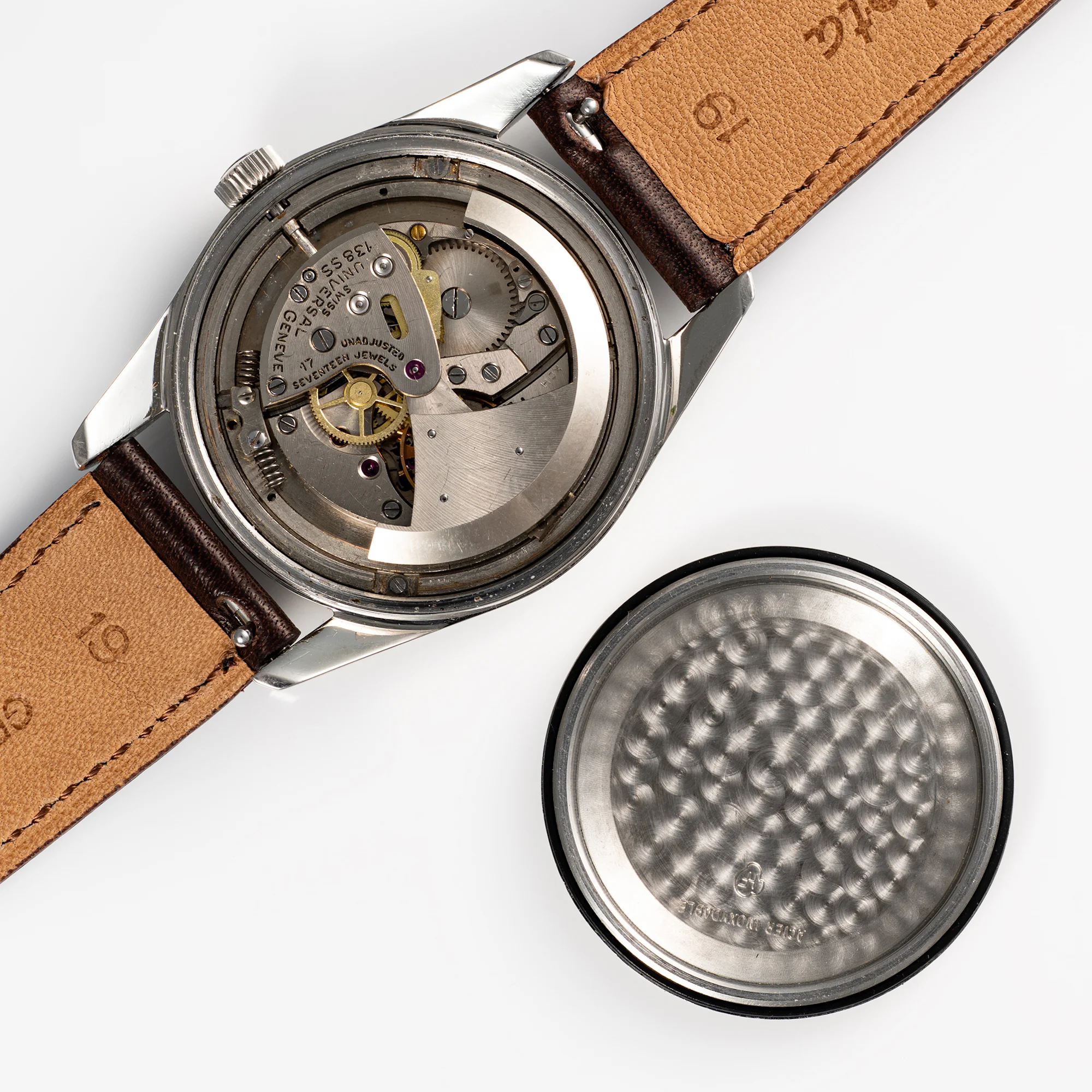
Photo courtesy Watches of Knightsbridge.
Plus, they are old—bumper movements are—which means something. Ask your watchmaker what watches he/she least likes working on, and the answer will likely be ‘watches you can’t get parts for.’ Want to know one of the reasons Rolex is Rolex? Because for decades they made it easy to get parts for their watches, and because they designed their watches with an understanding that parts would be replaced. I’m sure there are still some parts out there for a Universal Geneve cal 138, but they’re dwindling, meaning whatever else this Polerouter is—traffic-stoppingly beautiful among them—it’s also going to be, sooner or later, a headache.
I submit, Baller. The movement is really the only reason not to bid on this watch, and I must grudgingly admit it’s an insufficient argument to steer you from this. I mean, those hands! That dial! Come on! Even the case looks good! The estimate for this one is £5,000 to 7,000, and the entire glorious Watches of Knightsbridge auction commences on the 6th of June.