

Earlier this week, we tackled two of the four auctions taking place in Geneva this week (and into next). Now we tackle the last two—Phillips and Sotheby’s—which will round out to around 1200 watches that I’ll have looked at to consider for coverage. Have I missed some deals? Certainly. Are there maybe one or two watches that don’t quite look as nice in person as they do in pictures? Yes, again, I’m sure. That’s part of why I’m in Geneva this week, taking a look at as many previews as I can. As I said before, if I see anything worth noting, I’ll update my story, but I’ll skip further exposition and get right into the watches.
Phillips — November 7th and 8th, 2026
Okay, so I’m in Geneva this week, mainly for the Grand Prix d’Horlogerie de Genève, but in a great twist, Phillips starts off the action with their auctions starting the same morning of the GPHG awards ceremony that evening. That means I get to start the day watching bidding at Phillips before heading to the hotel to throw on a suit and party the night away. What more could you want?


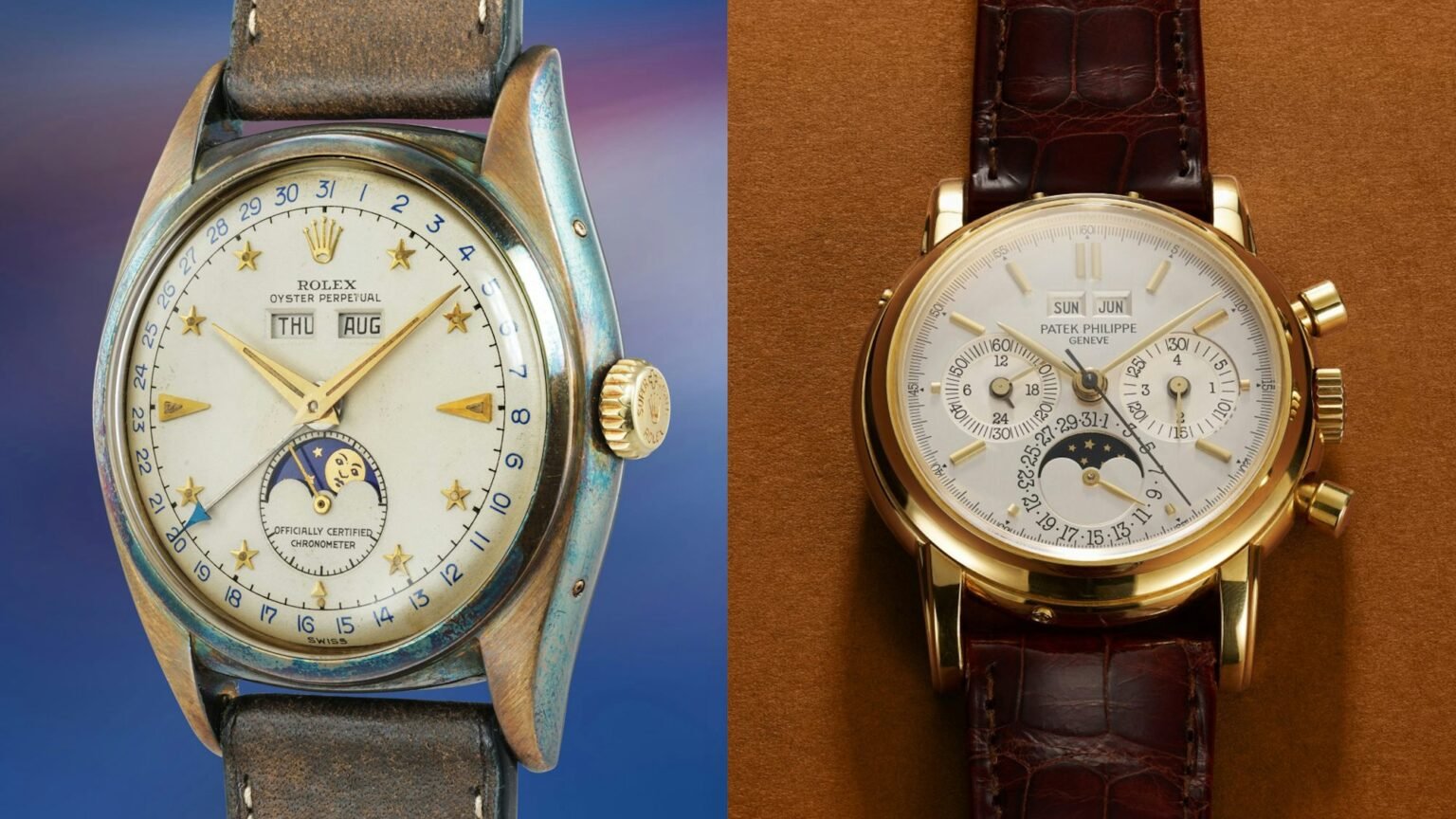
Well, there’s a lot I could want at Phillips, starting with this amazing Rolex ref. 6062 “Stelline” that is fresh to market. This watch, with an estimate in excess of CHF 600,000, is one of the nicest, most honest yellow gold ref. 6062s I’ve seen in a long time, and the consignor bought it from the original owner’s family before putting it nearly straight into auction, making it essentially a single-owner watch in all practicality. The dial shows hints of age, but nothing anyone could object to. The case is incredibly patinated, with hues of blue and green, and yet in phenomenal condition. If the Rolex “Dark Star” sold for over $1.5 million in 2018, I expect this will do much better. Completely unrelated, but I do think this Rolex ref. 2737 “Regulator” chronograph is quite neat.

Okay, that gave us a bit of a break before discussing Journe. There was some discussion recently regarding what exactly to make of this Pre-Production Chronometre à Résonance. Outside of that lot, there are 13 Journes (about 6% of the watches), and the Chronometre à Résonance “Régence” actually carries a higher estimate than the pre-production: in excess of CHF 1,000,000. Journe personally fitted a white-gold engraved “Régence” dial on the first Resonance made, and only three pink-gold Régence dials exist, so this should go for some crazy price, I’m sure. The Vagabondage III in platinum with diamonds was a $1.1 million watch earlier this year (trading hands privately), so I’ll use that number as a measuring stick for the one offered at Phillips.


The top lot, based on the estimate, for the first time in a long time and across all houses, is the Patek Philippe ref. 1436 in steel. It’s a diminutive watch measuring only 33mm, but it packs a punch, and this one has a case that looks really strong. Three steel 1436s have been photographed, but after a lot of discussion, research, and some inside baseball that isn’t relevant here, only two are correct. This watch is one of those two and, frankly, the only one likely to be acquired in the coming decades, as the other (the Astrua Torino example) is in a collection that will likely never sell.
This is a known watch with a fascinating history. It was largely ignored the first time it was available from the original family—actually originally rejected from auction for being “just” a steel Patek, while two outstanding other watches (a pink on pink 1463 and a silver on pink 1518) were consigned instead—before being hunted down and finally brought to sale at Antiquorum in 2009. The next time it was offered was at Philipps in 2015, where it achieved over CHF 3,000,000. That buyer now is offering it again.


That makes the current estimate starting at CHF 2,000,000 feel a bit conservative, but that might just be a play to build excitement. Demand for 1436s seems to be up—Phillips is offering four this fall across Geneva and Hong Kong, in all three metals—and I think Phillips is feeling out the market while also offering one of the pinnacle examples. Starting at CHF 400,000, there’s also a Tiffany-signed example—with some research to back up the dial being correct— but comparing the two cases shows how strong the steel example is.


Obviously I’ve spent a lot of time thinking about Patek split-second chronographs lately, so of course two early short-hand versions of the 5004 caught my eye—one in platinum with the traditional silver Arabic dial and one in white gold with the very rare black dial with baton indices that should go for much higher—and both have an estimate of CHF 180,000 to 360,000. The platinum example has the short crown and early block-style split-second bridge, which shows that it was never updated during service, making it even rarer, while the black dial has the 3rd series movement bridge and a long crown. Two other interesting Pateks are the relatively recent ref. 5013R-014, which is possibly unique with diamond indices, and the ref. 2497 “Gumbiner”-signed watch, with the weird signature squeezed above Patek. That watch last sold at Christie’s Hong Kong in 2019 for around $430,000, so $500,000 all in seems reasonable.


A bit down market, there are five incredibly cool Calatravas I’d personally be happy owning. The ref. 570 two-tone, black dial, Eberhard-signed Calatrava is stunning in person and, at 36.5mm, is wearable enough in a modern space. It’s also the only one known, which, among everything else, puts the estimate at a whopping CHF 250,000-500,000. Another “only one known” is the ref. 1589 shown next to it above. The affixed lugs and Breguet numerals are neat, but it just doesn’t pop as much in person. I didn’t see them in person, but the ref. 96 SC in yellow gold with a luminous Breguet dial is very much my speed despite the size, while the engraved Breguet dial of this example in steel is a close runner-up. For something a bit larger, you could consider this sporty ref. 565 Steel with Black, Starr, & Gorham signature.

If you have any knowledge of vintage Rolex chronographs, you know Pucci Papaleo. The man—a scholar, collector, and author—has seen more vintage Rolex chronographs than probably anyone in the world, and has documented them to share. His story has been chronicled on Phillips’ blog, but more importantly, he’s selling some incredible watches. This is the first thematic segment being offered (though I’m not sure how many), and it starts with the only known 14k yellow gold “Lemon” Paul Newman ref. 6264, with an estimate starting at CHF 1,000,000. I think Paul Newman watches are a bit on the decline, but a watch like this absolutely stands out.

While most of these watches are far outside what most people can afford, I’d encourage you to look at all of his chronographs. Some are surprisingly understated, which makes the outstanding estimates even more remarkable. Others are scholarship-changing, like the above ref. 3525 Bariletto, which has the only known signature from the retailer Prouds in Sydney, but looking closely, it seems to be an early signature indeed.

I looked at a few at the New York preview, and I really loved seeing the tiny 28mm ref. 2303 monopusher, ref. 3835 step-lug chronograph (double signed), small 32mm disco volante chronograph with salmon dial (retailed by Verga), and the likely unique ref. 3830 anti-magnetique square watch, which carries a CHF 1,000,000+ estimate. These unusually designed watches are great antidotes to what can feel like a repetitive Rolex market, and proof that you can find something outstanding outside the box and finally, eventually, have the market respect its importance.

I think most people expect the demand for independent watchmaking to keep rolling for a while. While some buyers of modern independents are chasing current trends, I see the originals as people deeply invested in horology, so I thought I’d highlight the two together. Two of the biggest names—Philippe Dufour and Roger Smith—have two of their most iconic watches up for sale. I think that, as the market becomes more educated and sees more of his work, early Dufour Simplicities will rise in value, and this is a nice early one from 2004. A bit more outside the box, but this two-tone white and pink gold Roger Smith Series 1 with Arabic indices is, at the very least, unique and will easily find a home on the high end of the CHF 300,000 to 600,000 range, I’d imagine.


But if you want to be like the cool, educated, early indie adopters, buy pocket watches. More specifically, buy this Richard Miklosch flying tourbillon with detent escapement, which I am dying to see in person. A few pocket watches went for massive money (somewhat unexpectedly) last fall auction season, but this should do incredibly well all the same. The mathematician-turned watchmaker influenced some of the biggest names in watchmaking (like Kari Voutilainen), though, like a few other notable names, he largely didn’t get his due until after his death in 2014. He only made 14 watches, one of which sold at Cortrie in Germany earlier this year for €900,000 before fees, blowing expectations out of the water. For another important tourbillon pocket watch, you could try to get this Jürgen Kuhls that was made in 1935 at the Deutsche Uhrmacherschule (where the flying tourbillon was conceived), but the last one sold last year for four times the low estimate here.
For more on Phillips’ “The Geneva Watch Auction: XXIV” live sale, visit their website.
Sotheby’s — November 8th and 9th, 2026
Last but not least are the offerings from Sotheby’s. Not because I’m burning out after so many watches, but I do think that certain things stand out in relief as distinctly deserving coverage. That said, on my third pass, a lot of things caught my eye, like this Vacheron jump hour and this Vacheron perpetual calendar (which has a somewhat comically low estimate—or maybe it’s just keeping bidders hopeful).

There is, unsurprisingly, a bunch of Journe. There’s another brass movement Chronometre à Résonance—the third… fourth… this season? I lost track. It’s on the earlier end and a different configuration than the others, so it at least provides options. There’s also a very vintage-looking Octa Chronographe, which looks that way because it’s a Ruthenium version that’s aged a lot. Last year, an Octa Chronographe’s result surprised me and started a meaningful conversation with a collector who helped open my eyes to how impressive these watches are, both technically and in terms of wearability.

The bulk of the interest, for me, came with Patek Philippe. I guess I’m just still a vintage guy at heart. With that in mind, the most significant Patek being offered this auction season is actually probably this ref. 3970J, which was apparently the first one ever made to bear a serial number (i.e., not a prototype), with that serial number being 875’000. This watch has sold twice before, but not in over 10 years, making it a great opportunity to buy something truly historically significant, especially as the 3970 has risen in demand in recent years. The estimate nearly ensures it’ll break a record for the reference at CHF 1,000,000 to CHF 3,000,000, but it will have to beat CHF 1,397,000 for the 3970EP-038 sold last year.

A watch you don’t see come for sale often is the Sky Moon Tourbillon ref. 5002, though the starting estimate here is the same as the 3970, and while it’s important and technically impressive, it’s a lot less elegant. For elegance, go for the ref. 1463 “Tasti Tondi” that’s signed by Hausmann and—again, without seeing it in person—looks like a very nice example. I like the idea of at this steel ref. 530 with an incredible black dial and a long signature. The lugs seem a bit “sleeve polished,” as some people say, but more importantly, the dial has been restored by Patek. It’s not the best work but it’s passable at the right price. For other, slightly more affordable, steel Calatravas, there’s this 565 with a luminous Breguet dial and an early ref. 96 that might fly slightly under the radar because it lacks any kind of special dial configuration (but has a nice long signature).

If you liked the patina on Phillips’ ref. 6062, for much less, you can get a similar vibe from a ref. 6032 Antimagnetic chronograph at Sotheby’s. Okay, CHF 200,000 to 400,000 is still a lot, but remember what I said about how compelling non-Daytonas are once you start looking? There are only four of this reference that have been sold, and not all are correct. This one is amazing, with fantastic patina and a great engraving on the caseback.
That said, one of my favorite Daytonas in history is the sodalite/sapphire bezel version Sotheby’s is offering, though someone needs to put it back on a loud, blue alligator strap and lean in. And, for a little while now, I’ve been looking for a nice Rolex Tru-Beat with the original deadbeat movement and Tru-Beat dial, but prices keep rising, and good ones are hard to find. This one, in yellow gold with a mesh bracelet, looks like it could be really nice, but the photos are a bit hard to interpret.

The only other modern watches that jumped out at me were a few recent limited editions that I was surprised to see on the market. I guess the Cartier Pebble came out a while ago, so it’s about time more started trickling out onto the market. But the Daniel Roth Extra Plat Souscription from 2025 and the Legacy Machine Split Escapement ‘The Jungle Book’ from 2024 are pretty darn new. Now, no one can tell you what to do with your watch, nor am I some kind of arbiter of these things. My only take is that I bet someone else would have loved that watch at retail, so I hope that’s about where the prices land.
Just like the two Patek 3448G on offer (one here, one at Christie’s), Ben also wrote a bit espousing his interest in the Daniels Millennium, so I won’t go any further on that. But I will use some of my last words here on a pocket watch; specifically, I really want to see this early A. Lange & Söhne pocket watch with perpetual calendar, minute repeater, and grande et petite sonnerie. This is essentially a step down from similar watches with split-seconds, and those used to not command estimates like this one does today, which, as a pocket watch lover, gives me a lot of hope for the market stabilizing into something that makes a bit more sense to me.
For more on the Sotheby’s “Important Watches” live sale, visit their website.
Marteau & Co. — October 30th to November 6th
One last auction to keep in mind this week needs attention faster than the others, as it closes before anything else. Marteau & Co. has an auction that closes on Friday, November 6, 2026, at 2:30 pm Geneva time, with rolling hammer prices if bids flow in online, and with a curious twist: they’re hosting a live gathering for collectors to watch the results without an auctioneer commanding the room. Just a chance to watch the bidding and hang.

The sale, on the heels of one of (if not the most) expensive online sales ever last month, is themed around the color blue, starting with the (previously covered) unique Philippe Dufour Simplicity with a blue aventurine dial that carries a CHF 850,000 bid at the time of writing. And while I’d like to say there’s other more affordable deals to be had, a lot of my favorite watches have already done insane prices. That includes this Kallinich Claeys “Piece Unique” Einser model. You’ll hear from Johannes Kallinich (as Claeys left the business recently) in the coming months, but unfortunately the CHF 12,000 starting price didn’t last long, and it now sits around CHF 100,000.

Funny enough, after Ben wrote about how truly unique another sale’s Voutilainen with a 45mm case was, I got a message from a collector saying Voutilainen made only a handful at that size—people just didn’t want them at the time. Sometimes, you have to just go with what you can prove, and I couldn’t prove that fact, so I let it ride. Well, here’s proof in the metal; white gold, to be exact.

I’m jumping all over in coverage, but I’ll call out a few more favorites. People seemed to have mixed feelings about the new Louis Erard x Vianney Halter, but I quite liked it, and here’s a unique version, but the price is now CHF 35,000, so haters to the left, as the kids say. Speaking of kids, a watch that benefits a children’s charity and is similarly wildly loved by bidders is this Baltic Stepgraph Tantalum Prototype with “Polar Mother of Pearl” dial. The reserve is met. By how much? Well, it sits at CHF 22,000 at the moment. I genuinely love to see it.

Finally, I want to share this really interesting, creative, and pretty impressive little watch from the underappreciated independent maker Paul Gerber. I personally haven’t taken to the watch much because I don’t love the font he used for his brand name, but a lot of people find it charming. The watchmaking is quite cool, with Hours, minutes, retrograde seconds, and a dynamic power reserve powered by a heavily modified Peseux 7001 with a patented twin-rotor system. A lot of people I respect find these watches cool, so they’re worth a look. But there’s plenty more in the sale, so take a look before it’s too late.
For more on Marteau & Co.’s “The Blueprint” auction, visit their website.