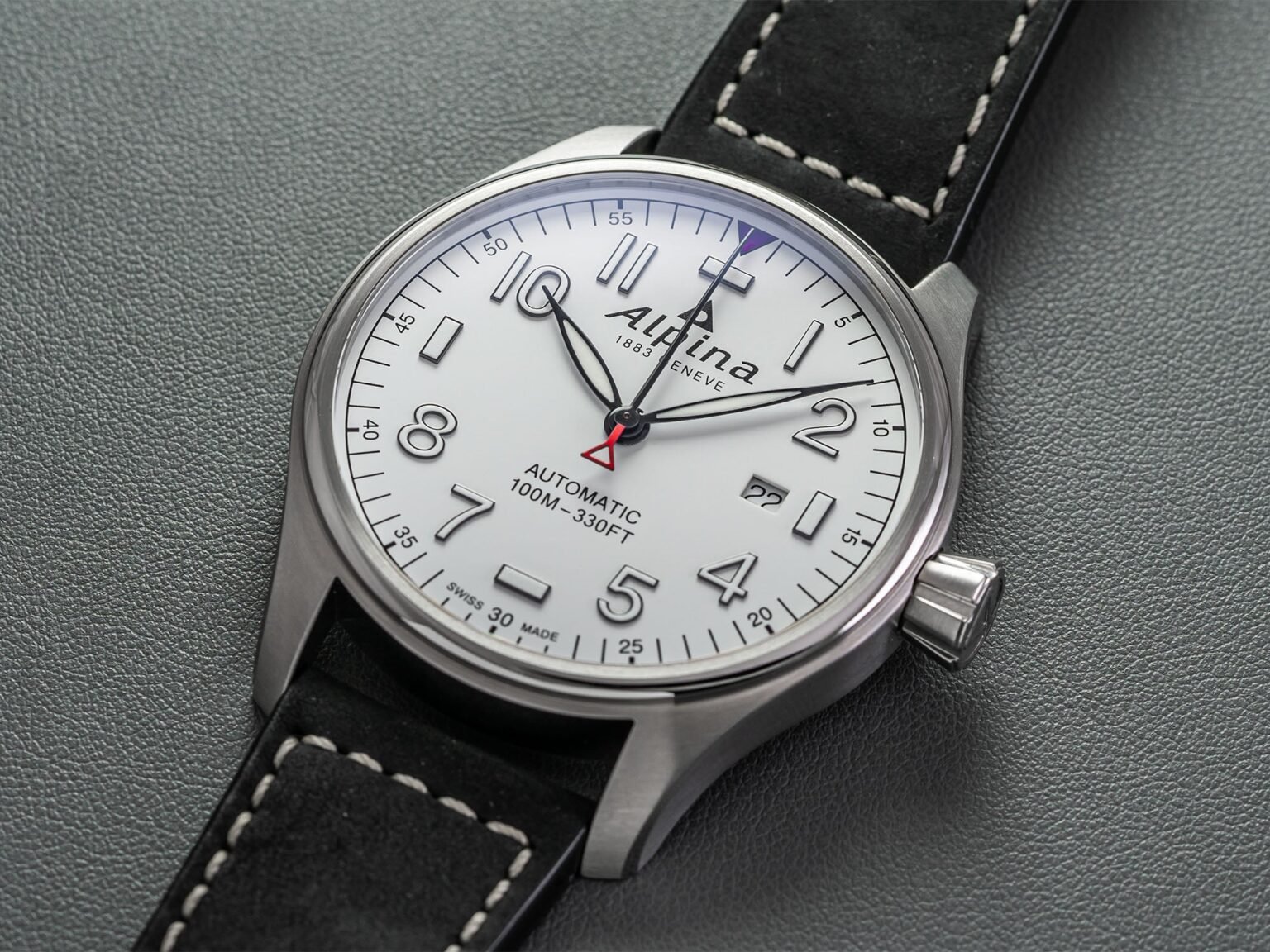

Debuting at this year’s Watches & Wonders, the Alpina Startimer Pilot Automatic received a major revamp, launching new sleeker proportions, new dial renditions, and refined details over four new models. Down below, we’re breaking down everything you need to know about the next generation of the Pilots’ watch line, from its origins to the major changes that make the collection feel fresh.
[toc-section heading=”A Heritage Forged in the Clouds”]
It’s easy to lose sight of the strictly utilitarian reality of the early aviation watch. When we look back to the 1920s and ’30s, you wouldn’t have found a luxurious, highly refined pilot’s watch within a hundred miles of the cockpit. It was a freezing, deeply hostile environment. Aviators demanded highly legible, aggressively oversized instruments that could be securely strapped over a thick leather flight jacket and operated with heavily gloved hands. Alpina was one of the brands leading from the front in that respect. The brand began actively supplying rugged, oversized pocket watches and wristwatches to various military forces and air forces across Europe, underscored by the legendary “Alpina 4” principles. The sheer ruggedness of Alpina’s early aviation pieces, defined by four critical tool-watch attributes (anti-magnetic, anti-shock, water-resistant, and stainless steel), became a mainstay for military divers and navy personnel.

Personally, I’ve always found it fascinating how these brutalist military instruments gradually morphed into objects of civilian luxury and desire, and I’m sure I’m not alone. When Alpina formally introduced the modern Startimer collection back in 2011, it was a somewhat faithful homage to those early designs. Vast dials, oversized onion crowns, and stark, black-and-white contrasting dials were all present, yet they were intimidatingly large. These 44 mm models (example above) were complete saucers on the wrist, considering their use had, by then, shifted from navigating a vintage biplane over the Alps to commuting to work on a cramped train.

This leads us to Alpina’s newest release from Watches & Wonders 2026. The brand has essentially rebuilt the Startimer Pilot Automatic from the ground up, and it feels like it’s finally nailed the balance for today’s collectors. The most obvious change is the updated case size, but Alpina has also cleaned up the dial and tucked a much better movement inside.
[toc-section heading=”Case and Crown”]

The most welcoming alteration made to the new Startimer design is the sheer reduction of its physical mass. Alpina has bravely reduced the case diameter to a highly versatile 40 mm, pivoting away from a traditionally oversized pilot’s watch. More importantly, the brand has heavily compressed the overall thickness of the case, giving the new Startimer Pilot Automatic a more holistically refined physique. Through some very clever engineering and a total redistribution of the case profile, this new iteration has been slimmed down to an impressive 10.14 mm thickness. This 10% reduction means that the watch no longer dominates the arm. Instead, it settles comfortably on the wrist without spilling over into excess, and although it now slips more easily under a tailored shirt cuff, it still retains its important instrument look and feel.

The finishing techniques applied to this new stainless steel case are also a significant step up from what you might expect at such an accessible price point ($1,795 – $1,895). Alpina eschews the full bead-blasted finish, as well as the entirely polished approach, opting instead for a sophisticated interplay of textures that interact beautifully with the light. The smooth bezel is treated to a meticulous, circular satin-brushed top and polished rim, dramatically reducing any harsh cockpit glare. This surface flows naturally into vertically brushed case flanks and lugs. To prevent the watch from looking too overly utilitarian, however, Alpina has introduced highly polished chamfers to the mix. These cleanly separate the brushed surfaces, elevating the Startimer’s architecture and giving it a sculpted, almost architectural quality.
Even the crown has been modernized. The oversized (sometimes cumbersome) onion crowns of the past have been replaced with a sleeker, aviator-style crown that features four distinct rows of deep knurling. As such, the crown now provides an even better grip, allowing for easy winding and time-setting. Despite this modification, it remains flush enough to avoid digging uncomfortably into the back of the hand.

Turning the watch over reveals a solid steel, threaded caseback that Alpina tastefully adorns with a deeply stamped, Art Deco-inspired aviation motif. While the voyeur in me occasionally misses a sapphire exhibition back to view the mechanics, a solid steel closure feels entirely appropriate for a watch steeped in such military heritage. Crucially, this robust case construction guarantees a highly reassuring 100 meters of water resistance, too, ensuring it remains impervious to the odd, unforeseen downpour or a quick dip in the sea.
[toc-section heading=”Dial Variations”]
The dial of any pilot’s watch must, above all else, deliver absolute legibility. To achieve this, Alpina has taken an intelligent “addition by subtraction” approach, clearing away the unnecessary elements to allow the display some breathing space. The most notable change is the removal of the printed 12-hour scale and the application of three-dimensional blocks. While still simple, they add depth to the display, opening up the canvas dramatically.

The new, deeply grained, almost velvety central dial section is another talking point. Light absorbs beautifully into this surface texture, completely eradicating any unwanted reflection. The nuanced texture is expertly framed by a slightly elevated, stepped flange that carries a crisp, highly precise minute track. During the day, the hour lumiblocks on the hands and hour markers will provide a wonderful sense of architectural depth, casting discreet shadows across the grained dial, but in the dark, they ignite with a fierce glow that will last far into the night.

Alpina has released four distinct personalities within this new framework. The core stainless steel models are available with dials in a deeply saturated petrol blue, military khaki green, and a stark, utilitarian black. While the blue and green variants utilize a slightly softer, light green luminescent compound, the black dial employs a crisp, stark white, luminous material that virtually leaps off the velvety background. There’s also a stealthier black PVD-coated case variant that features a black dial with vintage-toned, beige luminescence. This iteration strongly recalls the “gunmetal” aesthetics of early 20th-century pocket watches. Look a little closer, and you’ll note that the crossbar on the “A” of the red Startimer logo at 6 o’clock has been quietly removed, mimicking the shape of an Alpine peak. It’s a wonderfully subtle nod to the brand’s heritage.
[toc-section heading=”Caliber AL-525 Movement”]
Behind the closed caseback of the new Alpina Startimer Pilot Automatic lies the most significant upgrade to the entire collection. For years, the Startimer relied upon a movement built on the trusty, Sellita SW200 base — a perfectly reliable engine, but with a pedestrian 38-hour power reserve. For these new 2026 models, Alpina turns to its sister company within the wider Citizen Group, the highly respected Swiss movement specialist La Joux-Perret. The result is the AL-525 caliber, based heavily upon the robust La Joux-Perret G100 architecture.

Operating at a brisk 28,800 vibrations per hour, it delivers the smooth sweep of the central seconds hand and a vastly expanded 68 hours of autonomy. This transforms the Startimer into a genuinely “weekend-proof” timepiece. You can comfortably take the watch off on a Friday evening, leave it resting on your dresser while you wear something else over the weekend, and strap it back on come Monday morning to find it still ticking away without an issue. While the movement remains hidden behind that solid, stamped caseback, the choice of the La Joux-Perret base feels well-suited to the Startimer’s revamp. The Caliber AL-525 isn’t overly decorated, nor is it too fragile a piece of haute horlogerie. The movement includes 24 jewels, hacking seconds for precise time-setting, and a neatly integrated date complication at the 6 o’clock position.
[toc-section heading=”Strap and Wearability”]

As with any tool or sports watch, the strap is the critical, load-bearing component that dictates how the watch wears and interacts with the wrist. Alpina seems to understand this intimately, thoughtfully approaching the design of the straps across the four new Startimer variants. For the blue and green stainless steel models, a beautifully two-piece calf leather strap in light and dark brown is supplied, complete with beige contrast stitching and a stainless steel pin buckle. The black and steel version takes a decidedly more modern, tactical route, featuring a durable, black Cordura fabric strap lined with soft leather for comfort. It features aggressive red stitching running up both sides that directly echoes the red Startimer logo on the dial. Finally, the black PVD variant is matched with a brown, NATO-style leather strap equipped with black PVD-coated loops. This option leans heavily into the rugged, military aesthetic that so many collectors adore.

What will likely attract the modern collector most, however, is simply how the Startimer Pilot wears during the daily commute. The combination of the reduced 40mm diameter, the thinned case profile, and the 20mm lug width all feel incredibly balanced on the wrist.
[toc-section heading=”Conclusions”]
It’s not an easy thing for a brand to take one of its best-selling watches and strip away some of its most defining historical quirks. But this update to the Startimer Pilot Automatic shows that it is possible nonetheless. Alpina has slimmed down the case, cleaned up the dial, and fitted the watch with a superior mechanical engine. Rather than alienating the passionate collectors who originally fell in love with the brand’s bold aviation identity, the Startimer’s new architecture tastefully preserves the brand’s rich aviation history, proving that listening to the consumer genuinely does pay off.
For more information, visit the brand’s website here.