

From the imposing astronomical clocks of Tudor England to the exquisite pendant watches of Victorian Britain, timekeeping has long been a symbol of power, prestige, and technological marvel within Europe’s royal courts. This new series explores the fascinating evolution of clocks and watches crafted specifically for royalty, tracing how these intricate masterpieces reflected the tastes, ambitions, and innovations of monarchs. Through the lens of craftsmanship, artistry, and historical significance, we reveal how these royal timepieces marked the passage of dynasties and empires.
King George III, who reigned from 1760 to 1820, had a deep interest in science, particularly astronomy, horology, mathematics, and natural philosophy. He was one of the most scientifically minded British monarchs and commissioned several important horological instruments and supported scientific institutions during his reign.
King George III (1738–1820) is often remembered for his struggles with mental illness during his long reign, but he was also deeply engaged in science, astronomy, and horology. Although his interest did not necessarily come directly from his grandfather, King George II, there are examples of important commissions made prior to him succeeding to the throne. One such piece is the magnificent Grand Orrery below made by leading London maker, Thomas Wright in 1733.

Image 1 – George II’s Grand Orrery, Fleet Street, made by Thomas Wright, c.1733. King’s College London © The Board of Trustees of the Science Museum
It is believed George III’s father, Frederick, Prince of Wales, was keen that he was taught astronomy, mathematics, and the natural sciences from a young age by tutors such as John Stuart, Earl of Bute. Frederick died before becoming king, leaving his son George III to inherit the throne. George III’s scientific and horological interests were products of Enlightenment Britain, which continued throughout his reign.
Often the royal family used their connections to the leading makers to bestow gifts on those who served them. A good example of this being the Barnard Tompion miniature table clock below. It is thought to have been made for Queen Anne in c.1708 and was given to Andrew Stone by King George II before 1760. Stone was Royal Secretary to the King and also a tutor of the future King George III.

Image 2 – Barnard Tompion clock, Fleet Street, made by Tompion and Banger, c.1708. Science Museum Group © The Board of Trustees of the Science Museum
King George III’s coronation took place on the 22nd September 1761 and was one of the most elaborate spectacles of 18th-century Britain, setting the tone for his long reign. George became king at age 22. It was paired with the coronation of his new wife, Queen Charlotte of Mecklenburg-Strelitz, whom he had married just two weeks earlier.

State Portrait of George III (1738-1820) in coronation robes, by Allan Ramsay, c.1761. Public Domain
The ceremony was vast and theatrical, costing around £70,000 (£13 Million in today’s money). It included grand processions through the streets, enormous feasts, and lavish pageantry. The coronation drew immense crowds, as it was one of the biggest state events in living memory.

King George III coronation admission ticket, 1761. Public Domain
The coronation was both celebrated and mocked. While it impressed many, some contemporaries criticised the extravagance and disorganization (there were even complaints of rowdy behaviour and seating chaos in the Abbey – see above admission ticket).
The Age of Enlightenment
The Age of Enlightenment, which swept across Europe in the 18th century, created the cultural and intellectual climate that shaped George III’s outlook as king. This was a period when reason, science, and discovery were celebrated as the keys to progress. Thinkers and innovators challenged old authorities, advanced astronomy, mathematics, and physics, and looked to precise measurement and observation as the path to understanding the world.
Rather than inheriting scientific curiosity from his grandfather George II as previously mentioned, he absorbed the Enlightenment spirit through his education and personal interests. He became a patron of astronomy, supported figures like William Herschel, and even built his own observatory at Kew which opened in 1769 (below).

The King’s Observatory at Kew built in 1769 as it looks today. Public Domain
His fascination with horology and the science of timekeeping fit naturally into this broader culture of precision and progress. Accurate clocks weren’t just marvels of craftsmanship; they were essential for navigation, astronomy, and the expanding global ambitions of Britain.
George’s reign began towards the end of ‘The Golden Age of English Clockmaking’ when England—especially London—became the world leader in horology. This outstanding regulator clock below was made by Royal Clockmaker Benjamin Vulliamy (1747-1811) in 1780 for King George III and was used at the King’s Observatory at Kew. It is set in a polished mahogany case, with a side plate and glass top for the case.

Movement and detail of regulator clock made by Benjamin Vulliamy for King George III, London, c.1780. Science Museum Group Collection © The Board of Trustees of the Science Museum
A regulator clock is a highly accurate timepiece, usually used for making precise measurements in conjunction with astronomical observation. This is the movement from the clock made by Benjamin Vulliamy and used as the principal timekeeper at the King’s Observatory at Kew.
Rollers act as the bearings for the wheelwork, reducing the friction and the need for lubrication. For similar reasons the clock was also fitted with the grasshopper escapement invented by the pioneer of the chronometer, John Harrison (1693-1776). Harrison`s gridiron pendulum was also incorporated to ensure that the clock kept good time by compensating for changes of temperature.

Mural arc made for King George III by Jeremiah Sisson, London, 1770. Science Museum Group Collection © The Board of Trustees of the Science Museum, London
This impressive Mural Arc (or Quadrant), now in the Science Museum in South Kensington, is made of brass and iron and has an eight-foot radius. It was made in London by Jeremiah Sisson for King George III’s private observatory, where it was installed in 1770. Signed and dated ‘J. Sisson. London. 1770.’ and divided with a 142-degree scale. It was fixed to the observatory wall and used to measure the altitude of stars or the sun.
A Royal Passion for Science
George was deeply interested in science, agriculture, and technology. He was affectionately known as the ‘Farmer King’ (or sometimes ‘Farmer George’), due to his deep personal interest in agriculture and rural life. He was fascinated by new farming techniques and scientific agriculture, which were part of the broader Agricultural Revolution in Britain. He encouraged innovations such as crop rotation, soil improvement, and selective breeding of livestock.
However, his support for the Royal Observatory, Greenwich Mean Time, and scientific societies led to various new inventions, such as this magnificent philosophical table made for the King by George Adams, Fleet Street, London, 1761-62.

George III’s philosophical table made by George Adams, Fleet Street, 1761-1762. King’s College London © The Board of Trustees of the Science Museum
The philosophical table was the centrepiece of the mechanics apparatus made for the King just after he ascended the throne in 1760. It has a pillar in three pieces, two wooden rings and wooden nut; vertical board with ivory scale and backing board for pendulum experiments are attached. A range of attachments for use in different experiments were supplied with the table including the isochronous pendulum, the collision apparatus, the central forces apparatus and others.
His passion for knowledge was genuine; he corresponded with leading scientists, supported the Royal Society, and took a personal role in advancing British technological achievements.
Timekeeping fascinated him not only for its precision but for its practical utility. He understood that a nation governed by the clock was a nation poised to thrive. From Windsor to Greenwich, the king’s patronage was vital in nurturing horology—an essential tool in his vision for a modern, enlightened monarchy.
Solving the Problem of Longitude
George understood the importance of accurate timekeeping in navigation and empire-building. He championed the inventor of the marine chronometer and their crucial role in solving the longitude problem. His support accelerated technological advances with practical geopolitical impact.
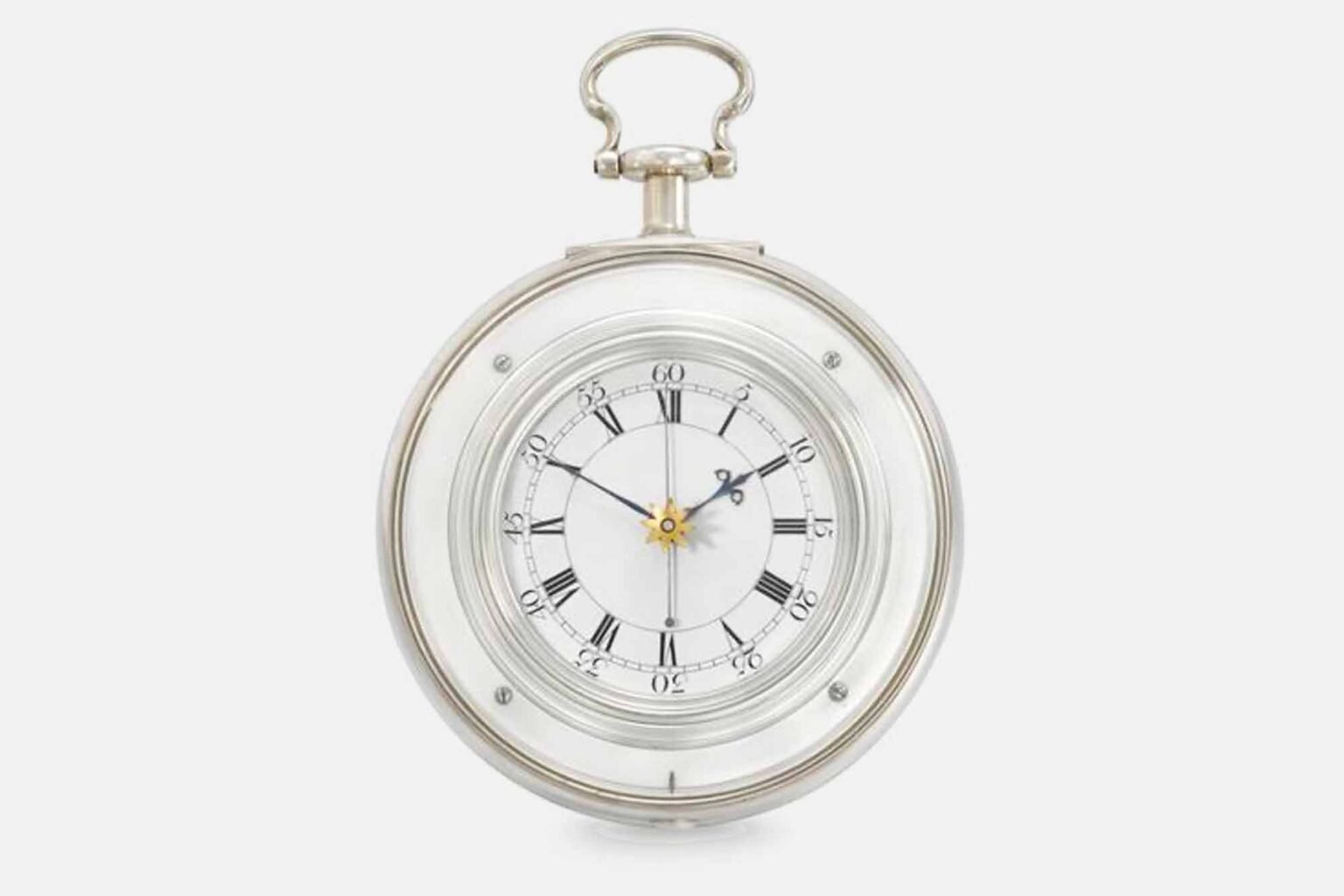
The story of finding Longitude has been told many times, but finding a solution to this challenge fundamentally changed the world and began the quest for precision timing. It was John Harrison who spent the best part of forty years of his life to solve the problem.

Movement of Marine Timekeeper known as ‘H5′, London, c.1770. The Clockmakers’ Museum/Clarissa Bruce © The Clockmakers’ Charity
By the early 1770s, Harrison — then in his late 70s — had already built his famous H1 to H4 timekeepers, with H4 proving in sea trials that it could accurately determine longitude. However, Harrison was continually denied full recognition and prize money by the Board of Longitude, which was sceptical and slow to acknowledge his achievement.
This is where George III intervened and in 1772, Harrison presented H5 to the King at his private Kew Observatory. George personally supervised the testing of the clock’s accuracy over a period of 10 weeks. The trials proved that H5 kept time with extraordinary precision, losing only about 1/3 of a second per day — a feat unmatched at the time.
Quote: “By God, Harrison, I shall see you righted!”
King George III, after personally verifying H5’s accuracy and being outraged by the treatment Harrison received from the Board of Longitude.
Thanks to George’s public support, the government was forced to award Harrison a large portion of the prize money — although not the full amount — before his death in 1776 aged 82 years old.
A Royal Collector of Great Taste and Appreciation
Although George revelled in science and precision timekeeping, he also admired the finest craft and workmanship that was evident by the finest watchmakers of the time. This is borne out by the beautiful watch he gifted to his wife Queen Charlotte as seen below.

Cylinder watch with enamelled gold case made for Queen Charlotte, Conyers Dunlop, London, 1740-1760. The Clockmakers’ Museum/Clarissa Bruce © The Clockmakers’ Charity
This ‘Cylinder escapement ‘dumb repeater’ watch by Conyers Dunlop, with enamelled gold case signed by George Michael Moser, was made for Queen Charlotte (1744-1818). It has a white enamel dial with steel beetle hands and an aperture for winding. A ‘dumb repeater’ is a watch which repeats the time by striking hammers onto the inside of the case rather than on a bell or gong. This has the effect of feeling a vibration rather than hearing a sound, much like the silent mode of a mobile phone today.
I have the pleasure of seeing this exquisite watch every week during my tour as it is on display in the Clockmakers’ Museum at the Science Museum in South Kensington.
Perhaps one of the most historically significant and technically advanced timepieces of its era was Breguet No. 1297 which was a remarkable pocket watch owned by King George III, showcasing both technical brilliance and royal intrigue. Made by the legendary Swiss watchmaker Abraham-Louis Breguet in c.1808, this timepiece was one of the earliest tourbillon watches ever created — a mechanism invented by Breguet to improve accuracy by counteracting the effects of gravity on the escapement.

Breguet No. 1297 made for King George III, Paris, c.1808. Image © Sotheby’s London
This four-minute tourbillon pocket watch means the tourbillon carriage makes a full rotation every four minutes, rather than the usual one minute. The movement uses a Robin escapement, which is rare and makes this particular watch unique among its series. It also has a thermometer, marked ‘Heat, Temperate, Cold’, a stop-slide or timing-seconds dial and a power reserve indicator.
Because Britain and France were at war during the Napoleonic period, Breguet had to sell the watch discreetly, as trade between the two countries was restricted. The watch bears no visible maker’s signature on the dial or movement — an unusual precaution for such a masterwork, intended to hide its French origin. The watch is signed No.1297
Recordon, London. Louis Recordon was a Swiss-born watchmaker and agent for Breguet representing his interests in London during this period.
While in England, the watch could have been signed by Recordon and housed in an English case crafted by Louis Comtesse. Upon its return to Paris, Breguet likely installed the tourbillon carriage, which he personally signed. The engine-turned decoration of the case, together with the addition of a dial featuring English inscriptions, would have lent the watch an authentic English identity—allowing it to be sent back to London without arousing suspicion.
Due to its royal patronage, its technical ambition, i.e. thermometer, English wording, rare escapement, and its exquisite decorative work, it has been described as ‘a masterpiece fit for a king’.
The watch was first bought by the King George in 1808 for 4,800 French francs, today that would be equivalent to c.£200,000. It sold at Sotheby’s on the 14th of July, 2020 for £1.6 million.
The Start of a ‘Modern-Day’ Royal Collection That Lives On
King George III is widely regarded as the founder of the modern Royal Collection. He bought major works of art, horological items, scientific instruments, books, and furniture — not for personal pleasure alone, but as a national and educational resource. He also established the Royal Library and encouraged cataloguing and preservation, laying the groundwork for today’s Royal Collection Trust.
Later, in the 19th century, Queen Victoria and Prince Albert further developed the Collection, turning it into a publicly accessible national treasure, particularly through displays at royal residences like Windsor Castle and Buckingham Palace which are still on show today.
George III’s legacy in science and horology lies in his genuine intellectual curiosity and commitment to precision, which helped make Britain a leader in scientific investigation and watchmaking excellence during the late 18th and early 19th centuries.
The post A Majestic Journey Through Clocks & Watches Made for Royalty: King George III, the Scientific Monarch and his Passion for Science and Horology appeared first on Worn & Wound.