

There are few places on earth that feel as mythologized and untamed as California’s Big Sur coastline. The cliffs seem too steep, the Pacific too violent, and the roads too beautiful to be entirely real. It’s the sort of place that attracts a particular kind of person, someone who sees adventure not as spectacle, but as a pursuit. For Windup in a Bay 2026, that pursuit led to Jade Cove.
What began years ago as a loose gathering of watch enthusiasts and divers has quietly evolved into one of the most distinctive traditions orbiting the Windup Watch Fair. This year’s expedition, organized with support from Marathon Watch Company and Prometheus Design Werx, brought together divers, military veterans, writers, firefighters, instructors, photographers, and gear obsessives for a weekend that became less about the treasure hunt that it began as, and more about rediscovering why people chase experiences like this in the first place.
Windup in a Jade Cove
The origins of the “Windup in a ____” concept were humble. When Windup first came to Chicago in 2022, a small group of enthusiasts who had connected online through watches, diving, and social media decided it would be more meaningful to actually spend time together outside the convention hall. What started as an informal Lake Michigan dive jokingly called “Windup in a Lake” gradually evolved into something larger, eventually becoming a recurring series of adventure-focused gatherings tied loosely to Windup events around the country.
Even as the adventures grew more ambitious, the core idea never really changed. The point was never simply the watches or even the diving itself. It was about building real relationships atop digital ones, through shared adventures. That spirit made Jade Cove feel like a natural destination. Perched beneath the rugged cliffs of Big Sur, the cove occupies near-mythical status in California diving lore. In the early 1970s, marine biologist and sculptor Don Wobber famously recovered a 9,000-pound jade boulder known as “The Nephripod” from the waters below, cementing the location’s reputation as a place where determined divers could still uncover genuine treasure beneath the surf.
Chasing California Diving Lore
Guiding the expedition was Oakland-based instructor Aaron Potash, who describes himself as a “classic California diver,” a term that feels perfectly suited to Jade Cove itself. Aaron describes the archetype as the West Coast equivalent of the old-school Northeast wreck diver: equal parts explorer, problem-solver, and stubborn idealist. Jade Cove demands exactly that kind of mentality because the challenge begins long before anyone enters the water.
Reaching the cove requires descending nearly 180 feet down steep terrain covered in loose dirt, poison oak, and aging rope lines installed years earlier by divers and treasure hunters chasing the same legend. Every step downward reinforces the reality that this is not a casual recreational dive site. Aaron repeatedly emphasized the importance of what he called “watermanship,” the old-school skill of reading the ocean itself. Swell timing, surge patterns, rogue waves, and exit windows all had to be evaluated on the fly. Unlike modern dive destinations built around convenience and predictability, Jade Cove demanded patience, humility, and adaptability.
The ocean below looked less inviting than indifferent, and even experienced divers found themselves staring quietly at the water while mentally calculating the risks involved in carrying full scuba kits down the ropes and back out again—something that both Aaron and diver, John Howton, had done themselves at this same spot just weeks prior under calmer conditions. That tension ultimately became the defining characteristic of the entire expedition.
“It’s not an adventure until something goes wrong.”
After a beautiful night of California camping, the team woke to an almost mystical morning fog. They scouted the cove once again. Conditions remained technically diveable, but only just. The cliff descent had become slick with moisture, the surf was surging unpredictably, and the prospect of hauling tanks, weights, and full scuba equipment down the ropes suddenly felt far more daunting than it had during the planning stages of the trip. Discussions became increasingly sober as the group collectively weighed the risks against the reward. Our elder statesman diver Jason Heaton reminded us that it was the great Yvon Chouinard who once said, “It’s not an adventure until something goes wrong.”
Most importantly, nobody tried to romanticize the decision. There is a version of adventure storytelling where caution is treated as weakness and every obstacle exists solely to be conquered. This wasn’t that. Everyone involved understood that the difference between a memorable story and a serious accident is often just one poor decision. Brock Stevens, an experienced Navy diver, focused heavily on risk mitigation throughout the conversations. The group checked rope integrity, evaluated footing, monitored the surf, and made certain nobody felt pressured into operating outside their comfort zone.
That openness mattered because comfort levels within the group varied considerably. Fire captain, disaster first responder, and recreational diver Asha Wagner ultimately chose not to enter the water at all after evaluating the conditions for herself. Instead, she stayed topside, greatly aiding communication, rope safety, and gear handling for the team on the slope. Her decision reinforced an important truth about expedition culture: bravery is worthless without good judgment and self-awareness.
For a while, it seemed increasingly likely the dive would be called off altogether. Then someone asked a deceptively simple question: “What if we just freedive it?”
Stripping the Mission Down to Essentials
The mood shifted almost immediately after the suggestion. Without tanks, weights, and heavy scuba equipment, the descent suddenly became lighter, simpler, and significantly safer. Freediving removed layers of logistical complexity while still allowing the group to explore the cove itself. Instead of stubbornly preserving the original plan, the expedition adapted to the conditions in front of it.
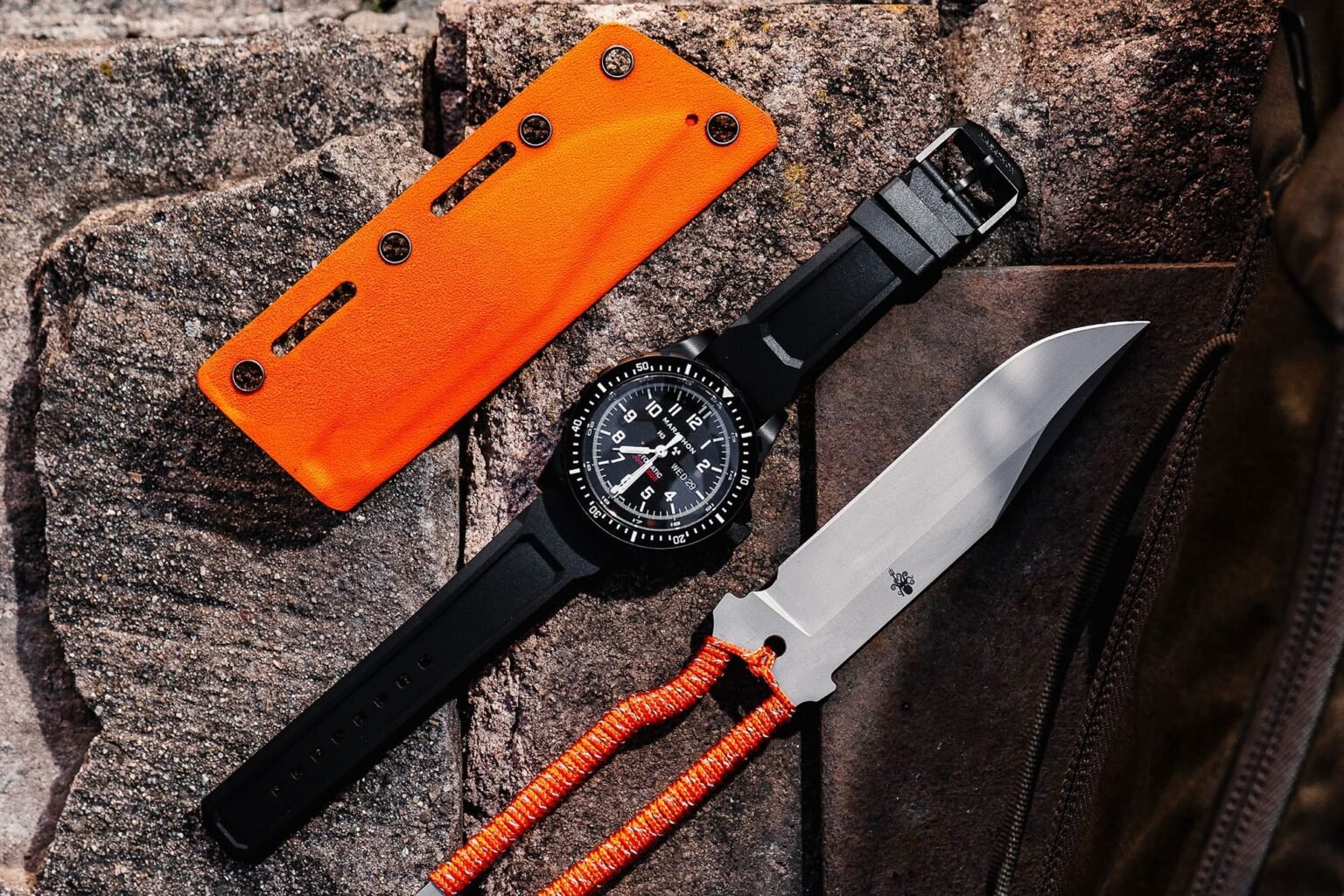
That simple pivot became the story of the trip. Freediving stripped the experience down to its essentials. There were no heavy tanks, no air management concerns, and no complicated equipment considerations beyond fins, mask, snorkel, gloves, wetsuit, and of course, a dive knife and Marathon watch. The focus became movement, awareness, and reacting to the ocean in real time.
As the group carefully descended toward the water carrying their slimmed down kit, the sea itself seemed to reward the decision almost immediately. A gray whale and her calf surfaced just offshore, sending a wave of disbelief and excitement through the group. For some, like Brock Stevens, it was the first whale sighting of their lives.
Come On In, The Water’s Wet
“Come on in, the water’s wet!” called Aaron, already up to his armpits. It was a balmy 54°. Beneath the surface, however, Jade Cove revealed itself in full color. Kelp forests swayed in the surge while sea stars, anemones, algae, and abalone covered the rocks in vivid oranges, greens, ochres, and pinks. Every inch of the underwater landscape felt alive.
It was also physically exhausting. The surge moved divers back and forth across the rocky bottom in persistent intervals, carrying them more than a dozen feet before reversing direction entirely. Visibility shifted constantly, and every short breath-hold dive required careful timing and positioning. Searching for jade quickly became equal parts patience and obsession.
At first, nearly every green stone looked promising before revealing itself as ordinary rock. Gradually, though, subtle differences began to emerge. Small translucent fragments appeared among the darker substrate, followed eventually by unmistakable pieces of smooth, luminous green jade resting beneath the swirling surf. Jade fever had officially set in. Divers surfaced holding stones aloft with equal parts triumph and disbelief while comparing finds between breaths and waves.
Against the odds, and after nearly abandoning the mission altogether, the group had succeeded, not by overpowering the environment, but by adapting to it.
Why the Dive Watches and Gear Still Mattered
Like any good Windup story, the weekend inevitably became a conversation about watches. Former Coast Guardsman Benjamin Lowery pointed to Marathon’s unusual place in military watch history as part of the appeal. While many analog military-issued dive watches disappeared once digital watches became dominant, Marathon remained a legitimate operational tool long after most competitors faded from active service use.
That authenticity matters to people who actually spend time outdoors. In difficult conditions, simplicity becomes valuable. Large markers, highly legible dials, and straightforward functionality matter far more than complexity when visibility is poor and attention is divided between waves, rocks, currents, and breathing. The same philosophy extended to the broader equipment used throughout the trip, which made Prometheus Design Werx a natural partner for the expedition.
Asha Wagner talks about how real-world gear quickly reveals whether thoughtful design decisions exist beneath the aesthetics. Small details, like keeping backpack straps elevated so they don’t drag through mud when set down, become surprisingly meaningful when operating in difficult terrain. In environments like Jade Cove, utility has a way of cutting through marketing language very quickly.
Nobody Owns the Ocean
By the end of the weekend, everyone walked away with something. Some left with pieces of jade tucked into wetsuit pockets and gear bags. Others carried home memories of whales surfacing offshore, cliff descents through the fog, freezing Pacific water, and the kind of improvised teamwork that only happens when the best laid plans start to unravel.
But the deeper takeaway had less to do with treasure itself. For Aaron Potash, the spirit of Jade Cove connects directly back to the divers who made places like this legendary decades ago. Those old California divers weren’t reckless thrill seekers. They were explorers, improvisers, and problem-solvers who understood that meaningful adventure rarely unfolds exactly according to plan.
Aaron summed up that philosophy simply: “Nobody owns the ocean. No one can tell you no. If there’s something meaningful out there, you figure out a way to pursue it responsibly.”
That mindset ultimately became the defining theme of Windup in the Bay 2026. The experience was not about chasing adrenaline or conquest. It was about adaptation, improvisation, shared experience, and the increasingly rare feeling of stepping away from the algorithm long enough to have a real adventure with real people in the real world. For one unforgettable weekend on the ragged edge of California, that’s exactly what happened.
The post A Fistful of Jade: Windup in a Bay 2026 with Marathon & Prometheus Design Werx appeared first on Worn & Wound.