

In Greek mythology, there is the well-known story of Icarus, a heady youth whose lofty aspirations send him flying on homemade wings of feathers and wax. In its cautionary denouement, Icarus flies too high and gets too close to the sun, melting the wax, sending him crashing back to Earth. If Carina Massone Negrone knew the story of Icarus, she would also likely have known that the greater the altitude, the danger is not the sun’s heat but extreme cold and a lack of oxygen. And yet, in 1935, the Italian aviator set an altitude record in an open-cockpit piston-powered airplane that remains unbroken to this day. Tudor has just debuted a short documentary film about Negrone, called “La Pilota: The Daring Story of Marchesa Carina Massone Negrone”, which covers the flying pioneer’s remarkable life and the watches—Tudors, of course—that she wore.
Carina Massone Negrone was a “marchesa,” a noblewoman by her marriage to a marquise, and could have enjoyed a life of ease in her palazzo in Genova. But her adventurous spirit compelled her to pursue activities that might have seemed “unladylike” in 1930s Italy. She was an avid swimmer and skier and fished the Mediterranean for sharks. And in 1933, at the age of 22, she took flying lessons from an Italian fighter pilot and became the first woman to get her pilot’s license from the Reale Unione Nazionale Aeronautica. Only a year later, she set an altitude record for a seaplane by flying to 5,544 meters. But she wasn’t done yet—far from it.
The cruising altitude of modern jetliners is between 35,000 and 40,000 feet. Passengers sit comfortably in a heated, pressurized cabin, sleeping, drinking weak coffee, and watching movies. In 1935, when pressurized airplanes were still a decade away, Carina Negrone, aged 24 and only two years after getting her flying license, took off in an open-cockpit Caproni biplane and climbed to 12,043 meters (39,402 feet). To combat the extreme cold and paucity of oxygen at that extreme altitude, she wore a specially heated jacket and breathed from a compressed oxygen cylinder. It was an extraordinary feat and set a women’s altitude record for propeller aircraft that still stands.

Carina Massone Negrone with a plane.


Stories like that of Carina Negrone abound, but so many become lost to history and obscurity. There is a statue of Negrone in her hometown of Bogliasco, Italy, and a commemorative postage stamp featuring her likeness. But I’d venture a guess that the great majority of readers have never heard the name Carina Negrone or of her flying records—until now. It’s a funny thing how watches can be vehicles for stories, and this is another example.
Tudor seems to have a keen interest in unearthing lesser-known stories of extraordinary human endeavors. Longtime readers might recall the story of the Tudor watch that stopped a bullet during the Vietnam War. Hodinkee produced two short films about the soldiers involved, their reconnection 50 years later, and Tudor’s restoration of the watch. And then, last year, Tudor itself produced a documentary film about the U.S. Navy divers who were tasked with the recovery of Apollo space capsules upon their return to Earth. Sure, there are watches involved, and there is undoubtedly a marketing angle involved, but these stories stand on their own for the inspirational human element.
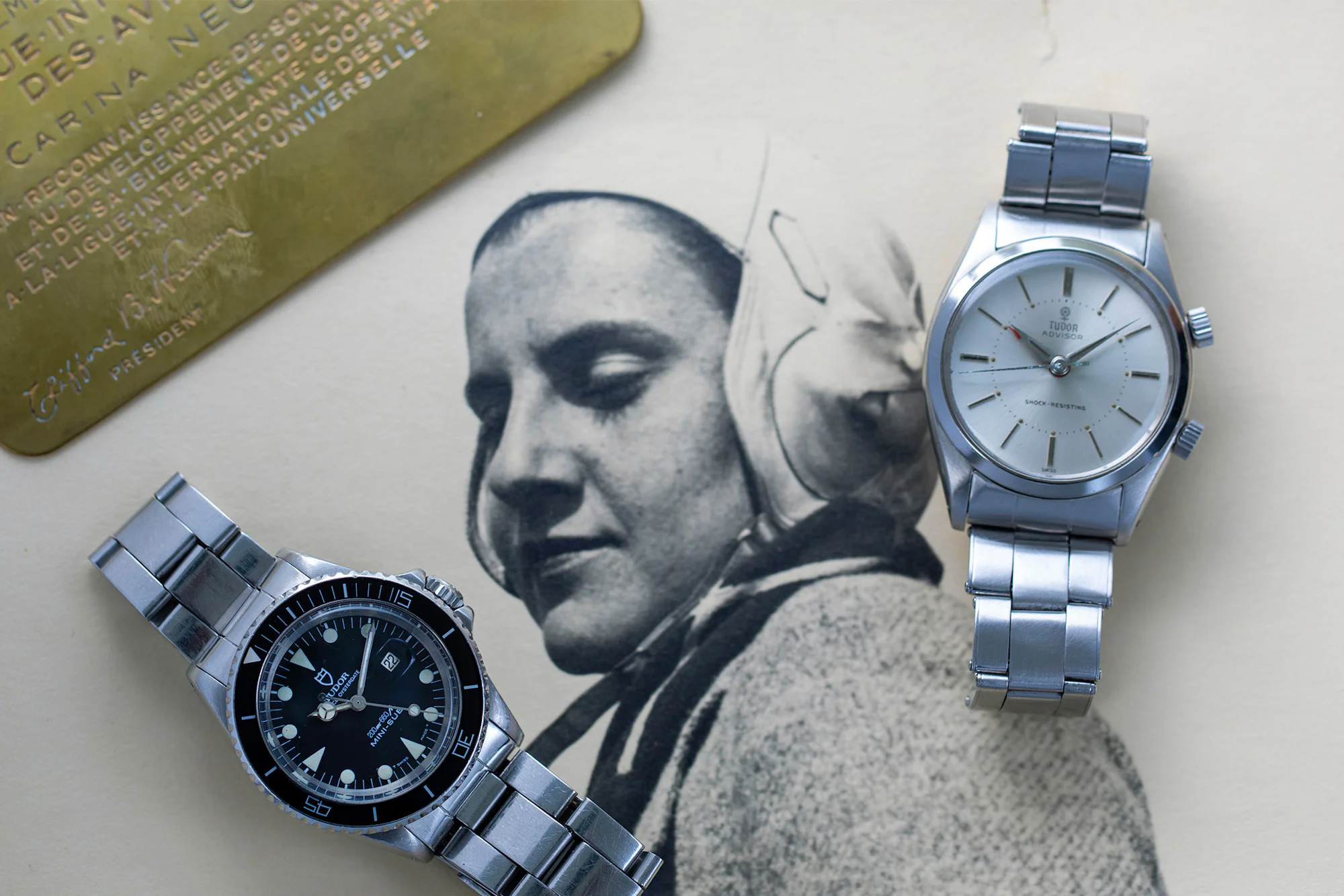
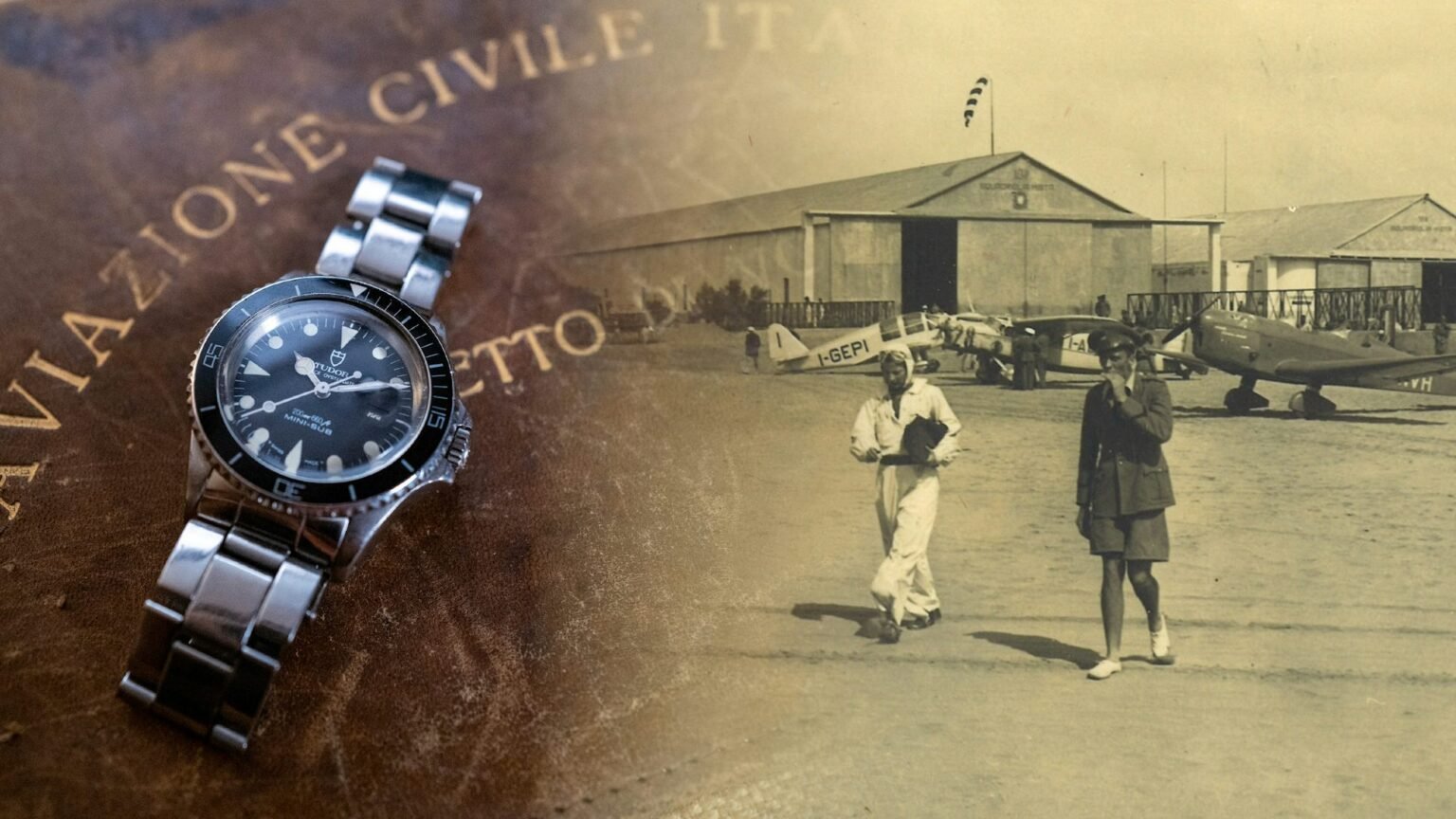
The two Tudor watches owned by Carina Massone Negrone and featured in “La Pilota: The Daring Story of Marchesa Carina Massone Negrone”.
So how are Tudor watches tied to Carina Negrone’s story? First of all, no one can be sure whether the pilot wore a watch during her altitude record-setting flight, and, if she did, whether it was a Tudor. But two of Negrone’s later watches remain with her family, Tudors she wore regularly. One was an Advisor from the 1950s, Tudor’s twin-crown mechanical alarm watch, and the other a ref. 73090 Mini-Sub dive watch. The latter was probably bought to accompany Negrone on her more aquatic forays—deep-sea fishing and swimming. And the Advisor served as a daily alarm, according to Negrone’s grandson, Jos, who appears in the Tudor film, and whom I interviewed for this story. When he was growing up, his grandmother, long since retired from flying, lived downstairs. He remembers hearing the mechanical buzz of her watch. I asked Jos Negrone about his grandmother’s love of watches.
“I don’t think it’s correct to say that she had love for watches. She did not collect watches and… I think it’s more correct to say that she needed watches, which is different, no?”

Carina Massone Negrone’s flight logs show the record-setting flight to 12,043 meters (lower, right page).

Negrone’s Tudor Mini-Sub.
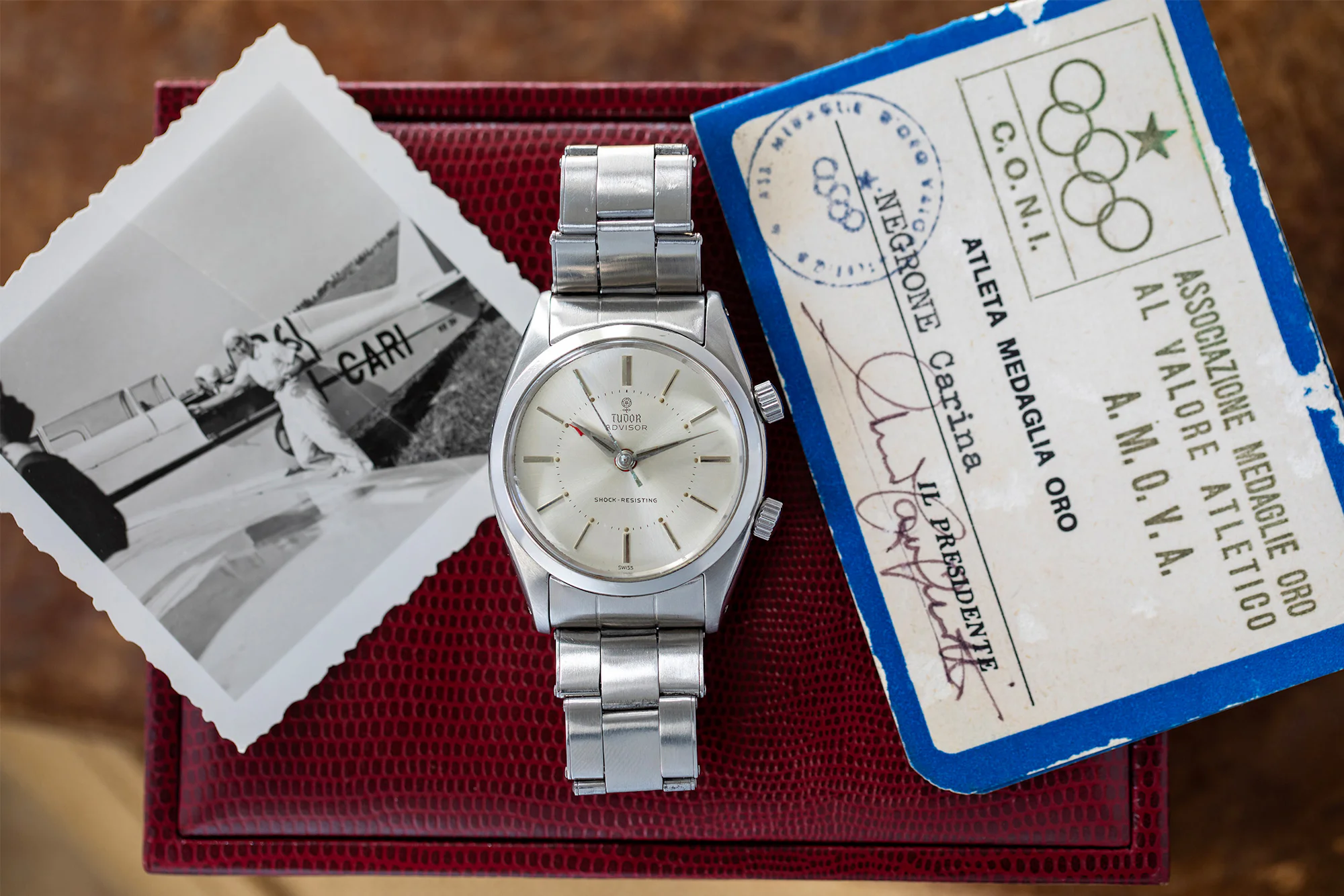
Negrone’s Tudor Advisor.
True enough. A mechanical alarm, whether a bedside clock or a wristwatch, was the most reliable way to wake up in the 1950s, and she wore the Advisor for decades following. It’s possible, even likely, that a Tudor was on her wrist during some of her later record-setting flights, including a 3,000-kilometer journey from Brescia, Italy, to Luxor, Egypt, during which she maintained an average speed of almost 300 kilometers per hour. But why Tudor? It would have been more predictable, even fitting, for a mid-century, adventuresome, aristocratic woman to wear a Rolex or maybe an Omega.
“Tudors have always been the clever choice in our family,” Jos told me. “Because they had the quality of a Rolex, but were a little bit cheaper. It was for people that want quality but don’t need to show off with an expensive watch.”
Jos went on to tell me that Tudors were often given as gifts in the Negrone family, including his own Big Block chronograph, which he received when he turned 18. Of his parents’ philosophy, he said, “We gift you with the least we can pay for the maximum quality… the shiny part—the Rolex part—the expensive part, if you want that, you would buy it on your own.”

Negrone’s Tudor Mini-Sub.
The film “La Pilota” leans heavily on archival footage and photographs, interspersed with interviews with grandchildren Jos and Madalena, as well as an aviation museum curator, to provide context for Negrone’s accomplishments. While there are the obvious references to the Tudor watches Negrone wore, they feel natural to the story, the entry point to the story instead of its focus. As with the Splashdown film, Tudor threads the needle in creating a marketing vehicle that isn’t overbearing in product placement. This shows the confidence of a brand that recognizes that highlighting accomplishments reflects well on the watches the people who achieved them chose to wear. There is also a through-line of commitment to telling these stories, and I can say with some certainty that more films and stories like this are to come.
Nowadays, a lot of watch content can feel overly packaged, disingenuous, and hyped. So it’s refreshing to see stories like this film from Tudor that center on a person, inspiring accomplishments, and the supporting roles that watches play. A personal motto of mine is”it’s not about the watch; it’s about what you do while wearing it,” whether that’s recovering a spacecraft bobbing in the ocean, flying into thin air, or any challenge we can invent for ourselves. A watch can be a talisman, a companion, a keeper of memories, and an inspiration to reach new heights.