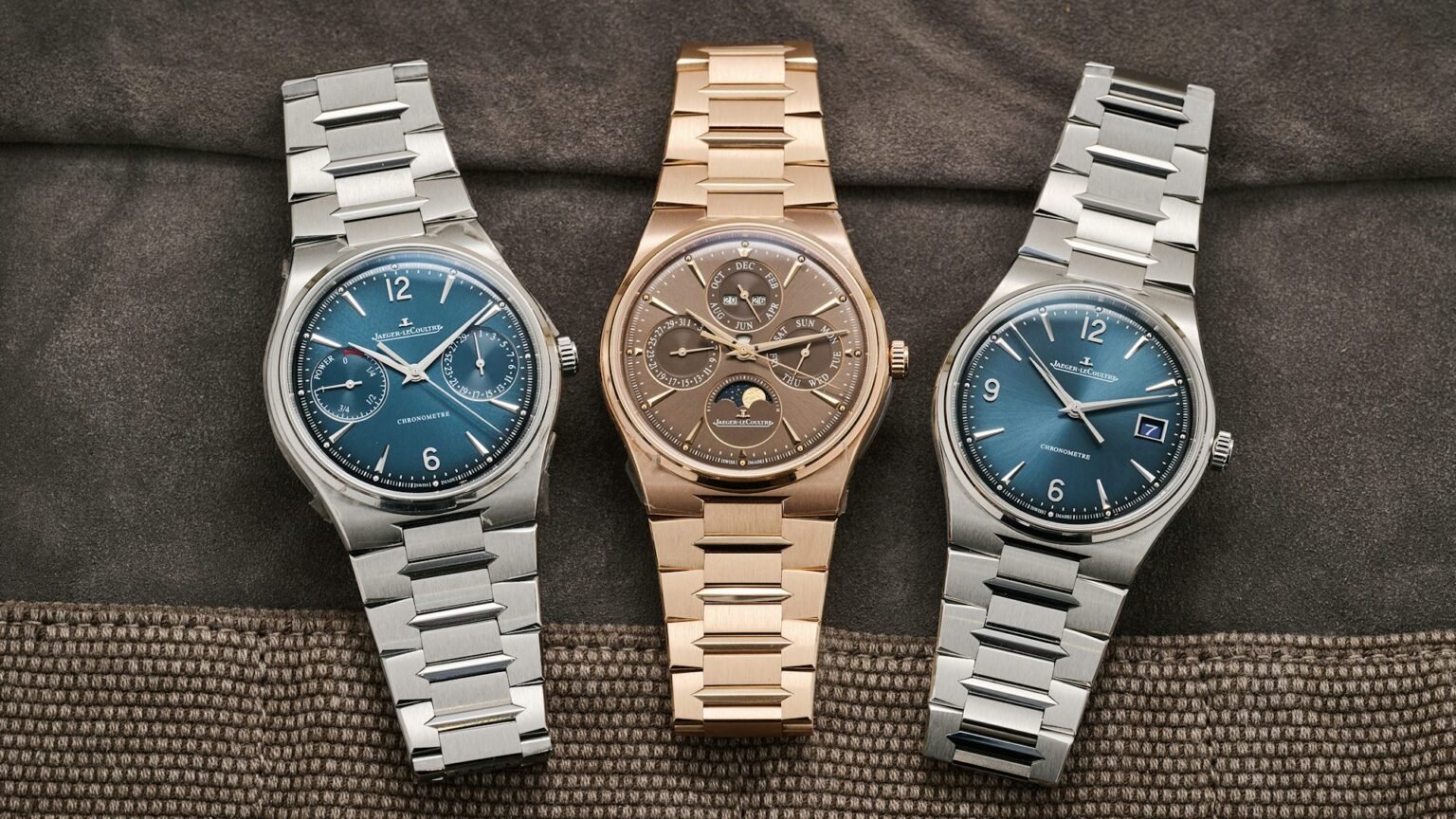


We’re a few months removed from Watches & Wonders, which gives us some clarity about what was buzz, what was hype, what fell off the wish lists, and what will be a long-term winner. It’s looking like Jaeger-LeCoultre had one of the best releases of the fair with the Master Control Chronomètre series. The Master Control line has largely been a dressy take on traditional design cues for a brand people usually think of first for its Reverso. But now, JLC has shown that Master Control can do more.

More than just a new case and bracelet, all watches are in-house chronometer-certified 4Hz, 70-hour power reserve movements (COSC does the certification) with a new High Precision Guarantee (HPG) seal, which supplants the former 1000 Hours Control. That new HPG seal means that the brand trials cased watches on four daily-wear specific issues—shocks, positions, altitude, and temperature—over three days, while guaranteeing eight traditional techniques of quality aesthetic finishing. The watches I photographed were brand new and wrapped in plastic, so you have to look past a bit of that to see the quality, but it certainly is there in person.

Now with three models in steel and rose gold, with five SKUs (one watch only comes in steel and not gold), measuring 38mm by 8.4mm or 39mm or 9.2mm with 50m of water resistance, the new line brings a lot to the table. Inspired by the brand’s Master Mariner Chronomètre line, launched in 1973 as their offering for an integrated bracelet (or adjacent, as it was a somewhat nascent and kind of half-hearted design). All the models are far more refined, 50 years later, and almost deserve their own stories. Instead, we’re going to take them all briefly one at a time, starting with the entry level and moving up.
Jaeger-LeCoultre Master Control Chronomètre Date
If you’re looking for something that straddles dressy aesthetics and useful basic complications with the touch of integrated bracelet sportiness, you have to start by looking at the MCC Date. It carries over the familiar look of the Master Control Classic, with a framed date window and central seconds, but swaps the dress watch look, and soft white dial for the bolder look of rose gold with a chocolate brown sunburst dial or stainless steel and a blue sunburst dial.

The true entry point is the MCC Date in steel, for $14,200. The blue soliel finished (sunburst) dial is somewhat unusual for the market, since it’s not exactly a dark and reserved blue, but it’s not bright and punchy either. It sits somewhere in between, with a bit of a dark, icy quality. The color-matched date wheel does its job well, though with its different texture, it doesn’t quite disappear to the eye. The case-matched date window draws the eye, anyway, which is the point, I imagine, but it’s not too distracting.

The brown color is soft as well. I’ve joked with TanTan and Ben that this is like the Honeygold Odysseus, in a way. Brown on rose gold never looks bad, but by softening up the color here as well, it does a good job of trending toward a monochrome color. The contrast. The date window looks better matched from a distance on the steel and better close up on the rose, though that won’t make any difference in buying decisions, I’m sure.


On the wrist, it fits quite well, measuring a slightly smaller 38mm by 8.4mm compared to the other two models. I didn’t really notice the difference in width in person, but maybe a bit of the thickness. And yet, it sounds crazy to say that 8.4mm somehow feels different than the 8.1mm of a Jumbo Royal Oak, for instance. Maybe it’s just how the whole case fits on the wrist, but it’s just the truth.
The rose gold models do a lot to highlight the complex, well-thought-out design of the integrated bracelet. You have clean, sweeping lines from the case to the bracelet, faceted and polished, with brushed top surfaces on the three-link design, and a polished hexagonal-cut segment between the link connections. It’s incredibly well done and far more complex than a Nautilus or Royal Oak, but at a much lower price. However, between $14,200 in steel and $52,500 in rose gold, there probably isn’t much overlap between the two watches on the market.


Jaeger-LeCoultre Master Control Chronomètre Power Reserve
Next up is the Futurmatic-inspired MCC Power Reserve, which feels like the far-and-away standout of all three. Only available in stainless steel, the retail price is $17,000, which starts to feel a bit high for pricing, but the experience and the quality make a good argument for it. Here, you still get the date, but as a circular display in a subdial balanced against a power-reserve indicator at 9 o’clock, it just benefits the watch so much with that balance, something the date version lacks.


The Caliber 738 movement measures only 4.97mm thick, but unfortunately, it has one downside from the movement in the date version: the date has to be set with a case pusher. Everything else seems quite nice, and though the finishing isn’t artisanal, it’s much better than some other brands offer with their movements at and around this price. And, to recap, it’s the same 4Hz and 70-hour power reserve basic metrics that the rest of the MCC line has.


I talked about the bracelet construction before, but I’ll elaborate a bit further here on some other things you’ll notice about the case and bracelet. The taper is soft, going from 20mm to 18mm, with a slightly hidden button for the butterfly deployant clasp and a hidden micro-adjustment system that allows the bracelet to be opened up a few millimeters for “winter and summer sizing” according to JLC.
But when I saw these watches in person after missing Watches & Wonders, JLC CEO Jérôme Lambert pointed out a feature that becomes apparent on the wrist. The brand purposefully dropped the end of the case down pretty abruptly so that the watch—here 39mm by 9.2mm—should fit a wide variety of wrists.


You can see how the light can shift the blue dial darker (sportier) and lighter (above, which is a bit dressier), and allows it to work in a variety of different conditions. While the perpetual calendars are out of my price range anyway, I think even then I would naturally gravitate toward the Futurematic-inspired design.

Jaeger-LeCoultre Master Control Chronomètre Perpetual Calendar

The big boy here, at least when it comes to price, is the MCC Perpetual Calendar. At $45,700 in stainless steel and around $100,000 in rose gold (though officially “Price on Request”), these are obviously more serious propositions for a different level of collector. Yet, when compared to the MCC Power Reserve, it’s no larger.

The more complicated the watch gets, the better the brown dial looks to my eye. Maybe because it gets away from that Lange comparison I mentioned, since the Honeygold Odysseus doesn’t have a four-subdial QP layout and the added wrinkle of the leap year indicator over the center post. There’s the date at 9 o’clock, the day of the week at 3 o’clock, and a moon phase at 6 o’clock. JLC’s design places the month and year on the 12 o’clock subdial, which points to one slightly unfortunate fact.

The caliber 868 inside isn’t new (though it has a high certification), but the perpetual calendar movement is modular. In fact, it uses the same module used by (and invented by Kurt Klaus for) IWC, which isn’t a bad thing in itself. IWC leaped ahead with the ProSet perpetual calendar, which now allows the module to work forward and backward for IWC watches. But here, with the watch not set via the crown but by a pusher in the caseband, and with the inability to set it backward if you accidentally go too far, the watch is a bit behind its Richemont brethren. I also think that year indicators are a bit unnecessary. If you normally forget the year, you may have other issues than setting your watch.


The same thing as said for all the other watches can be said for the case and wearing experience on the wrist. The other Richemont option for an integrated bracelet perpetual calendar that comes to mind is Vacheron’s Overseas Ultra-Thin QP. Here, you’re 1.1mm thicker, but you save around $70,000 by choosing a steel model versus white gold, or even then approximately $30,000 in rose gold versus Vacheron’s gold options. So is the savings versus thickness worth it?


I do think that, despite my personal preference for the MCC Power Reserve, the MCC QP is the place where Jaeger-LeCoultre can pick up some serious market share. The IWC Ingenieur Perpetual Calendar is 41mm and 13.3mm thick, though $4,900 cheaper. Is that a trade-off I’d make? Most likely yes, with the added benefit of a cleaner look.

The IWC Big Pilot Perpetual Calendar is almost $10,000 cheaper, but at 46.2mm wide, it’s not even in the same world and a totally different use case. Frederique Constant’s Highlife Perpetual Calendar is now over $10,000 and at just shy of $12,000, but what it shares in visuals, it just doesn’t come close in terms of quality and finishing. When you look at the market, you can see all the places where JLC comes out as a winner.
Final Thoughts
This release fills a somewhat glaring gap in the JLC catalog. Some people won’t be a good fit for the Reverso, which already has a hard time being anything near sporty. While the Master Control was a solid line, it could be very stuffy and formal for a younger audience or for someone looking for a watch that suits many situations. The Polaris is still the king of sporty watches for JLC, but it’s very sporty and, aside from its limited use cases and the single 40mm version, it also wears a bit too big for a lot of people. The only other downside, however, is that the 50m water resistance feels like an area where the brand could have pushed to put the watches ahead of the likes of Patek and AP.
What JLC did well, however, was finding a good option to fill that gap. The Master Control Chronomètre isn’t a forced release like some that we see, where brands try to push up or down the sizing spectrum to grab some market share. Even in a vacuum, I could see the MCC as a successful launch for the brand and a strong foundation for future development.