

The watches that prove commercial and collector successes emerging from Watches and Wonders 2026 will have climbed a wall of worry. There was plenty to fret over heading into the watch industry’s largest and most important annual salon this year. The eruption of war in the Middle East challenged travel plans and clouded the outlook for visitors from the region and beyond. Indeed, sales have certainly been impacted in the Middle East, and the question remains how quickly stability might return.
The existing bugbears of the watch sector – rising input costs from raw materials, including record gold values, ongoing U.S. tariffs, not to mention the continued strength of the Swiss franc, as well as years of retail price increases – remained omnipresent. All told, these factors could have set the stage for a subdued, cautious event. Instead, the industry converged in Geneva, striking an optimistic and inclusive tone where it worked hard to show it’s been paying attention to the demands of clients and customers with new watches that drove home a theme of demonstrating value in often, but not always, familiar packages.

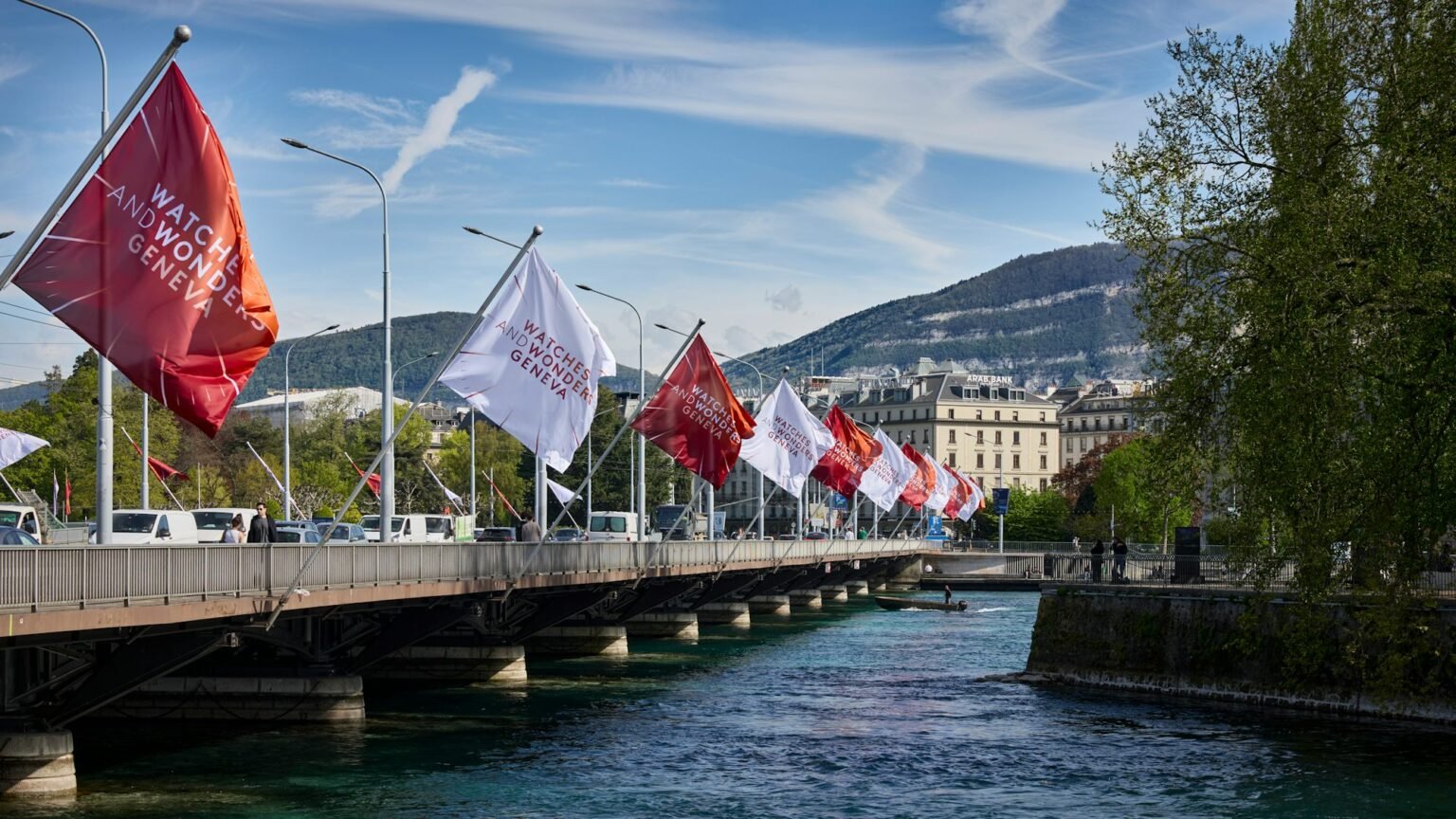
With public-facing events including Montreaux Jazz concerts in the Geneva city center, Watches and Wonders emphasized its role as a cultural tent pole for the industry and the Swiss watchmaking region, aiming to be more open and welcoming. The new, more public-oriented strategy certainly paid off as attendance jumped to nearly 60,000 unique visitors, a record for the Salon, amounting to a solid 9% increase overall compared to the year before.
Cyrille Vigneron, the chairman of the Watches and Wonders Geneva Foundation, says the event has become even more conscious of the need for inclusiveness and public interaction. With 65 brands at Palexpo in 2026, up from 55 the year before, it continues to welcome new marques and products representing a wider spectrum of categories, tastes, and origins.
“We want to avoid simple luxury to become not only too much, not only exclusive, but something that is kind of a ghetto that goes so far as excluding people. We want to invite everyone to appreciate the beauty of what is there,” he says.
The intention, he adds, is to publicly showcase watchmaking in Geneva in the spring as a “moment of joy.” Judging by the enthusiasm and attendance surrounding the week-long bounty of events and gatherings, the mission was fulfilled. The best new watches offered by the top brands represented fresh considerations in wearability, innovation through new mechanical technology or materials, and straight-up value propositions at approachable pricing.

Rolex set the tone, as it almost always does. Celebrating the centennial of the Oyster case, which is present across the model line (except for the dressy 1908 collection), underscoring the value of the most important case design in watch history. We saw a new Oyster Perpetual priced at the same level as other base models, with the design-driven, audacious Jubilee dial revived from the late 1970s in a more playful, colorful updated form. We saw special edition OPs in Rolesor and some dainty, full gold, brushed models in yellow and Everose gold – a true surprise. And, of course, a new gold alloy, Jubilee Gold, the first from the Rolex foundry in more than two decades, that gives more choice to clients seeking precious metals. This in-house-developed and produced gold hue marks a departure from yellow, Everose, and white gold, combining elements from all three for a fresh interpretation of what a gold Rolex watch can be. Available just on special Day-Date 40 models for now, we expect the new alloy to be offered in more models in the years to come.
At sister brand Tudor, another surprise: the Monarch. As the brand reminds us, it can intrigue and create beyond iterations of the vintage-diver-inspired Black Bay and the modern utilitarian workhorse Pelagos. With a new, in-house, METAS-certified, well-finished movement featuring a small seconds display, a razor-sharp faceted case coupled with a matching new bracelet, and a heritage-driven, error-proof ‘California’ dial in a champagne shade meant to evoke the look and texture of papyrus, the revived Monarch offers something definitely unexpected from Tudor.

Jaeger-LeCoultre returned to the same category with ambition and style, offering a thin model that is sure to compete. The Master Control Chronometre is available in stainless steel or pink gold in three configurations, including an entry-level time-and-date model in steel priced just above €12,000 and a perpetual calendar in steel priced under €40,000. There’s also a date-and-power-reserve model in steel priced under €15,000. All the MCC models are, for the first time for the brand, COSC certified, and they also include JLC’s new ‘High Precision Guarantee’ that offers in-house testing and certification, ensuring the watches will remain accurate during altitude changes, daily wear positions, resist shocks, and perform in a range of temperatures. Not only are the steel models competitively priced considering the brand’s quality, design, and movement-making prowess, but the new certifications also demonstrate an added level of worth for customers comparison shopping in the crowded category.

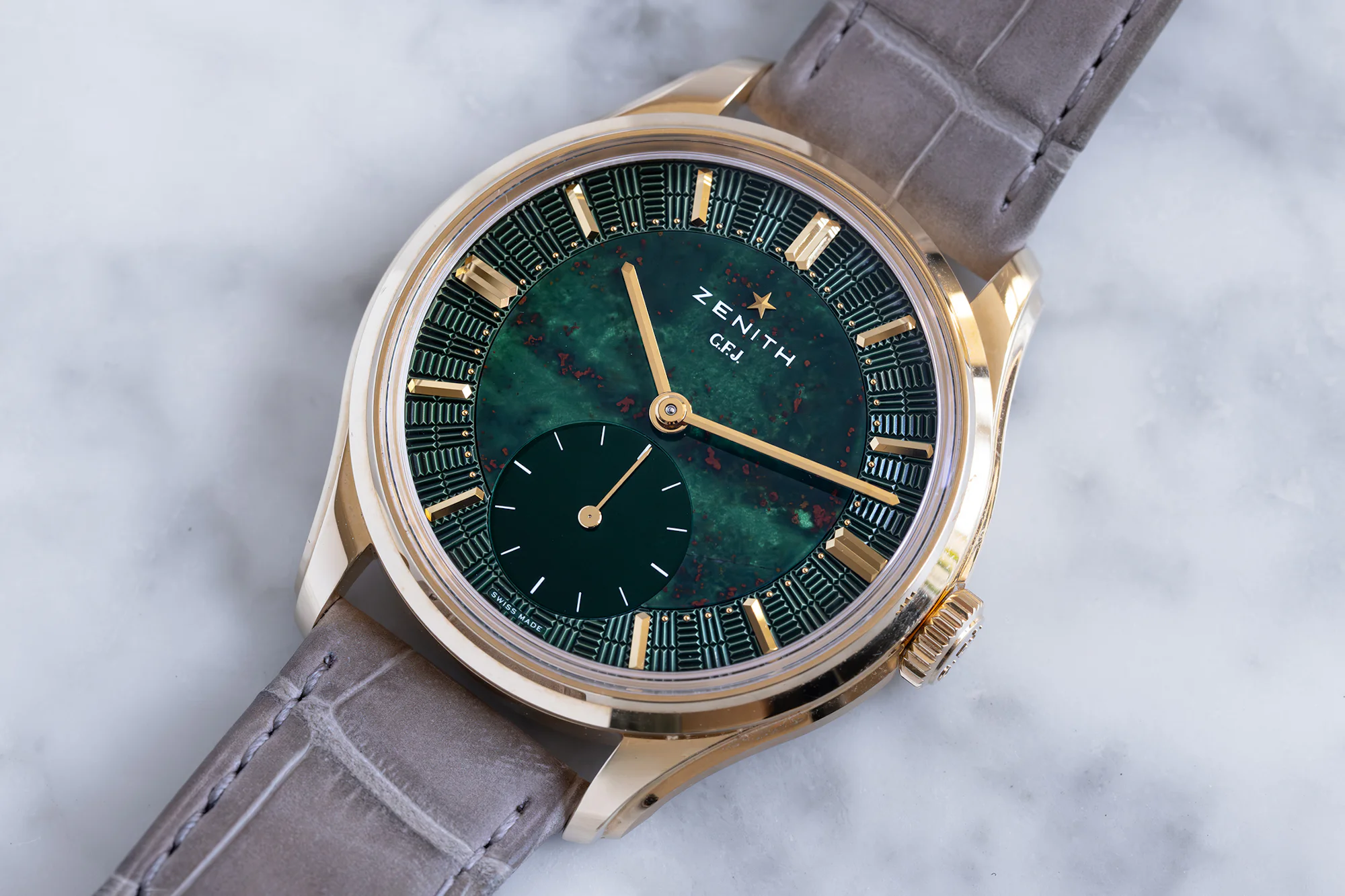
At enthusiast favorite Zenith, new iterations of the G.F.J. showcase the upscale model line, driven by a new version of the historic observatory-accuracy competition-winning 135 caliber, which is here to stay and will be part of the collection for years to come. The yellow gold with bloodstone and tantalum with onyx dial cased models demonstrated that G.F.J. offers a range of possibilities for future iterations and collaborations.
But perhaps the most customer-driven new product from the brand is a micro-adjustment, double-secure, patented bracelet clasp for the Chronomaster Sport that offers elevated comfort and sizing. Zenith executives told us they’d been working on the new patented clasp system for about three years to perfect on-the-wrist, tool-free resizing, with 2.5mm increments for a total range of 10mm. Perhaps the best part is that the clasp will soon be available for existing Chronomaster Sport customers to purchase separately and fit to their own model as a bracelet upgrade. We’re awaiting pricing details.

From Japan, Grand Seiko finally gave us the ultra-high-end, world record level accurate, spring-drive dive watch in a size smaller than 41mm that fans have been asking for. The Spring Drive U.F.A. Ushio 300 Diver demanded attention. Powered by the Caliber 9RB1 UFA with “Ultra Fine Accuracy” of ±20 seconds per year (a world record, by the way, from a caliber introduced last year), the High-Intensity Titanium case measures a relatively compact 40.8mm by 12.9mm, a significant reduction from previous Spring Drive divers.
The bracelet is made of the same material and features 6mm of microadjustment in 2mm increments, and an 18mm dive extension. With classic green and blue variations of the brand’s “Ushio” tide-inspired fumé dials and a 120-click unidirectional bezel with a ceramic insert, it’s a user-friendly-sized expression of an ultra-luxury diver with 300 meters of water resistance. At $12,400, it’s not an inexpensive proposition, but it does offer the most accurate movement available on a diver with materials and finishing that are arguably best in class.
“It meets the demands of global consumers as Grand Seiko evolves from the historical Seiko diver’s watch,” Akio Naito, the President of Seiko Watch Corporation, says in an interview regarding the Spring Drive U.F.A. Ushio 300 Diver.
Executives at Cartier also underscored their aim of responding to the market and consumers. The Roadster, a watch that debuted in the early 2000s and disappeared around 2012, returned in a more refined, slimmer case, due in part to customer interest and nostalgia for the bold, automotive-inspired design that certainly stands out in the current line-up.

“We see more and more clients asking for the Roadster,” Chief Executive Officer Louis Ferla says, adding that the model gives clients the choice of another sporty option in the lineup in addition to the Santos.
The Cartier range is mostly elegant models based on well-established, century-old designs, including variations of the iconic Tank and the Santos Dumont. The Santos Dumont was enhanced and upscaled this year, with new models featuring ultra-fine, intricate bracelets in precious metals. As the standard Santos on a bracelet was, perhaps, one of the only truly sporty options, the return of the Roadster complements that watch in a very different package, giving clients more choice and more value options within the lineup.
“That notion of fair value is very, very important for us,” Ferla says. “We want to ensure that when the client comes to a boutique, they have a very good product for the amount of money that they spend.”
At Patek Philippe, models to mark the 50th anniversary of the Nautilus were truly surprising in their restraint, minimalism, and extraordinarily thinness. Aside from the fact that they are made of precious metals rather than steel, these unexpected models could be said to almost amount to fan service. It’s hard to complain about that. Without a date and seconds hand, the 5810G at 6.9mm is thinner than the original Nautilus 3700, while keeping the ‘Jumbo’ proportions of 41mm in diameter. And then there’s the 38mm 5610P that keeps the same format and thickness, thanks to the novel and surprising use of the historic Caliber 240, and reduces the diameter to an even more user-friendly and wearable 38mm ‘medium’ size in platinum.
As Patek has, for years, been trying to play down the prominence and outsized role of the Nautilus in its catalog with the discontinuation of the 5711 and the launch of the controversial Cubitus in steel, these client-focused anniversary models were, quite simply, a welcome and unexpected home run.

On the innovation front, perhaps the biggest surprise of the show was the Tonda PF Chronograph Mysterieux from Parmigiani Fleurier. While its refined turquoise dial, platinum bezel, and restrained steel case represented a further refinement of the brand’s quiet luxury persona, the novel way of presenting a chronograph was truly revelatory. The hidden-hand trick and leap-forward of the brand’s previous GMT Rattrapante and Minute Rattrapante models were taken to a whole new level.
The Mysterieux offers a new kind of chronograph where the complication is hidden until the monopusher on the left case side is activated. While the 13mm case thickness is notable, it still seems thin given that there are five hands on the same axis that spring into action when the chronograph function kicks in. Priced at $44,600, it offers a completely new way to consider and use a chronograph, in one of the most refined and elegant watch design languages on the market.

TAG Heuer also brought real innovation to the chronograph with its Monaco Evergraph. The new TH80-00 movement eschews the traditional column-wheel or cam-based chronograph. Instead, it uses a compliant mechanism with flexible components made of nickel phosphorus that bend rather than pivot to actuate the chronograph function.

That means less friction, less lubrication, and potentially a much more durable chronograph with a unique feel when using the complication. Produced with specialized movement maker Vaucher (that also produces movements for Parmigiani), it’s a big leap forward for the brand’s ambitions to bring more of its chronograph movements in-house or use proprietary movements and technology that aren’t available elsewhere.
Priced at $28,500, it’s a major step up in price for a TAG Heuer regular-production chronograph, but it aims to compete on a research-and-development level that’s usually priced much higher at other brands offering similar upgrades and innovation.
Certainly, there were brands that made an impact by offering the highest value watches at the most approachable prices. Oris continued to dominate this end of the spectrum with the revived Star – an incredibly important watch in the brand’s history that was the first to be able to use a Swiss lever escapement, thanks to the tireless work of Dr. Rolf Portmann in his fight against the unfair restrictions of the Swiss Watch Statute. The reborn Star is a handsome, high-quality, classic timepiece priced at CHF 1,800, offering demonstrable value.
Frederique Constant, another value-focused Swiss brand, continued to show that it can produce haute horology complications at approachable prices with its smaller-sized, upgraded Worldtimer on a bracelet or strap, priced at just $6,195 for the two production models, and a special gem-set limited edition of 88 pieces priced at $9,995.

And finally, showing that Swiss brands aren’t the only ones aiming to demonstrate value, Frankfurt, Germany-based Sinn attended its first Watches and Wonders in 2026, and among the three new models debuting was the notable 544. The time-and-date timepiece with a no-nonsense matte-black dial offers a robust, simple, yet exceedingly well-constructed steel watch on a bracelet with a Swiss movement, and is priced at a very reasonable €1,740.
There was plenty of evidence this year that brands were trying to connect with clients and show they are well aware of their frustrations and pricing concerns. Some leaned into giving people what they want, such as a six-figure, platinum, ultra-thin Nautilus fan-service offering from Patek. Rolex celebrated the underlying value of its critically important Oyster case. Offering clients what they’ve been asking for was the move at Zenith, Grand Seiko, JLC, and Cartier.

Surprisingly groundbreaking innovation, while remaining uniquely elegant and understated, was the call from Parmigiani. Offering a truly new and unexpected chronograph movement at TAG Heuer that stands apart in its mechanics and price proposition, and an unexpected model revival and redesign from Tudor, grabbed attention. Then there were the clear value demonstrations from Oris, Frederique Constant, and Sinn.
It was a Watches and Wonders that saw the industry and brands working overtime to demonstrate they were listening to and trying to provide value to the end user, whether that be through design wants, mechanical innovation, or simply price-to-value comparisons. The inflationary economic reality of the post-COVID era has most certainly reset the parameters for the watch industry and pricing. These brands and their new offerings marked a bid to reconnect and make the case that value can still be discovered if you know where to look.