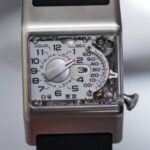
The last, but certainly not least, panel of Windup Watch Fair 2025 features Andi Felsl and David Sharp, CEO and COO of Horage. The two discuss the remarkable story of how Horage’s breakthrough in the world of mechanical regulation. It’s called MicroReg, and Horage believes it is a game-changer. Hear (or read) all about it, including an audience Q&A, below.
The following conversation has been lightly edited for brevity and clarity.
Zach Kazan
Hello everyone, welcome to the final panel of Wind-Up Watch Fair New York City 2025. This panel is sponsored by Horage, and I’m pleased to be joined by Andi Felsl, CEO of Horage, and David Sharp, COO of Horage. It’s a pleasure to have you both here. We’re going to be talking about Micro-Reg, a fascinating new technology developed by Horage—potentially game-changing in the watchmaking space. Andi, can you start by explaining what Micro-Reg is in layman’s terms, and how the idea came about?
Andi Felsl
Thank you for having us—it’s a pleasure to be the last panel of the fair. The idea dates back about ten years, when we were preparing for volume manufacturing of our first movement, the K1. At the end of assembly, I realized regulation was going to be a cost issue. Regulation is a costly exercise because it requires precision, and we don’t have the production volume of Rolex or Omega. We needed a different way.
I wondered: could we regulate the watch from the outside, while it’s being worn? Regulation has been a big issue for over a century. The Swiss watch industry spends an estimated 150 million francs per year regulating watches, yet customers are often unhappy. Since 2016, after our first production run of K1, I’ve been thinking about how to solve this.
Mechanically, it was too expensive. But I met people from a company called Swiss Sonic, founded by Elmar Mock, who had pioneered ultrasonic welding decades ago. He used ultrasonic technology to create actuators. I asked them: could you turn a screw remotely, like a watchmaker does, using an actuator? They said yes. That was the “aha” moment—realizing we could fine-tune regulation electronically, without opening the watch.
Zach Kazan
It’s sobering to think about the cost of regulation in those terms. Do you see this as something that could fundamentally change the industry?
Andi Felsl
Yes. I’d call it the last open frontier in mechanical watchmaking. Quartz was the first revolution, silicon was the second. Regulation remains unsolved. A watch might be COSC-certified in Switzerland, but after a flight to New York it may no longer meet that standard. Heat, cold, vibration—all affect precision. Traditionally, you’d need to reopen the watch and send it back for regulation, which is costly. With Micro-Reg, the user can adjust it themselves.
Some say precision doesn’t matter, but I disagree. People are happier when their watch is precise. Precision adds to brand value. If you don’t take care of it, you’re not serving the industry or the community.
Zach Kazan
David, how does Micro-Reg impact the experience of the watchmaker?
David Sharp
It affects both watchmakers and end users. If you ask most watchmakers what part of their job they least enjoy, it’s regulation. It’s tedious, time-consuming, and costly. Micro-Reg simplifies that.
The core movement still requires top-quality manufacturing and regulation within the COSC window of minus four to plus six seconds. But fine-tuning is where time is consumed. Micro-Reg expedites that. It doesn’t automate or replace skills—it allows a watchmaker to turn a screw in a defined manner. No watchmaker can guarantee turning a screw exactly two degrees. They test, adjust forward, adjust back. Micro-Reg lets them move it precisely.
Watchmaking already relies on precise tools—micro-dosers for lubrication, torque screwdrivers for screws. This is another precise tool for regulation. For users, it means they can safely adjust their own watch. It helps them understand regulation, which is often misunderstood. Conditions like heat, cold, altitude, or activity all affect performance. Micro-Reg gives owners a safe way to fine-tune their watch to their lifestyle.
Zach Kazan
It’s fascinating to imagine collectors making small adjustments themselves.
David Sharp
Exactly. Think of car collectors before electronic control units—you had to adjust timing for winter and summer. People understood engines needed involvement. Watches are delicate, so people are afraid to touch them. Micro-Reg opens understanding, with built-in safety. Owners can regulate their watch to their own usage, not just an arbitrary standard.
Zach Kazan
David, introducing something so new to a traditional industry must be challenging. How do you approach that?
David Sharp
The Swiss watch industry is slow to change—glacial, even. Resistant to change. But we’ve always thought differently. We wanted to stay true to mechanical watchmaking. Quartz, Spring Drive—those are accurate, but not pure mechanical. We wanted to maintain the heartbeat of a mechanical watch.
Micro-Reg doesn’t replace the balance or hairspring. It’s not a new regulating organ—it’s a way to fine-adjust the existing one. We call it “the sleeping watchmaker.” It sits dormant until activated, then turns the screw a defined amount. A watchmaker can still adjust it manually if they want. The traditional organs remain untouched.
It also removes risks: opening a watch introduces dust, scratches, or damage. Micro-Reg avoids that. Communicating this was key. Initially, investors asked if the industry would adopt it. We knew the market existed—850 million francs spent annually on regulation. To prove it, we offered early customers a watch for 4,000 francs, with no guarantee. Over 200 people took the bet. That proved demand.
Once Swiss media covered it, the industry took notice. Even Rolex asked about it. This technology changes the narrative around super chronometry and certification. With Micro-Reg, you can certify a watch in a closed case, reducing costs dramatically.
Zach Kazan
Beyond precision, does Micro-Reg open doors to other design possibilities?
Andi Felsl
It doesn’t make sense for tourbillons, but it works for everything else. We wouldn’t change our existing architectures much—we already use modularity. The next big step is chronographs. That will take three to five years, but it will likely include Micro-Reg.
Zach Kazan
David, how does this shape the broader conversation around in-house movement development?
David Sharp
That’s a big topic. Many “in-house” movements are re-engineered versions of existing designs, carrying old issues forward. We started clean-sheet, simplifying and rationalizing with modern tools. Micro-Reg reinforces that you don’t need to resist change. Innovation is possible in a traditional field.
There’s also a business logic. Brands relying on external suppliers risk losing access, as happened when Swatch stopped supplying movements. Smaller brands need smart partnerships and planning to secure their own movement technology. Consumers value in-house movements—they generate 20–30% more pricing power. Without that, it’s hard to sustain innovation.

Zach Kazan
What’s next for Horage?
Andi Felsl
We’ve always invested in IP, engineering, and supply chain rather than machines. But during COVID, we saw manufacturing bottlenecks. So we invested in milling and gear-cutting machines. Now we’re focused on building manufacturing cells of 3,000–10,000 units, shared among brands, to achieve cost efficiency and quality. We want to bring that infrastructure to the U.S. That’s our main project now.
David Sharp
From a product perspective, our modular K1 caliber allows simpler future development. We have iterations coming soon, including one with three features never combined before. Chronographs are a long-term goal, but challenging. Our K3 caliber was designed from day one with Micro-Reg in mind, making integration easier. That opens super-chronometry precision to lower price points, unheard of before.
We’ve slowed slightly to reflect on opportunities, but we have exciting launches ahead. In November, something new in the automatic/tourbillon sphere. In spring, a new watch and another left-field project. Plenty of innovation coming.
Zach Kazan
That’s very exciting. Horage is one of the most interesting brands today, with fundamentally different thinking. It’s great to hear about what’s next. Let’s open it up to audience questions.
Audience Member
Does the device give feedback on amplitude or beat rate, or just seconds gained or lost?
Andi Felsl
We have a microphone built in, but only use it to confirm an adjustment was performed. We don’t measure amplitude or beat rate like a traditional Witschi device, because that wouldn’t reflect real-world usage. Only the user can determine accuracy by time-graphed wear. We evaluated pros and cons and decided against misleading measurements.
Audience Member
What about magnetization? Could the device detect that?
Andi Felsl
We use silicon, so magnetization isn’t an issue. We tested recently with a client who works in MRI scanning—probably the worst environment for a watch. We put our watches in a three-tesla MRI scanner, and they all survived perfectly.
The post WU25 Panel: Horage and the Revolution of Regulating Mechanical Watches appeared first on Worn & Wound.