

“In times of war or uncertainty there is a special breed of warrior ready to answer our nation’s call. A common man with uncommon desire to succeed… I am that man.”
–U.S. Navy SEAL Code
A Note
Writing about the military – especially those who served our nation in the U.S. Armed Forces – is something I consider to be an honor, and it’s a responsibility I take seriously. The risk of sensationalizing or exploiting veteran experiences for media or corporate gain is too great and happens too frequently to leave that acknowledgement unstated. My respect for and personal relationships with the military population sometimes leads me to be overly cautious in my approach to these subjects to protect the privacy of the individuals or the institutions with which they are affiliated. Some experiences are off the record, and that is okay. The spirit of the story remains.
I also want to acknowledge that discussions of military history can be divisive. I am a U.S. military historian by training and that shapes how I think and write. But my perspective is just a small percentage of the many globally nuanced lenses that can be applied to this topic. The watch world is international, diverse, and certainly strong enough to withstand the contributions of many – even if our conclusions differ.
I am a civilian. After leaving school, I had the good fortune to work as a liaison to the U.S. Office of Veterans Affairs. Because of my educational background, I knew the facts and figures that allowed me to put accounts of my colleagues’ service into context. I was inducted into the unique conventions of military humor (decidedly not HR-approved), taught how to execute a perfect parachute landing fall (“PLF” to those in the know), and eventually, sometimes trusted as a confidant for memories that will burden the veteran for the rest of their life. I’d read the history books and it helped me understand. But the veterans had actually been there. They’d written the books.
Military service and the bonds of that particular kinship have their own language and culture. Those of us who haven’t experienced the same moments can build conversational understanding and forge the sinews of connection with some practice. But we’ll never be able to speak that language with fluency. I say all of this to help share my personal perspective on the ethics of a non-veteran discussing duty, sacrifice, and courage.

To write about watches is to write about those who wear them and the stories they choose to share. The truest meaning of those stories belongs, in the end, to those who lived them.
A New Way of War
John F. Kennedy didn’t know it, but he was living through the defining year of his presidency, and one of the most globally decisive moments of the twentieth century. It was 1962, and for thirteen days the world held its breath as it teetered on the precipice of nuclear destruction. A peaceful resolution that ended with the reduction of armament in Cuba and Turkey was a humanitarian victory, but one that was juxtaposed by the quiet expansion of America’s martial footprint in Southeast Asia.
However, the nature of warfare was changing. The First and Second World Wars are classified by historians as “total war(s),” in which a nation’s entire industrial and human capital are brought to bear against an enemy. But the invention of the nuclear weapons that put an end to further hostilities in 1945 altered the trajectory of warfare as it had existed since the dawn of time. No longer could nations unleash their full potential. If they did, the majority of the planet – and its many squabbling societies – would be snuffed out like a flame.

War had changed and the U.S. Armed Forces had to change with it. Covert operations became a primary way for the military agenda to continue through other means. After all, you couldn’t step on political toes if your hypothetical forces never left behind footprints… right? To that end, President Kennedy authorized the creation of a new type of elite force designed for maximum flexibility and multi-domain capability. Their missions would be high-stakes and their conditioning would render them unbreakable. The Navy SEALs had been born.
The Early SEALs
The first SEAL Teams were formed around 120 personnel from the famed Underwater Demolition Teams (UDT), affectionately known as the “Frogmen.” The nickname – derived from their minimal gear, rubber swim fins, and stealth swimming abilities – belied their serious purpose: to chart beaches and clear underwater obstacles to provide mission-critical intel and safe passage for the amphibious landing forces who would follow them.
They took their lessons from the Second World War. In the Pacific Theater in 1943, Allied troops sustained staggering casualties in Tarawa as dense coral reefs prevented landing craft from approaching the shore. The lack of prior information about these obstacles proved deadly, as thousands of troops from the 2nd Marine Division trudged half a mile through chest-deep water under a barrage of Japanese fire. An estimated 75% of the first wave were killed or wounded in action. To the present, it remains one of the bloodiest engagements in U.S. Marine Corps history.

Today, Navy SEALs pay homage to their UDT roots and keep the bravery of their ancestors top of mind. Though nearly defenseless – armed only with fins and a dive mask – these early warriors led countless attacks on enemy shores. A bronze statue named the Naked Warrior stands just minutes from the Naval Special Warfare Center in Coronado, California, serving as a reminder to all BUD/S students of the hallowed lineage that awaits those on the other side of the Trident.

The first equipment of the 1960s SEAL Teams was assembled from both military and civilian channels. While the Navy slowly worked to outfit the units with their necessary supplies, Lieutenant Commander Roy Boehm took matters into his own hands. The first executive officer of SEAL Team Two, Boehm had been approved to buy materials on the open market, and archival records show he did so liberally. A purchase order shows 125 Tudor Oyster Prince Submariner ref. 7928 were procured directly from the brand’s New York City office and shipped to the Naval Amphibious Base Little Creek in Virginia in December 1962. The first Navy SEAL watch was a Tudor.

Coronado Calling
Last month, I flew to San Diego to get an inside look at the Navy SEALs and the history of their relationship with Tudor watches. We heard firsthand accounts of BUD/S training, Hell Week, and the extreme physical and mental fortitude of the 20% who succeed. We learned about the Teams’ core values, ran a mile on the same beach, and saw the repository of equipment used by decades of SEALs in the 10,000 sq. ft. museum that opened last year. Above all, we learned that the only easy day was yesterday.
The Navy SEAL Museum San Diego (NSMSD) traces the history of U.S. Naval Special Warfare from WWII through the modern era and offers a variety of experiences to visitors. From virtual simulations of diving vehicles and hostage rescues, to exhibits featuring uniforms, rebreathers, and weaponry, guests can get a sense of the proud heritage and legacy of the Navy SEALs.
The highlight of our event was a private panel with two SEALs who were instrumental in the Apollo 11 Recovery Program. The panel was moderated by New York Times bestselling author Jack Carr, a SEAL himself. We were joined by John McLachlan and Robert ‘Bob’ Rohrbach, both of whom were featured in Tudor’s 2025 video Splashdown: The Unspoken Legacy of Naval Frogmen in Early Space Exploration. The men were reuniting for the first time since 1969. They were kind enough to answer questions about their time as SEALs and their bond with their Tudor watches.

Another New Guy Gets a Watch
A Tudor watch was part of the standard kit issued to each new SEAL.
Rohrbach noted with some sarcasm about the process, “it was a very involved ceremonial thing. You walk up to the supply officer, put your hand out, and he put a watch in it. That was it. There was no glory. It was… it was just another new guy gets a watch.”
McLachlan agreed, recalling, “it was very anti-climactic. ‘Here’s the watch, here’s your life jacket, here’s your KA-BAR. See you around.’”
Yet there was, at the same time, an acknowledgement of the way a watch was set apart from other pieces of equipment. In the Navy, the term “surveyed” refers to the process by which materials that have been lost, damaged, or destroyed are officially removed from the command’s inventory records.
When reflecting on leaving Active Duty, Rohrbach recalled, “I had to turn the watch back in. So I went up to Supply and the supply officer looked at me and said, ‘well, what are you doing?’” The officer told Rohrbach to meet him around the back of the building after a few minutes.
He continued, “the door’s open, and he’s holding a watch… he said, ‘it’s surveyed. It’s no longer useful, so you might as well keep it.’” Rohrbach was following protocol, but perhaps the supply officer understood the flexibility of orders in the name of nostalgia.

When asked about other pieces of gear that held meaning, Rohrbach noted, “we could keep our swim fins… and greens and uniforms. But the watch was the most special thing.”
McLachlan echoed the sentiment. “The watch was the special thing.”
Watches and War
The theme of timekeeping in war isn’t a unique one in our space. In fact, it was this very relationship that served as my catalyst for becoming a watch enthusiast. It remains baffling to me that throughout history the chaos of battle was kept temporally organized by such a small and mechanically delicate object. It can’t protect its wearer in any way or bring harm to an enemy, yet it has an immense bearing on the outcome of a conflict. If one expands the scope beyond pure logistics, the watch becomes a symbol of mortality in combat: a talisman for those who had more time – a bleak omen for those who had less.
Tudor watches were pieces of gear, just like the objects in the museum preserved behind glass. They were tools engineered to perform a function. They were designed to execute their job so flawlessly they were forgotten by the warrior wearer who devoted their full attention to the matters of the mission. But in discussing the issued Tudor watches with the SEALs on the panel, it became clear this wasn’t the full picture. A duality seemed to exist. A watch was simultaneously a tool and more than a tool. It was designed with utility in mind, and made for the mission. Yet, keeping the issued watch for decades after separating from service – passing that watch along to children and grandchildren – suggested the watch was also made meaningful by the mission.
McLachlan and Rohrbach wore their Tudors while executing the Apollo 11 splashdown recovery. After a job well done, the men of UDT 11 were flown to Chicago to celebrate and be celebrated. The men of UDT 12 were preparing to deploy. McLachlan remembered, “the night of this ticker tape parade, I was taping up grenades and filling our magazines with ammunition to do our first stop in Vietnam the next day.” The country was rejoicing in a spectacular milestone of innovation, but the UDT/SEALs still had a war to fight. The end of one mission brought the start of another.
A Continued Relationship
For nearly three decades, to be a Navy SEAL was to wear a Tudor watch. After Boehm’s purchase of the Tudor Sub on the open market, the watch became standardized for both SEALs and UDTs. A 1965 handbook authored by Lt. Thomas Dunne, codifies the connection, stating:
“The wristwatch used in the team is waterproof and pressure proof. It is used for computing duration of water operations, for computing bottom time and decompression stops, and for controlling rates of descent and ascent. The Diving Supervisor and a member of each swim pair must have a watch for any diving evolution.” [emphasis mine]
A Tudor Oyster Prince Submariner ref. 7928 is pictured next to the text.

On an episode of Hodinkee’s Talking Watches, Philip ‘Moki’ Martin reflected on his SEAL graduation in 1965, stating, “I was so proud to receive the big watch. I watched all the Frogmen and SEALs and they all had the big Tudors… The first day you graduate you get issued your – it’s called a water bag with all your clothes and everything – and then you get your watch. You get your Tudor.”
Tudor watches were regularly featured in the records of deliveries to the U.S. Navy supply system through the 1970s and 1980s, with watches still being issued to newly graduated SEALs into the 1990s.
Never Out of the Fight
Multiple decades later, the watches still serve as connections to Rohrbach and McLachlan’s past service. McLachlan noted, “it’s fun to check the time… it feels good to look at the watch and remember everything that’s gone before.”
Rohrbach gifted his original Tudor to his son, but had been reunited with it shortly before our event at the museum. He recalled, “I put it on… and then I started to have these memories flooding my brain of all the fun times I had wearing this watch. It just felt so comfortable. It was like nothing had ever happened: I was back in my mid-twenties. Then I tripped and realized I’m not in my mid-twenties.”

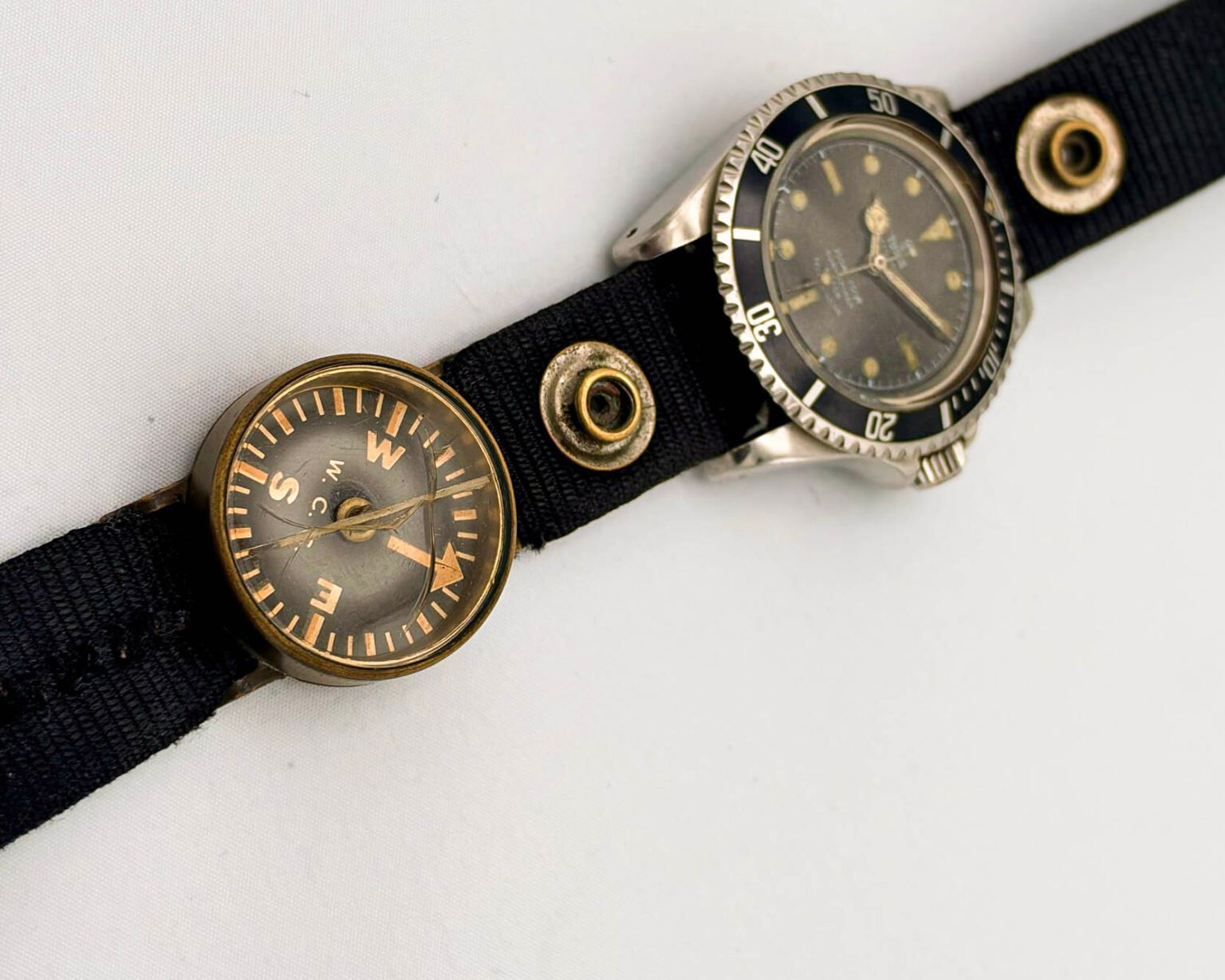
While McLachlan and Rohrbach’s watches live out their next chapter on a wrist, Moki Martin’s Tudor Sub now resides at the Navy SEAL Museum in San Diego. As I picked it up, feeling the nylon and observing the rotation of the cracked compass, I thought about Moki, John, Bob – and the thousands of men they represented – navigating the dense jungles of Vietnam. I thought about them continuing on to missions the rest of the nation might not know, understand, or ever be able to fully appreciate. I imagined the bittersweet feeling of separating from service after experiences of that magnitude. Settling into new lives, time with family, and growing older. I thought about the watch – there for it all.
Just another piece of gear. So much more. Tudor
The post To Carry and To Keep: The Tudor Watches of Warriors appeared first on Worn & Wound.