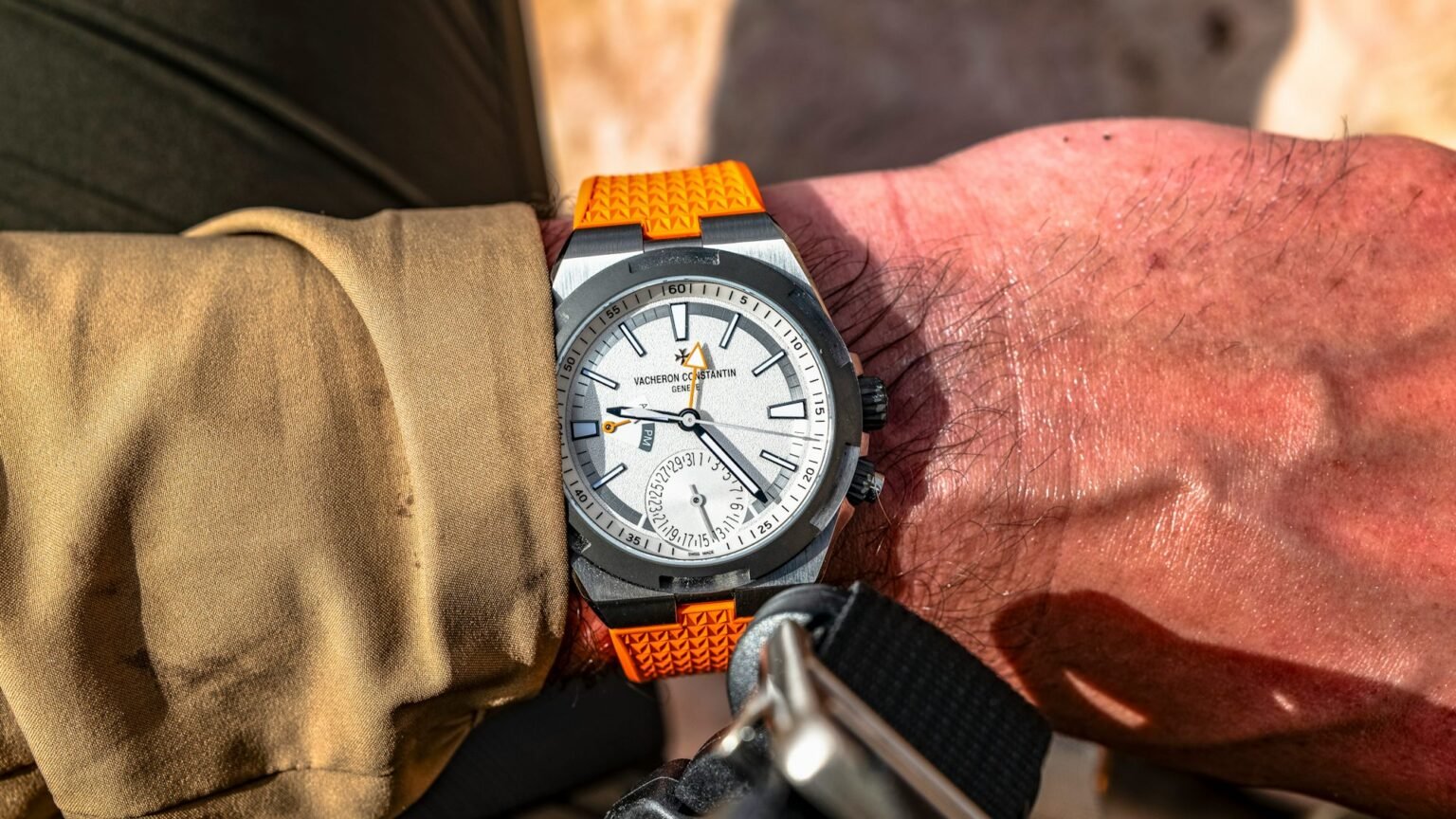

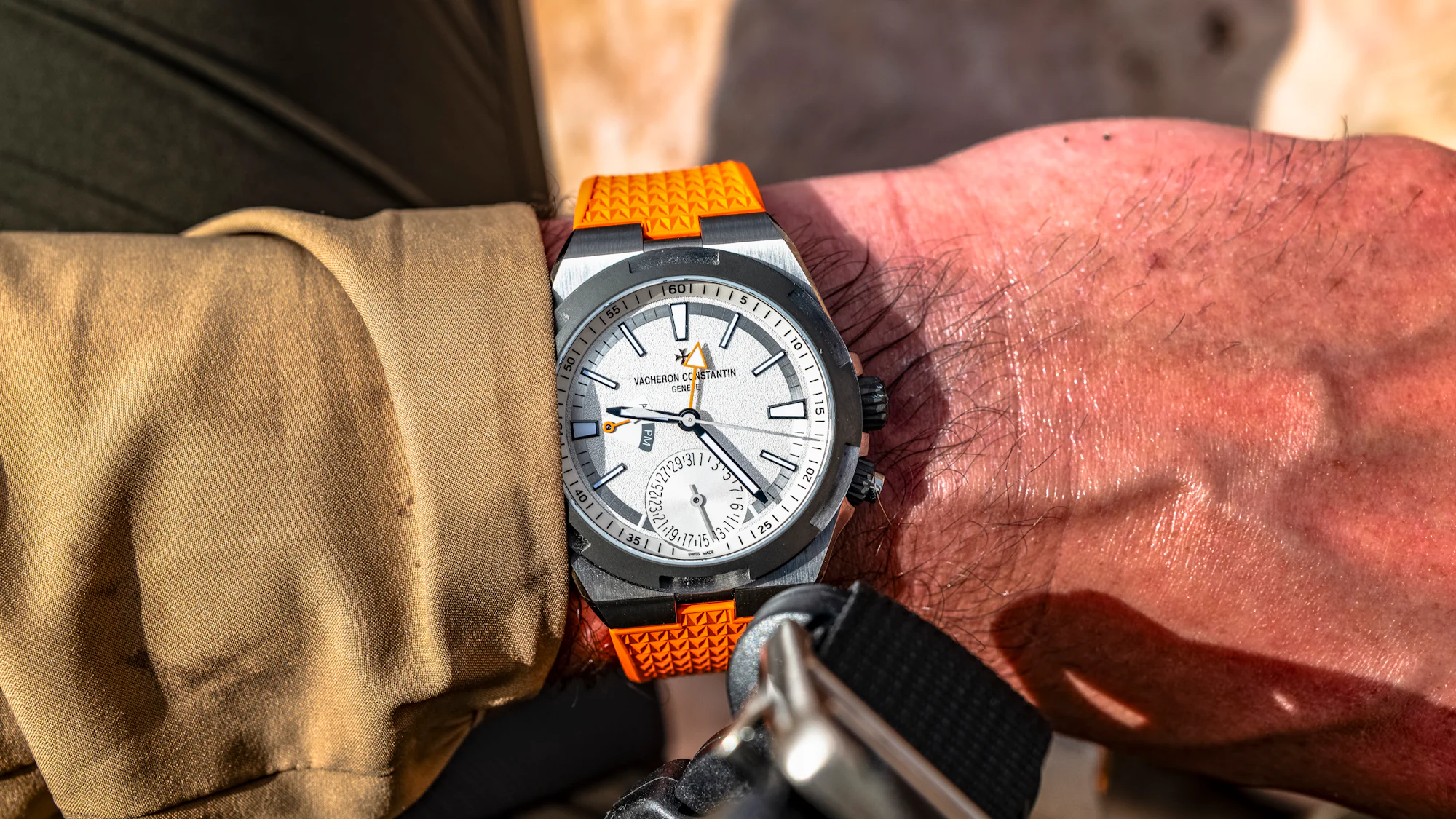
Somewhere high over the cinematically unforgiving terrain of southern Utah, I cling awkwardly to a metal rung neatly stapled into a slab of near-vertical Navajo sandstone. Using a free hand, I adjust a pair of sliding metal tethers to enable my climb. These are the lifelines that will hopefully keep me alive should my grip or footing fail. Being no fan of heights, I wonder how much longer this will last as I notice the route of rungs extending straight up and out of sight along the cutting topography of the ridgeline.
Instinctively, I glance at my wrist to mark the time. I’m met with yet another novel, but very real, concern – I’m wearing someone else’s $40,000 watch.

I’m in Canyon Point, Utah, not far from the northern border of Arizona, for an event held at Amangiri, one of the finest hotels in the world. The exclusive event celebrates Vacheron Constantin’s latest entry into its sportiest category: the Overseas Dual Time Cardinal Points. But I am an interloper among the assembled guests, many of whom are among the brand’s most notable North American collectors. While I’m no stranger to the glitz, glamour, and all-you-can-eat shrimp of watch industry press events, this is something altogether different; this is a client event.
While your average press trip is often quite nice, our usual hands-on time with a given new model is often limited to an hour or so in a boardroom in some Geneva-based HQ or in a meeting space at a brand’s manufacture in Le Locle or elsewhere in Switzerland. Sometimes one may fly to an American city, where the boardroom is traded for some conference space at a hotel or perhaps a more fantastical installation of design and ephemera to help support the launch. Rarely does one find themselves able to take a watch into the field, and, as you might assume, that chance becomes all the rarer as zeros are added to the price tag of a watch.

And while you may get a chance to borrow a watch, maybe even take it diving or on a wooded walk with exposed tree roots (gasp) – scratches, dings, and general peril are frowned upon in a manner (again) that increases with the price of the watch on your wrist for said adventure. Enter Vacheron, a new luxury titanium sports watch, and a pair of via ferrata routes called “Hoodoo” and “Vertigo,” aka my chance to take a dream watch on a gnarly adventure. Don’t let me forget to tell you about the bridge.

Yes, that is the bridge.
A Bit of Background
In the event that you haven’t been paying attention to the market at the top end of titanium travel watches (if not, why even have access to the internet?) Vacheron Constantin released the Overseas Dual Time Cardinal Points this past April at Watches and Wonders. The release was met with great fanfare and rave reviews (myself included).

The Overseas Dual Time Titanium Prototype from 2019.
While the release came as a surprise, we had been primed for the Cardinal Points via a special prototype model (which I covered here) and, eventually, a limited-edition release from the brand in 2021: the Overseas Dual Time “Everest” models. Spanning a chronograph and a dual time, both in titanium and limited to 150 pieces, the Everest models were part of a launch tied to the story of an unsuccessful bid to summit Mt. Everest by Cory Richards – a photographer, mountaineer, entrepreneur, and Vacheron Constantin ambassador. Richards and his climbing partner, Esteban “Topo” Mena, attempted a new route on Everest in 2019, and he wore a prototype (seen above) of the watch that predates the LE by more than two years.
In an effort to call my own balls and strikes here, I am biased. I loved the prototype, the 2021 Everest LE, and the new Cardinal Points, and my impressions were drawn from time with the watches during a very luxurious trip. This is only to say that my enthusiasm for these watches is not new. These are dream-watch-level executions of the sort of watch that sits at the core of my taste for sport watches. Titanium, dual time, solid water resistance, multiple strap options, all wrapped up in an adventurous package from a top-tier brand likely better known for fanciful lugs, platinum cases, and retrograde complications.

The 2026 Overseas Dual Time Cardinal Points “East” (blue) colorway.
The Cardinal Points (and the Everest before it) feel like when an auteur director leads a genre film. For me, Vacheron announcing a production titanium travel watch is like the first time I saw the trailer for Dennis Villeneuve’s Sicario. I’m just so in. If I were casting watches for the upcoming sequel to Heat, the only thing holding me back from suggesting that Chris Shiherlis should wear a Cardinal Points is that the storyline is set in the year 2000.
If you had “James makes a ‘Heat’ reference before ever really getting to the point” on your bingo card, take a drink.
A Brief Cardinal Points Timeline
For those who glossed over the previously linked stories, the Vacheron Constantin Overseas Dual Time Cardinal Points is a specific expression of the Overseas (VC’s integrated-bracelet sports watch), housed in a 41mm grade 5 titanium case. The watch is 12.2mm thick, has 150 meters of water resistance, and comes with a trio of mounts: a full titanium bracelet (with tool-free micro extension), a rubber strap, and a textile strap. All can be swapped to one’s heart’s content without the need for a tool, and the non-bracelet options are color-coded to complement the available dial color options, which are coordinated with the cardinal points of a compass. The white dial is “North,” the brown dial is “South,” the blue dial is “East,” and the green dial is “West.”

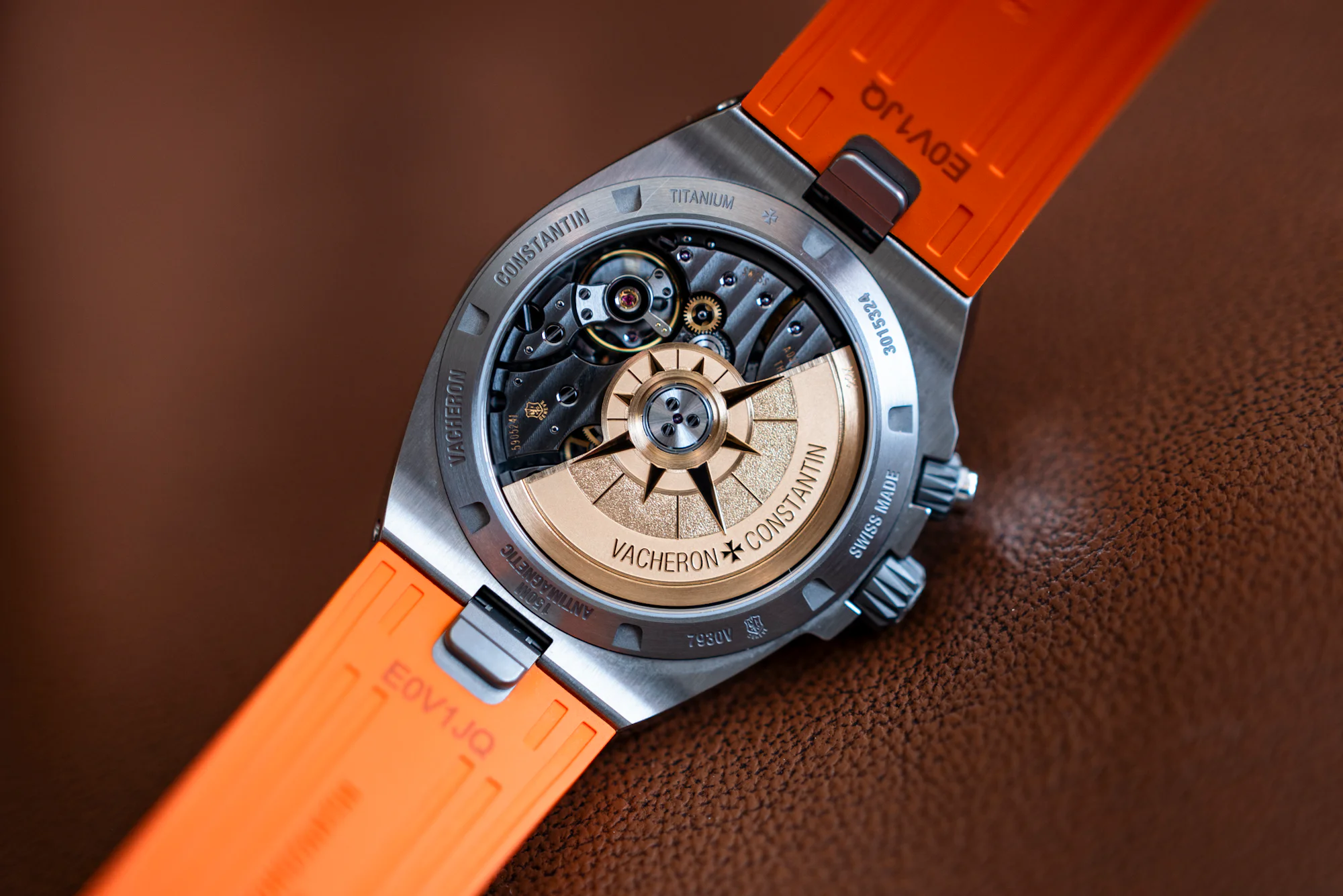

Inside, Vacheron employs the brand’s 5110 DT/3, an automatic 4 Hz movement that has 60 hours of power reserve and carries the Geneva Seal. Functions include time, a second 12-hour hand for dual time, and a coordinated AM/PM that shows the day/night indication of the orange dual-time hand. Finally, we have a subdial for the date at six, and that display is tied to the screw-down pusher located below the crown on the case’s right flank, allowing for easy adjustment should you cross the date line.

Those are the basics. Now, where was I? Oh, right, hanging onto a glorified staple high over the desert of southern Utah…
As I attempt to scramble across a rock ledge filling the space between the top of one stages of the metal rungs and the start of another, I realize that if I slip, not only will I likely smash the white-dialed Cardinal Points “North” on my wrist against a jagged piece of rock that was possibly in the background of 1996’s Broken Arrow (which was partially filmed nearby), I will also likely take out the fellow below me on the rungs.
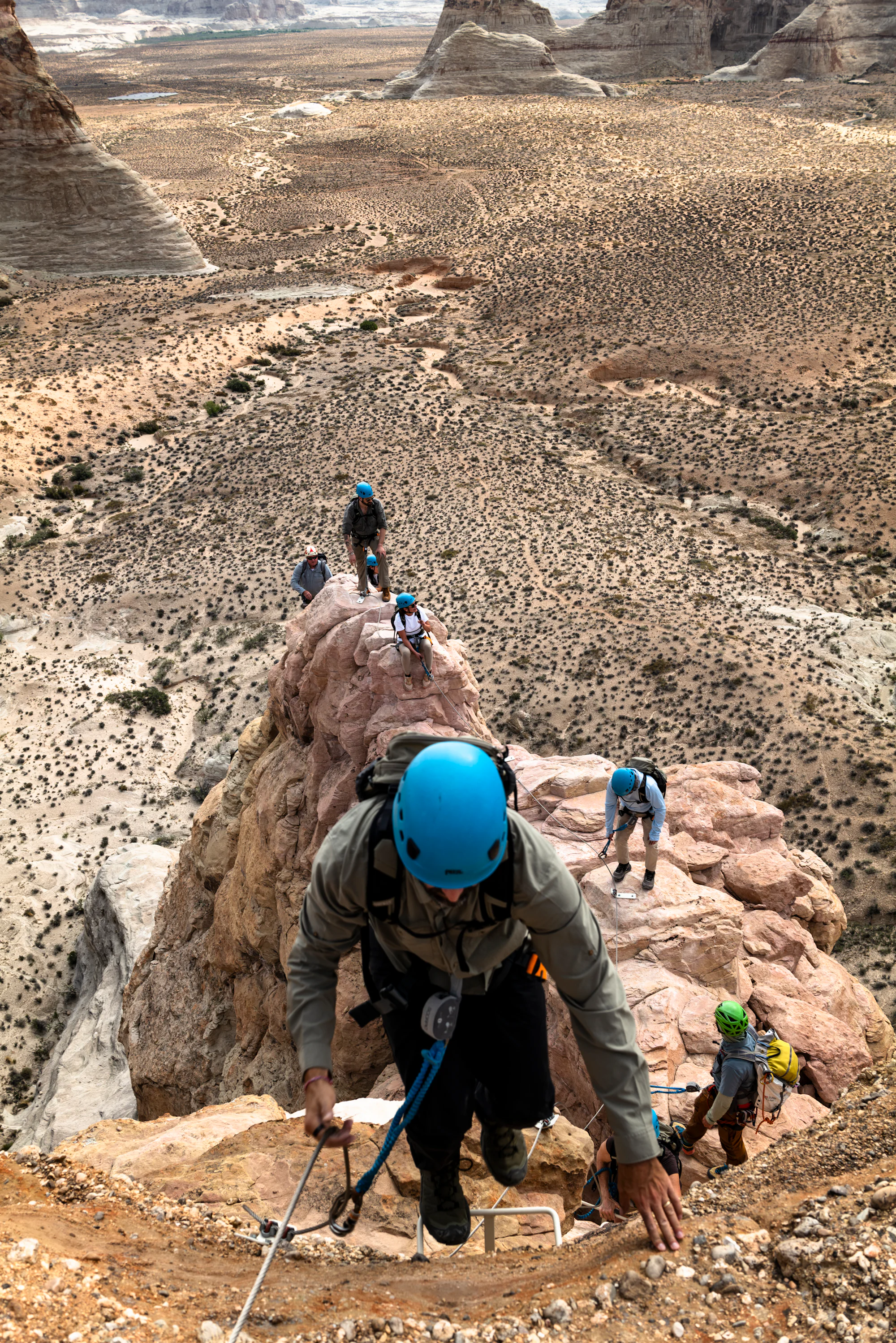
The man downrope from me, a lovely guy named David, was sporting his own Cardinal Points, which had just been delivered before this trip to Utah.
I focus and move slowly, gritting my teeth anytime I feel the titanium buckle, fitted to the bright orange strap, contact the landscape. I try to forget the guide’s list of common injuries caused by falls on these routes. Climbing somewhere below me, Cory Richards is in the single-file chain of Vacheron VIPs. I pray he can’t see me.
Looking up, I see our guide disappear over a ledge at the top of the route. Checking the time, I find my forearm slick with sweat. I am unsure whether it’s the stress of climbing with the watch or the 35 °C heat. As I crest the cliff’s edge and hobble toward a large flat section of rock, I’m just thankful that I managed the climb up without slipping, and that I have a moment to take in the scenery (and shoot a few shots of the “my” Cardinal Points and others, some of which were recent allocations to their owners).


Three wrists at the top of the route: David’s “South” CP, Cory Richards sporting a blue “East” model, and the “North” white dial on my wrist. Please disregard any sweat, sunscreen, dirt, or fear left on mine.
As much as I’d like to be the kind of guy who would wear his own Vacheron on a climbing trip, I’m not sure that would be an honest reality, at least not before this climb. I’m not even sure I would have worn one of my own (much more humble) watches, and, internally, I questioned the sense in bringing my biggest and heaviest camera along for the climb. This is the sort of activity that would normally call for a Garmin or a G-Shock, and perhaps a helmet-mounted GoPro.
After a short water and photo break, our guides take us to the bridge. Essentially the middle element between the route up and the climb back down to the ground, this bridge is a sight to behold (and an experience to cross). Spanning 232 feet and only 18 inches wide, this single-file bridge sways in the air some 600 feet over the base of the large gorge. You clip in on one side and stroll across its metal walkway, with cables on each side allowing for handholds. While I’m not specifically afraid of heights, I also wouldn’t say it’s the sort of rush I seek out. I crossed the bridge at a brisk pace, with utmost effort applied to maintaining some level of (entirely fabricated) nonchalance.
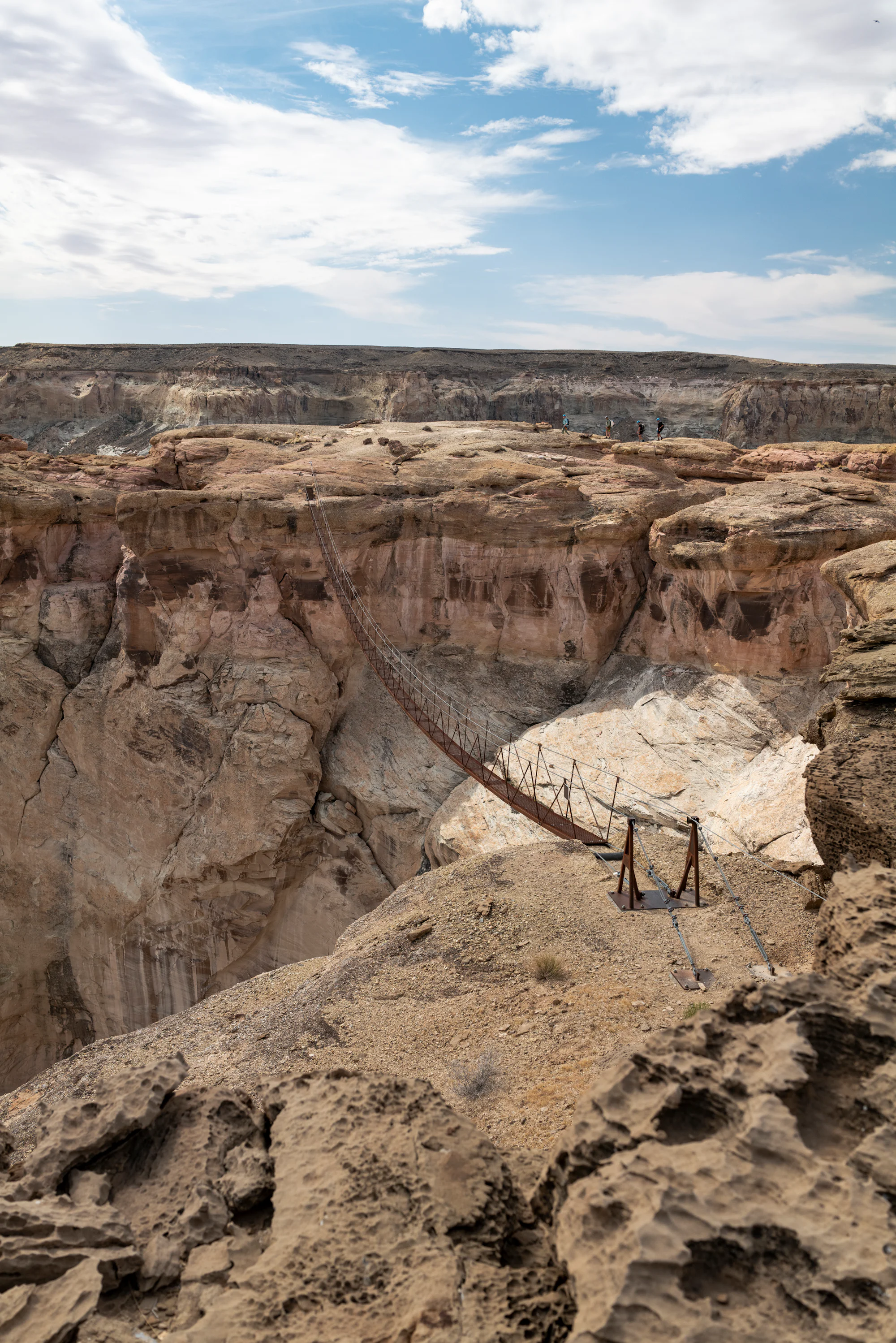

Having crossed, I was rewarded with the chance to relax (lower my heart rate) on the far side as the rest of the group mustered their courage to cross. The final task on this several-hour excursion lay ahead: the climb down on a route called “Vertigo” that snakes its way through curving pockets of rock as you slowly descend back to the desert floor.


Hands-On With the Cardinal Points
While I found the via feratta experience to fall somewhere between type 1 and type 2 fun, getting a chance to wear a Cardinal Points during a proper adventure is certainly the former, and it only served to underline the way I felt about the watch after spending time with every possible iteration since the idea was shared back in 2019.

On the short hike to the base of the via feratta route.
From an extensive hands-on perspective, it’s simply a marvelous watch. The sizing is great, not too big in any dimension, and the svelte transition from case to bracelet makes this Overseas feel even more compact on the bracelet than it does on either strap. While we’re on the topic of the bracelet, it’s worth noting how premium it feels, especially for a sport watch.
Thin, very comfortable, and thankfully largely brushed on the front surfaces. Add to that both quick-change ability and pull-to-extend micro-adjust for each link on either side of the clasp closure, and you have a very refined, lightweight, comfortable, and nicely tapered bracelet that matches the look and feel of the Cardinal Points while also underscoring the familial Overseas connectivity.


The Cardinal Points bracelet, with the extensions closed.

The Cardinal Points bracelet, with the extensions opened, note the small increase in space on either side of the closure point for the clasp.
Changing the dual time for a different time zone is done via the crown and, given that it’s a dual timer and not a GMT, you’re just trying to set the desired hour while the AM/PM indicator is in the correct position. With oversized applied markers, large hands, and orange accents for the second time zone, legibility is simple enough, and while I think that a date window would suffice, the date subdial feels like a specifically Vacheron choice, and I think the function does a good job of filling space on the dial.
I could go on about the dial for a while, but I’ll do my best to be concise. From the minimal text, the dual minute scales on the rehaut and dial’s edge, the applied Vacheron logo, and the mix of textures and finishes, I think these dials strike a difficult balance that supports both Vacheron’s capabilities and the model’s specific sportiness. The rehaut minute ring is glossy, the dial surface has a texture, then the date has circular graining, and the AM/PM indication is smooth. As a final touch for the welcoming long seconds hand and the date hand, we find a silvery/white finish that leaps off the dial when it catches available light. The end result is complicated and a bit asymmetrical, but feels purposeful and well executed.


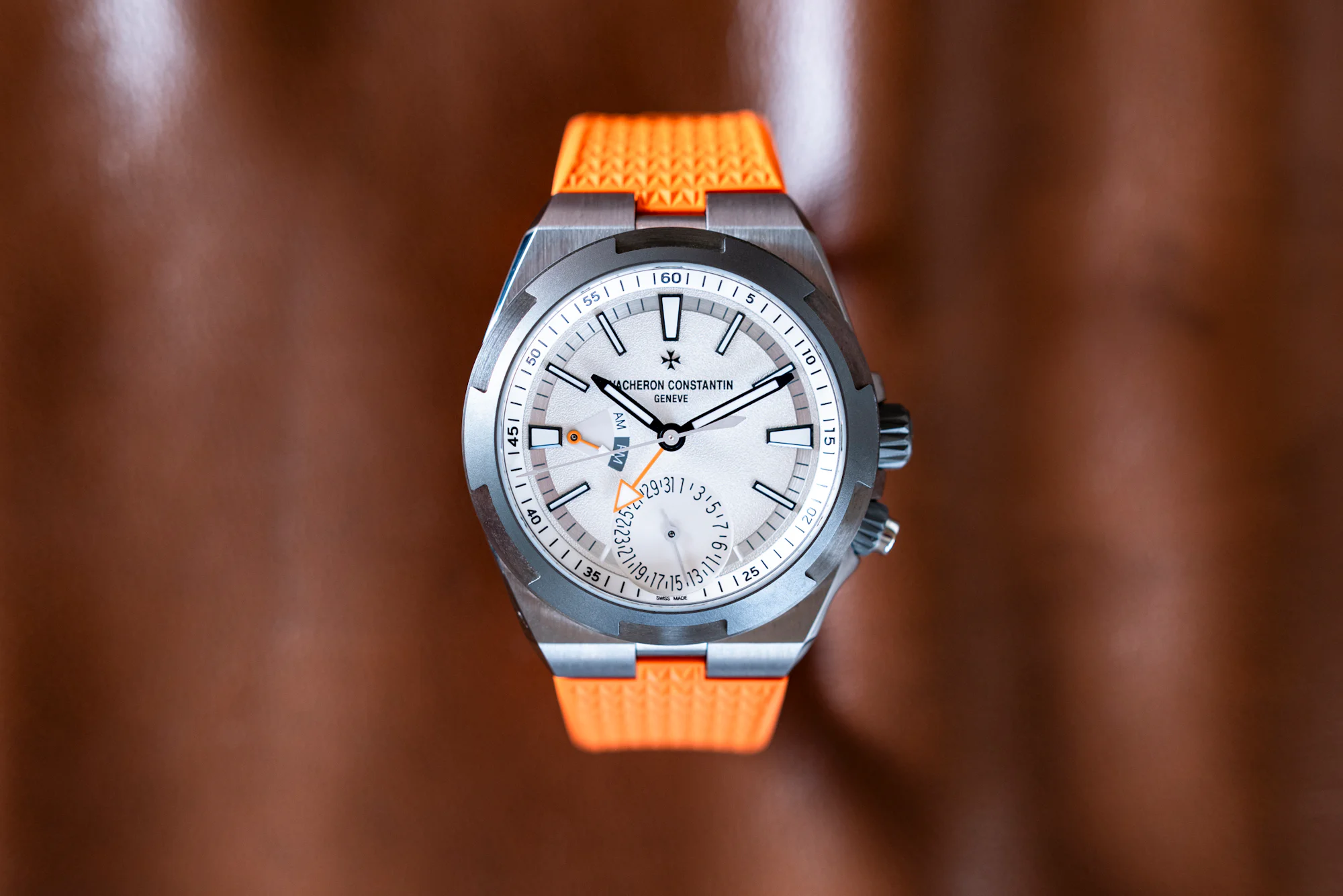
Then there are the colors. Before spending a couple of days with all four at hand, I think I would have ranked the colors in order of preference as white, blue, green, and brown. But after spending time with both, I found myself very much drawn to the brown dial, which might be a first for me with any watch, ever. The brown is not a warm, leathery color, nor is it overly yellow. Instead, it’s quite grey and, in the correct light, has a purple/reddish tone. It’s also a brown that works well with the orange accents.

The four dial colorways of the Cardinal Points, left to right, South, North, West, East.
If you’ll allow my continued pickiness: for the white, which is usually my go-to, I found it quite bright and punchy, and at a similar spec, the blue is lovely (and likely among the most popular for the model), but I found it to be very saturated. For the green, my subjective take is that I find green watches to be very trendy, and I’m unsure how they will age beyond this moment in time. It’s a great color, but it wouldn’t be for me.
Surprisingly, after proper hands-on time, I’d likely re-rank my color preference to brown, white, blue, and green. Deeply subjective, I know. Thankfully, none of the colors are bad, and if you’re lucky enough to be both in the market and able to get an allocation for a Cardinal Points, I don’t think you can pick wrong. After the muted blue-grey of the prototype and the similar dial on the Everest LE, the decision to launch with four colors (none of which is all that similar to the LE) helps build distance from the Everest models and is something of a surprise. Tudor should take note.

The Cardinal Points South next to it’s bracelet, note that one side of the extension is open while the other is closed.

The Cardinal Points East on its blue strap.

The case profile and green strap of the Cardinal Points West.

The Cardinal Points West on wrist.
Speaking of the Everest LE, I got a chance to spend some time with Vacheron’s own example from back in 2021, and you can see that much is similar, while the colors and other small elements have changed. The Cardinal Points are an evolution via the new colors and a slightly thinner execution, from 12.8 to 12.2 mm, which you can see in the photo below, which has the 2026 CP on the top and the 2021 Everest on the bottom. Additionally, for the 2021 LE, you can see that the interior minute track is printed on top of the textured dial finish rather than in its own separate ring on the dial. The Everest dial feels a bit more sparse and sporty, while the CP’s dial design feels slightly closer to the core of Vacheron’s current design language.

The 2021 Everest LE under the 2026 Cardinal Points.

The 2021 Overseas Dual Time Everest LE.

The 2021 Overseas Dual Time “Everest” LE on wrist.
In preferring one over the other, I’ll always have a soft spot for the Everest, but the thinness and additional color options are notable additions to the offering. If we want to get really picky – and I may be the only one – I do wish they had kept the orange arrow on the bezel of the prototype that pointed to the date crown.
All told, this is an all-time favorite watch for me, and it has very little competition for the space it holds in my mind. The brown-dialed “South” model on the bracelet was likely my favorite combination of dial color and mount. But if you’re taking such a watch climbing up a big ‘ole ladder in the desert, pop it on the rubber.

The Cardinal Points South on the bracelet on my wrist.
Competition
Despite my above comment about competition, no watch exists in a vacuum. And while I have called the Cardinal Points a $40,000 watch, the reality is it’s $41,000. As a foundation, the 2021 Everest Dual Time LE was $31,300 at launch. Today, a standard steel Overseas Dual Time (itself a lovely watch) carries a price tag of $35,200. This means that the price delta between the Everest and a steel example in 2021 is almost identical to the delta between a Cardinal Points and a steel ODT in 2026. Not to diminish the real-world weight of $41,000, that comparison to the closest sibling within VC’s current catalog is notable, especially for a watch that is among the hottest releases of the year and a very competitive allocation.

A steel version of the Overseas Dual Time.
In a post-5164A world – that being Patek’s own steel travel time Aquanaut, which was discontinued in 2024 – there isn’t a lot of direct competition. Mark covered some of the options in his recent look at the Laurent Ferrier Sport Traveller, which hits a similar format but at ~$75,000. You could look to the second-hand world for a 5164A, but prices currently hover around $100K, and you still don’t get a bracelet.
If you didn’t need titanium and somehow white gold was close enough, the Patek Philippe 5164G exists, but it’s also over $70K and doesn’t come with a bracelet. The Rolex Sky-Dweller is out there and brackets the Cardinal Points in pricing, starting at $17,700 in (mostly) steel and jumping to $53,450 in white gold, but again, no bracelet for the white gold (is available for other specs).

The Patek Philippe 5164A.
Audemars Piguet no longer makes a dual-time Royal Oak, but a steel second-hand 26120ST can likely be found for about the same price as the Cardinal Points (~$40k). Again, this is more along the lines of pricing and brand comparison, as the two are very different watches.
As for other brands in a similar scope, Lange has yet to make a travel complication for the Odysseus. While it’s likely some cool high-end travel watch has slipped my mind, it’s also very likely that one of you can let me know in the comments.
Assuming you’re operating in the realm of $40,000 sports watches, I’d argue that the Cardinal Points is well positioned, and I would expect other brands to take note and develop more direct competition in the coming years.
Wrap it up, Stacey
In some way, shape, or form – or better put – in some prototype, LE, or production, the idea of a titanium Vacheron Constantin Dual Time has been on my dream watch shortlist for at least 7 years. And while the prototype and limited edition models will always have their own interest and appeal, I think the Cardinal Points quartet represents the most evolved iteration of the idea. Tough, easy to wear, modern, interesting, and flexible, all while being a Vacheron Constantin.

Thankfully, there was a pool, as I needed some way to rinse off the watch before I gave it back.
As someone who recently passed my 20th anniversary of writing about watches, I think it’s notable that one of the hardest outings I’ve ever had with a sports watch was with a Vacheron Constantin. I stood on the top of Mt. Baker with my Rolex Explorer II. I’ve explored remote coral atolls with Oris. Had a Casio Rangeman torn off my wrist during an aggressive down climb (fall) in BC. I’ve done both cold and tropical dives with Tudor. I recently lost (and had a friend recover, thanks Geoff) a Citizen Aqualand on a wreck in the Great Lakes. I’ve swum with sharks in Hawaii with a Seiko on my wrist. Heck, I once wore a Lange Datograph Tourbillon very close to the pool’s edge in Italy.
And while the via ferrata route presented limited actual risk to the Cardinal Points, I definitely considered the possibility of having to sheepishly return over a battered and possibly broken watch. When I confirmed all of this with the folks from Vacheron, they just shrugged and questioned the logic of coming all this way to such a beautiful spot, only to leave the watch in the hotel room safe.

Not exactly a boardroom in Geneva, is it?
When I originally signed up for a day’s activity in Utah, I picked a chill hike because I figured it was my best chance to get time in the environment with the watch on my wrist. Later, I was encouraged to move to the more intense activity, as it would be a better and more interesting way to experience the watch. You don’t have to ask me twice.
That’s a perspective I can get behind, and I think it speaks to the core of the idea behind a brand like Vacheron Constantin in making a watch like the Cardinal Points. Should I ever be fortunate enough to have one to call my own, you can expect the titanium case to have a couple of scratches, each with a story of its own.