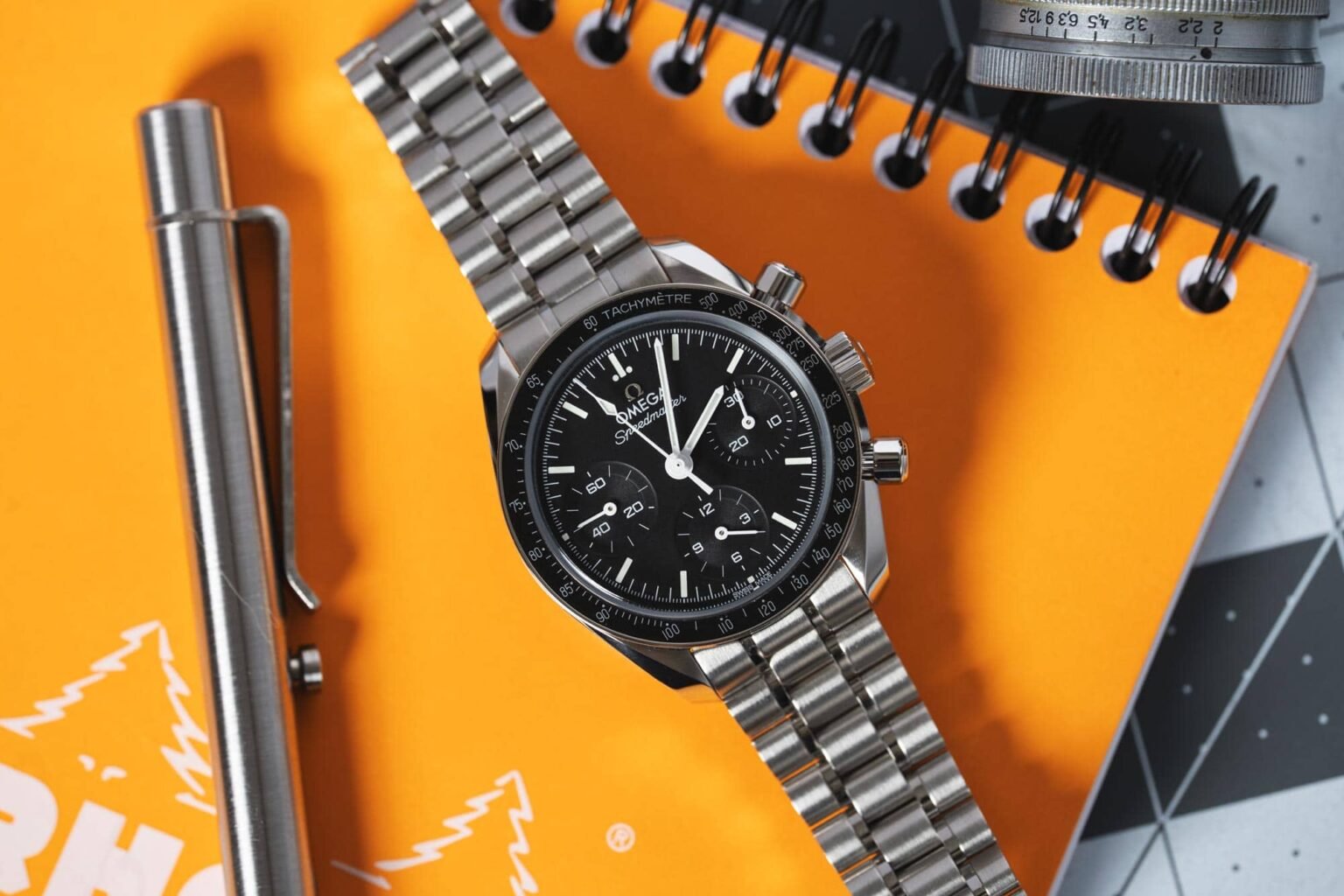


The name “Speedmaster Reduced” is a blanket term for the Speedmaster Automatics with cases smaller than the iconic 42mm Omega Speedmaster Professional. First launched in the late ’80s, there is a dizzying number of references included in the “Reduced” family, some being more well-known than others, such as the ref. 3510.50 and ref. 3520.50.00. Always popular among the enthusiast community, they offered Speedy looks at sub-Speedy prices and, simply, a smaller option. Now considered “neo-vintage,” the Reduced models were discontinued around 2010.
Something that is cool about the Speedmaster is that while it’s a singular watch, it’s also a design language. It’s the typography, marker style, hands, bezel, etc. As such, it can be molded to different formats and the end result still reads “Speedmaster.” This is perhaps best seen in the Mark series, but is also quite true of the Reduced models and, beginning in 2017, the Speedmaster 38.
I might be in the minority here, but I like that Omega will go in weird directions with the non-Professional Speedmasters. Maybe they work, maybe they don’t, but I’m sure all will find an audience somewhere, or at some time. Even models like the Speedmaster Chronoscope, which makes no sense to me, have the potential to be future cult hits. And for a while, Omega went a bit weird with its smaller option.

With a gap in the catalog left by the discontinuation of the Reduced references, Omega released the Speedmaster 38 line in 2017. That version went for a softer, contemporary, and perhaps even fashionable aesthetic. The sub-dials were oval-shaped on most versions, the bezel had a split-insert design unique to them, and the typography changed from the boxy forms of the Moonwatch to a thin, almost Bauhaus sans-serif. Think the type of numbers you’d find on mid-century architecture.
How successful they were commercially is hard to say. Anecdotally, the 2017 Speedmaster 38 models are not as common among enthusiasts, but that doesn’t speak to their broader acceptance. Regardless, almost ten years later, Omega has decided to update the Speedmaster 38, returning it to the more typical Speedmaster vocabulary. There are seven references at launch with various dial colors and case materials, but one clearly stands out as oriented toward the Speedmaster enthusiast: the ref. 324.30.38.50.01.002, or more simply, the black dial.
The result isn’t really a revival of the Speedmaster Reduced. Rather, it’s perhaps the obvious modern equivalent: a smaller, automatic Moonwatch.
Review: Is the New Omega Speedmaster 38 the Modern Speedmaster Reduced?
Stainless Steel
Omega Cal. 3332
Black
Yes
Box Sapphire
Bracelet
100m
38 x 44.96mm
14.73mm
18mm
Push-Pull
Yes
$6500
The Watch
The new Speedmaster 38 answers the question, “What if I want a Speedmaster, just smaller?” As such, there isn’t anything surprising about it, which is why it works. The case? Pure Speedy, just smaller, except for when it’s bigger. Let me explain.
Measuring 38 x 44.96 x 14.73mm with 18mm lugs, the Speedmaster 38 is, as expected, smaller in every dimension save one: thickness. As the 38 is powered by the automatic, Co-Axial chronograph caliber 3332, it’s thicker than the manually wound, caliber 3861-powered Pros. This is, unfortunately, not surprising. Omega doesn’t have a thin automatic chronograph in its movement arsenal.
Interestingly, older Reduced references like the 3510.50 used the Omega caliber 1140, which was based on the modular ETA 2890-A2 and was thin for an automatic chronograph, allowing the watch to come in a little under 12mm thick, including the crystal. The 38’s 14.73mm includes the box sapphire crystal, so optically it looks a bit thinner than it might sound. But, yeah, it’s thick. “Stout” is perhaps the best description. It’s a solid brick of a watch, and while I’m sure it would be even better if it were a little thinner, it’s not bad as is.


The dial, too, is exactly what you expect. It has the easily identifiable Speedmaster language in a smaller, though not that much smaller, format. The surface is a matte-finished black varnish with white print and lumed rectangular markers per hour, with the signature dots flanking the marker at 12. The sub-dials feature numerals in the same typeface and format as the Pro, and the handset is the same too. It really is just a smaller Speedmaster, save for some proportional changes.
While Omega is launching seven versions of the Speedmaster 38, the black dial is the only one with a special feature: no date. This also brings it closer to the original Reduced models and keeps it truer to the Professional. There is something about the Speedmaster 38 being an automatic that makes it more of a “convenient” version of the Speedmaster, and as such, a date didn’t feel out of place conceptually. That said, it’s obviously cleaner without one.

A more curious detail is the use of the dot-over-ninety bezel. It doesn’t relate to the Reduced models at all; rather, it refers to the bezel design of Speedmasters from pre-1970-ish. Omega brought it back, along with the stepped dial, on the most recent version of the Speedmaster Professional as part of that model’s vintage nods. The placement of the dot affects nothing, of course, but its presence here makes Omega’s goal clear: this isn’t meant to reference the Reduced so much as translate the current Moonwatch into a smaller format.
If they wanted to speak to the Reduced model’s history instead, it could have been cool to bring back the minute/second numerals printed along the inside of the lume markers on the original references. They made the dial much busier but also gave those watches their own personality. Instead, Omega is clearly going for a smaller Moonwatch, which makes more sense from a broader market perspective. I won’t hold my breath, but this does leave room for a cool special or limited-edition.

Measuring Up to the Professional
Let’s set the stage again: the Speedmaster 38 measures 38 x 44.96 x 14.73mm and the current Speedmaster Professional Hesalite measures 42 x 47.2 x 13.5mm. Some other important dimensions: the bezel on the 38 is 36.7mm, and on the Pro it’s 39.8mm. I think those matter because the difference between the bezel diameter, which is a true circle, and the side of the asymmetrical case speaks to how these two watches wear.
I’ll always argue that Speedy Pros don’t feel like 42mm watches; rather, they feel closer to 40mm, which is about the bezel size. The Speedmaster 38, on the other hand, feels like a 38mm. This is partially because the delta between the bezel and case diameters is smaller, but also because of a few proportional and design choices that make the 38 seem a little larger.

First, the dial, while physically smaller, appears larger than, or at least the same as, the Pro’s. From what I can tell, this is due to the placement and size of the sub-dials. Despite being the smaller watch and thus having a smaller dial, the sub-dials on the 38 are farther from the dial’s center and larger than those on the Pro; they even cut off the lume plots at 3, 6, and 9. This creates pressure along the edge of the dial, making it seem more pushed out. The dial print in general also comes closer to the edge.
Additionally, while the case is smaller, the pushers and crown remain large. The pump pushers, in particular, are very pronounced. This gives the watch a fullness that might have been missing had they been scaled down. Lastly, by going with an 18mm lug width, which makes sense for the lug design, the proportions of the Speedmaster Professional are more or less maintained.
One slightly humorous detail: the Speedmaster 38 has a water resistance of 100m. Do with that information what you will.


Does It Wear Small?
On my 6.75” wrist, it looked and felt great. I’ve never thought that the Speedmaster Professional was too big, especially when I’ve worn one, but that doesn’t make the idea of a smaller Speedmaster any less appealing. The Reduced Speedies and now the Speedmaster 38 aren’t sized down to the point of novelty. They aren’t mini; they are just the next logical size down.
So, yeah, it feels smaller, but it doesn’t feel like a small watch. Even at 38mm, there’s some serious substance to it. The twisted lugs are broad, the crown and pushers are full-sized, and, as mentioned, it’s thick.
That 14.73mm number includes the crystal, so some of the visual thickness is negated, and there are also a lot of break lines that help it appear a bit thinner. More significantly, the lugs are about halfway up the case, so the bracelet pulls the watch down, hiding the caseback. I’m not trying to say it feels thin; it doesn’t, but it’s not as bad as nearly 15mm sounds.

It should come as no surprise, but if you like the look of Speedmasters, you’ll like the 38. Sure, there are differences, but as the language is all borrowed from the Pro, the aesthetic is the same. It’s clean, classic, reserved yet somehow a touch ornate, and sporty. The most noticeable visual change comes from the different placement of the sub-dials, which doesn’t change the aesthetic so much as the dial’s balance. The sub-dials feel more significant on the 38 than on the Professional.
The bracelet is also pretty excellent. I don’t have experience with the previous generation, but this one closely resembles that of the newer Professional models, with smaller, rounded links and two polished lines. It tapers from 18mm to 15mm at the clasp, which is nicely sized and features a two-pusher opening and a small amount of micro-adjustment. It’s a pain in the ass to size, but otherwise it’s a great bracelet.

Conclusion
Writing this before launch, I am very curious about how the new Speedmaster 38s will be received. With so many Speedmaster options, will people be excited for a smaller Moonwatch? Will enthusiasts for the older Reduced models appreciate a return to form, more or less?
Aside from the other colors, the black dial seen here seems like the obvious one Omega should make: the Speedy Pro, but smaller and automatic. The proportions work; it fits well and looks the part. Is it the most exciting release? No, but sometimes doing the obvious is the best thing. I personally wish it looked a little more like the 3510.50, paying homage to a cult watch in its own right, but I get why Omega wouldn’t do that either. Or, at least, not yet. Similarly, panda dials feel inevitable.

The 2026 Speedmaster 38 is priced at $6,500, a $200 increase over the previous model. All things considered, that’s not much. Though expensive, considering it’s an Omega and an automatic Co-Axial Chronometer chronograph, the pricing is to be expected. The only rub, at least for us enthusiasts, is that OG Speedmaster Reduced models are going for around $3,000. That’s a lot more than they used to be, but still less than the modern version.
As a current and former Speedmaster Professional and Speedmaster Reduced owner, there is something compelling about a smaller, modern Speedmaster. I currently own a 105.012-66, which, while gorgeous, is a 60-year-old watch and should be treated as such. I like the idea of having a Speedmaster that I don’t need to worry about as well, but I wouldn’t get a second Professional. It would just be too similar.

That, perhaps, is where the Speedmaster 38 makes the most sense. Given that it’s smaller and automatic, which adds some convenience, yet has the right looks, the 38 might just be different enough. It doesn’t hurt that it’s a little less expensive, too. Omega
The post Review: Is the New Omega Speedmaster 38 the Modern Speedmaster Reduced? appeared first on Worn & Wound.