

Over the past few weeks, I’ve been taking a slightly overdue look through a backlog of recent acquisitions for my library. As I pointed out recently in a story on Taschen’s “Ultimate Collector Watches,” buying more books scratches the knowledge-acquisition part of my brain while saving me from writing a check the watch-collector side of my brain can’t cash. Yes, I already have a few bins full of books lying around, and piles around the living room. But New York apartment sizes be damned, I’m acquiring more books.

I recently had a spinal fusion and, while I’m recovering just fine, I’m still sorting out how to photograph watches without bending or twisting for a few months. All the books in my backlog are under 10 pounds (just barely), so my doctor can’t get mad at me for lifting. So I’m going to turn this into a short weekly column to go through some books I have that deserve coverage. And the first one I picked up (both originally a few months back and again, for this column) was the succinctly titled and gorgeously produced “Grand Seiko” by ERG Media published earlier this year.

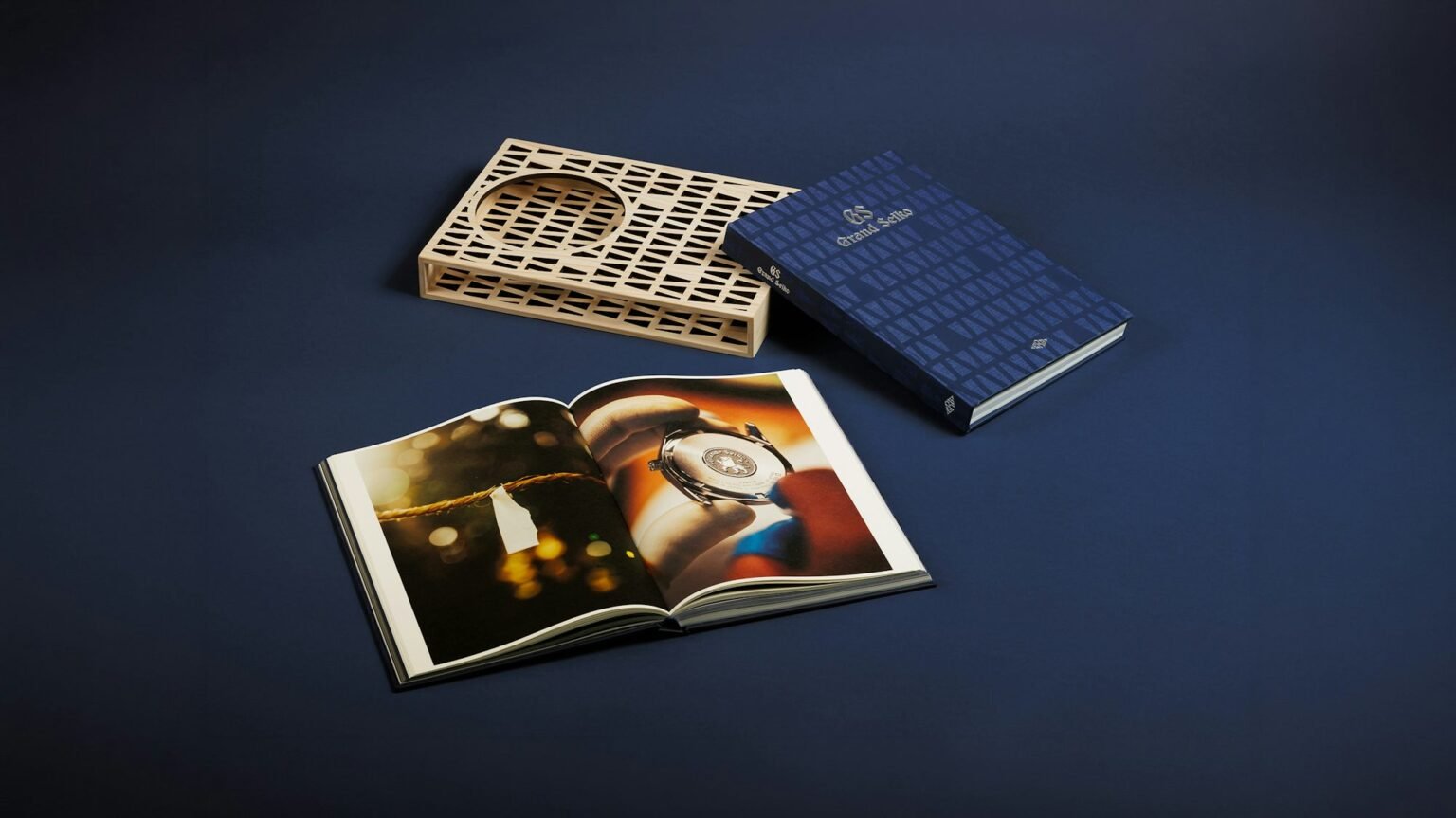
As an official Grand Seiko-approved product, everything carries the brand’s (often exacting) seal of approval. But it’s also anything but a sanitized and soulless look at a brand’s heritage and history. Instead, “Grand Seiko” weaves a beautiful look at watches and watchmaking with Japan’s culture and landscape, and Grand Seiko’s New York flagship. But first, you’ve got to appreciate the packaging.


There are watch books on my shelf because I grab them a lot. Others are rare, and I got them on a bargain. None of them look nearly as good when it comes to packaging—not by a wide margin. The wood slipcover has a windowed appearance that mirrors the architectural details on paneling and doors that you’ll find in Grand Seiko flagship boutiques and on their museum floor in Ginza, Tokyo. The fabric hardcover has the same motif on both sides. It’s really stunning, which has actually given me a bit of a conundrum. It’s a shame to put it away on a shelf or bury it under stacks.

A photo of the Grand Seiko section of the Seiko museum in Ginza, Tokyo, from our tour with Grand Seiko two years ago.
The content and printing (both on high-gloss pages and very heavily textured paper, giving it a film-print quality) are great—this is what ERG is known for, though it’s the first book from them I’ve been able to get (I’ve window-shopped a lot). Unlike some publications that are text-dense or just full of gratuitous photos but no real information, “Grand Seiko” shares sections of really great information while breaking it up with some really outstanding, vivid, and maybe the most creative take on watch-related photography I’ve seen since Dan Holdsworth’s “Vallée de Joux” for Audemars Piguet. Yes, it leans heavier on photography, but it’s really damn good photography.

It’s hard to decide what is more important in a watch book, content or photography. I’d lean toward the former. As much as the internet has democratized watch collecting, sometimes there’s content in books you can only find there. It’s not guaranteed the content is always right, I guess, but if I’m picking up a book lately, it’s to look something up. “Grand Seiko” has information worth picking up a book for, especially in the age of pre-packaged AI-summarized Google searches that are often just… well… wrong.


The book starts with the brand’s history and the models through the years, illustrated with small examples and larger hero images of the watches, which is arguably the most useful info. The book moves into craftsmanship and other subjects—with a bit less text but still enough to learn the whole history—and wraps up with a look at the boutiques. The next-most useful section as a reference is the final one, covering calibers and dial types. Having all that information on one page, without having to click through multiple hyperlinks to compare back and forth, is useful to someone like me.


I’m a photography nut. A few photographers stand out to me for taking something clean and industrial (car manufacturing, aerospace, etc.) and making it both rigid and beautiful. My friend Benjamin Rasmussen is one. Thomas Prior is another. The photography is split between Thomas Walk, Terry Kritis, and ERG founder Ted Gushue (plus watch photos from Seiko). They did a phenomenal job.

I think the photography serves people well if they’re brand fanatics who will never be able to visit Japan but want to “ooo” and “aah” over the beauty of the place where their favorite watches are made. The same could be said for people who have gone and are nostalgic, or who are biding their time until a return. For me, I have to admit that the photography was so frustratingly good that it made me jealous that I don’t see the world that way. It’s quiet. Intentional, raw, and vivid. There’s a patience and a thought behind the photography that I, a reactive documentarian, rarely ever had. But it’s not something I can hold against them, just myself.
At $275, the book seems fairly priced for the production value and what it provides for a Grand Seiko enthusiast. It’s available online from ERG Media. All photos courtesy ERG Media.