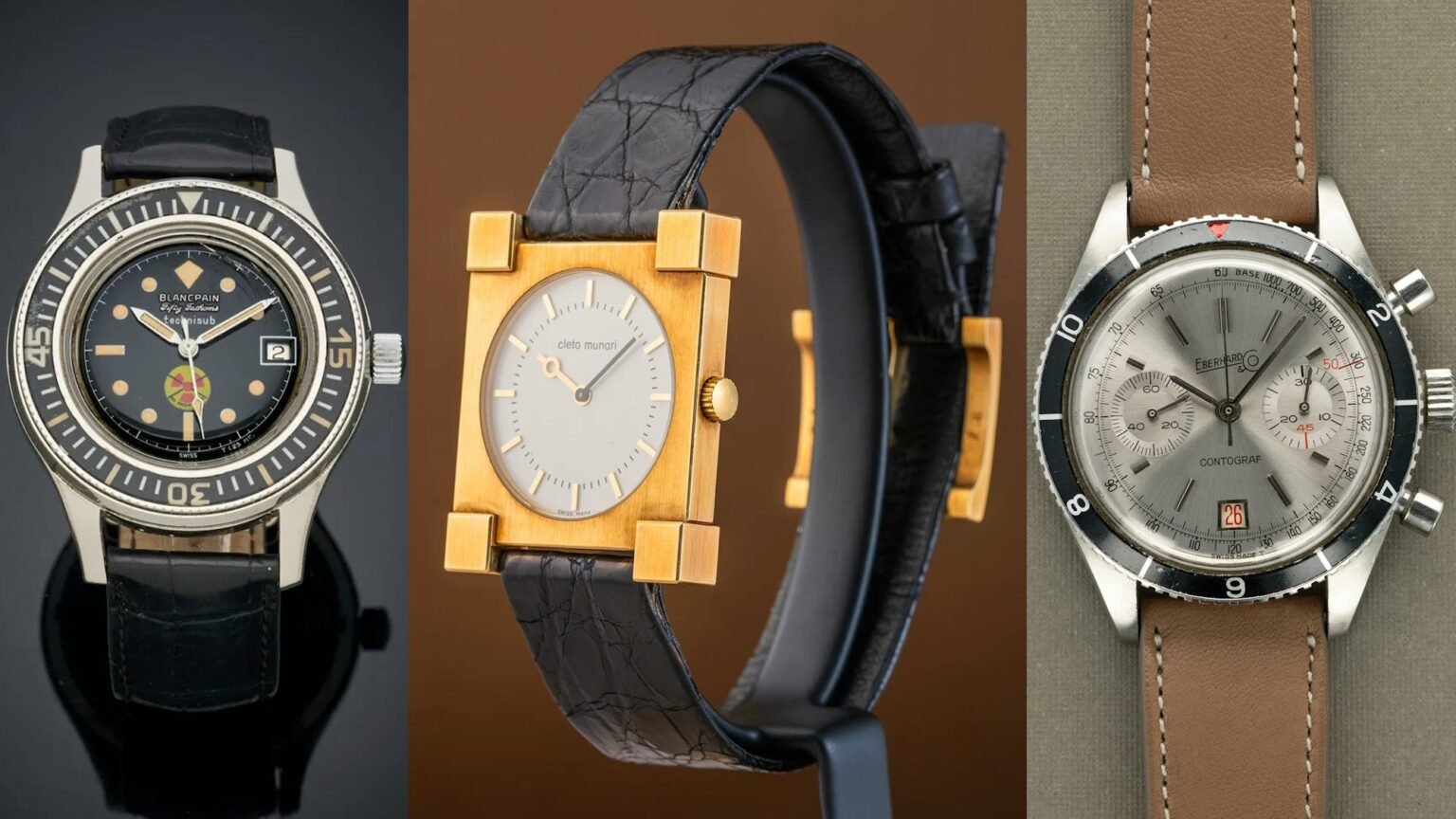


You hanging in there, Baller? It feels like it’s been a hard bit, or at least it is with the folks I check in with. I hope that, despite whatever’s frustrating you and causing grief—from stubbed toes to wildfires and their attendant smoke to your team not making enough moves at the trade deadline—you’re getting by. And congrats, obviously, to all the Sixers fans.
Strays

Photo courtesy of Huntington Company.
Perhaps, like me, you were unaware that in 1967 Bulova made an Accutron Astronaut in 18k gold, and if that sounds like fun, Goodwill’s got one that’s on an 18k JP Champion bracelet to boot. The good folks at Huntington Company have a bit of a left of the dial watch this week, this Sarcar triple date with moonphase, and a fun game to play is to imagine what it’d be priced at with a different name on the dial. If you’re bored by watches that are too quiet, or you’re interested in truly unhinged complications, here’s a Boegli which features a music box that plays a bit of Mozart’s “The Magic Flute.” For those who missed their shot on the Louis Erard x Kudoke Regulator from a few years ago, here’s a very very nice blue one, and if you’d prefer a different blue watch, this Rolex Oysterquartz Datejust is almost certainly not from 2005, as the listing says (it’s got a tritium dial, for one, plus the reference 17000 ceased production in 2001), but it certainly looks in great shape. Finally, here’s a phenomenally pretty gold Audemars Piguet Day Date Moonphase (almost certainly ref 25594), with a dial that’s undergone some sumptuous tropicalizing indeed.
Wittnauer 235T
If you’re looking for cool cultural associations that may inflate this Wittnauer 235T’s cache, this is the model Wittnauer sent NASA to consider for use in the space program (ten companies were asked; only Omega, Rolex, Wittnauer, and Hamilton sent watches, though Hamilton sent a pocket watch and was dropped from consideration [Rolex sent a 6238]). When I got into watches, the scuttlebutt was that the Wittnauer 242T—the black-dialed, larger-diameter chronograph also powered by a Valjoux 72, offered by Wittnauer at the time—was the entry submitted to NASA, though that was eventually clarified as more NASA documents came to light.

Photo courtesy of Invaluable.
If you’re looking for a more esoteric metric for why to care about this particular option, this example comes in the middle of the model’s development in terms of dial configuration. The first 235Ts were badged only Wittnauer at the top, which dials were eventually referred to as 235T ‘Solo’ models. Next came this iteration, with Wittnauer and Genève on the dial—a sort of transitional dial. Finally, eventually, the dial took its most common form, with Wittnauer Professional Chronograph printed up top. I haven’t a clue how many of each model were made, nor which years each version was introduced, but judging only by how often they turn up in the market, these Wittnauer Genève models are the least common, as far as I’ve seen.
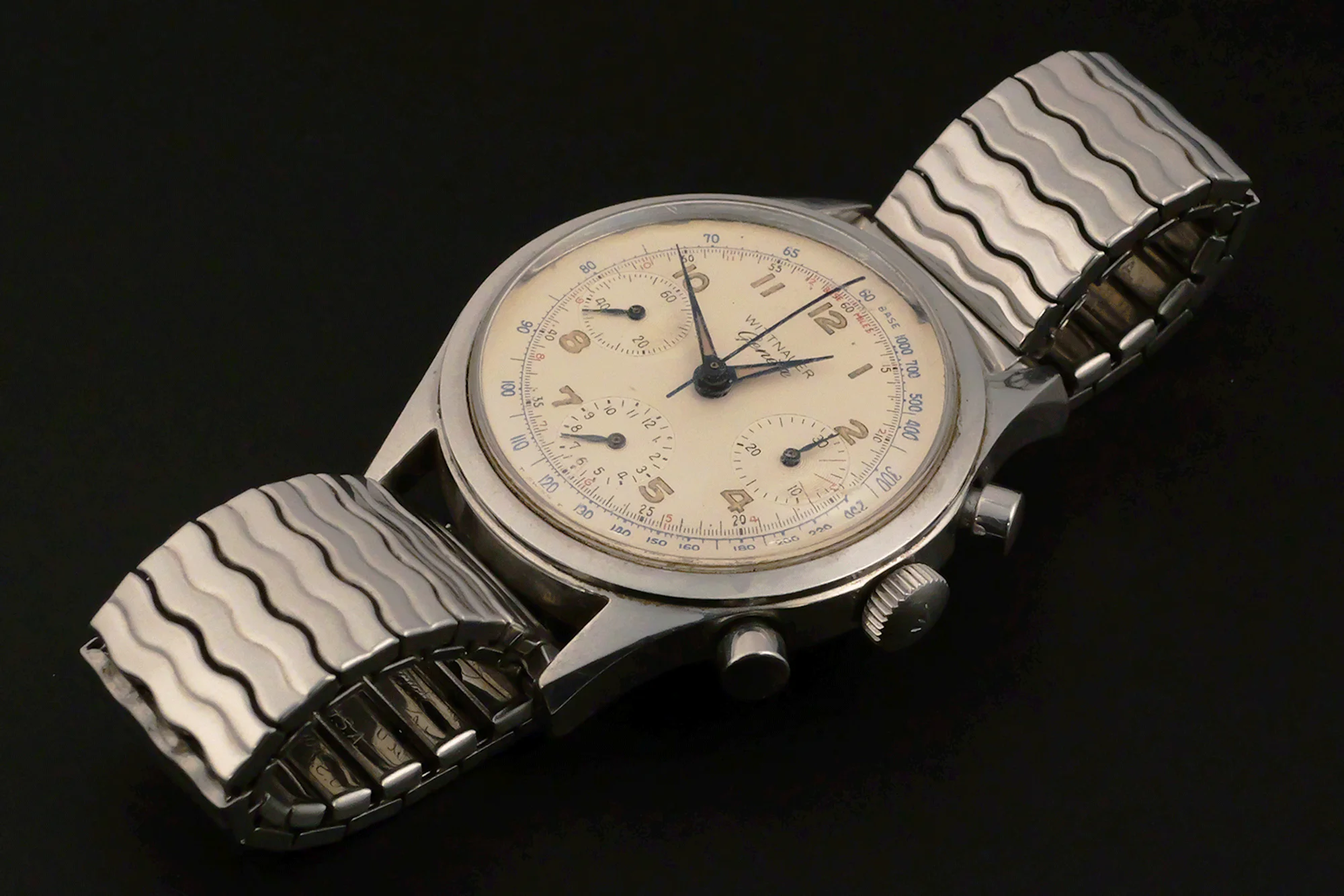
Photo courtesy of Invaluable.

Photo courtesy of Invaluable.
This example has a few spots on the dial, but otherwise presents really well. The case still has its bevels on the lugs, it’s still got its original crown, and the tritium lume has taken the usual faded yellow puffiness you expect from these Wittnauers. I’ll put my cards on the table and admit to having a horological crush on the 235T since I first got into watches, and despite the dials spot, this model is just phenomenal in person—the white of the dial and its three color printing, the puffy tritium, the blued hands, everything. The 36mm case looks fine as well, with the bevels still clear on the lugs.
The market for 1960s “boomer” chronographs has simmered a good bit since the frothy highs of half a decade ago, which has made these Wittnauers, in my opinion, a relative bargain again. Powered by a Valjoux 72 and wearing incredibly well, it’s excellent that these are typically gettable for under $3,000 or so. Bid up to $400 as of writing, it’ll sell on the 8th.
Cleto Munari “Sotsy”
Open a new browser window and look up “Olivetti Valentine.” If you’re not a typewriter dork, first count your lucky stars, but then take a moment and appreciate what is, even if you’re not aware of it, one of the wilder typewriter designs. That thing came out in the late 60s, and examples now reside in the permanent collections of museums around the globe.

Photo courtesy of Relojes Vintage Mexico.
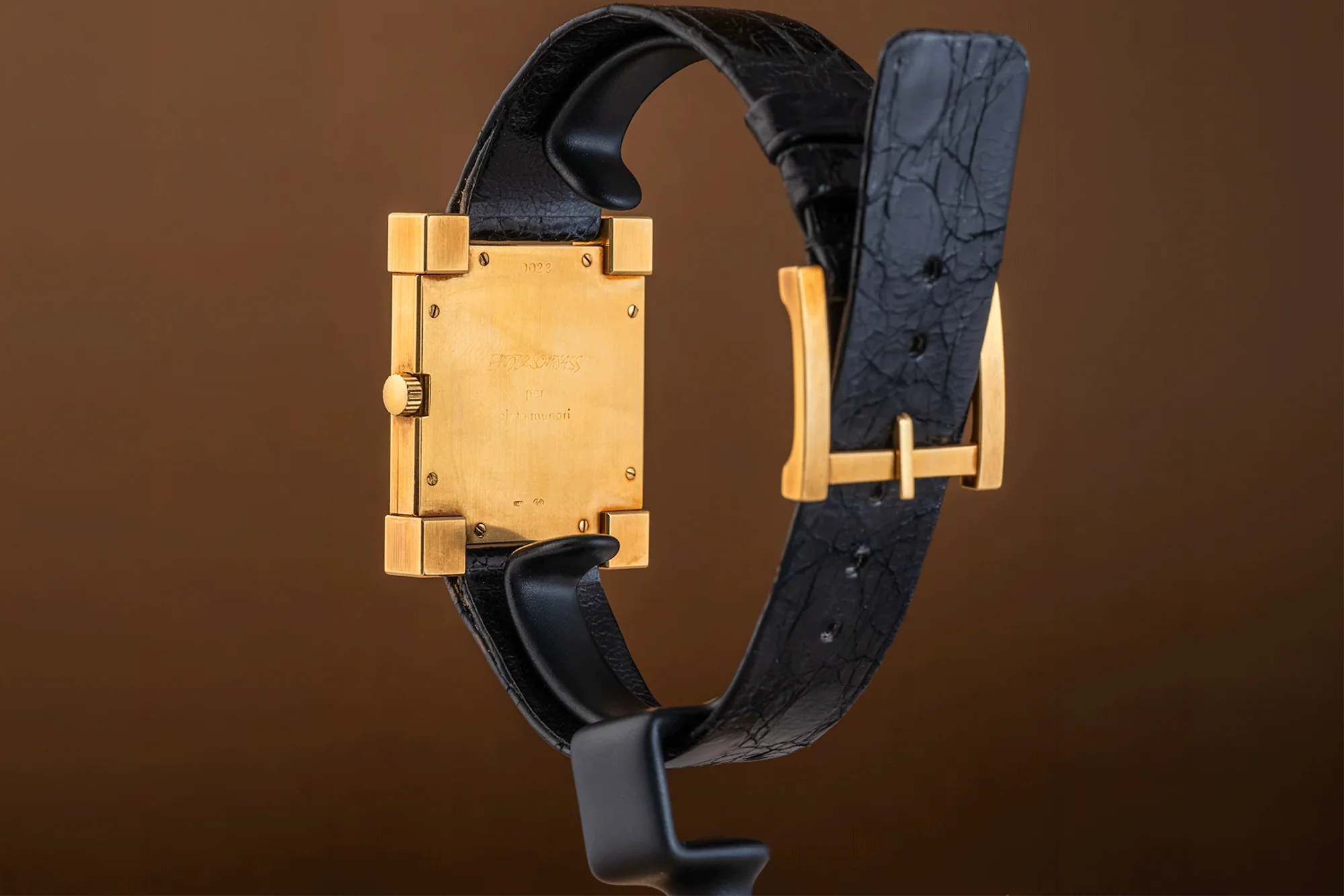
Photo courtesy of Relojes Vintage Mexico.

Photo courtesy of Relojes Vintage Mexico.
Now consider the fact that one of the designers of that typewriter would eventually say about it that it was “too obvious, a bit like a girl wearing a very short skirt and too much make-up.” If you want, feel free to picture the watch a designer like that might make—someone involved with a bright, curvy, colorful, world-famous design who ended up dismissing that work.
You, of course, don’t need to picture such a watch: it’s this Cleto Munari “Sotsy,” as subdued and reserved as the Olivetti Valentine is extraverted and wild. Aside from the opulence of the 18k gold case, this watch is so buttoned-up as to be nearly mute, so austere it feels a bit like someone whispering “shhhh” in a library.

Photo courtesy of Relojes Vintage Mexico.
And yet, the watch is strangely magnetic, a testament to how excellent a designer Sottsass was. Given everything else—its plain and lovely dial, its interesting-without-being-showy hands, its architectural case—I was surprised that the thing I kept returning to was the buckle. It’s so well designed to work with the rest of the case, and it’s impossible to see it without feeling a strong dose of comfort. You don’t even need to like the watch, but if you see the watch and the bracelet that comes with it, you cannot miss how much the designer cared about every last detail.
These watches don’t come up much, and Relojes Vintage Mexico’s offering this full-set example for $28,000.
Blancpain Fifty Fathoms “No Red” Technisub
I’m including this out of a mix of appreciation and obligation. The obligation part’s easy: it seems unreasonable, borderline unhealthy, to be into watches and not have some measure of appreciation and respect for the Blancpain Fifty Fathoms, and so when interesting ones arise, I can’t help but note them. This one’s not only a “No Rad” model, but it’s co-signed by Technisub, one of the outfitters who sold watches to divers, and those two details are enough right there.

Photo courtesy of Drouot.

Photo courtesy of Drouot.

Photo courtesy of Drouot.
But the truth is, even if the Fifty Fathoms wasn’t all the things it is, I’d argue this watch merits inclusion on Bring A Loupe anyway, for any number of reasons, but chief among them is how good it looks. Such a statement’s a little blandly obvious—this wouldn’t be included if it looked trashed—but the plain fact is that this is a 60+ year old tool watch with a great dial and a case that hasn’t been beaten to hell.
The watch’s condition could be due to any number of factors. Maybe it simply was never worn that much, or perhaps it adorned the wrist of an agoraphobe. Or, more than likely, it was worn just like any normal watch and was generally cared for, and, therefore, the thing is a testament to how well-designed these watches were in the first place. I appreciate that it may sound a little corny, but it’s the truth, and it is affirming and excellent to see one of these watches come through decades later as proof that, sure, everything falls apart, but perhaps well-made things do so a little more slowly.
This auctions on the 7th of August, with an estimate of €17,000-20,000.
Eberhard Contograf
The Eberhard Contograf is one of those models I’m perpetually shocked isn’t more beloved and heralded (or maybe it is and I’m just out of the loop, as ever). Start with the basics: it comes in a 38mm stainless steel case made by Huguenin Frères. It has a rotating external bezel, and every Contograf I’ve seen comes with a 12-hour bezel, meaning it could, ostensibly, be used as a simple GMT. It’s powered by the Eberhard cal 310/82, an in-house column-wheel chronograph movement that not only features a date, but, on this model, has an independent date corrector at 9 (the cal 310/82 was also used in the Doxa T-Graph and was badged the Doxa 287).
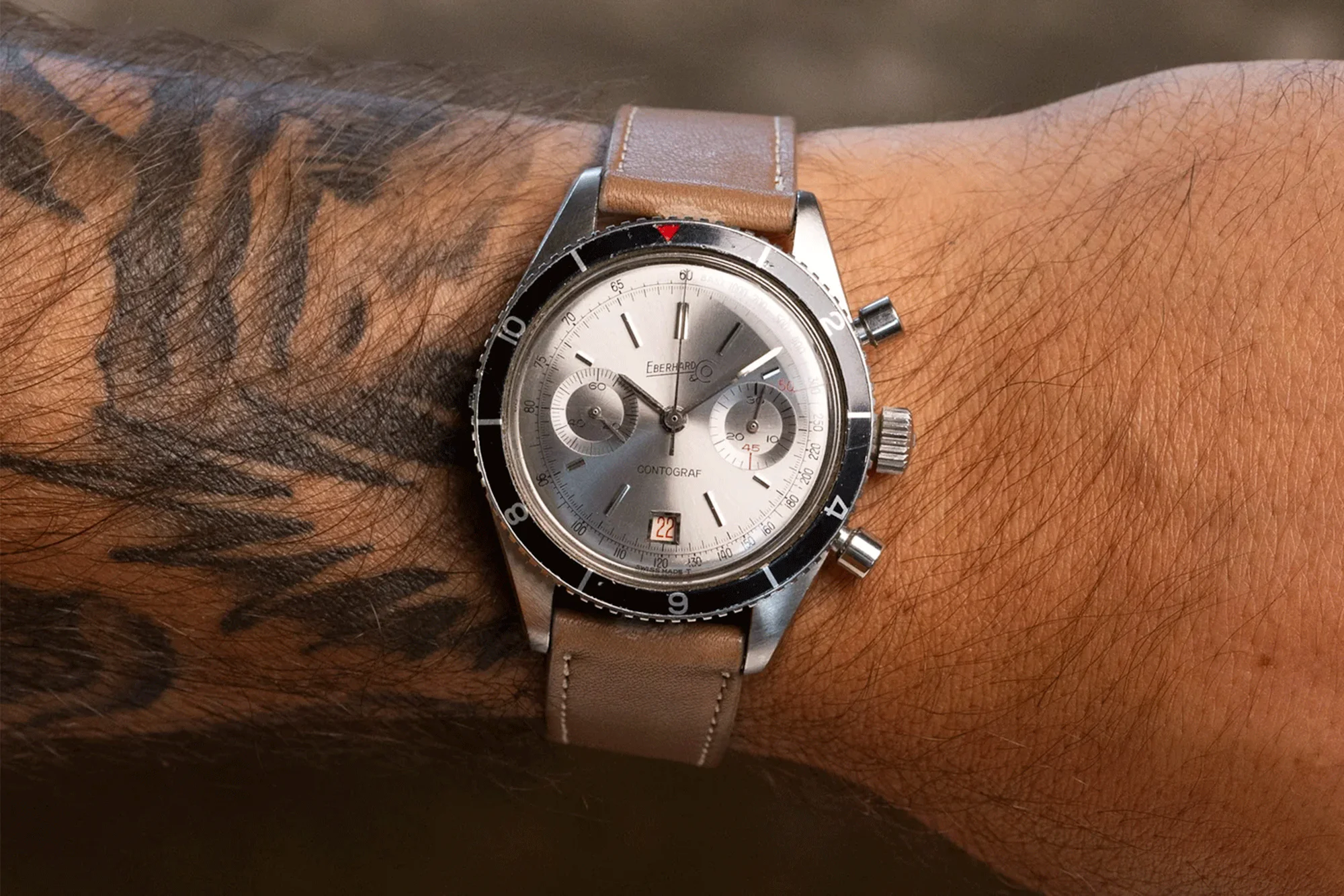
Photo courtesy of Oliver & Clarke.
I should note that it’s not as if Contografs are overlooked. Though they’re fairly rare and priced accordingly, the model’s legendary enough to have merited a re-issue in 2014 (a re-issue I, for one, would love to see refreshed and debulked from its 42mm diameter and fairly thick case, given it’s powered by an automatic 7750). The reissue, however, is one of those watches that makes a wearer even more long for the original.

Photo courtesy of Oliver & Clarke.

Photo courtesy of Oliver & Clarke.
Fortunately, the folks at Oliver and Clarke have this lovely non-lume model available. Featuring a brushed-steel dial and a case that appears remarkably unused for being nearly 60 years old, this watch has a ton going for it. Such beauty isn’t cheap, though the $13,850 asking price for this watch is fully supported by the market.
Buyer Beware

Photo courtesy of The Saleroom.
This sterling silver Tiffany & Co jump hour is the sort of watch it’s way too easy to so badly want to be real that you overlook its many flags. In this case, there’s a lot to give pause (the impressions on the silver, for a start), but the giveaway is in the dating. The caseback’s got a number of stamps, one of which is a C, which dates the case to 1918, which wouldn’t be a big deal were it not for the fact that the watch is powered by a movement that wouldn’t be invented for another thirty years. I’d been digging for what exactly was wrong with this one, and hat tip to @jumphourking for making it incredibly clear.