
It’s not often we see a wholly new watch released from Rolex, a brand famous for its methodical evolution over generations. In 2012, Rolex introduced an entirely new platform in the Sky-Dweller, showcasing a creative approach to innovation and mechanical know-how in a manner never before seen from the brand. The Sky-Dweller was the Crown’s first watch to feature an annual calendar complication, and in typical Rolex fashion, it went about achieving this in a highly unique fashion, complete with a unique layout, and something called the “Ring Command.” There’s a lot to unpack with the Sky-Dweller, but it all comes together in a surprisingly intuitive manner.
[toc-section heading=”Sky-Dweller History”]

As mentioned, the Sky-Dweller represents the first annual calendar from Rolex, but it is far from the first watch from the brand to feature a suite of calendar complications. Prior to its shift into pure sport watches in the 1950s, Rolex produced a legendary pair of full calendar references in the 8171 and, later, the famous 6062. These remain the most complicated references ever produced by Rolex, as they would pair a full calendar, presenting the day, date (pointer style), and month, along with a moon-phase indication.
While Rolex has been progressive in its use of some calendar functions, it has never brought them all together within a single reference since the likes of the 6062, which went out of production in the early 1960s. The Datejust (introduced in 1945) was an early popularizer of the date complication; while the Day-Date (introduced in 1956) brought a full day-of-the-week aperture across the top of the dial. The month indication has been suspiciously absent, however, until 2012 with the release of the Sky-Dweller, a watch that is only missing the day of the week – though you might say that it makes a fair tradeoff for a GMT display. So, while the Sky-Dweller is indeed an annual calendar, it is not a full calendar.
[toc-section heading=”Understanding the Sky-Dweller”]

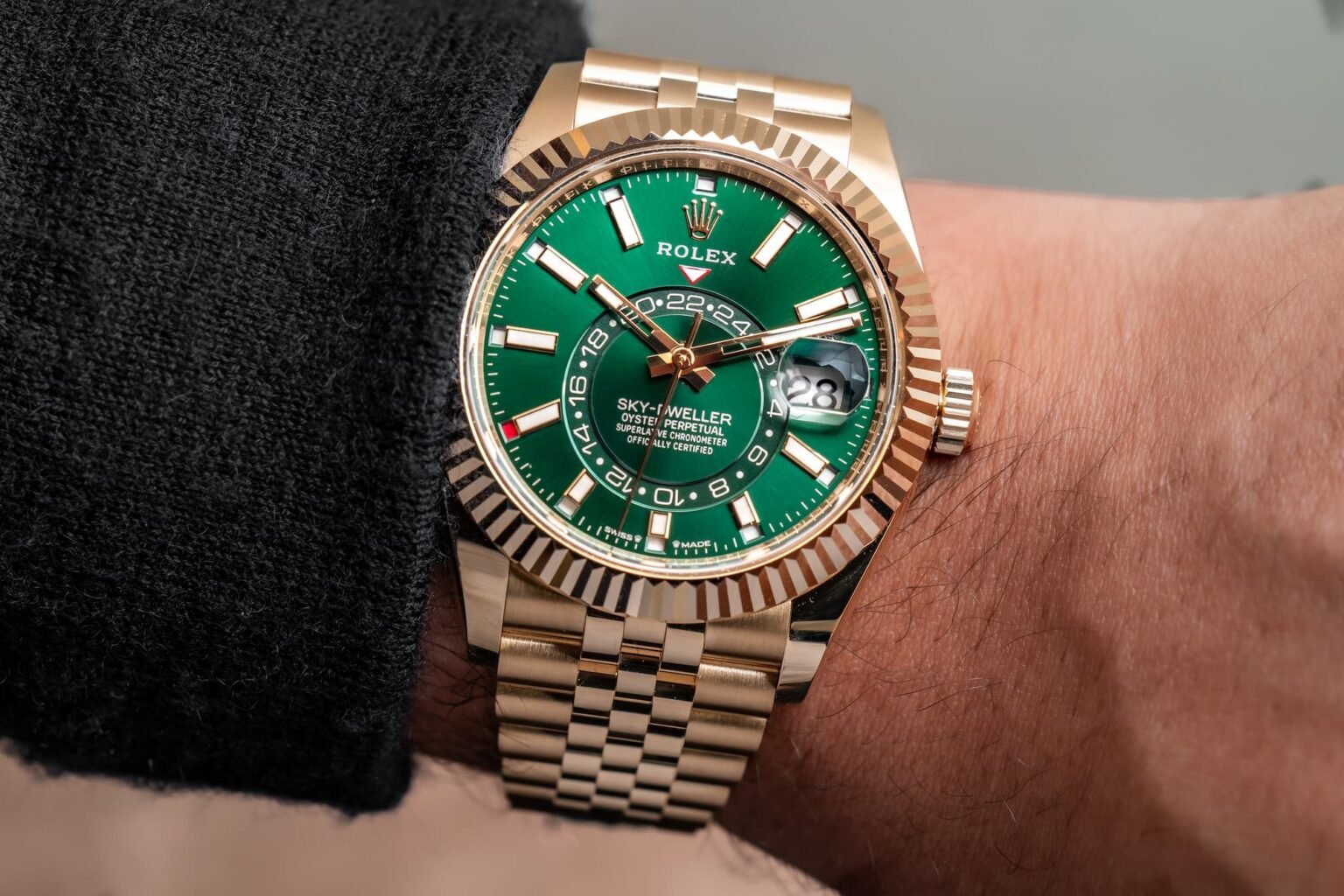
The Sky-Dweller is rather unique as far as annual calendar watches go. In fact, the watch is somewhat unsuspecting at a glance, with no visible indication for the month making itself known. Instead, the priority is on the time, with a 24-hour ring set within the dial, and the typical date window at 3 o’clock, complete with the polarizing “Cyclops” lens on the crystal. Upon further inspection, you’ll find another set of smaller apertures at the tip of all 12 hour markers, one of which will be red. These are in fact the months of the year, which, rather conveniently, also number 12. The month is marked by the aperture turning red, while the others remain white, thus blending in with the hour markers.
As the month is not generally something you need to know several times throughout the day, the manner in which it remains hidden feels entirely appropriate, and somewhat ingenious for its simplicity. Plus, being an annual calendar, this watch will adjust itself to account for months ending in 30 or 31 days, only needing to be corrected each February (you’ll need to find a perpetual calendar to account for that).

All of this is driven by the automatic Rolex Caliber 9002, set within a 42mm Oyster case that is available across a variety of materials. What makes this caliber so unique is how the winding and setting is handled, which requires both the crown and the bezel. At its neutral position, the movement can be wound. Twisting the ring counterclockwise one position allows the crown to adjust the calendar; once more will allow for adjustment of local time; and one final time to adjust the reference time within the 24 hour ring. Dubbed “Ring Command” by Rolex, It’s an intuitive system that means there are no hidden buttons within the case as you’d usually find in this sort configuration.

All things considered, with the added thickness that comes with this mechanism along with the complications present, the total watch thickness of 13.8mm feels almost impressive. But make no mistake, this is a watch you will notice on your wrist, especially in light of it only being offered in a mix of precious metals. Of course, that isn’t necessarily a bad thing, but it is likely one detail we’d see ironed out in a second generation of this watch.
[toc-section heading=”Stand-out References”]

The Sky-Dweller is offered in five different metals: White Rolesor (steel and white gold); Yellow Rolesor (steel and yellow gold); yellow gold; white gold; and finally, Rolex’s proprietary Everose gold alloy. It’s worth noting that the White gold case is available only on Rolex’s Oysterflex bracelet Each of the remaining metals can be had with both Oyster and Jubilee bracelets, while the full-gold references are all also available fitted to an Oysterflex strap.


There are two specific dials that I want to call out here, and they are the mint-green dial available only on the White Rolesor reference (336934-0002), and the blue-green dial available only on the Everose gold reference (336935-0005). Both of these dials bring out a vibrant personality of the Sky-Dweller that place it in rather unique territory, even for Rolex. The blue-green in particular absolutely sings against the Everose metal, and it can only be had on a full bracelet, meaning you cannot pair it with an Oysterflex strap.
Each of the configurations offer something different in terms of color, from browns to blues, and all receive a sunray texture finish, giving each a degree of pop that befits the polished fluted bezel. If, however, you desire something a little more befitting of a “tool” watch, and prefer to fly under the radar, the white and black options both manage to highlight the practicality of the complication as Rolex has designed it here. They emphasize legibility over the presence of any color, and they are compelling for an entirely different reason as a result.

Finally, we have to point out what is likely the most ostentatious Sky-Dweller currently in production, and that is the Reference 336938-0008, which pairs a bright green dial with an old-school full yellow-gold case and bracelet. This is undoubtedly the showstopper of the bunch, and signifies a historic configuration for Rolex. If you want to remain at the apex of the collection, but aren’t fond of green, you’ll find the old-school cool pairing of the same full yellow-gold case and bracelet with a champagne-colored dial for that tone-on-tone look that hits just right.
Overall, the Sky-Dweller collection is both a visual powerhouse, thanks to its use of different metals and dial pairings, while also serving as a testament to Rolex’s ability to innovate in interesting ways. We’ve seen the latter attribute expressed with the recent release of the Land-Dweller, but the Sky-Dweller isn’t afraid to lean into a visual cacophony of configurations underscoring its versatility. And at the end of the day, the Sky-Dweller may just be the most versatile watch in the Rolex stable. Price for the Rolex Sky-Dweller starts at $17,750 for Oystersteel and white gold models, climbs to $24,700 for two-tone models, $51,400 for solid gold on Oysterflex, and $60,100 for solid gold on bracelet. You can learn more at rolex.com