
[toc-section heading=”The Roots of Horology”]
Let’s unpack the word “horology,” because if you want to understand watches on a level that goes far deeper than just admiring a turquoise dial or the utilitarian feel of a lightweight titanium case, you have to understand the terminology around the hobby itself. The word comes from the ancient Greeks: you take the word “hora”, which translates roughly to “hour” or “time,” and combine it with “logy”, derived from the Greek word “logos”, which means the study of a subject. Together, you have the study of time. While the definition itself leans toward sounding deeply philosophical, it’s a concept frequently misinterpreted as mere shorthand for high-end wristwatches. In reality, the scope of horology as a discipline is vast. It covers absolutely everything from the discovery of ancient sundials to gear-grinding grandfather clocks that used to adorn the hallways of wealthy historic estates.

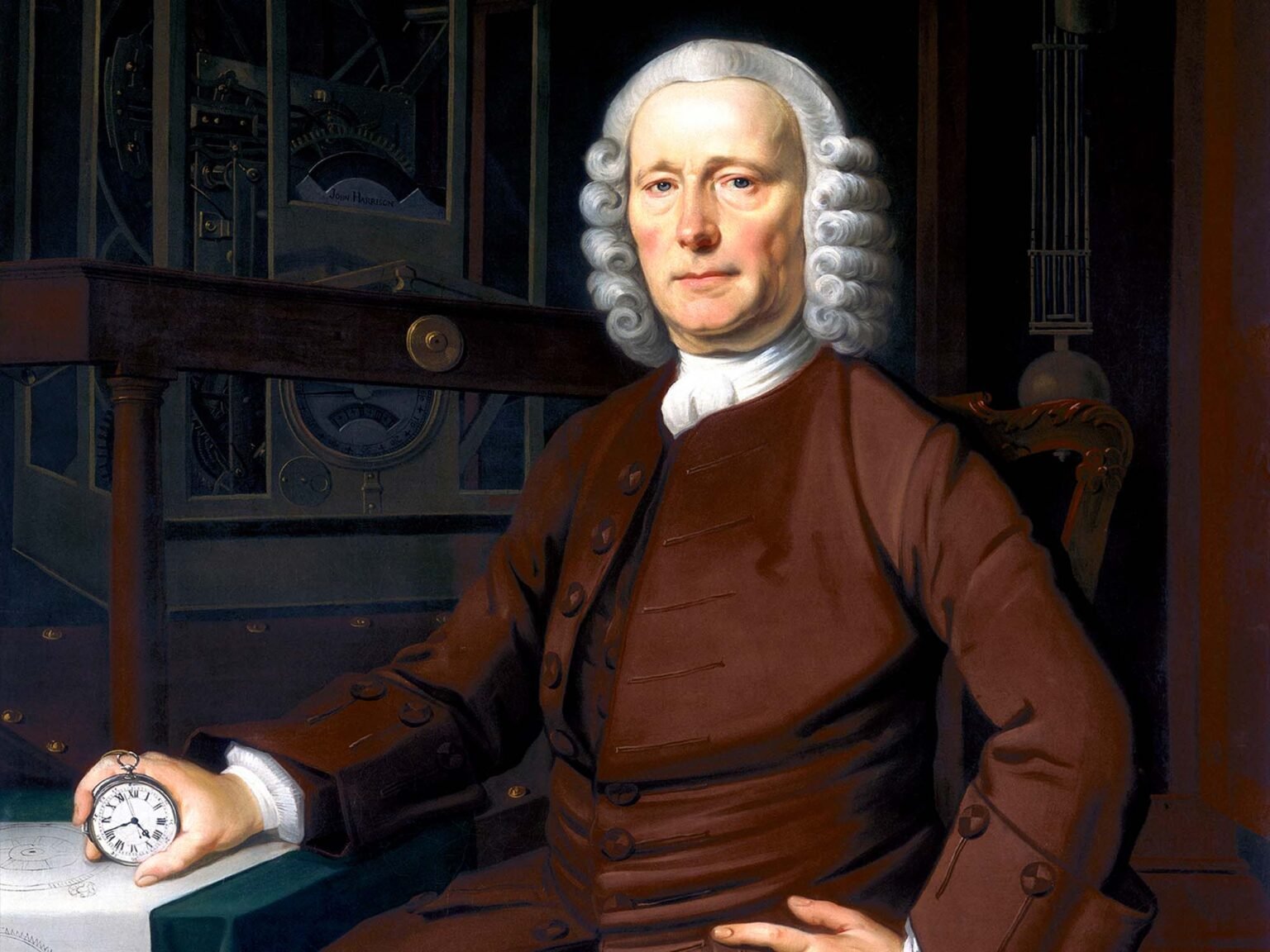
Consider marine chronometry. Hundreds of years ago, knowing the exact time was a matter of life and death. We’re talking about a time when ships were getting completely lost at sea, and entire crews were crashing into jagged reefs in the dead of night, all because sailors had no means of accurately calculating their longitude. The British government literally offered a king’s ransom to anyone who could invent a clock that would keep highly accurate time out at sea. It took the brains of a self-educated carpenter, John Harrison (above), to crack the code, realizing that traditional pendulum clocks were rendered absolutely useless on the chaotic deck of a ship and that seafarers required something far more ambitious. He developed the H4 marine timekeeper and solved the longitude problem. He’s the very reason global navigation exists at all.
[toc-section heading=”The Science Versus the Art”]
If you take a mechanical watch movement and strip it down to its absolute barest bones, it is nothing more than physics. When you wind the crown on the side of the case, a coiled piece of metal called the mainspring tightens up inside a small barrel contained within the watch. That spring desperately wants to uncoil and release all its stored kinetic power at once in one immediate snap, but the movement doesn’t let it. Instead, a series of tiny, interconnected gears slices that energy into perfectly even, microscopic fractions of a second. This all happens at the escapement, which sits behind the mainspring, acting as a gatekeeper and literally drip-feeding energy to the balance wheel. The balance wheel swings back and forth, acting as the oscillator and maintaining a fixed periodic rhythm, telling the watch or clock how fast to “tick”. This microscopic engineering within a movement is a beautiful symphony of individually working parts, but if horology were all about physics, there’d be no market for watch-collecting per se. A $30 battery-powered watch would absolutely destroy a $100k mechanical timepiece in a head-to-head accuracy contest. Instead, we still obsess over mechanics. Why? Because of the art.

Horology is also about making something beautiful for the pure joy of it, and the emotional resonance of the materials used in watchmaking as a practice. The warmth of traditional 18k yellow gold, for example, has an undeniable charm, whereas a patina-developing bronze case acquires its own character over time. Then there are the ultra-modern forged carbon or grade 5 titanium models, and more intricate techniques, like black polishing, to consider. A master watchmaker might sit at a bench for three solid days to polish the microscopic head of a single screw, just as he might carve the decorative stripes of a côtes de Genève finish into a mainplate with meticulous care. These decorative flourishes serve practically no functional purpose. Similarly, the tortuous art of skeletonization serves no practical end (other than, perhaps, lightening the overall weight of a movement). Yet, in their totality, they represent the ultimate human indulgence, demonstrating what the unaided human hand can achieve. To frame it with greater clarity, horology is about both the physics of timekeeping and the beauty that brings the science to life.
[toc-section heading=”Complications in Horology”]
A watch that just tells the time (the hours, minutes, and seconds) is a classic, elegant instrument. But once a watch does anything more than that, it’s known as a “complication” and these represent the ultimate status symbol for a collector and the absolute pinnacle of engineering.

Gravity, for example, is the natural, invisible enemy of the mechanical watch. Depending on the timepiece’s orientation, gravitational forces exert varying pressures on the delicate internals of a movement, causing deviations in chronometric accuracy. Legendary watchmaker Abraham-Louis Breguet (above) resolved to conquer this inconsistency a couple of centuries ago, housing the escapement components within a rotating cage. By continuously revolving the escapement upon its own axis, the pull of gravity was effectively neutralized. He christened this invention the tourbillon (example below from F.P. Journe), and today, its execution reflects some of the best watchmaking in the industry. Similar accomplishments can be found in the likes of the travel watch, AKA the “true” GMT complication, which allows the wearer to jump the local hour hand forward or backward in distinct one-hour increments without affecting the seconds or home time.

Some watchmakers push the boundaries of horology even further, producing timepieces that can replicate the entire solar system. The perpetual calendar (example below from Patek Philippe) is a complication that understands the precise duration of each specific month of the year and even anticipates the arrival of a leap year without you needing to even touch the winding crown. Marry this complication with a moonphase indicator that charts the waxing and waning of the lunar cycle, and you’ve got a compact celestial calculator for the wrist.

Should we discuss the absolute zenith of haute horology, however, we must inevitably turn to the acoustic complications such as the minute repeater, which treats the wearer to a symphony of gongs once the slide on the flank of the case is actuated. The complex mechanism chimes the current hours in a sonorous low note, the quarter-hours on a melodious dual tone, and the subsequent individual minutes on a crisp, resonant high note, giving the wearer an audible performance as opposed to a visible one.
[toc-section heading=”The Rise of Independent Horology”]
There’s a massive horological renaissance happening all over the world right now. From J.N. Shapiro’s hand-turned guilloché models (below) and RGM’s pedigree movements, to the modern integration of Weiss, to Vortic’s restoration artistry, a wave of American watchmakers is reclaiming a lost heritage. Look across the waters to the craftsmanship emerging from the U.K., where up-and-coming independent watchmakers are now beginning to reclaim Britain’s rich national heritage of horology. Even over in Germany, specifically within the enclave of Glashütte, robust three-quarter plates and untreated German silver establish an artisanal identity distinct from that of the Swiss.

These independent watchmakers are insisting on doing things the hard way, often crafting nearly every single component of their watches entirely from scratch, utilizing vintage hand-cranked engine-turning machines and several time-honored techniques to preserve the spirit of traditional watchmaking. When you purchase a bespoke piece from an independent artisan, you know exactly whose hands bled over the filing and polishing of your specific watch. It’s what more and more collectors are turning to: buying into the heritage of horology.
[toc-section heading=”The Preservation and Restoration of Horology”]
This brings us to the final, and perhaps most historically important, aspect of what horology really means. Whether you’re admiring a hand-finished, high-end watch or checking the time on a reliable, budget-friendly quartz watch, you’re partaking in the same fundamental human desire to measure and understand the passage of time – horology.

Fundamentally, the term “horology” is the fascinating (and broad) study of timekeeping. It encompasses everything from ancient sundials (example above from Greece) to celestial navigation. Unfortunately, the term is often misused by enthusiasts as a synonym for “expensive watches”, which narrows the scope of the discipline somewhat.
Next time someone refers to a watch as “haute horology,” remember one thing above all else. The measurement of time doesn’t discriminate based on the thickness of a collector’s wallet. Whether you’re wearing a $500 microbrand watch or a six-figure complication, horology is everything time-related: it’s ancient Greek philosophy, naval history, micro-physics, artistry, and everything in between. Moreover, it’s a continual reminder that while we can never truly capture a single second, we have built something magnificent to honor its passage.