

Go Knicks.
That is all.
Scorekeeping last week’s picks: the Grand Seiko sold for $29,700; the Patek Philippe 570 is still available; the Certina CD sold for €120; and the LeCoultre Uniplan sold, but the auction house didn’t upload the final price.
Strays

Photo courtesy Goodwill.
Here’s a Breguet Classique 5907 on Goodwill. Yes, a Goodwill in Minnesota received, as a donation, a solid-gold Breguet with a four-day power reserve, a manual-wind 510DR movement, a full guilloché dial, Breguet hands, and, as if all that weren’t enough, the watch comes with its original box. As Warren G advised, mount up. Beyond that heavy-duty watch in the least likely place, this Dodane Diver is very cool, and this Vincent Calabrese (who also made the Corum Golden Bridge) Wandering Jump Hour on Meticulist is incredibly cool. Apparently, it’s my time—or a good time generally—to be excited by rectangular-cased non-Reverso JLC models, and if you’ve been after a Juvenia Architect, this one seems like it’ll be gorgeous once it’s cleaned up a bit. I don’t know anyone who collects Verity watches, but this diver sure looks great with its classic Monnin case and—there’s no other word for it—rad hand set. Finally, here’s another IYKYK from Zenith, this time a 40T, which has absolutely nothing going for it other than a beautiful, simple case and a dial marking beneath the handset that has to be one of the coolest movement-related badges on any model I’m aware of.
In an effort to balance out last week’s quartet of time-only watches (the Grand Seiko *did* feature a power reserve, so technically there weren’t no complications), this week seems a good time to feature all chronographs. These are listed in likely order of purchase price, with a bit of something for everyone, regardless of your price point.
A Dugena Monza
Okay, yes, this has a chromed case, which to me is basically antithetical to a sports watch, since by definition sports watches should be more rugged and able to handle their share of dings and nicks, and a chromed case, at very best, will eventually lose its finish just through exposure to sweat. That caveat aside, however, this Dugena’s got a lot to offer.

Photo courtesy Galerie + Auktionshaus Peter Klöter.
First off, it’s powered by the venerable Valjoux 7733 (the listing incorrectly lists it as a 7734, since the watch lacks a date). While not the sexiest chronograph movement in history, the Valjoux 773X (originally the Venus 188, but that’s a different story) led to the Valjoux 7750. Whatever any of us think about the 7750—that rotor wobble! The thickness!—it’s inarguably one of the most important movements in the history of watches, a veritable mechanical Kevin Bacon, connectible to a comically large swath of watches from most brands you can name.
Second, this Dugena simply looks cool, which is not nothing. With its red accents on the dial and its squared-off subdial hands, the thing veritably screams early 70s, and the case, while already showing a little chrome loss, has a great shape and style and, at 37mm, is right in the sweet spot in terms of fit. Pair all that with the fact that the opening bid on this watch is €100, in an auction starting on the 27th, and you’ve got an entry-level chronograph that punches well above its price.
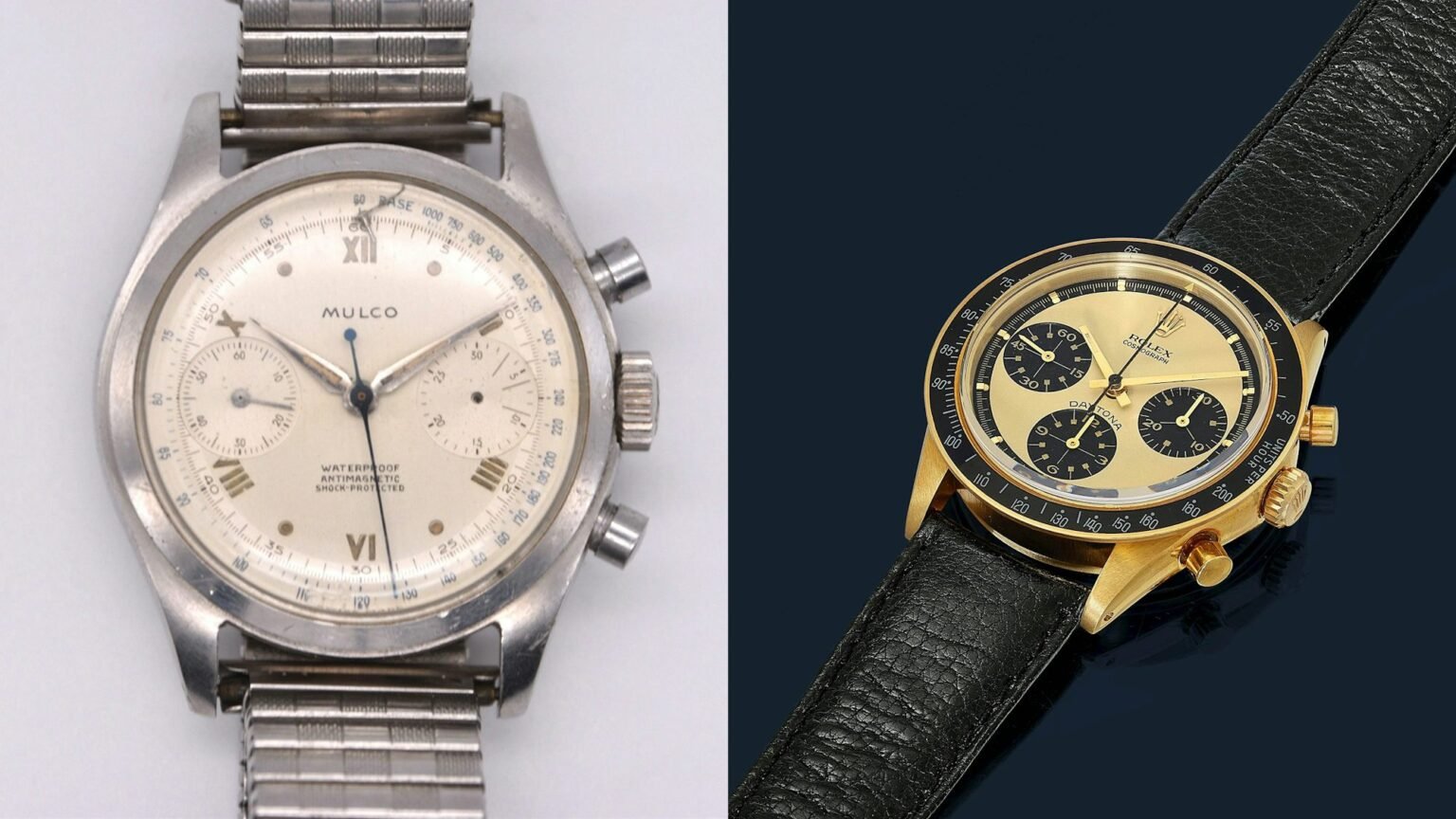
A Mulco with a Spillman Case

Photo courtesy ARTEAL.
To be clear, this Mulco is at least a little broken. That minute-register hand that’s fallen out of the 3 o’clock subdial—you can see it up at the 12 o’clock marker—also took the post with it, meaning the hand can’t just be pressed back on. So there’s that headache to price in.

Photo courtesy ARTEAL.
However, if you can get past that, you’ve got a watch likely to clean up very nicely indeed. Unlike the Dugena above, this Mulco’s got not only a stainless steel case, but one that seems likely to be a Spillman case. It’s only 35mm, but that was standard in the 60s, when this watch was likely released. Past that, the dial is mostly dynamite, with lumed Roman numerals and a blue tachymeter ring. Sure, there’s evidence of wear, but a) the whole thing looks honest, with the lume on the hands and dial matching, and b) the estimate is CHF 150-200. Throw in what’s likely a Valjoux 22 movement to boot, and, even with the detractions from the watch, it’s worth considering.
This one goes to auction on the 27th, meaning you’ve got plenty of time to convince yourself one way or another on this one.

Alternatively, we have this dressy chrono from Tavannes. Tavannes is a fascinating company worth digging into, and this watch gives a great sense of why they were a brand to be reckoned with in the first half of the 20th century (they were, supposedly, the fourth biggest watchmaker in the world in the 30s). This thing’s got a great Art Deco design, a lovely snail track for the chrono, and will likely sell for under $1k all-in.
A Excelsior Park Monte Carlo
The Excelsior Park Monte Carlo is a truly weird watch. Be apprised that this thing is from the early 80s, despite looking for all the world like some offshoot of the Zenith Cairelli (apparently the cases are identical). Not only that, but the watch has one of the wilder movements you can find.
You all know about Project 99 and the Hamiltons/Breitlings/Heuers they powered. While these watches are all legitimately cool, the movement itself was tricky, as it was both modular (meaning the chronograph was a Dubois Depraz module fitted onto an extant movement) and a micro-rotor. Your mileage may vary with your local watchmaker, but the only movement I know Donovan Paradise to sort of sigh about, automatically, when confronting it, is the Cal 11/12/15.

Photo courtesy Artcurial Beurret Bailly Widmer.
The weird part of this Valjoux 7740 is that it’s a Cal 11/12 that’s been modified to be manual-winding. This is also one of the few vintage chronographs I’m aware of that featured the same subdial layout as the contemporary Rolex Daytona (hours at 9, running seconds at 6, elapsed minutes at 3). That it’s got a date is, I suppose, just gravy.
Okay, so how about this specific example? Pretty good, overall. The lume looks good on both the dial and hands, the dial seems to have no marks, and the 42mm case seems unlikely to have been polished, though we’ve only got the one picture to go on. Currently with no bids and an estimate from 2,000-4,000 CHF, this watch auctions on the 24th.

Photo courtesy ALEXANDRE LANDRE – PARIS.
Once again, we have an alternative: this gorgeous Longines 3721. Sadly, the case seems to have been polished a bit at some point, meaning the very pronounced angles on the lugs you’d expect are there, but only as a hint. Still, powered by the 13ZN, a dial that’s picked up some spots from aging that somehow don’t look back, and with a full 18k gold case, it’s an awfully nice watch for being 89 years old.
A Patek Philippe 5960P
The Patek Philippe 5960 remains woefully underappreciated. First, it’s got an annual calendar—a complication Patek invented in 1996—meaning you’ve only got to adjust the date at the end of every February. Second, the CH 28-520 movement, aside from featuring the sort of finishing you’d expect from Patek, is the maison’s first automatic chronograph movement. Third, the dial’s got so much data crammed so elegantly into it, it’s almost laughable. There’s the day, date, month, and power reserve all up top. At the bottom, there are stacked minute and hour hands on the single chronograph subdial at six, and in the small aperture above the 6 within the chronograph subdial, there’s a day/night indicator.
Oh, also: it’s a flyback chronograph, natch.

Photo courtesy Koller.
The 5960 was launched in 2006, and I’ve spent years now tracking this reference in perpetual amazement that it hasn’t skyrocketed. True, the white-dialed steel version is a bit sportier (plus it comes on a bracelet), but even those are still readily available for less than their original list price ($54,800 in 2014).

Photo courtesy Koller.
This particular example is from 2007 and, unsurprisingly, not only seems in excellent condition overall, but also comes with all its original everything—box, papers, and the setting pin included. I find it almost literally incomprehensible that this watch has an opening bid of (only) 20,000 CHF. On the one hand, yes, that’s a ton of money. Also, yes, that’s an incredible amount of complication and horology crammed into a very wearable 40.5mm. This watch sells on the 23rd.
A Rolex Daytona Ref 6241
No, it’s not a John Player Special, nor a Limoncello. To my knowledge, this 6241 has no cool nickname to set any collector’s heart racing. No, what sells this watch is that it looks almost completely unworn, having been, according to the listing, “worn only on a few holidays” and kept in a vault the rest of its life.
Coming with its original box and warranty card, dated 1970, this watch is a total knockout. As expected, the watch is 18k rather than 14k, as it was sold in Europe. I’ve spent an unmentionable amount of time going through these pictures and have yet to find a flaw with the watch, though such perfection will cost you. The opening bid is 350,000 CHF, and the watch goes up for auction on the 23rd.