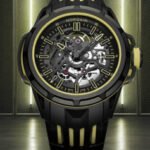
Dubai Watch Week is upon us, and TAG Heuer is using it as a launching pad for for a new version of what is objectively one of the most impressive watches they’ve ever made. The Monaco Split-Seconds Chronograph Air 1 builds on the Monaco Split-Seconds that was introduced at Watches & Wonders in 2024. That one, you’ll recall, had a movement fashioned largely from titanium and weighed in at just 85 grams. The retail price at the time was a head scratching CHF 135,000, but it was also an incredibly impressive caliber and feat of engineering. Rattrapante chronographs like this are indeed quite rare, and certainly one with a caliber made of titanium is unheard of and adds additional layers of complexity to whole endeavor.

The new Air 1 version of the watch is still 85 grams, but it achieves that weight even with new solid gold components in the case. The design of the case, still in the iconic Monaco square, has been substantially reworked and inspired by design and manufacturing processes that are part of the Formula 1 landscape. The case has effectively been hollowed out, with intricately skeletonized case flanks designed to maximize the weight to performance ratio.
TAG Heuer achieves this through a process they refer to as Selective Laser Melting (SLM). This is an additive manufacturing process that is typically applied in aerospace, medical, and automotive manufacturing, and like other forms of 3-D printing it’s essentially a cheat code in achieving otherwise impossible geometries and structures in titanium and, in this case, gold. According to TAG, the use of SLM here allows the brand to “put technology at the service of design,” a reversal of how watches have been made for much of the history of the craft.

The 41mm case borrows from the air intakes of hyper cars, which on the Air 1 form a type of exoskeleton in a honeycomb like shape. The main case and the lattices that frame the caliber inside are made from Grade 5 titanium, while the material under the bezel is solid yellow gold. It’s a striking, futuristic look that doesn’t have a lot in common with the classic Monaco, but that feels like it’s part of the point. This feels like a “concept car” version of a watch we’ve all become very familiar with.

Part of the aesthetic impact of this watch, as well as that of its predecessor, is the sapphire dial that allows for a view of the movement. In spite of the avant-garde nature of the piece, it’s quite legible with plenty of contrast. Many skeleton dial watches, of course, become kind of an eye chart. While the Air 1 might not be the cleanest or most straightforward chronograph dial we’ve seen, it’s far from the most challenging to read.

It’s easy to forget that TAG Heuer, a brand that is largely known for its vast array of watches aimed squarely at the mass market, also has a history of moving the ball forward when it comes to the most advanced aspects of modern chronometry. The Air 1, and the Split-Seconds project more broadly, are an important reminder of that tradition that stretches back to Heuer’s forays into Olympic timekeeping in the 1920s and runs all the way up to cutting edge quartz technologies produced in more recent decades. The Monaco Split-Seconds Chronograph Air 1 is another impressive chapter in that history.
The retail price of the Monaco Split-Seconds Chronograph Air 1 is CHF 150,000. It will be available in December. TAG Heuer