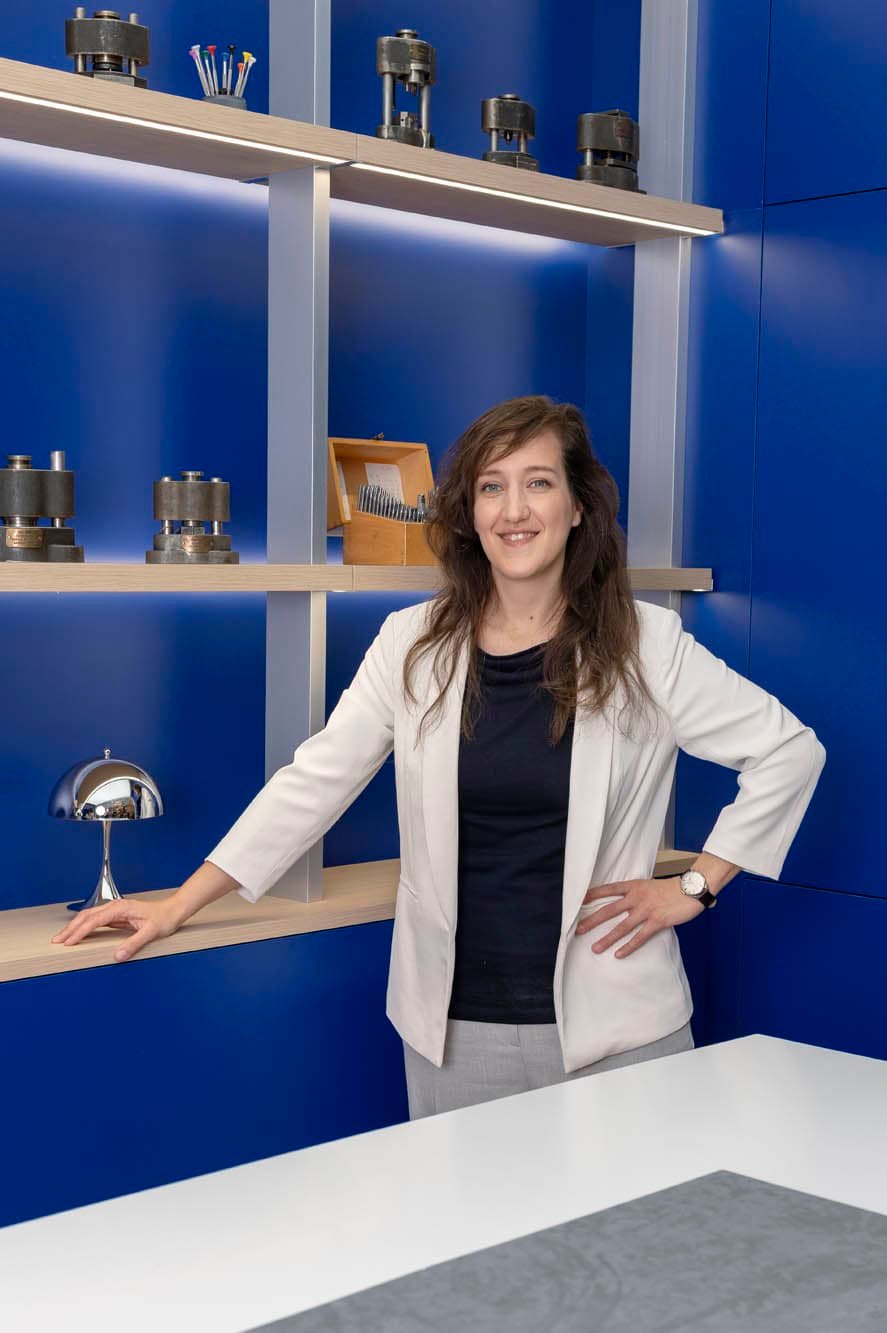

Laurence Bodenmann has served as the Heritage Director of Zenith for a decade. She’s also a member of the scientific committee for The Watch Library, a non-profit public interest foundation established in 2021 to document, preserve, and share watchmaking archives. While Bodenmann has become a staple of the industry, her role in watches was mere happenstance or rather came out of necessity. It spurred from a summer job at the International Museum of Horology in La Chaux-de-Fonds while trying to earn some extra money during her pursuit of a degree in anthropology.
“I was always interested in logic – when I was young, I first thought I wanted to be a math teacher,” she recalls. “But as I got older, I realized what interested me most was how different people approached reasoning,” Bodenmann continues, “and how factors like cultural context and economical or sociological diversity informed their thought process. I found it fascinating to observe how one person would approach an object or problem in one way and another person would do it completely differently.”

While Bodenmann didn’t initially expect to find herself in the world of horology, we can see why it’s been such a natural fit. The entire watch industry revolves around her astute observations as a teenager. Every person within a manufacturer – from the watchmaker sitting at a bench to the executives running the brand – is faced with the same object – a timepiece – and many of the same problems, from mechanics and design to positioning and relevance. In addition, that object itself – a timepiece – is a cultural artifact that represents these decisions, each different craft, and the historical perspective of the era in which it was created.
Bodenmann’s interest in and comfort with diversity is a direct reflection of her background. Her mother was a scientist, her father was a historian, and she grew up with three siblings. “My exposure to diverse viewpoints most directly came from my father,” she explains. “When his colleagues would come into town for research, they would always stay with us in our home – my father wouldn’t allow them to stay at a hotel. I remember my siblings and I listening to their exchanges, and I really feel those moments were formative in broadening our perspectives.”
When it came time to go to university, this naturally led Bodenmann to study anthropology. This brings us to one summer between school years, she found herself looking for a summer job, something to help pay the bills that was also relevant to her interests. “I would often look for jobs at libraries or museums,” she shares. “These institutions collect diversity – they are paradise for curious people like me – and I would always look for different types that specialized in different things,” Bodenmann continues, “one for a city, one for art, but one thing I had never done was work in a library for a museum.”
Here, at the Museum of Horology in La Chaux-de-Fonds, she found both worlds colliding. A portion of the museum is the specialized library of the Centre d’études L’Homme et le Temps, a comprehensive resource for horological research, containing a wide range of literature, industrial archives, and iconographic documents related to time measurement. That fateful summer, Bodenmann saw an ad for a position as a documentalist there. Her job was to work as an intermediary between the museum library and professionals in the field of horology to answer any questions that could be uncovered with the materials throughout the rich archives.

“After about six months of working there, the director of the museum at the time, Ludwig Oechslin, came to me in our little office for the documentalists and said to me ‘I have been impressed with your work, and I wondered if you might be interested in learning a bit more about my job?’” Bodenmann shares.
Of course, she said yes. Oeschslin is a niche haute horology legend. His accomplishments include restoring the Farnese Clock housed in the Vatican Library, co-creating the Ulysse Nardin Freak, co-founding Ochs und Junior (a watch company with a focus on astronomical and calendar complications), and designing the Türler Clock, a unique astronomical and perpetual calendar clock exhibited at the Museum of Horology, where he served as the director from 2011 to 2014.
This moment went on to further solidify Bodenmann’s rapport with Oechslin and the museum and ultimately led her to help organize a symposium on American watchmaking and an exhibition on how American watchmaking challenged the Swiss industry thanks to Waltham and its implementation of verticalization.
Little did Bodenmann know at the time that another seed was planted on the journey that would bring her to Zenith. However, she had become acutely aware the watch seed was planted. “After contributing to this exhibition, my interest in watches was really fueled,” she affirms. “I expressed to the museum that I wanted to create other exhibitions in the same vein for other markets – significant watchmaking cities in Switzerland like Le Locle and Basel and other countries like Germany. I came back to those same things that inspired me when I was younger,” she remembers. “These watchmakers from all different parts of the world have quite similar ingredients but very different outcomes, and I wanted to uncover why.”

For Bodenmann, the end product (the watch) is the tip of the iceberg and “the why” is everything beneath the surface. This is another way in which her anthropological education comes in. “So, I had been working on these projects for a few years, and I was also teaching on the side at the School of Applied Arts. Then one day, I got a call from a colleague I had partnered with from the Musée d’Horlogerie du Locle-Château des Monts, and he told me about this position that had opened at Zenith for Heritage Director – he insisted I must explore the opportunity. I was hesitant,” Bodenmann admits, “I was fulfilled by the exhibitions I was creating and teaching, but he kept insisting because he knew – we all knew in the museum world – when it comes to sources, Zenith’s archives are unmatched.”
Zenith’s archives stand as one of the Maison’s most valuable assets, representing an approach that goes beyond the “tip of the iceberg” (the watches themselves) and that deeply values “the why” behind these creations. While a vast majority of brands have lost much of their record keeping to poor management, World Wars, economic instability, changes in leadership, and relocations, Zenith has held a uniquely strong position. Its headquarters have remained in the exact same facility in Le Locle where the brand was founded in 1865. Zenith’s founder was also one of the first in Switzerland to adopt the concept of verticalization, bringing all aspects of the watchmaking process under one roof in those steadfast headquarters. When the quartz crisis hit and Zenith’s American owners ordered the termination of all mechanical watch production and the destruction of the related tooling and blueprints, one employee famously defied the order and hid plans, components, and equipment behind a walled-off section of the factory attic. If Bodenmann was going to take her mindset and skillset in-house to any watch brand, it had to be Zenith.

As you may have guessed, she decided to apply and take an interview, be it a bit begrudgingly and with some ulterior motives. “I had always been both amazed and a bit skeptical about what I had heard about Zenith,” she confesses. “To have these sources and archives outside of the museum space was unheard of, and I wanted proof. So, when I decided to take the interview, I was really motivated by the hope that they would show me a glimpse of the archives – or maybe I could say I needed to use the bathroom and sneak a peek!” she jokes.
Jokes aside, Bodenmann left the interview with a new sense of knowing – knowing she really wanted this role. That was November of 2015, and now, she’s notched the milestone of her 10-year anniversary as Heritage Director at Zenith. This was not a new role at the brand – there had also been two generations of people holding the position before her. However, Bodenmann’s background, personal beliefs, education, and view on timepieces as cultural artifacts that are merely metaphors or representations of history and culture brought an entirely new sensibility to the role. What she really wanted to foster was moving the role of heritage further out of the commercial side and further into the product development side. This was how she oriented her mission.

We see this reflected deeply in a year like 2025, a milestone year for Zenith marking the brand’s 160th anniversary. The product releases throughout the past several months have reflected different elements of the Maison’s heritage from color choices with a focus on the brand’s signature blue hue to the evolution of icons like the El Primero. We’ve seen heritage inspired collaborations like that with Zenith’s neighbor to the east USM who shares an eerily parallel history with the watchmaker. Quite possibly the most literal embodiment of Zenith’s heritage influencing its anniversary edition product is in the G.F.J. model honoring the founder Georges Favre-Jacot and his award-winning Caliber 135 movement. The industry collectively agreed on the significance of this design and caliber, adding yet another award to its roster with the Chronometry Prize at this year’s recent GPHG awards, the Oscars of Watchmaking.

Technical feats aside, you’re hopefully walking away from this story with the understanding that for Zenith, a watch like the G.F.J. means more than remarkable timekeeping, record-setting precision, COSC-certification, or countless accolades – it is a cultural artifact that tells the story of the brand and its craftspeople in a particular place and time in history. “When we decided to build a model around the Caliber 135 for the 160th anniversary, this inspiration came from two things,” Bodenmann explains. “The first, to consider the emblems in Zenith’s identity that illustrate a moment in history for the brand and for watchmaking as a whole, and the second, to create a new emblem that represents this moment in the brand’s history, which can live on.” Zenith
The post How a Summer Job While Pursuing a Degree in Anthropology Turned into a Decade-Long Career as Heritage Director at Zenith appeared first on Worn & Wound.