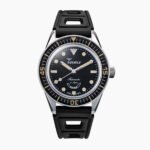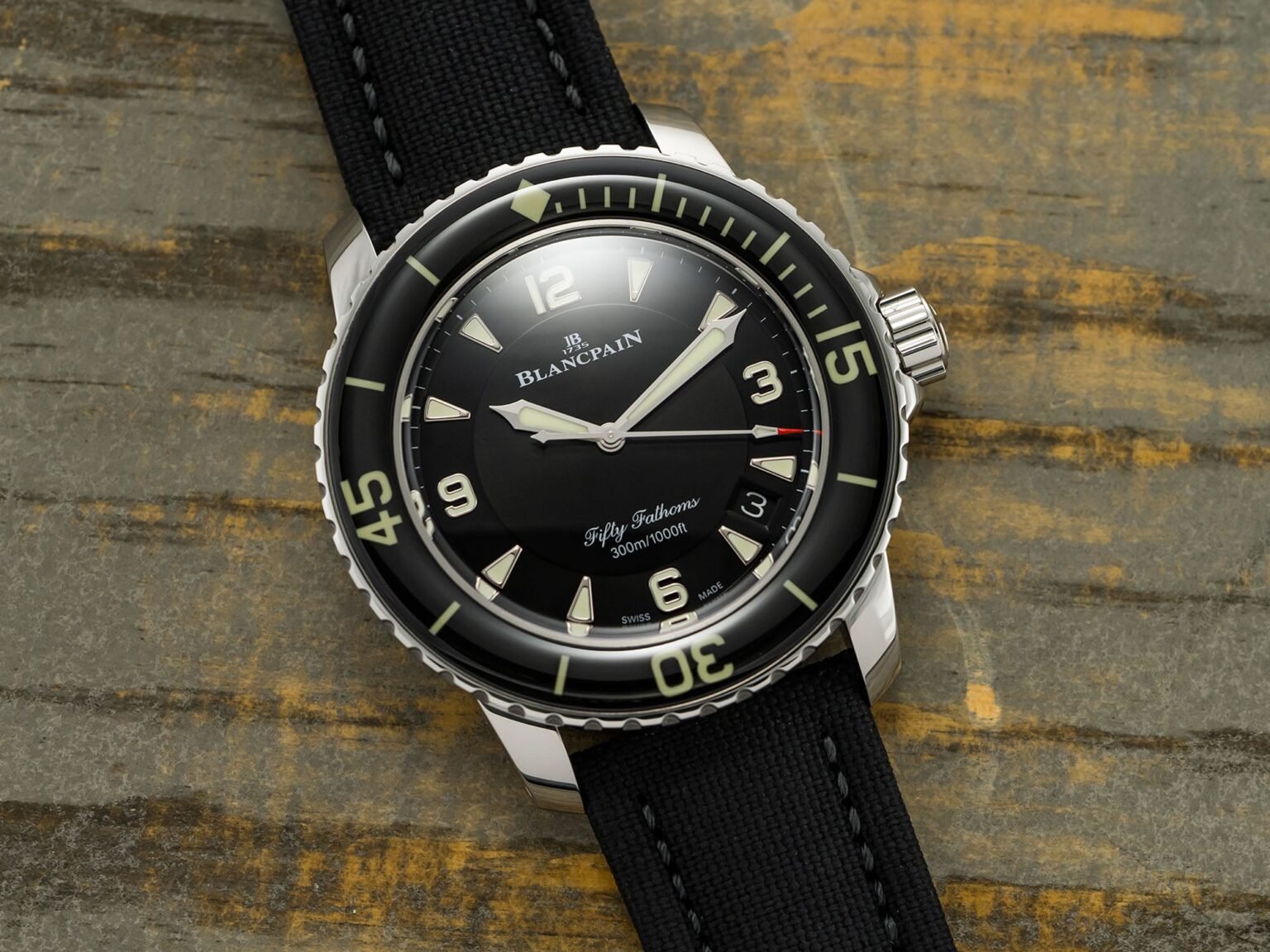

Blancpain, founded in the Swiss village of Villeret in 1735, has been making timepieces for almost 300 years, but perhaps its most impactful contribution to wristwatch history was relatively recent — and began its heralded life as a military tool rather than a luxury item. In 1953, Blancpain was headed by Jean-Jacques Fiechter, an avid diving enthusiast who had long wanted to develop a watch that would be ideal for his hobby. Fiechter worked with Captain Robert Maloubier, a French naval officer, to design a reliable, mission-ready timepiece that Maloubier’s elite combat diving team could wear. Here we will take a look at the Blancpain Fifty Fathoms Bathyscaphe, a more everyday take on the iconic diver.
[toc-section heading=”Blancpain Fifty Fathoms: A Historic Divers’ Watch”]

The watch, called the Fifty Fathoms, had a 42mm steel case — exceptionally large for the time — and it was water-resistant to 91.45 meters, or 50 fathoms, the maximum depth recommended for scuba divers. Its dial was black and its numerals were luminescent for greater legibility underwater. It was the first divers’ watch with a self-winding movement, the first with an antimagnetic case, and the first to employ the patented, double-sealed crown that Fiechter had developed. Most notably, the Fifty Fathoms was the first watch to include a lockable bezel with dive-time scale that rotated in only one direction. This practical and potentially life-saving innovation prevented a diver from accidentally jarring the bezel in the wrong direction for an inaccurate reading of how much time he’d spent underwater and thus miscalculating how much oxygen he had left in the tank. The original, military-only model ushered in civilian versions, including one famously worn by Jacques Cousteau (below, left) in his award-winning undersea documentary, The Silent World. (Read the full story behind the Fifty Fathoms here.)

Unlike the better-known Rolex Submariner, which debuted shortly after it, the Fifty Fathoms disappeared from the market for a while, a victim of the pervasive Quartz Crisis of the 1970s and ‘80s, but it re-emerged for a new generation of enthusiasts in the 2000s and has since claimed its current spot as a defining product family for the venerable Swiss maison. And like any successful relaunch in today’s watch industry, the modern rebirth of the Fifty Fathoms has inevitably spurred the revival of several standout variations from its storied history, most notably the Bathyscaphe collection spotlighted here.
[toc-section heading=”Fifty Fathoms Bathyscaphe: A Vintage Revival”]
With the Fifty Fathoms well established as a collection in its own right by 2013, the original model’s 60th anniversary, Blancpain expanded the family that year with the introduction of the Fifty Fathoms Bathyscaphe, the series’ first true line extension. Named for the undersea vehicle invented by Auguste Piccard, which was first launched in the same year, 1953, that the Fifty Fathoms debuted, the Bathyscaphe took its design inspiration from models of the later 1950s, hosting the same distinctive handset, 4:30 date window, simple geometric hour markers, and luminous dot on the bezel for orientation, a detail requested by the original models’ military clients.

At 43mm in diameter, and with an option in an even smaller 38mm, the Bathyscaphe spoke both to the growing enthusiasm of watch connoisseurs for vintage styles, particularly vintage military looks, as well as the trend back toward smaller case diameters. (Yes, as hard as it may be to believe today, 43mm was at the time considered a substantial miniaturization, perhaps because the core Fifty Fathoms was still weighing in at 45mm.) Marking the Bathyscaphe as a 21st-century timepiece was its unidirectional bezel’s use of Liquidmetal, an amorphous metal alloy that bonds with the ceramic insert to enhance its scratch resistance; and its use of the modern Caliber 1315, among whose technical attributes is an uncommonly long 120-hour power reserve.
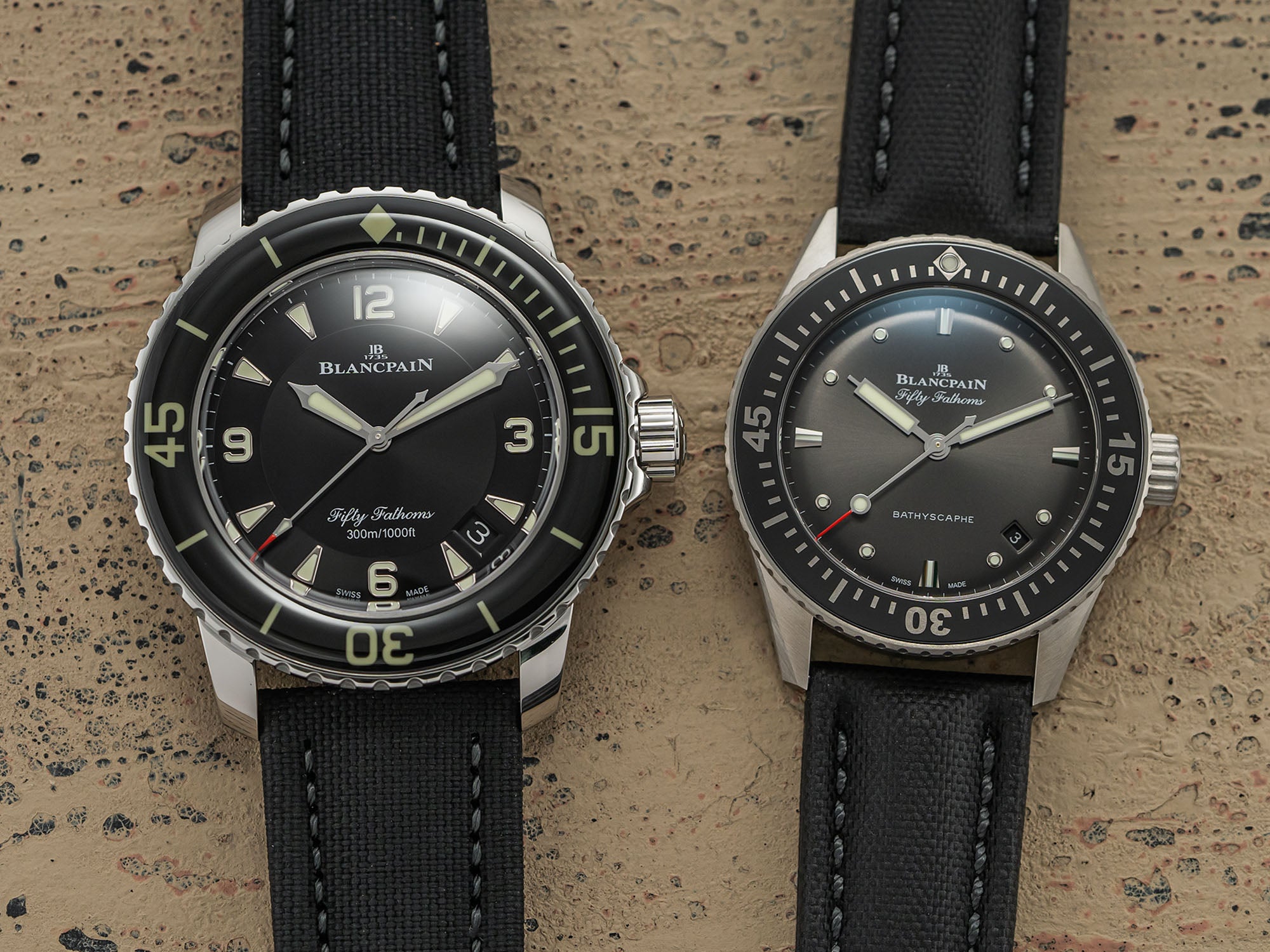
Initially debuting in just two steel versions — the 43mm men’s model with a charcoal gray dial and the feminine-targeted 38mm model with a white dial and white ceramic bezel — the Bathyscaphe has become, if anything, an even more versatile and varied range than the “classic” Fifty Fathoms series, with numerous small and large complications and an array of materials put to use in the cases, dials and bezels. {Perhaps somewhat unexpectedly, however, the Bathyscaphe subfamily is no longer the domain of the smallest Fifty Fathoms watches, the core line having added a 42mm iteration in 2024 and a 38mm model — one not exclusively aimed at ladies — in 2025.) Here is a rundown of every major timepiece currently available in the Fifty Fathoms Bathyscaphe series.
[toc-section heading=”Bathyscaphe Automatic”]

As detailed above, the original three-handed Bathyscaphe forms the backbone of the vintage-inspired sub-family, with more than a dozen variations of color, strap, and case material. The Bathyscaphe models generally use ceramic, with Liquidmetal dive scales, rather than sapphire for their bezel inserts, and an assortment of dots and rectangles, rather than triangles and Arabic numerals, for their hour markers. Standouts in the collection include the model with a case made of the Swatch Group’s proprietary Sedna gold alloy and a blue sunburst dial; and a blue-dialed model with a case made of plasma gray ceramic, a high-tech material that made its debut on the 2014 Ocean Commitment Limited Edition, which was quickly sold out. Blancpain has since introduced versions of the Bathyscaphe Automatique in robust, lightweight titanium and even more recently in black ceramic (with bracelets in the same material).

Inside the Automatics beats the self-winding Caliber 1315, an in-house movement that is now standard throughout much of Blancpain’s Fifty Fathoms families, particularly the core three-handed models. The movement is notable for its sturdy power reserve of 120 hours, or five days, stored in three series-coupled barrels, and for its use of antimagnetic silicon for its balance spring. The movement comprises a total of 227 components, including its rotor, made of 18k gold with an NAC treatment.

The first 38mm Bathyscaphe, which debuted right alongside the 43mm model in the anniversary year of 2013, was clearly targeted at ladies with its all-white colorway, but subsequent models, like the 2017 model with a steel case and ocean-inspired “Abyss Blue” dial, are decidedly more unisex to reflect changing tastes among watch consumers. The automatic movement inside the smaller Bathyscaphe, is not Caliber 1315 but Caliber 1150, which offers a still-impressive 100-hour power reserve in its twin barrels.
[toc-section heading=”Bathyscaphe Chronographe Flyback”]

Blancpain launched the chronograph version of the Bathyscaphe just one year after the automatic models, in 2014. Riffing on the minimalist design of the three-handed dive watch, the chronograph models’ dials feature three recessed subdial counters and 4:30 date window, all woven elegantly into the vintage-influenced design without making it look cluttered.

The self-winding movement inside is one of Blancpain’s most impressive in-house calibers, boasting a high-frequency balance (36,600 vph, or 5 Hz), a four-day power reserve, and an integrated column-wheel chronograph with flyback function. Case materials are chiefly steel or ceramic, paired with a colorful range of dials and bezels and mounted on NATO, sailcloth, or metal bracelets. Recently, Blancpain has also introduced its own ceramic bracelet to complement the ceramic cases.
[toc-section heading=”Bathyscaphe Quantième Complet Phases de Lune”]

The “quantième complet” or “complete calendar” is a specialty of Blancpain, usually found in more traditionally elegant models like those in the maison’s Villeret collection. Its sportier execution here, however, works very well, with a dial sporting Blancpain’s distinctive calendar arrangement, with the day and month appearing in windows, the date indicated by a central pointer hand on a numbered scale, and the moon-phase with the hallmark grinning moon (which Blancpain refers to as its “mischievous” moon-phase”) in a large aperture at 6 o’clock, making its monthly journey across a starry field.

A sapphire viewing pane in the caseback offers a view of the complete calendar’s movement, manufacture Caliber 6654.P4, packing a three-day power reserve in its two mainspring barrels and equipped with a hairspring made of antimagnetic silicon that aids in maintaining a high and constant level of precision. The latter device is the modern-day answer to the original Fifty Fathoms’ soft-iron inner cage that shielded the movement from magnetic interference but also would have made it impossible to show off said movement behind a clear caseback like this one. As the brand’s fans know, Blancpain never skimps on the haute horlogerie decorations, which are also in full view, including beveling, perlage, and snailing, as well as the signature openworked rotor. And In case you were wondering, this highly complicated piece is still a Fifty Fathoms, with its self-winding movement protected inside a 300-meter water resistant steel case.
[toc-section heading=”Bathyscaphe Quantième Annuèl”]

Annual calendar watches, a relatively recent style of complicated timepiece (the first one debuting in 1996), offer one of the most practical functions for an everyday wearer: as per its name, an annual calendar displays the day, date, and month and need only be manually adjusted by its wearer once per year, at the end of February.The first (and thus far only) annual calendar within the Fifty Fathoms collection debuted in 2018 and, like the Complete Calendar model showcased above, features a layout emblematic of Blancpain in its Villeret models: day, date, and month stacked top to bottom in windows on the left side of the “meteor gray” dial, an unconventional but oddly intuitive arrangement of calendar elements. The movement is automatic Caliber 6054.P.4, based on the Caliber 1150 that powers the 38mm three-hand Bathyscaphe, with modifications for the annual calendar functions.
[toc-section heading=”Bathyscaphe Day-Date Desert Edition”]

The Bathyscaphe subfamily welcomed a limited edition with a day-date design in 2020, and at first glance its unusual color scheme might look quite the opposite of anything maritime or aquatic. However, it does have a story behind it. The sandy beige dial of the Fifty Fathoms Bathyscaphe Day-Date Desert Edition is inspired by the desert sands of Death Valley, California, where underwater photographer Ernest H. Brooks II made his famous dive into the Devil’s Hole underwater chasm in 1962. Its 43-mm brushed steel case features a dive-scale bezel insert made of brown ceramic, and the dial’s Arabic numerals, syringe hands, and day-date window evokes a vintage Fifty Fathoms model from the 1970s. Inside the 300-meter water-resistant case is Blancpain’s automatic Caliber 1315DD, notable for its silicon balance spring and five-day power reserve. You can learn more at blancpain.com