
At Worn & Wound, we admire watches for their functionality and ability to withstand whatever life throws at them. But we also celebrate the practice of beauty! As such, handcrafted dials, or Métiers d’Art dials, are often considered the pinnacle of human craftsmanship in the field of watchmaking.
Independent French watch brand AWAKE has made this its calling card by embracing a bold and contemporary take on exceptional craftsmanship. By reimagining traditional techniques, AWAKE brings out their essence in the service of creativity. Each piece in its Handmade collections features a unique dial that celebrates the passage of time and the beauty of things made to last, inviting you into the world of workshops, traditions, and time-honored craft that keep cultural heritage alive.
Presented by Worn & Wound and AWAKE, this guide takes you on a journey to discover some of the most impressive craft techniques used in watchmaking today by sharing a few exceptional examples of each. So sit back, grab a loupe, and enjoy.

Sơn Mài
The use of lacquer in Asia stretches back thousands of years to ancient China and Japan, but Vietnam also developed its own unique branch of the art called sơn mài. Initially used as a protective material for everyday items like furniture, religious artifacts, and even architecture, it gradually transitioned from a primarily functional practice to an artistic one. During the Lý and Trần Dynasties, between the 11th and 14th centuries, the use of sơn mài was widespread in decorative arts and Buddhist sculpture. By the time the Lê and Nguyễn Dynasties took over in the 15th-19th centuries, techniques had become more sophisticated, and craftsmen layered the lacquer with precious materials like gold and silver (often called silver gilting).
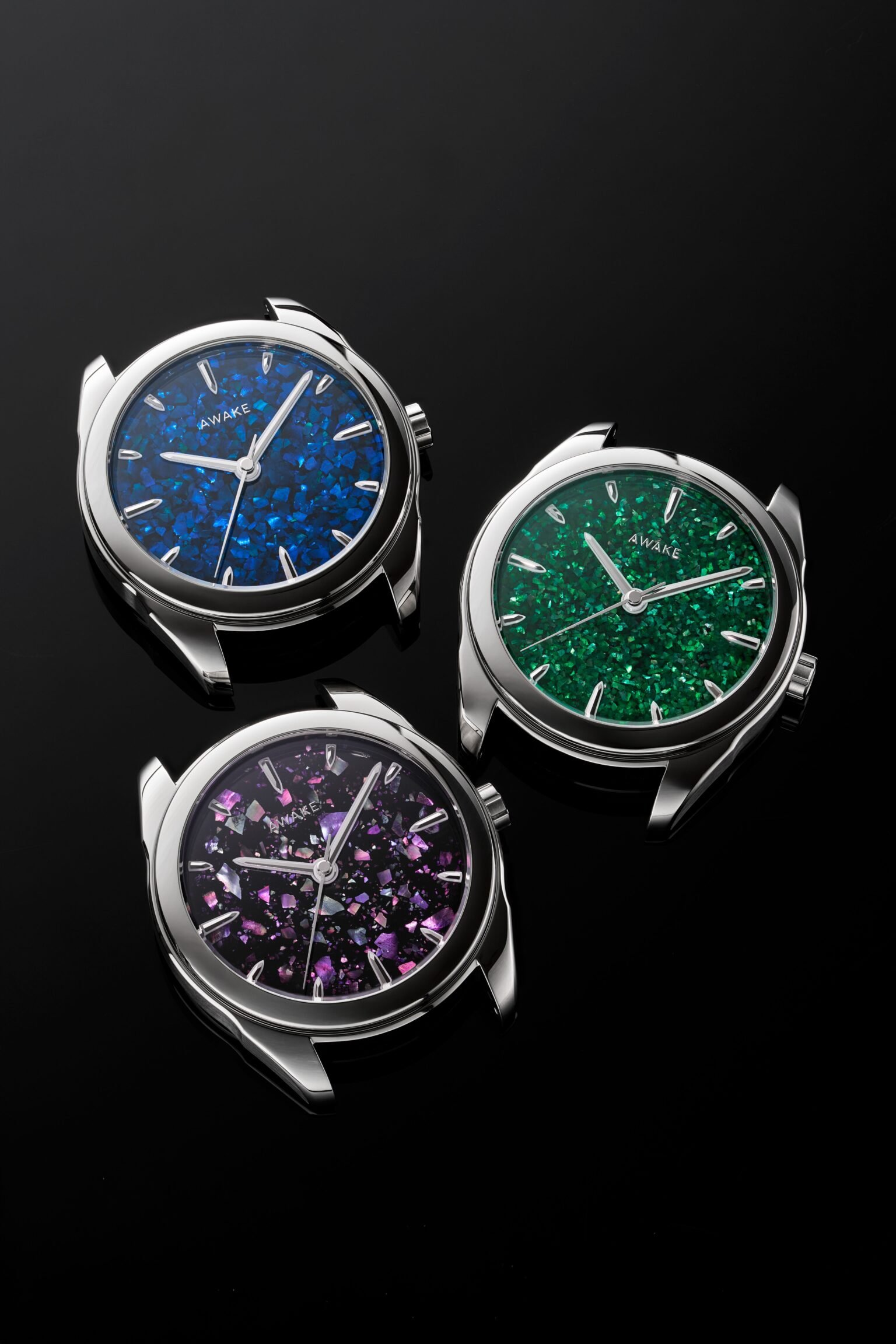
Sơn Mài is an ancient Vietnamese lacquering technique that uses a natural resin, renowned worldwide for its incomparable shine and transparency, which comes from a tree endemic to northern Vietnam: Rhus verniciflua. The unique feature of Sơn Mài is that it incorporates a multitude of materials into the dial base, such as pure silver or gold leaf, fragments of mother-of-pearl and even eggshells, creating mesmerising, almost three-dimensional visual effects. Natural pigments created from organic materials are then applied in a light veil, giving each dial its own personality. A dozen layers of pure lacquer are then applied, dried, sanded and polished one by one to cover and protect the whole in an invisible case of almost infinite depth. This meticulous and patient work requires immense skill and years of expertise to create living, vibrant dials with an organic appearance.

Tangential to this technique is the art of marquetry in watch dials. Popularized over the last century or so, marquetry on a watch dial involves cutting, coloring, and assembling dozens or even hundreds of veneer fragments to create an image. Examples include Straw Marquetry on watches like Isotope, Wood marquetry (made famous by Hermès), mother of pearl marquetry, seen on watches from Awake, and stone marquetry (Piaget and Van Cleef are experts here).
Lacquer Dials
Urushi is an old Japanese art of lacquering with the earliest examples seen in artifacts like bowls and ornaments dating back over 7,000 years. Its origin is, naturally, the urushi tree sap, which is prized for its durability, resistance to water, and deep shine. Not unlike sơn mài, urushi lacquering was used most commonly early on for ceremonial objects and furniture. It reached its golden age during the Edo period in Japan (17th to 19th century) and was exported around the world; in Europe, urushi products were highly desirable and copycat techniques were called “japanning”. Today, urushi lacquer remains a core part of Japan’s cultural identity both as a form of fine art and craftsmanship.

The Grand Seiko SBGW295 with Urushi lacquer dial

The jet-black colour of the urushi in this watch’s dial was achieved through the addition of iron.
While Sơn Mài lacquering results in textured, abstract, and organic-feeling dials, Japanese Urushi lacquer is a more codified approach that is especially refined in smaller objects like watch dials. The first steps involve harvesting and refining the urushi sap, a process that involves filtering, stirring, and aging the sap. It is then applied to a dial blank (typically brass or wood) and then smoothed and cleaned. Extreme precision is required here due to the small scale. The lacquer layers are applied using ultra-fine brushes and then dried in a process that utilizes humidity and oxygen to polymerize the urushi. After drying, the dial is sanded and polished, and the whole process begins again. After 10-20 cycles, the end result is akin to wearing a mirror on the wrist. The depth and longevity of urushi lacquer dials are known the world over. Since the creation process is partly organic, no two dials are quite alike. Urushi lacquer in watchmaking is often associated with the likes of Grand Seiko, Chopard and its Métiers d’art line, and high-end indies like Kari Voutilainen.
Fumé / Gradient Lacquer Finishing
Fumé (or French for “smoked”) dials are recognizable due to their smoky gradients. Fumé dials became popular during the 1960s and 1970s as they paired well with the funky case shapes and bold design choices of the era. At that time, the most common colors were earthy browns and greys with the occasional burgundy or teal. Though the popularity of fumé dials waned in the 1980s alongside the Quartz era, they have made a comeback in modern times in both high-end and attainable watches as enthusiasts have begun to appreciate their unique nature.

H. Moser & Cie Endeavour Centre Seconds with a blue fume dial
If Sơn Mài and Urushi lacquered dials are considered cultural siblings, fumé or gradient lacquer finishings can be considered distant cousins. Less uniform in nature, fumé dials are generally characterized by lighter colors in the center that gradually darken toward the edges. This effect is achieved by applying a base color and then spraying the lacquer layers of varying density, generally heavier on the edges compared to the center. As the layers stack, the effect is still glossy and full of depth, but with an additional smoky effect that can change depending on lighting conditions. This takes great skill, as the transition must be perfectly smooth; an uneven dial won’t cut it. H. Moser & Cie is an expert in this technique and has been a major player in popularizing it with a modern audience.
Enameling
Enameling and the world of art and jewelry are no strangers. From ancient Egypt to medieval Europe, enameling can be found in many of the world’s societies by the time enameling became more widely used in clocks. Early time-telling devices like pocket watches and clocks featured enameling on both their cases and dials. These undoubtedly were luxury items for the well-heeled. Examples of enamel dials include Grand Feu, or great fire, where ultra-hot firings of the enamel produce amazingly glossy dials. Ematelier, Anordain, Jaquet Droz, Ulysse Nardin are champions of this intense and dramatic technique. Other forms include cloisonné and miniature paintings on enamel (more on those later).

The Jaquet Droz Grande Seconde shows off its ivory grand feu dial
Enamel dials, unsurprisingly, require significant energy and precision. Like many other methods, the first step is preparing a dial base. Next, the enamel is applied to the dial. Unlike traditional lacquer, enamel is not a paint or fluid but a powdered glass mix. The dial is “dusted” with these glass particles until it forms a fine layer. To achieve enamel’s distinct glassy finish, the dial is fired in a kiln at temperatures over 1,500 degrees Fahrenheit. This “grand fire” fuses the powder into the dial base and creates a smooth surface. Repeating this process multiple times results in a silky, creamy dial that will not fade with time.

anOrdain’s Model 1 lineup includes transparent and opaque enamel dials
Enamel dials are extremely difficult to produce due to high failure rates during the firing steps; every cycle contains risk of cracking, bubbling, or distortion. Temperature control is key: go too fast or too hot, and the enamel can fracture. It’s not unusual that only a small amount of enamel dials produced are passable. Contemporary examples of enamel dials include the anOrdain Model 1 and particular models within Seiko’s Presage line.
Miniature Painting
As a special subset of enamel dials, miniature painting dials take what is difficult about the science and process of enameling and turn it up to 11. The origins of miniature painting on dials actually start with paintings on watch cases themselves – particularly pocket watches. By the 18th century, Geneva was in its own golden age and had established itself as the epicenter for enamel artistry. Watch cases and inner covers were often decorated with hand-painted depictions of famous works of art, allegories, or other scenes. As wristwatches became more popular, miniature painting on dials became a mainstay for high-end maisons to showcase their skills.

The Vacheron Constatin Tribute to Explorer Naturalists Collection

A closeup of the hand-painting process
Painstaking as any technique in this guide, these dials are created by using exceedingly fine brushes to apply paint directly onto the enamel base before firing the layers to melt the two together. Every stroke of paint must be perfect at risk of ruining the entire dial, and every layer of enamel paint must be independently fired and fused. Generally, shading is done by layering opaque or translucent enamels, and materials like gold or silver can be layered in for additional brilliance. When all the layers are complete, a final protective layer of transparent enamel is often applied and fired to lock in the surface. Historically, hand-painted dials depict motifs, portraits, or landscapes like Vacheron Constantin’s tribute to Japanese Deities or Blancpain’s celebration of the Four Great Beauties.
Guilloché
Guilloché is a technique with origins in European metalwork and jewelry that made its way to watch dials by the late 18th century. The invention of the engine-turning machine – also called rose engines for their patterned cam shape—enabled artists to produce beautifully complex patterns consistently. Before its use in watches, decorative engine-turning was often used on wood and precious metals during the Renaissance and Baroque periods. Fabergé eggs are famously decorated using this same technique. By the time watches entered the scene in the late 18th century, guilloché was applied to dials to enhance legibility and add elegance. Breguet is widely credited with popularizing the method, though it began to fade during the later 19th and 20th centuries as watchmakers and companies shifted towards stamped or pressed patterns that mimicked the aesthetic of guilloché, albeit at a far lower cost of production.

The Breguet Classique 7337 with its guilloche dial
Preparing a guilloché dial typically begins with a metal base that is polished and flattened. Then, a rose engine or a straight-line engine is used to engrave the desired geometric design. By rotating and oscillating the tool with cams and levers, the artisan can etch a variety of patterns like Clous de Paris or Basketweave. After engraving, the dial is often plated or coated with silver, gold, or rhodium. Sometimes a transparent lacquer or enamel can be applied for additional protection. Breguet is the name most associated with guilloché, and the current catalog still features watches decorated using traditional rose engines. Famously, Audemars Piguet’s early Royal Oak watches featured original tapisserie dials that were made possible by engraving machines.
Hand Engraving
There’s nothing like doing it the old-fashioned way. Hand engraving, including relief and hollow engraving, has been seen in horology since the pocket watch era. At that time, it was not uncommon to see hand-engraved cases and covers. As production grew and parts became increasingly standardized, hand engraving saw a decline in exchange for machine-pressed patterns and mechanically-assisted engravings. There has always been, however, a market and space for high artistry in horology, and hand engraving remains a mainstay, whether on cases, movements, or dials.

Naoya Hida watches have become famous for their hand-engraved numerals on the dial
Hand engraving, unlike guilloché, solely relies on the skill and precision of the engraver. No machine assistance here. The master artist uses a burin, a small hardened tool with a sharp, V or lozenge-shaped tip designed to cut the metal precisely. By applying controlled pushes and pulls at different angles, the engraver can create patterns, lines, and textures that would otherwise be impossible by hand. One of the purest expressions of human skill in watchmaking, hand-engraved dials are exceedingly rare and generally very collectible. Though historically reserved for classical watches (think Vacheron Constantin), newer maisons like Naoya Hida and even Louis Vuitton are bringing hand-engraved watches to a new audience.
Hammering
Hammering as a decorative technique finds its roots in ancient metalworking. Alongside hand engraving and guilloché, hand-hammering was also commonly used for case and movement finishing and decorating. This particular type of handcrafting creates dials that showcase texture and reflect light in ways that other finishing cannot achieve. Artists create hammered dials by using a small, specialized hammer and applying multiple punches of varying spacing, depth, and uniformity. It is important not to deform the dial any more than is necessary, though the dial can be annealed (a process of heating and softening) in preparation before hammering to allow for deeper shaping. Annealing is often required multiple times since hammering work hardens the metal dial. Watchmaker Atelier Wen has been heralded for its commitment and mastery of this traditional method with its ANCESTRA 蛟 (JIĀO) watch. Any collector who values tactile surfaces and handcrafted skill should consider a watch with a hammering finish.

The Atelier Wen Ancestra (JIĀO) showcases a hand-hammered finish on its dial
Not mentioned at depth in this guide is the art of sertissage, or gem-setting. A category all of its own, gem-setting has become an increasingly appreciated art form of its own with giants like Cartier (famously known as the king of jewelers and jewelers of kings), Rolex, and Piaget showing their expertise in gem selection and setting. The selection of the stones based on their color, clarity, and shape is painstaking, and a well-executed gem-set watch is beyond a mere overt display of flash. It is something that must be handled in person to fully appreciate.

The Patek Philippe Aquanaut 5268/461G-001
Handcrafted dials are enduring examples of human ingenuity and creativity in watchmaking. They represent the quintessence of passion and technical mastery and are works of art in their own right. Unlike impressive hand-finished movements, handcrafted dials can be admired both on the wrist and off. From AWAKE’s traditional Sơn Mài lacquer finish to JLC’s world-famous micro-painted dials, the landscape of handcrafted dials has arguably never been more diverse. Whether you simply want to admire them or own one, these watches are proof that the art of watchmaking is alive and well.
We would like thank AWAKE for their support and making this guide possible. Visit awakewatches.com to see their latest ‘Sơn Mài dial creations.