

It’s been some time since we visited Philippe Dufour’s workshop—at least officially. I’m not sure if my colleagues have stopped in before, which wouldn’t surprise me. Once you know Dufour, stopping by his workshop in Le Solliat becomes much more informal. But until two weeks ago, I actually hadn’t stepped foot inside the old building that was once his kids’ schoolhouse and that has become his workshop.

Back in 2013, Ben stopped by during the “Road to Basel” series, but a lot has changed since then. Or has it? Despite being a watchmaker for over 59 years now, all Philippe Dufour seems to want to do is make watches. And where better to do it than the famed “Valley of Complications”?
When we last left him, Ben noted that he had just delivered the last of his Simplicities, after about 200 watches. “He will never make another,” said Ben, and that Dufour was working on a more complicated follow-up. Well, since then, he certainly has delivered more Simplicities, including one with an aventurine dial that was auctioned for charity, and there are still more watches on the bench. And it’s not just him at the workshop; his daughter Danièla is also working away as well.

Tools on the display cases inside Philippe Dufour’s workshop and a selection of pocket watches
In 2022, I traveled to Switzerland and the Vallée de Joux for the first time to research and photograph a story on the watchmaker Charles-Henri Meylan. I immediately fell in love with the place. The three-dimensional pastoral landscape, with its winding roads, foggy mornings, and blazing red sunrise behind the imposing Dent de Vaulion, left me convinced that even without watchmaking, I could see myself living here. But if you love watchmaking—beyond the fact that AP, JLC, and Breguet are based here, plus outposts for VC, Patek, Blancpain, Bulgari, etc.—it doesn’t hurt when someone like Philippe Dufour (or Julien Tixier, David Candeaux, the list goes on and on) lives there, too.

A landscape of trees of the Jura mountain range and the Dent de Vaulion mountain over L’Abbaye in the Vallée de Joux, Switzerland.
A year later, in 2023, I returned for the reopening of the local watchmaking museum, Espace Horloger. It was then that I met Philippe for the first time. We talked for about an hour, about the importance of history and the fact that so much of that history was built by people whose great work didn’t become a brand, but was about being part of something bigger themselves.
As the term établissage reenters the watchmaking community’s lexicon, it’s worth remembering that the story of the greatest watches of their time, like La Grosse Pièce, was written by multiple authors. Philippe and I quickly connected over this topic, the state of the industry, how much we like Lange, the forgotten names of watchmaking, and a love of pocket watches.


The watch that Philippe Dufour made in watchmaking school back in 1967.

Obviously made with a school ébauche, but the quality of work and finishing was great, especially for the time.
Most of our time was, in fact, spent talking about pocket watches. I brought a few watches for an exhibition at the Espace Horloger (which I’ll write about later), and I wanted to share with him how the Swiss have had an impact on American watchmaking. So I took out a few watches—two of mine, one that belonged to my grandfather—and he took a look at the convergence of two watchmaking worlds in the late 1800s. Then he went to the safe and took out some of his own pocket watch collection, which is both impressive and cohesive.
Yes, we didn’t really talk much about wristwatches, but there is some big news out of Le Sollait. I’ll leave that until the end, but to satiate the “wristwatches are the only watches that matter” crowd, I’ll also show you the watch that he was wearing that day.

Dufour, looking at a Waltham Model 1884 Chronograph, created by Henri-Alfred Lugrin, while a Waltham Model 1884 Five Minute Repeater with a module done by Charles-Henri Meylan sits nearby.

Two Waltham Model 1884 chronographs, one with a totalizer and one without, next to the Waltham repeater, on Dufour’s workbench. What’s that above? Oh, just an unfinished bridge for a Simplicity.

Danièla Dufour looks on as her dad looks at a Waltham chronograph.

The watch that he was wearing when I stopped by.
Philippe still gets a lot of use out of the amazing 50th Anniversary Audemars Piguet ref. 15202 Royal Oak, which his wife bought him. “I think when someone says ‘Philippe Dufour is interested in a watch,’ it probably helps,” I said. He laughed and said. “Probably, but I don’t like to go to the factories and ask. It feels a little uncomfortable. I don’t want to be that person.”
Somehow, he still gets them, often as gifts from his wife, who buys them knowing Philippe won’t do it himself. And yet, the Jumbo was one of only two wristwatches we looked at in the workshop that day. It should have been three, he said. He recently received the Breguet 250th-anniversary Souscription, and while he had the box, he had left the watch at home.

Another one of Philippe’s favorites, and a friend of his, a custom watch from Ludovic Ballouard.

Dufour started pulling out boxes with watches to share. Some were relatively simple but with interesting case finishing and with large displays for military or technical usage.
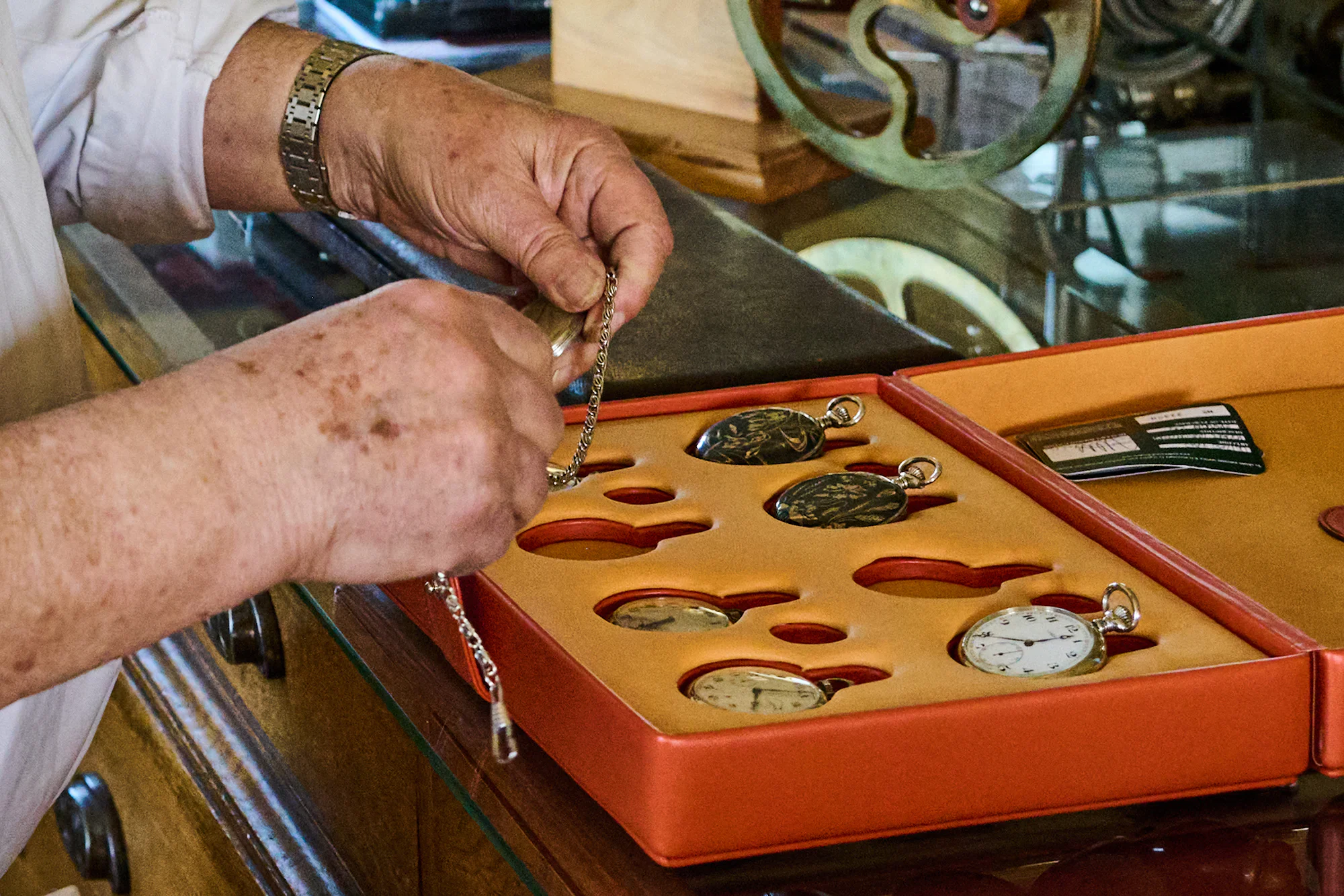
You can see that despite being “simple” watches, two of them in the top corner have Niello (or Nielled-Silver) cases, where a pattern is engraved into the silver cases. Next, the niello (a mix of silver, copper, lead, and sulfur) is crushed into a fine powder, mixed with a flux, and packed into the carved recesses.

A watch made to fit the “General Service Trade Pattern” for the British Ministry of Defense. This one belongs to Danièla Dufour.

The space in Le Sollait. Dufour occupies the first floor, and his daughter, Danièla, works in the chair at the left.
Part of my need to visit Dufour’s workshop was just because of the outsized impact he’s had on the industry, and wanting to see where some of the work has been done. In my mind, the early era of independent watchmaking, the fascination with high-end finishing, the appreciation for historical watchmaking and its application to modern wristwatches—it all starts with Dufour. Sure, you could make the argument for others—Daniel Roth in 1989 with the C187 tourbillon, Derek Pratt working on pocket watches before that, or Journe making his first prototype wristwatch in 1991 (while it took until 1999 for the production models)—but Dufour’s first watch, a Grande et Petite Sonnerie Minute Repeater in 1992, really changed everything.

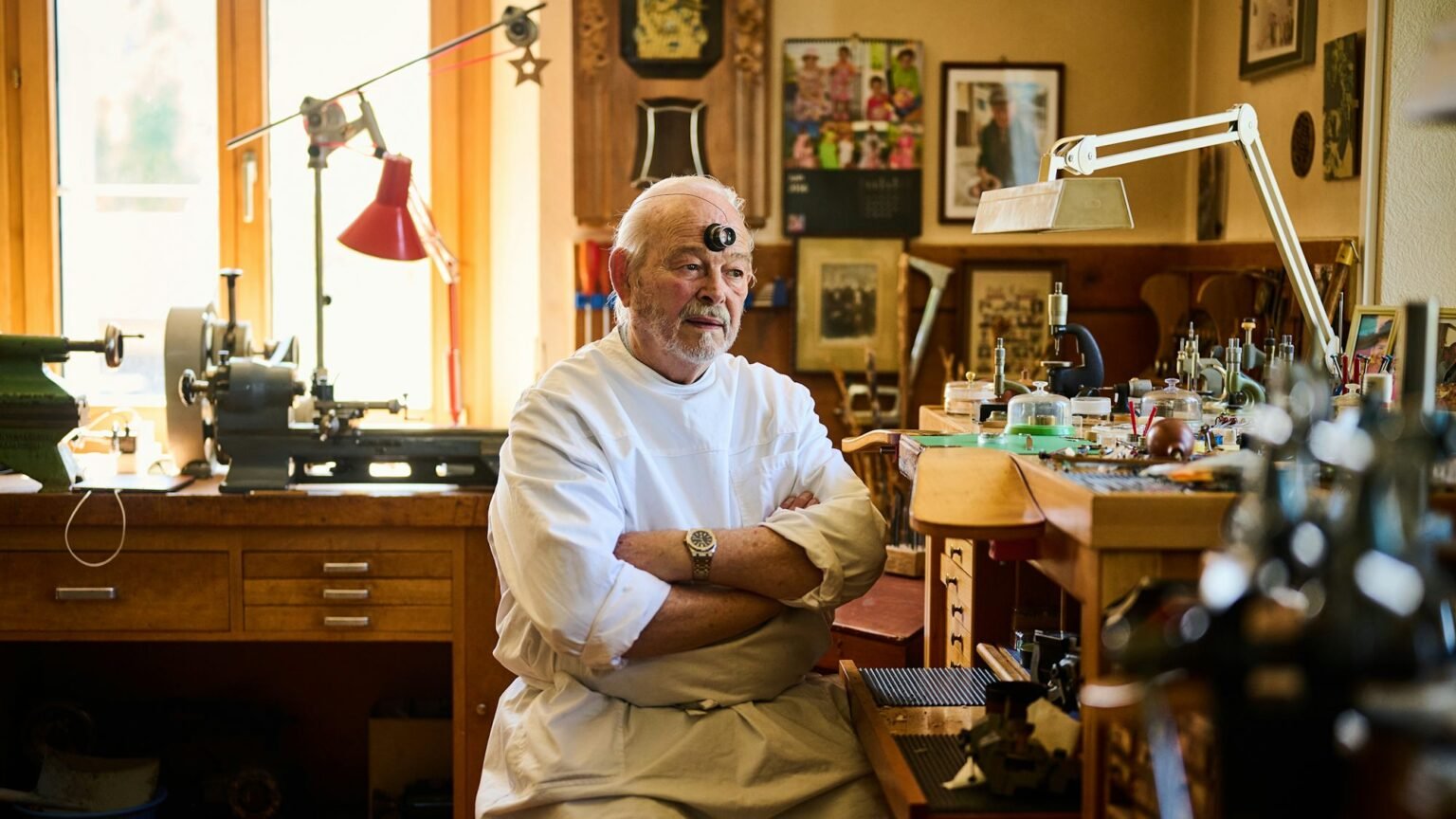
Philippe Dufour at his bench in Le Sollait.
And that all started here. With his school watch from 1967. Dufour had a break-in at his workshop a number of years ago. A number of watches were stolen, including his father’s Zenith, which feels particularly tragic to me. The rest of the things that were stolen were largely important movements without cases, and his fear is that they probably ended up in the trash when people realized they weren’t easy to sell. But luckily, Dufour’s personal pocket watch was saved.

The school watch of Philippe Dufour.

The movement of that school watch, finished by the man himself.
Other people have told the story of Dufour’s first commission, the Grande et Petite Sonnerie pocket watches for Audemars Piguet, and their role in pushing him to start his own brand. No matter how you try, there’s no way to simplify this incredibly complex mechanism into something more commercial and affordable. It’s delicate, temperamental, super complicated, and yet four years after making his fifth pocket watch in six years, he made it smaller and turned it into a wristwatch.
“I had to teach myself how to use the computer to make the watch smaller,” he told me. “It wasn’t as easy as just saying that it needed to be reduced by a certain amount. You could shrink the width, but every time you shrank the thickness of the plates, it threw off all the other calculations.”

The story of his first watches, the sonnerie pocket watches. Five were made for AP and a sixth has his name on the dial and belongs to an important collector friend of mine.
Next, he showed me the demonstration model for his Duality, the follow-up wristwatch with dual balances and differential. The watch was inspired by a school watch example that he found in a book documenting Seth Atwood’s collection at the now-defunct Time Museum in Rockford, IL. The fact that six students at the École d’Horlogerie in Le Sentier made these watches between 1932 and 1934 is absolutely nuts to me. The Albert Piguet-made example sold for CHF 250,000 a few years ago, and it feels like a steal now.
I actually saw that watch with two Dualities a few years ago, and you can see the similarities in the design. Dufour told me that yes, he only made 10. Some people online say there are more because they’ve seen higher serial numbers, but that’s because he planned to make 20 and gave people whatever number they wanted in that range. He also told me that he could sell 15-20 more based on requests, but he doesn’t have time. Finally, he has come up with a better version of the watch, with an improved differential—a Duality Mk. II, if you want to call it that—but again, he needs to make more watches in less time, and the Duality is too complex right now.

The Duality movement demonstrator. For those who haven’t seen the watch before, the idea is that you have two balances evened out in rate error with a differential, but to regulate the watch, you need to do it one balance at a time. The result, which he didn’t expect, is that the subsidiary second takes two minutes to complete a rotation.

An exploded diagram of the differential, colored in by hand.

A photo of the differential, compared to a match stick.
If you wander around the building, you’ll see things like movements sitting off to the side from tests of equipment or a pile of gentian wood that Dufour famously shaves down to use to polish the anglage on his watches.


Which leads us to the exciting news. If you didn’t know already, Dufour is still delivering Simplicities. Probably his most famous watch, partially because of the larger quantities, elegant, classic design, and variety of designs. He told me he no longer has a wait list but rather takes orders when he has time and availability to do so. He will make small tweaks to the dial design and different case materials. But the most important thing to him is that, despite requests to brand further afield in design, he wants to make sure that the watch will remain recognizably a 37mm-cased Simplicity. Currently, he has six movements in progress, with two finished.

Mainplates for the 37mm Simplicity.

Above you can see bridges that cover the mainspring barrel and ratchet wheel, done in various states of finishing. He also had a test example of a bridge so he could make sure that if he was doing the chamfers, he could make sure the angle was correct. It’s fun to see that the work is still in progress for Dufour, as he approaches his 78th birthday next month. He told me that he works Monday through Friday and often on Saturday. “Maybe sometimes Sunday,” he said. “Always Sunday,” said his daughter Danièla.


Tools scattered around the workshop.


A clock by AHCI member Florian Schlumpf.
During our time together, I started poking around at his bench, I guess you could say. We got back to talking about the Sonnerie pocket watch he designed, then the wristwatch. He showed me a mockup of the wristwatch—a prototype movement in a demonstration case. He wound it, set the time, put it off to the side, and throughout our chat, I’d hear it chime off in the distance, just like when he first made it.


The prototype unfinished Grande et Petite Sonnerie Minute Repeating wristwatch.

The dial side mechanism of the same watch.
Philippe Dufour’s Pocket Watches
When I reached out to Dufour, I told him I was in town to look at pocket watches. That actually changed a bit; with the Royal Pop launch, I had pocket watches on my mind in more ways than one. But it felt like a great opportunity to talk about something that both of us care about. So he pulled out a few pieces. I didn’t take photos of all of them, but here are some of the highlights.

Dufour had to grab a tool to actuate the pusher on this watch, which was without a full pocket watch case but had a demonstration case on it.

It was an Ami LeCoultre split-second wristwatch with foudroyante or jumping seconds. Dufour was able to show how you can activate the start, stop, catch up, and even the reset, which fully resets the foudroyante as well. Unlike some modern jumping seconds, this one runs during chronograph activation to clearly time shorter intervals (up to 1/4 second on this 2Hz balance).

The Ami LeCoultre caliber. It reminds me that Ami LeCoultre probably deserves his own story. This was a design that Ami LeCoultre was known for.


Years ago, a friend came to Dufour with a box that he had found at the local dump. They had gone to drop off trash and noticed a bunch of old watchmaker boxes. One said that it was an 18”’ minute repeater, so he opened it and then brought it to Dufour, who bought it for about 100 Francs. “After the quartz crisis, people were just throwing things out from all the brands in the valley.” When they went back to see if there were more watches, someone had already grabbed all the other boxes.


An early quarter-repeating pocket watch with a LeCoultre-designed ébauche.

Pipes and machine parts. Tools of the trade in the Dufour workshop.

This was a fun one. Imagine being a student in the 1950s and having your school project be a perpetual calendar, minute-repeating, chronograph pocket watch. Sure, why not?

The finishing is incredible, especially for a student.

That’s all from Le Sollait. Happy early birthday to Mr. Dufour.