

Naming a watch is important. This goes without saying, probably, but it’s something we don’t really talk about or think about enough. Just last week I was having a conversation with a colleague about how unfortunate it is that Grand Seiko seems to keep missing the mark with naming conventions. With so many releases, it’s tough to keep individual reference numbers at the front of the mind, and “Tentagraph” has yet to permeate watch culture in the way the brand perhaps thought it would. Some brands have a knack for coming up with catchy and distinctive names for watches that both make a ton of sense and are easily remembered and associated with a given watch. The team at Ulysse Nardin are the kings of this. The Freak? The Super Freak?? The Blast??? All immediately iconic in my opinion.

Today, Ming joins the Watch Name Hall of Fame (side note: that’s an article idea we’ll be pursuing shortly, I’ve just decided) with the Peep Show. When the Ming team first showed us a prototype of the Peep Show at Geneva Watch Days last year, we were led to believe it was a working name, or a code word for a product that was not fully fleshed out. Obviously we all thought it was pretty amusing at the time. But just last month, during Watches & Wonders week, when I learned that Peep Show was indeed the official name of the watch, well, let’s just say I was surprised and delighted, because it’s honestly perfect.

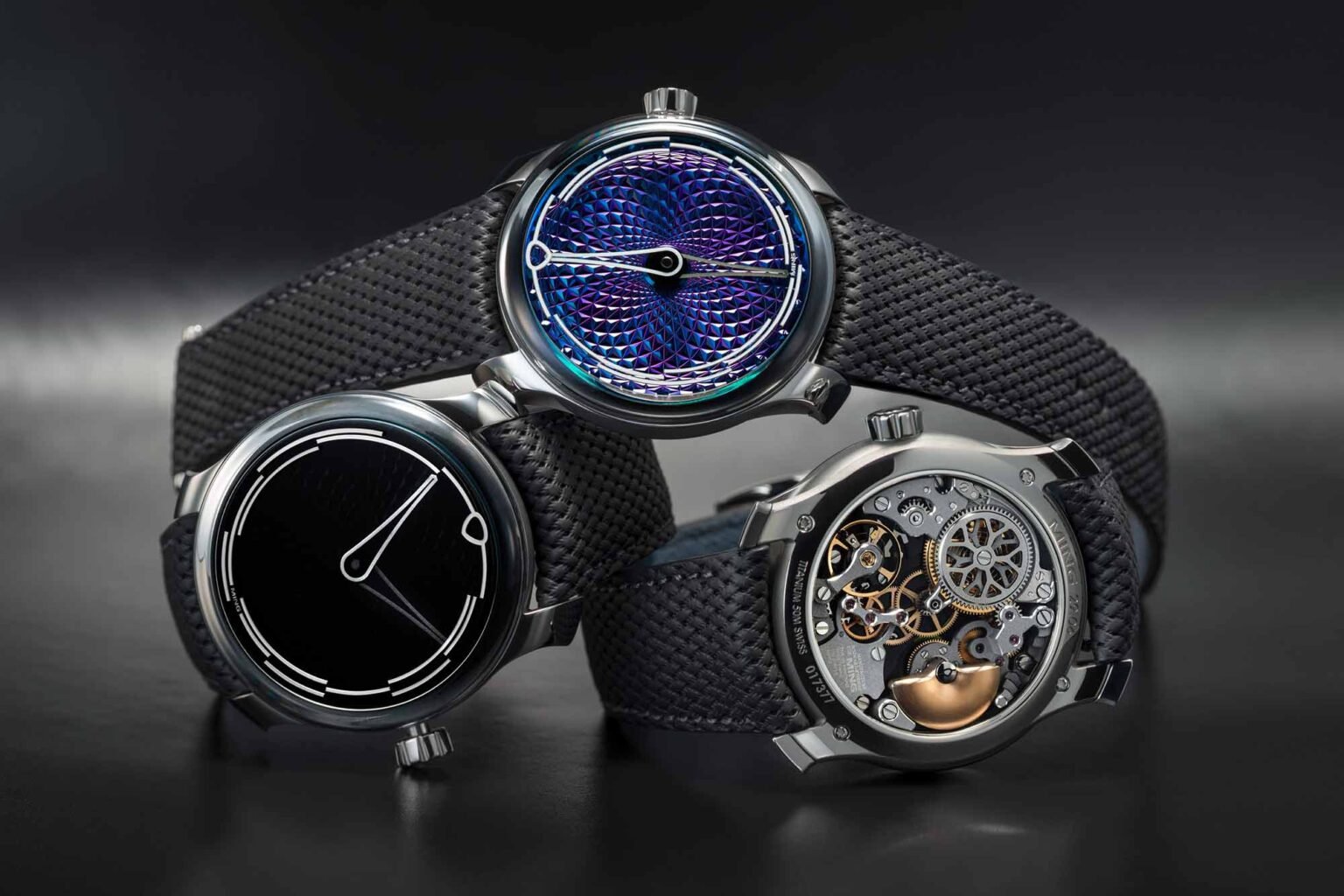
What is the Peep Show, you might be asking yourself at this point. A fair question. The Peep Show, reference 29.06 if you’re boring, is Ming’s latest limited edition, and built around a relatively simple idea: sometimes you see the dial, and sometimes you don’t. It builds on Ming’s experiments with a color shifting multiphasic dial in the 57.04 Iris by using a polarization effect. According to Ming, traditional hour and minute hands have been replaced on the Peep Show by linearly polarized sapphire discs. The result is that when the hands are aligned, light passes through the discs and the iridescent dial comes into view. When the hands are rotated 90 degrees relative to one another, that transmission is blocked, and the dial appears completely black.


The effect, in person, is a lot of fun, and even in the dimly lit hallway of the Beau Rivage, where I saw a Peep Show sample en route to another meeting last month, the dial, when fully revealed, is strikingly colorful. But it’s worth noting that the “peeping” effect that I saw, and I’m sure most other members of the watch media saw, occurred through the rapid advancement of the hands around the dial, not through the slow revealing and disappearing of the dial that most actual owners will experience day to day. As cool as it is to see the dial completely change right before your eyes in a moment, I think the gradual shifting will likely be even more satisfying. The dial, by the way, is finished with a machine made guilloche pattern and has been given the same multiphasic treatment as the Iris, so there’s plenty of texture and visual interest when the peeping happens.


The case is Ming’s 29-series design in grade-5 titanium, and measures 40mm in diameter and 11.8mm thick. This case design does not feature a traditional bezel, and has a seamless integration of the crystal that allows for a more complete view of the dial from extreme angles.
The 29.06 Peep Show runs on the ASE 200.M1 caliber, made by Schwarz-Etienne for Ming. It’s a micro-rotor movement with 86 hours of power reserve when fully wound, and features flourishes like a skeletonized barrel and openworked bridges.

Given the complexity of the dial and execution of the polarization effect, as well as a pretty high end movement, it’s no surprise that the 29.06 is a limited edition with a price tag that puts this into the bucket of higher end Ming. Limited to just 50 pieces, the retail price of the Peep Show sits at CHF 22,000. More information can be found on the Ming website here.
The post Ming, How’s the Peeping? Introducing the 29.06 Peep Show appeared first on Worn & Wound.