

Material innovation is increasingly becoming a core pillar within the watch industry. Whether borrowing and reconfiguring materials from different industries or composing your own from the ground up, it is clear materials matter when it comes to both technical feats and aesthetics achieved in watchmaking today. Sometimes, I like to think of these cutting-edge materials as mile markers on the highway of horology. I am always considering the world 50 or 100 years from now, when the watches of the present will become the watches of yesteryear, when what we consider modern will become vintage. I believe that the application of new materials will be a mark of this era of watchmaking that will serve as a milestone moment in the ever-unfolding history of horology.
For Rado, the story starts with a sapphire crystal. While the brand was not the first to use this in place of acrylic or other weaker options, it was among the early adopters. However, Rado took it a step further by patenting a sliding water-sealed mechanism with a tension-fit construction. Here, the thick, faceted sapphire crystal was secured under high pressure into the oval-shaped hard metal case with a specialized gasket, designed to be exceptionally tight. Its effectiveness sparked further curiosity – what if this same scratch resistance and robustness could be applied to other parts of the watch or the watch in its entirety? With that guiding principle, the quest that would lead to the creation of high-tech ceramic began, and I got the chance to see a peek behind the curtain at Rado’s high-tech ceramic facilities in Neuchatel right outside of Geneva just in time for the material’s 40th anniversary.

The year is 1986. Rado just launched the Integral, the first serially produced watch to use high-tech ceramic for its case and bracelet. In the years to follow, the brand would continue to advance the material starting with the introduction of colored variants beginning in 1992. By the new millennium, Rado was making major strides, perfecting the ability to execute the material in complex shapes thanks to an injection molding process. By 2011, the brand had uncovered an exceptional process to give the high-tech ceramic a metallic look without using any actual metal, and plasma high-tech ceramic was born. During this era, Rado began garnering more and more attention for its breakthroughs not just from a technical standpoint but a design standpoint as well, receiving two prizes from the Good Design Awards in Japan and two prizes from the German Design Awards.

An early Rado DiaStar
Now let’s connect the dots with some insight into how these processes work from powder to components. It starts with raw material, high-purity zirconium oxide powder to be exact. Next comes coloration, a process included early on so that the pigments become fully integrated with the material itself rather than coated or applied on top once the components are complete. Here, the zirconium oxide powder and pigment along with a binder are agitated until combined. The resulting powder is then mixed with a different polymer binding agent, compressed into a solid material, then crushed again into granules creating a homogeneous “feedstock” that can be molded. The goal here is to eliminate as much porosity as possible.
Next up, we get to the injection molding phase in which the feedstock is heated until liquified and then injected into the molds at a high pressure. An important note here comes down to size: to accommodate for shrinkage in the steps to follow, the molds are roughly 25% larger than the desired final product. After cooling and removal from the mold, the pieces are placed in a chemical bath then an oven at a high temperature over the course of two to three days to dissolve the polymer binder. The result is a pure ceramic object in the correct size that can be machined and polished using a unique method. Here, the finished components are placed in a vat of neutral colored ceramic chips in varying shapes and sizes with a water-based substance combined with an abrasive material and agitated to polish themselves – ceramic on ceramic.

From here, we follow the timeline of Rado’s advancements in high-tech ceramic to arguably the coolest innovation of all – plasma – and it was all just a happy accident. The brand stumbled upon this process that literally feels like magic, transforming ceramic to appear like metal, no coating needed. At the time, Rado was trying to make its ceramic even harder by applying diamond to the surface using mind-blowingly high temperatures of 20,000°C, which is hotter than the surface of the sun. What they discovered is at this wildly scorching temperature, a chemical reaction is triggered in the ceramic that changes the composition of the structure from the inside out, resulting in a metallic grey. While we were not allowed to photograph it, we did get to look through the porthole window in the blazing oven, and it was the stuff of sci-fi films – it seemed unreal.

The plasma oven (image supplied by Rado)
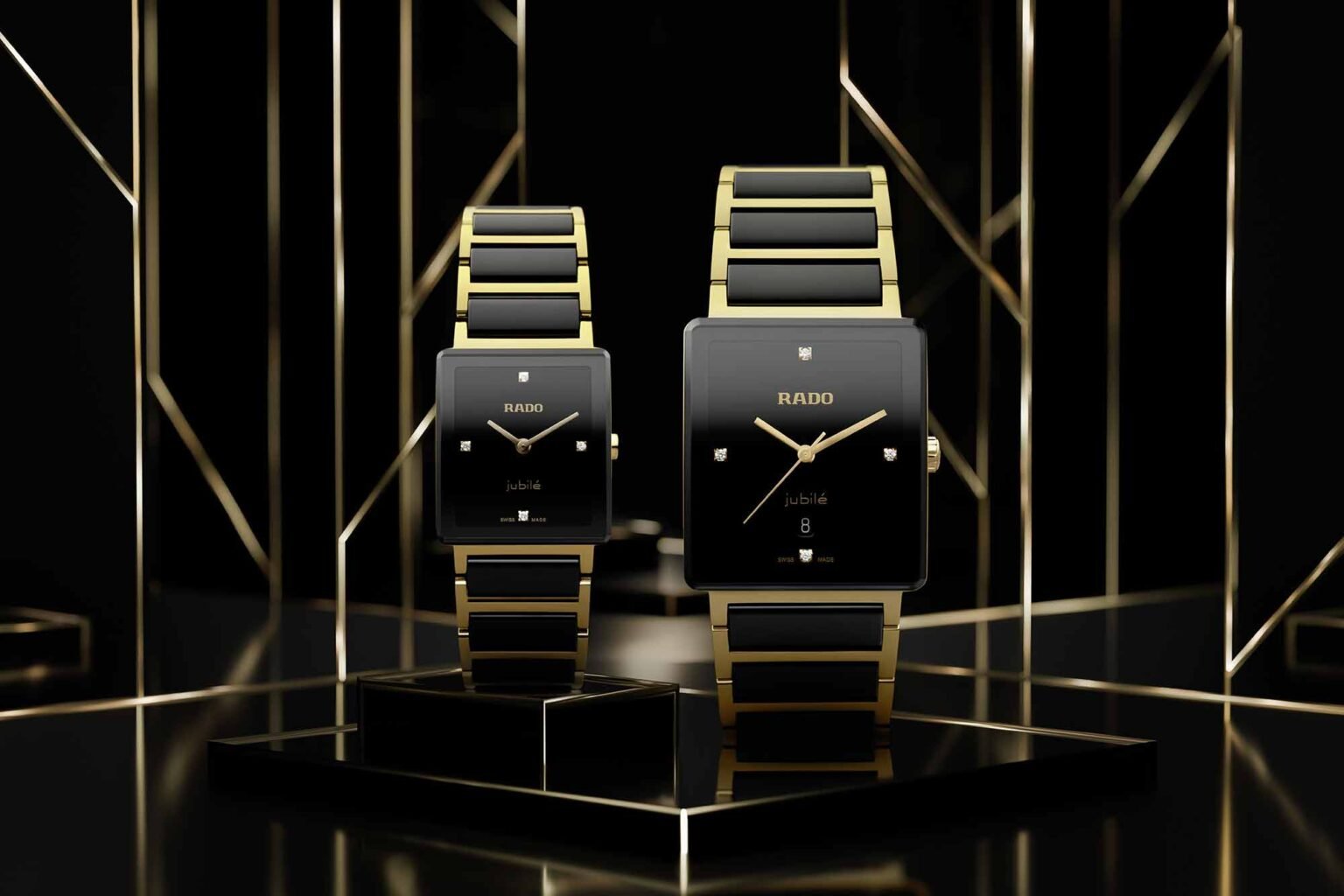
This brings us full circle back to the model that started it all: the Integral. It is only fitting for the 40th anniversary that Rado brought this model from 1986 to the present with an homage eerily similar to the original. You will notice only subtle differences: an updated movement, a streamlined and pared down bezel design, a more elegantly tapered bracelet, and slightly larger proportions overall. But on the whole, this is just the revival of a classic.

The 40th Anniversary Integral
It is always a privilege when a brand is willing to lift the veil on how it innovates the watches we love. However, some are ultimately more transparent than others. At the end of the day, Rado kept its secrets close to the chest – photography was extremely limited (hence the Rado supplied photos populating this piece) and the experience was highly curated to expose only the portions of the process the brand wanted us to see. These moments are always a bit of a letdown. High-tech ceramic is an incredibly compelling innovation – one that remains unmatched – and I was excited to show and tell collectors about how cool and complex the legwork to execute this material really is. While the visit missed the mark, I hope you’re still walking away from this story having learned something new and gaining more appreciation for this groundbreaking material celebrating its 40th anniversary. Rado