

It ain’t always Black Bays and Pelagi at Tudor. At least, not all the time. Since the brand returned to the U.S. market in 2012, Tudor’s success has been rooted in the broad appeal of watches like the Heritage Chronograph, the Pelagos, and, of course, the Black Bay. These are heritage-coded, conventional watches that nailed the price point, specs, and aesthetic demanded by the enthusiast market at the time.

In the preceding decade, we saw that formula become a playbook as the Pelagos and Black Bay evolved into increasingly specific slices of that original concept. But what about the Tudors that fall outside of the playbook? Remember the North Flag or the Fastrider? What about the Black Bay P01? While the playbook has successfully executed moves for left-side crowns, silver cases, and channel lugs, not all of the brand’s explorations into other formats have been smash hits. And it’s not merely a question of having a historical footing, sure, the North Flag and Fastrider were quite modern, but the P01 was a functional deep cut from the brand’s archives.
As a watch brand, a music act, heck, as just about anything in our oh-so-branded world, it can be hard to operate outside of “your lane”. That can include what is actually your lane or what has become your lane in the current context of a given brand’s media.


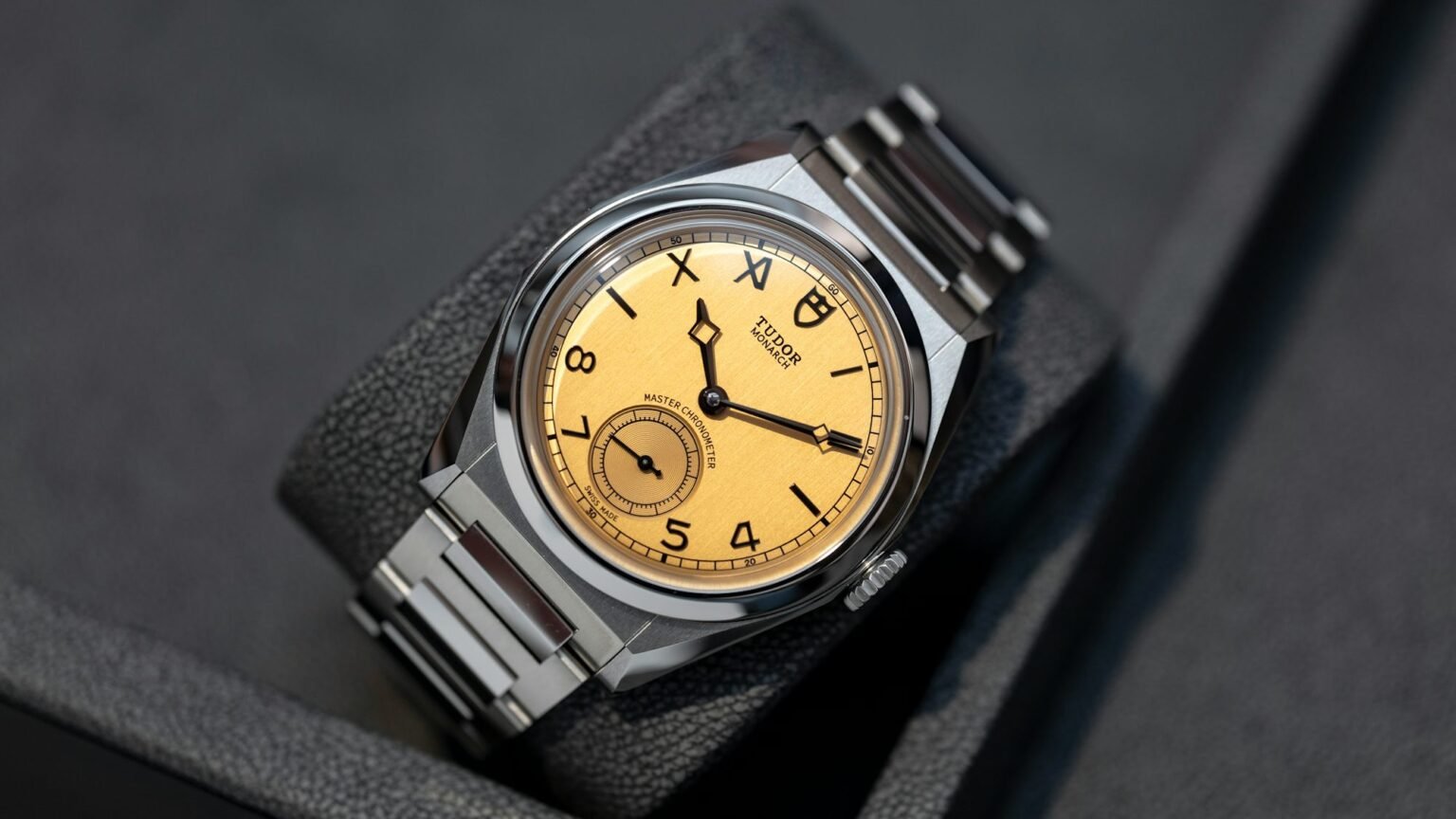
For 2026 at Watches and Wonders, Tudor stuck to the playbook, offering refinement, additional specs, new bracelets, and the like – except for one watch, the Monarch. A true novelty connected to the brand’s 100th anniversary, the Monarch is a curiosity. It’s a modern automatic watch that references a family from Tudor’s catalog at the end of the last century, but with an aesthetic that blends elements from the 1920s through the 70s. Its case is angular and offers mixed finishing, the bracelet glitters with reflective polished center links, and the dial offers a Cali-style layout with a pale copper-toned metallic base. The hands are a sort of gothic neo-snowflake design (for both hours and minutes), the dial furniture is black, and the seconds reside in a subdial at six.
As of launch, the Monarch is offered in a single reference, M2639W1A0U, without lume or a date display. When I first saw the announcement of the Monarch, my initial reaction was puzzlement, but that eventually gave way to curiosity as I got to know more about the model and its execution. A few hours later in Geneva, I got to see it for myself. But we’ll get to that in a moment.


What Is (Or Was) A Tudor Monarch?
While Tudor doesn’t often communicate about the brand’s history in the 90s or much before the 2012/2013 return to the US market, this is the era that gave us the Monarch, which launched in 1991. The model represented a somewhat more mass-market sport/elegant model that included both quartz and mechanical options and spanned several executions and, more broadly, ideas.

Tudor Monarch ads from 1997 (left), and 1994 (right).
A brief overview of what is available online suggests that there wasn’t a strong, lasting identity for the Monarch. There were two-tone pseudo-integrated bracelet models, GMTs with Chinese Zodiac bezels, Ebel-like chronographs, and tonneau cases that could only have come from the 90s.

A Tudor Monarch reference from 2005.
While the whole Monarch line is hard to pin down, there is one element that seems to be something of a calling card – the use of Tudor’s shield as the 12 o’clock marker. It’s a distinctive feature that, while we’ve seen it on other past models (think: Oysterdate Chronograph Ref. 7031/32, the Tudor Aeronaut, and many more), is also seen on the new Monarch.
What Is The Monarch In 2026?
For those who skipped the intro (or couldn’t keep up with all the new watches announced at the fair), let’s recap the specs for the new Tudor Monarch. It’s a steel watch that measures 39mm x 11.9mm with a lug-to-lug of 46.2mm. The lug width is 20mm, the crown screws down, the water resistance is 100m, and it has a display case back. It comes only on a bracelet with a unique-to-Tudor two-link faceted design (and a T-Fit clasp) and retails for $5,875.


Timekeeping is provided by a new movement, the MT5662-2U, which is both COSC and METAS certified (including 0/+5 seconds a day accuracy) and has a higher level of finishing than is common to Tudor’s movements. This traditional-style finishing includes gold inlay on the winding rotor and Côtes de Genève perlage for the bridges. We also see a traversing bridge for the balance, and the MT5662-2U is anti-magnetic, featuring a silicon balance spring and being rated to 15,000 gauss. It is a 4 Hz movement with a 65-hour power reserve.
So that’s the press release stuff out of the way. Let’s get to the metal. In hand and on wrist, the Monarch feels special. That’s likely due to its distinct nature in Tudor’s lineup, led by a unique footprint on wrist, decade-blending aesthetic, and eye-catching dial execution.

As a nod to Tudor’s 100th anniversary, the Monarch draws on design elements dating back to the 20s, with its faceted case and small seconds at six. You can see some direct lineage in the watches shown above, and, when combined with the brand’s usual historic design cues (most notably, the Snowflake hour hand), we have a new Monarch that incorporates notes from a broad consideration of Tudor’s past.
Rounding out that potluck of inspiration, while the Monarch name dates back to 1991, the line (and brand) did actually feature models with Error-Proof dials (aka “Cali dials”) in the early 2000s (shown below on a rather cool Prince reference from ~2002). The Error-Proof dial was a Rolex innovation in the 1940s to improve legibility, and the brand secured a patent for the dial design in 1942.

Tudor Prince, 2002.
With the inspiration outlined and a bit of historical context provided, the new Monarch may be an amalgamation of past Tudors, but it feels decidedly novel in its execution. The angular case wears well and, while not especially large, feels somewhat oversized thanks to the thin bezel and largely uncluttered dial. The case and bracelet work well together, and the two-link bracelet features a polished, steepled center link that catches the light nicely. It certainly doesn’t feel sporty, but it’s not particularly dressy either. As weird as this statement may sound, it’s almost like a modern take on a Bubbleback, which makes some sense (maybe?) given the inspiration outlined above.
Speaking of the dial, the color is quite bright, a glowing copper-orange, but it doesn’t overpower the base brushed finish, nor the snailed finish on the small seconds display. While I had perhaps 25 minutes with the Monarch at Watches and Wonders, I have had hours with the photos I took, and from a purely subjective standpoint, I think that the hands and markers define much of the new Monarch’s personality. Imagine the same, but in white metal, or without the cali numerals? Totally different and much more conventional (traditional, even). The double Snowflake hands, the choice of a black finish, and the cali layout all come together in a way that feels defiant while still covering the bases for the brand’s 100th anniversary.

To be clear, I see it as defiant in a couple of ways: expectations, design, and appeal. I think it’s intentionally a love-it-or-hate-it design, and it’s neither a Black Bay with an anniversary dial nor a direct modernization of a past model. Within the scope of Tudor, the 2026 Monarch is a statement, one outside of the brand’s usual lanes.
A single reference, a new movement, something special from a big year for Tudor.
Usually, I could now compare the new Tudor to one from a few years ago. A Black Bay to a Black Bay, a Pelagos to a new Pelagos, but not here. If you’re keen on the design, this is one you’re going to have to see and try on for yourself. I rather like it, but in a way that is entirely different from how I like my Pelagos 39 or the litany of Black Bays I’ve tested over the years.
A Consideration Of Price
If we’re talking about Tudor’s history, pricing is part of the story—especially when Tudor returned to the U.S. market, and a lot of attention was placed on its positioning and enthusiast-focused value. At $5,875 for the new Monarch, the subjective value statement will quickly reflect one’s own position on Tudor and the brand’s pricing over the past decade (or less). Where Tudor’s post-in-house core used to be in the $3,000-$4,500 range, times have changed. In a recent story covering a new F1 edition from Tudor for this past weekend’s race in Miami, Tim said the pricing element was a conversation for another time. Let’s start that conversation now.
Factor in inflation, the strength of the Swiss Franc, the rising cost of labor, and, let’s be fair, the strength of the Tudor brand, and the last five years have seen that core price point push upward. A Black Bay 58 started at $3,375 in 2020; today, it’s $4,975. That’s a 47% increase. On paper or for your wallet, that’s a big jump in price. That said, those dollars (and the product they buy) don’t compare 1:1 over the past 6 years.

Using CPI inflation numbers, $3,375 in 2020 would be ~$4,125 today, which drops that increase to +$750, or +22% over the past six years (+3.6%/year). In that time, Tudor also upgraded the BB58, with thinner proportions and Master Chronometer certification. While pricing has certainly increased, and it definitely feels as though we’re seeing fewer high-value options than we used to, it’s worth considering that Tudor has raised the spec of their product, opened the recent facility in Le Locle, and has to deal with the current tariff scenario for U.S. sales. Want another quick comparison? The Pelagos 39 debuted at $4,400 in 2022 (~$5,000 in 2026); today, it sells for $5,625. I bought one in early 2023, and the ~13% price increase over the past three years wouldn’t stop me from doing it again.
That being said, the topic of pricing (and the resulting stress, gnashing of teeth, etc.) extends well beyond any single brand and needs to be considered from the enthusiast perspective (especially for an enthusiast-driven brand like Tudor). For any brand, for any product, there is a limit, and I believe that losing sight of that limit will remove a given watch (or brand) from the enthusiast conversation.
At the core, in a world where everything is (and feels) more expensive than ever, I think Tudor is doing a good job of keeping its core pricing (largely) realistic, but that doesn’t mean it’s without some sticker shock for those who have loved the product for the last decade or more. Heck, I know I’m surely not the only one who remembers buying an SKX007 for $170 in 2008. Price creep is real, and price sensitivity has a real impact on buying trends and, in certain categories, the enthusiast relevance of a given watch.

While I’d argue that the relevance of the Black Bay, especially the 58, is not under any threat, the Monarch is new, unconventional, and represents the next step up in price. If you’ll accept that the previous pricing core for Tudor was $3,500-$4,500 (give or take), I think it has expanded to cover more models and, yes, somewhat higher prices. I think today, for the brand’s sport offerings, the core starts with the Ranger ($3,550) and tops out around the Pelagos ($6,025). You can pay more for the Ultra, or for a carbon case, but I see those as extensions of the core.
Within that price range, the Monarch sits under $6,000, and in the context above, that feels realistic to the current scenario, both for Tudor in 2026 and for what the Monarch is for the line-up. Yes, it’s outside the core, but it’s also a distinct model with its own movement, upgraded finishing, and a pin to Tudor’s 100th anniversary.
Wrap It Up, Stacey
Anyway, the Monarch.
Alongside an array of line evolutions, bracelets, and new colorways, the Monarch is the only truly new thing that Tudor brought to Watches and Wonders, and I think it’s an exciting offering that speaks equally to Tudor’s past and present. I like that it’s a single model and an anniversary piece, without a solid-gold price tag or some goofy text on the dial. It’s reserved, feels great on the wrist, has real personality, and it certainly won’t be confused with, or replace, your Black Bay or Pelagos.