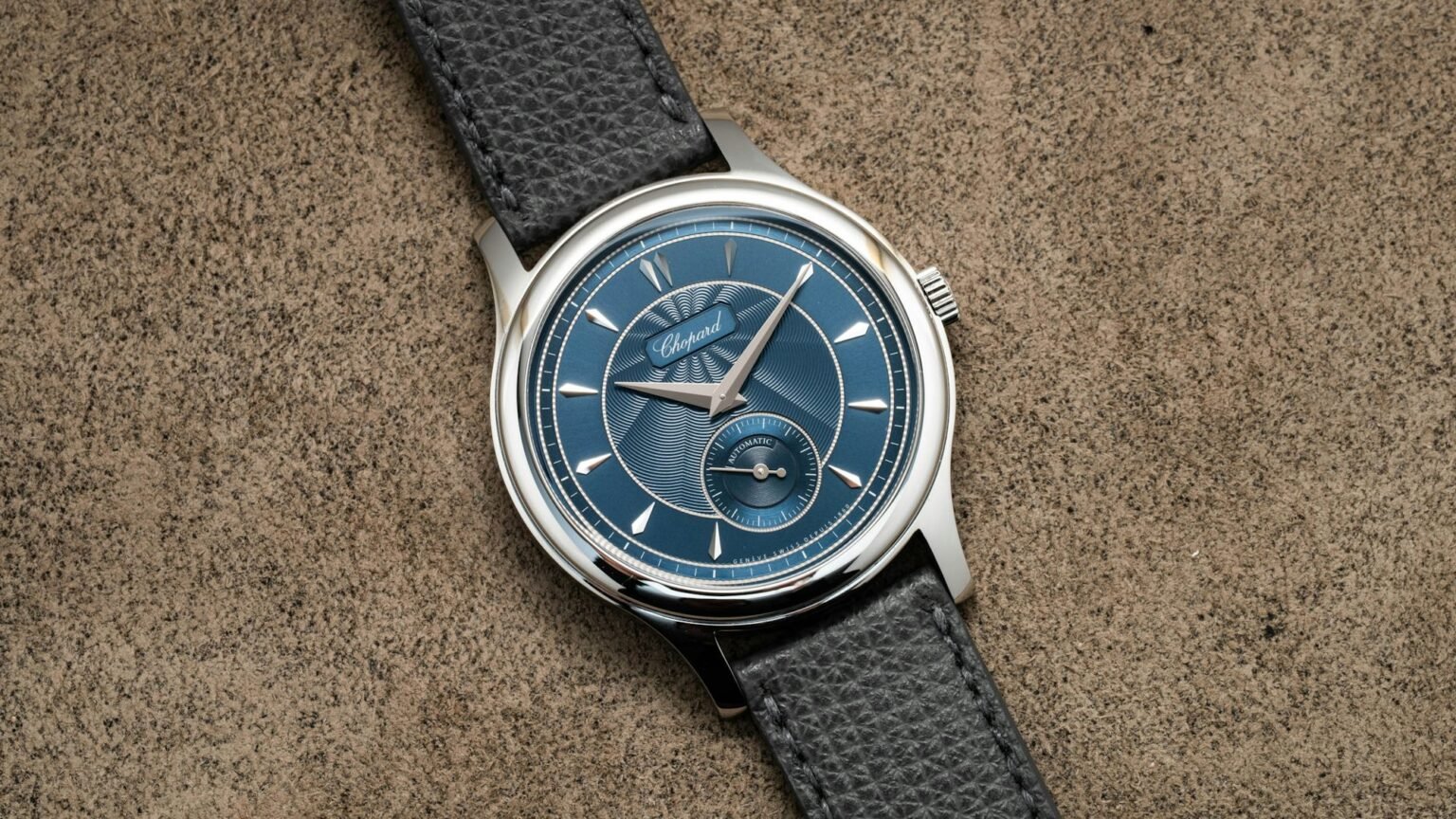


If there’s a watch that seemingly stole the hearts of many collectors this year at Watches and Wonders, it’s definitely Chopard’s new blue-dialed L.U.C 1860 dress watch. The funniest part is that the new model is really only a dial color change. That’s it. And yet, among a sea of new designs and complications, Chopard managed to pull off something much larger than its description on paper, and ended up being one of my personal favorite releases from the show.

If you’re familiar with the previous, now-discontinued salmon dial version of the L.U.C 1860 released back in 2023, well, chances are you already know much about this watch. But its identical specs are very much a good thing, as I think Chopard has really hit a home run with the 1860 as a proper, compact, and thin (8.2mm) dress watch amongst its larger L.U.C. movement-powered siblings.
The 36.5mm case in Chopard’s Lucent Steel alloy is very safe in its design, with smooth, curved lines and a fully-polished, rounded bezel and top lugs. While there aren’t any little extra design touches that add any additional flair, the sides are vertically brushed to create a bit of contrast. Is the case boring as a result? Certainly not in my eye, as its subdued character works well in the 36.5mm format and, most importantly, it serves as a very nice frame for a spectacular dial.


That dial, produced by Chopard’s in-house dialmaker Metalem, is an absolute home run. And it surprises me to say this, given that I typically don’t care all that much about blue dials. I haven’t bought a blue-dialed watch in years. But this shade of “Aeruse Blue” is close enough to a perfect blue in my book. Yes, I know how ridiculous that might sound as a blanket statement. But the shade is very pleasing to my eyes. There’s a good amount of saturation and brightness without feeling cartoonish, which makes the blue look fantastic in the light. Undoubtedly, the dial’s glimmer is also thanks to its base of 18-carat white gold, decorated with stunning hand-turned guilloché, prominently seen in the center section and the small seconds subdial.
Four slim tracks of what I can only describe as a crinkle-cut guilloché pattern keep the natural shade of the white gold for a bright contrast and for shaping the different tracks and sections of the dial. It also serves as a nice complement to the applied white gold hour markers and the dauphine hands. Surrounding the center-engraved section is a radially brushed track that holds the hour markers, while the track containing the printed small-seconds markings, as well as the minutes track, is circularly brushed. This means that the dial catches light in so many ways.
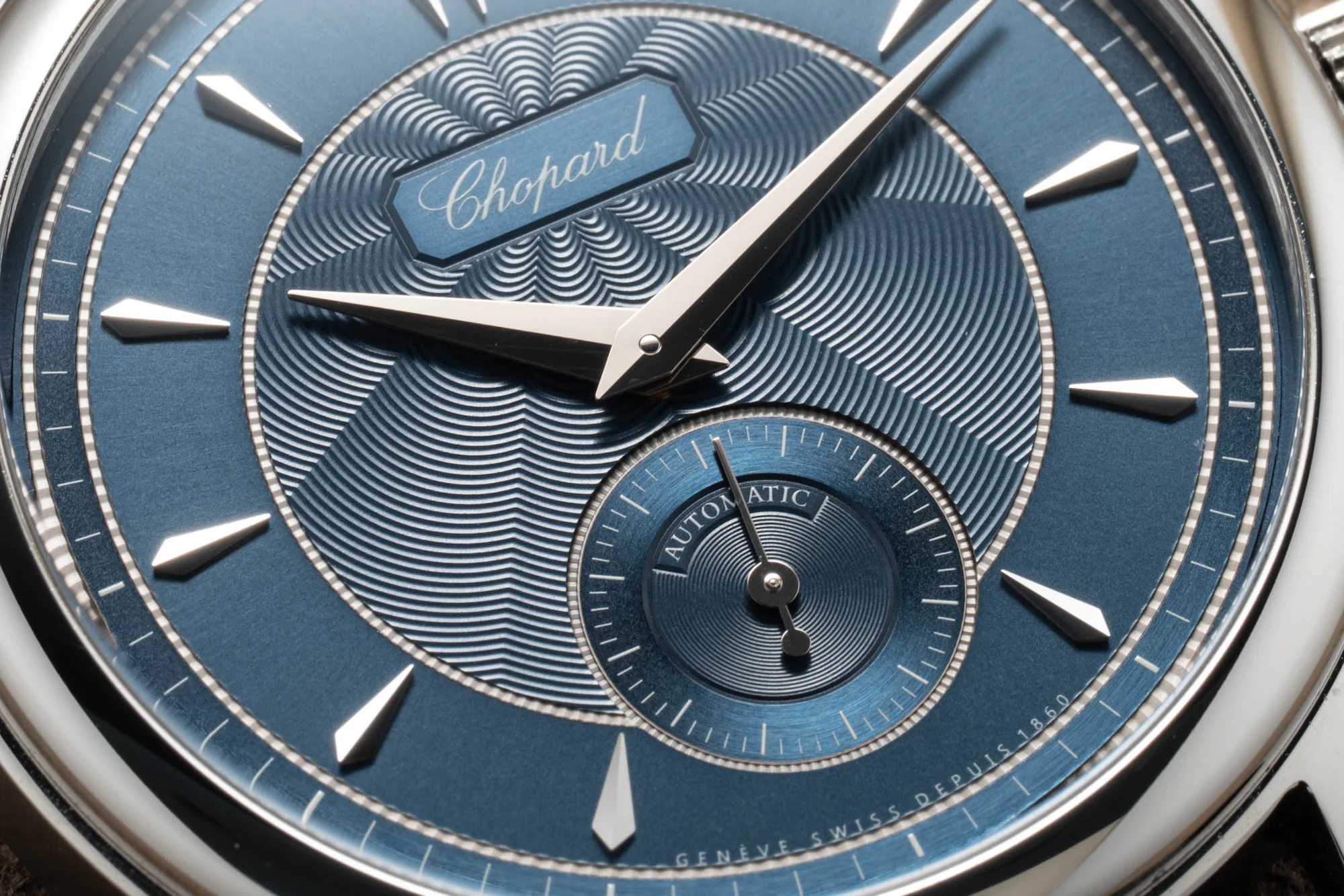


Perhaps the most controversial part of this dial, if you will, is the center guilloche pattern that radiates from the brand logo rather than from the center point of the dial, which we saw in the original editions of the L.U.C 1860 back in the late nineties after the introduction of the Caliber 1.96. To me, what this design decision takes away in horizontal and vertical symmetry, it adds back in personality. I like the fact that this allows for a much wider showing of the radial waves of the pattern, and allows for this blue-dialed L.U.C 1860 to serve as a tribute to the original blue-dialed L.U.C 1860 with a twist. The omission of the date window on this watch continues to be a good decision, though I think the “Automatic” text could be removed as well.

The exhibition caseback shows off the L.U.C Caliber 96.40-L. Its architecture remains faithful to the original Cal. 1.96, with a micro-rotor in 22-carat gold and twin-stacked barrels that offer a 65-hour power reserve at a beat-rate of 28,800 VpH (4 Hz) despite the caliber’s slim 3.3mm height. What the 96.40-L offers is the removal of the date and the inclusion of hacking seconds. Finishing remains wonderful to look at on this watch, with very pleasant anglage complementing the Côtes de Genève stripes on the three main bridges and an underlying layer of perlage. As seen engraved on the bridge, this caliber is certified with the Poinçon de Genève to indicate Geneva-seal standards for the entire watch. Complementing this certification is the watch’s COSC chronometer certification, which means it meets a tolerance of -4/+6 seconds a day.
On the wrist, this watch feels and looks great. I mean, you probably aren’t surprised to hear that from me at this point in the article, but I’ve genuinely been enamored by this watch since I first saw it two weeks ago in Geneva. That dial catches light spectacularly, and since salmon dials tend to clash with my skin tone, this one removes that personal issue entirely. And the 36.5mm case is excellently proportioned even for smaller wrists.

More importantly, this watch, like its predecessor, feels like one designed for watch enthusiasts, appealing to both modern watch enthusiasts and vintage collectors alike. Sure, at $29,700, the price of this L.U.C 1860 has increased quite a bit since the 2023 model’s introduction at $23,200. But while some might balk at that price for a compact, time-only watch in steel, there’s obviously so much more to this watch than meets the eye, not to mention that the dial is also entirely in gold. In the sea of aggressive price increases we’ve seen from so many brands across the industry, the new L.U.C 1860 still feels like an incredible amount of high-end watchmaking for the money, and remains one of my favorite new releases I’ve been lucky enough to handle this year.