
Watches & Wonders 2026, the world’s largest international trade fair devoted to fine watches, wrapped up last weekend in Geneva, Switzerland, after showcasing the event’s largest roster of exhibiting brands yet, from industry titans to ambitious independents. Team Teddy was on the ground at the show as per tradition, to discover, shoot, and try on as many new timepieces as our crazy schedule allows — and to home in on our favorites in various categories. Scroll down for our editors’ favorites of the year’s new dress watches.
- Danny Milton: Zenith GFJ Bloodstone
- Bilal Khan: Chopard L.U.C 1860 Chronometer Areuse Blue
- Erin Wilborn: Cartier Tank Normale
- Mark Bernardo: Piaget Andy Warhol Automatic Rose Gold Bull’s Eye
- D.C. Hannay: Jaeger-LeCoultre Reverso Tribute Hokusai Yōrō Waterfall
- Jonathan McWhorter: Grand Seiko Masterpiece Collection SBGZ011
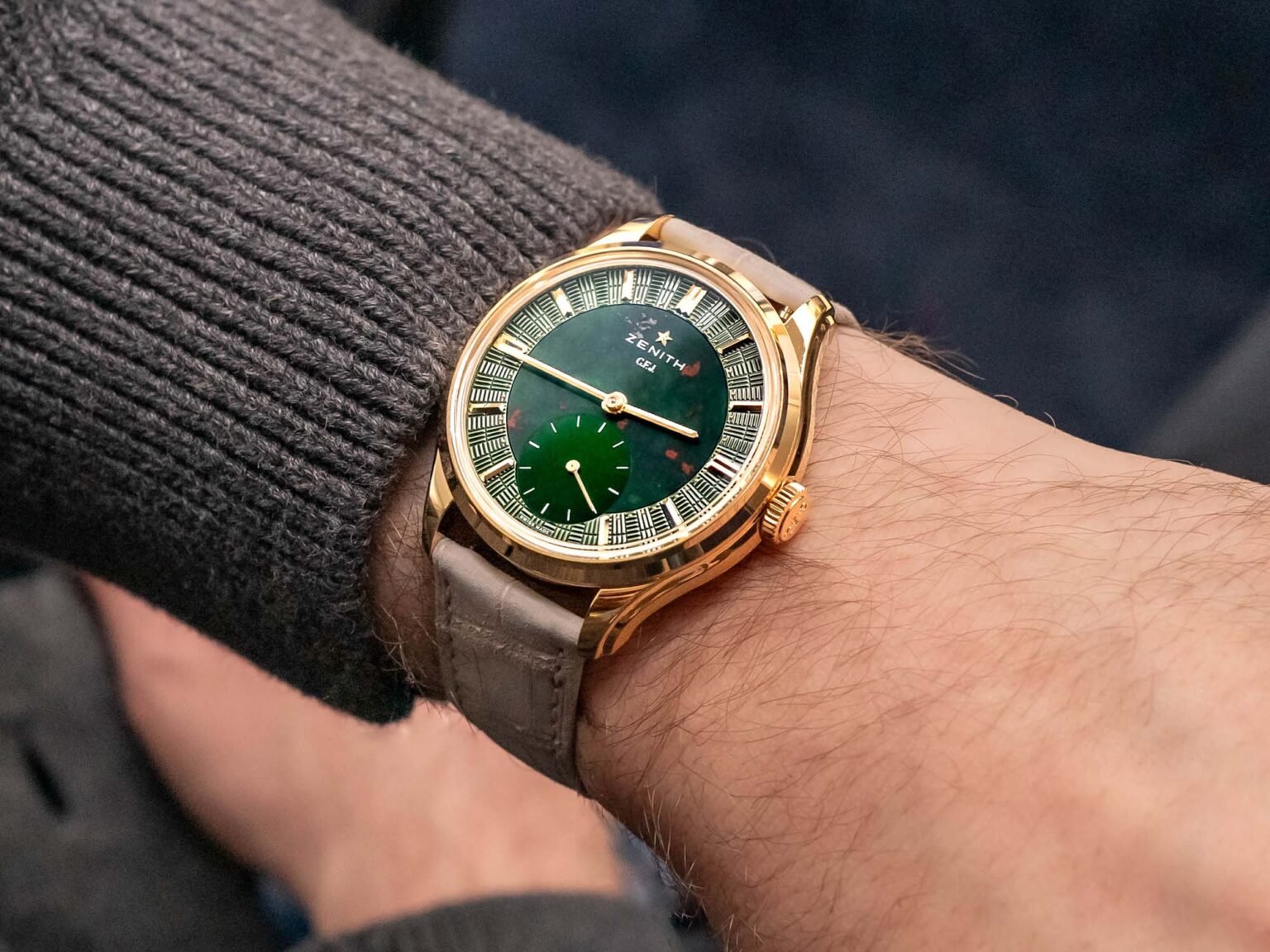
Danny Milton: Zenith GFJ Bloodstone

Sometimes a watch you don’t expect to love at the show sort of creeps up on you and forces itself upon you. Such was the case with Zenith’s follow-up to last year’s white gold GFJ, which was a new, yellow-gold edition with a Bloodstone dial in a rich green. Green dial and yellow gold is a tried and true recipe for success. Just think back to the Rolex “John Mayer “Daytona and you get the idea. But that watch never did much for me, and then I saw this one in person — first at the Zenith manufacture a few days before the fair began. I put it on my wrist and immediately understood it. The case finishing, the proportionality, and the light beige strap made for the kind of horological delight rarely experienced. Sure, this watch is a sequel, and yet it still feels fresh. I think the Zenith team has found a real winner in the GFJ and it strikes me as a fine canvas for future iterating. I, for one, cannot wait to see what the brand cooks up next.
Bilal Khan: Chopard L.U.C 1860 Chronometer Areuse Blue

Chopard’s L.U.C 1860 Chronometer is a pure dress watch, through and through. A contemporary take on the classic original 1860 from the mid-1990s, this year’s model comes in an “Areuse” blue dial named after the river that flows near the brand’s manufacture in Fleurier, Switzerland. The dial grabs you first with that hand-guilloché finishing, but there is so much more to the L.U.C 1860. Turning the case over reveals the L.U.C 96.01 micro-rotor caliber that has largely stayed the same over the last three decades, which is a very good thing considering this is an iconic seminal movement. The 96.01 also allows for the 36mm wide and 8mm thick case size that pulls the magnificent dial and movement together into one cohesive package. It’s hard for any dress watch to come close.
Erin Wilborn: Cartier Tank Normale

It’s the most quintessential Tank shape there is, and during this year’s episode of the Cartier Privé collection (which, for those uninitiated, is where you’ll find exclusive, limited edition takes of some of the Maison’s finest), the brand dropped two Tank Normale models in platinum and yellow gold. My obvious favorite has to be the platinum version, which adds a touch of romanticism with burgundy-hued indices and is paired with a deliciously slinky seven-link bracelet (in matching platinum, of course). A representation of Cartier operating at its most classic, both models are powered by the manually-wound Calibre 070.
Mark Bernardo: Piaget Andy Warhol Automatic Rose Gold Bull’s Eye

Even as the lines between watch styles continue to blur in the 21st Century, some traditions hold. Most of us can agree that a gold-cased watch with an intricate Clous de Paris-engraved bezel and a dial hewn from a rare precious stone is not an “everyday watch” — for everyone that is, except someone like Andy Warhol, the Pop Art pioneer and ‘60s style icon for whom this modern watch is named. For the rest of us, this gorgeous new reference (GOA5125) from Piaget is clearly a special-occasion dress watch, and, like much of the late Warhol’s art, somehow occupies an appealing crossroads between traditionally masculine and feminine styling. Based on the vintage piece that Warhol was known to wear during his celebrity heyday, the Warhol watch features a cushion-shaped case measuring 45mm x 43mm (and just over 8mm thick), made here from 18k rose gold. The case is distinguished by its textured, stepped bezel and an inset crown that preserves the smooth contours of the watch.
The warm, reddish brown dial is made from bull’s eye, a quartz-based stone prized for its silky luster and found in jewelry as well as (if you’re into that kind of thing) crystal healing. It’s delivered on a contrasting dark blue alligator strap, and like all Piaget watches, contains an in-house movement, in this case the automatic, meticulously finished, ultra-thin Caliber 501P1. The famously quirky Andy claimed he never bothered to wind or set the time on his own watch, but if you choose to do so on this one, you’ll have a comfortable 40-hour power reserve to get you through whatever occasion calls for it.
D.C. Hannay: Jaeger-LeCoultre Reverso Tribute Hokusai Yōrō Waterfall

I’ve never been much for modern dress watches (too big), much less haute horology (too fussy), but Jaeger-LeCoultre really brought the goods this year. Sometimes you just gotta bow down and shout “We’re not worthy!” Among JLC’s most scorch-tastic offerings for W&W 2026 are the final boss editions of the Reverso Tribute Enamel Hokusai Waterfalls Series, and the Yōrō Waterfall LE happens to be my particular favorite. I know, I know, I’m famous for prattling on about the diminishing returns of high-end timepieces (and their eye-watering price tags), but exceptions can be made when the watch in question actually crosses over into the realm of art. And when said art is from one of Japan’s most celebrated (and one of my personal favorite) artists, I’m hooked. No triple-tourbillon solarium in a sapphire bubble here; just one of the most gorgeous executions of the enameler’s art you’re likely to see in your lifetime.

The product of over 80 hours of macro-level craft, a minimum of 14 layers of enamel are rendered onto a blank white-gold canvas just two centimeters square, with the Yōrō Waterfall variant as the loveliest of the quartet. Does it help that the actual time-telling side is equally divine? You bet it does. The grand feu enamel dial is resplendent in a translucent olive green, coloring the intricate, hand-guillochéd bamboo pattern, achieved by a total of 144 passes of a rose engine lathe. The movement itself is JLC’s manually-wound Caliber 822, which helps explain the case height of just 9.73mm, an astonishing figure given the visual depth of both faces. But alas, with an edition of just ten pieces at a retail price of “upon request” dollars, this masterpiece in miniature will have to remain on my fantasy team.
Jonathan McWhorter: Grand Seiko Masterpiece Collection SBGZ011

Like many great dress watches, the SBGZ011 does the most with less. On its surface, we have a platinum three-hander with a manual-wind movement. Classic dress watch formula, the crowd applauds and nods approvingly. However, and obviously, there is more than meets the eye when it comes to Grand Seiko. Where the SBGZ011 takes things up a notch is the absolutely stunning execution on the form — both visually and conceptually. When on the wrist, everything you see is hand-engraved or finished by hand to some degree. That includes: the case engraving, the Grand Seiko signature at 12 o’clock (hand-engraved), the Spring Drive wordmark at 6 o’clock (hand-engraved), all 48 visible minute markers (hand-engraved), and the eight-pointed star signifying the Special Dial (hand-engraved). The minute and seconds hands are both curved by hand to meet the dial just so. The hands are also made of white gold, as are the hour markers. The SBZ011 is crafted to emulate the rushing of spring water over the Tateshina Waterfall, and the effect is spectacular, changing and flowing depending on different lighting conditions. After all, many a watch from the Micro Artist Studio of Grand Seiko would be expected to have a romantic natural backstory, all at increasingly high levels of execution, but this one goes to eleven.