
When I think of Heuer, or TAG, or TAG Heuer, for that matter, I think of chronographs. You probably do too. Carreras, Monacos, Autavias, Monzas, Veronas, Montreals, etc… All iconic models, their pursuit of the stop-watch-in-a-wrist-watch goes far beyond just that of aesthetics. Famously, in 1969, they were among the first three brands to introduce an automatic chronograph with the Caliber 11. Then, in the 2010s, they pushed chronograph innovation to its limits with high-concept, high-frequency calibers like the Mikrograph, Mikrotimer, and Mikrogirder.
In the last few years, TAG has focused more on the commercial side, honing in on a contemporary design language with the glass box Carreras, as well as a workhorse caliber of their own, the 80-hour, column-wheel, automatic TH20. 2026, however, marks a return to more innovative, if high-end times. Earlier this year, they introduced the six-figure Carrera Split-Seconds Chronograph, a 36,000bph rattrapante made in collaboration with Vaucher, under the category of “avant-garde horlogerie.” A curious development that was perhaps undermined by having such a daunting price, it did serve as an amuse-bouche to their big Watches & Wonders novelty: the Monaco Evergraph, which includes at least one first in watchmaking.

There is a lot to unpack with the Evergraph, but the movement is a good place to start. Inside is a new caliber called the TH80-00. An integrated chronometer-certified automatic chronograph with 47-jewels, it features a 70-hour power reserve, and a frequency of 5Hz or 36,000bph. That’s the simple stuff. The TH80-00 also features TAG’s proprietary TH-Carbonspring oscillator. An amagnetic material that TAG debuted in 2019; after a brief attempt at industrialization, they took it off the market, only to return last year with two limited, full-carbon-cased chronographs. New hairspring materials are as uncommon as new escapements, if not more so, so this is very cool, especially in a high-beat chronograph. But, there’s more.
Chronographs feature either a cam-lever (like the Valjoux 7750 and Sellita SW500) or a column-wheel (like the TH20, Seagull ST19, or Omega Cal. 321) as the governing mechanism for the start, stop, and reset functions. Well, in a first, TAG uses neither. Rather, a whole new system called the “compliant chronograph mechanism.” While the name leaves something to be desired, the system removes all of the levers and springs associated with the former mechanisms, replacing them with two “bistable” components.

The new parts are manufactured using LIGA technology, which stands for Lithographie, Galvanoformung, Abformung. Yep, that’s German, but it’s essentially a manufacturing method used to create very precise, often very small or thin parts. It uses X-ray or UV lithography to create a negative in a substrate, and then electroplating to build up a new part in that negative (to the best of my understanding). Developed over five years by the TAG Heuer LAB, the compliant chronograph mechanism has fewer parts, thus less wear and tear, promising “…no change or deviation over time in its performance. Whether on the first press of the pushers or the ten-thousandth, the chronograph always delivers the same sensation and accuracy.”
So, to summarize, the TH80-00 is an integrated chronometer-certified automatic chronograph with 47-jewels, a 70-hour power reserve, a frequency of 36,000bph, a TH-Carbonspring hairspring, and the novel compliant chronograph mechanism. Oh, and the crown is at nine, while the pushers are at two and four, paying homage to the Caliber 11. Sounds impressive, but there is actually more to it, which brings us to the design of the watch.

I wouldn’t dare venture a guess at the number of Monacos TAG has made over the years. Nor within that number, how many variations on the iconic-if-divisive square case have been conjured. From true-to-the-original to hypermodern, I’m certain an entire spectrum exists. The Monaco Evergraph, while containing as modern a movement as possible and a very contemporary dial aesthetic, sits somewhere in the middle.
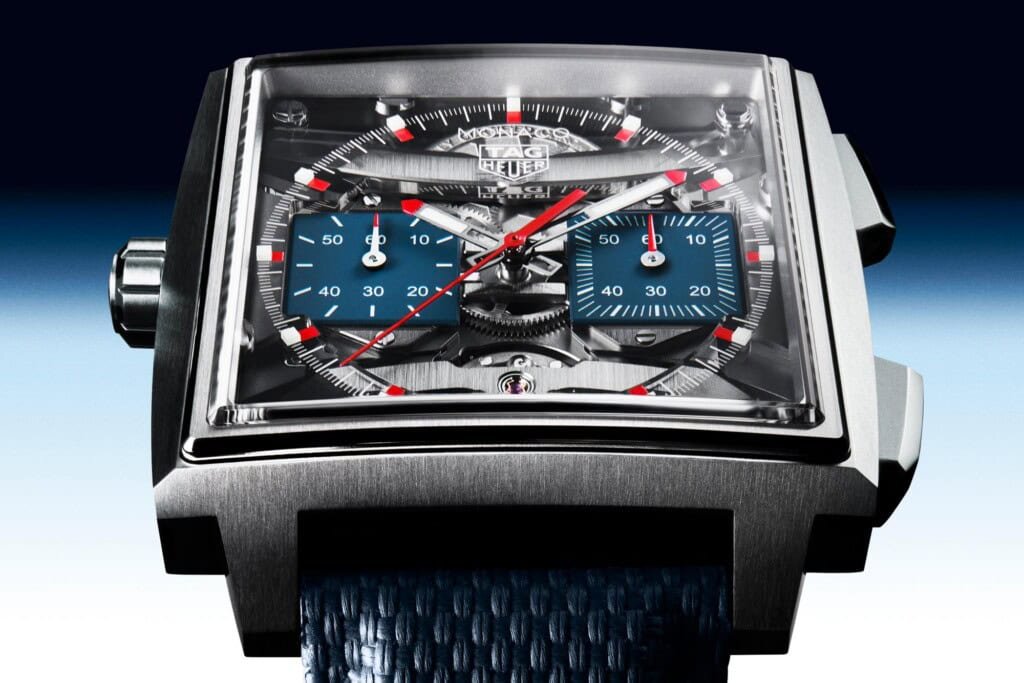
Made of grade 5 titanium, the 40mm case has the classic square shape from above, bowing slightly on its sides. No flanges, carbon fiber doodads, or random skeletonization. With that said, the pushers are dramatically oversized, clearly projecting a contemporary aesthetic. While the press photos don’t quite indicate how, the release does express that the case has been reconsidered for ergonomics as well.

The dial, which is more the suggestion of a dial, is thoroughly modern, drawing on the aesthetic set up by the Monaco Split-Seconds from 2024. A completely open space revealing the top side of the TH80 movement below, the traditional dial elements that carry Monaco-DNA are floating square sub-dials at three and nine, and a primary index printed on a layer of acrylic, thus appearing suspended in mid-air. Everything else is movement.
And this is where we can get back to some of the TH80’s features. The top side of the movement is appealingly symmetrical across both axes, featuring oversized transversal bridges at the top and bottom. The bridge at twelve is over the barrel, featuring a jeweled pivot directly under a floating TAG Heuer logo. The bridge at six, and this is where things get interesting, holds the balance. As such, it’s safe to call this a dial-side balance. And as a fan of dial-side balances, I think this is very cool, as they are fairly unheard of on chronographs, let alone high-beat watches.

While there is a certain chaos to these open dials that TAG and other LVMH brands are quite fond of, this is on the palatable side, given the very attractive movement layout, which, by the way, is fully square to fill the case. My only gripe is that the sub-dial at nine is an active seconds, which feels redundant with the balance on full display. I would have preferred a 12-hour counter. With that said, the minute counter at three does go to 60, which is uncommon and preferable.
If you’ve been keeping track of these higher-end TAG chronos, you’ll probably recall that the Monaco Split-Seconds from 2024 was 135,000 CHF, the follow-up “Air” version was 150,000 CHF, and this year’s Carrera Split was $127,000. So, you’re likely expecting another bonkers price tag. Well, not quite (as bonkers). The Evergraph comes in at $25,000 USD/CHF, which, while a lot of money, is a full 100k less than its predecessors.

My guess is that this comes down to hand-finishing, but perhaps the strategy was also to create sticker shock, making the Evergraph feel more reasonable. Either way, it’s a pretty rad watch, and points toward an interesting future for TAG’s chronos. Hopefully, the innovations present here will trickle down over the years into their sub-$10k models, making them more compelling.
The Monaco Evergraph is available in two versions, a light model that speaks to the original Monaco design, and a DLC version that references the “dark lord.” The Monaco Evergraphs are not limited. TAG Heuer
The post Watches & Wonders: TAG Heuer Reinvents (a part of) the Chronograph with the Monaco Evergraph appeared first on Worn & Wound.