

Origin Story
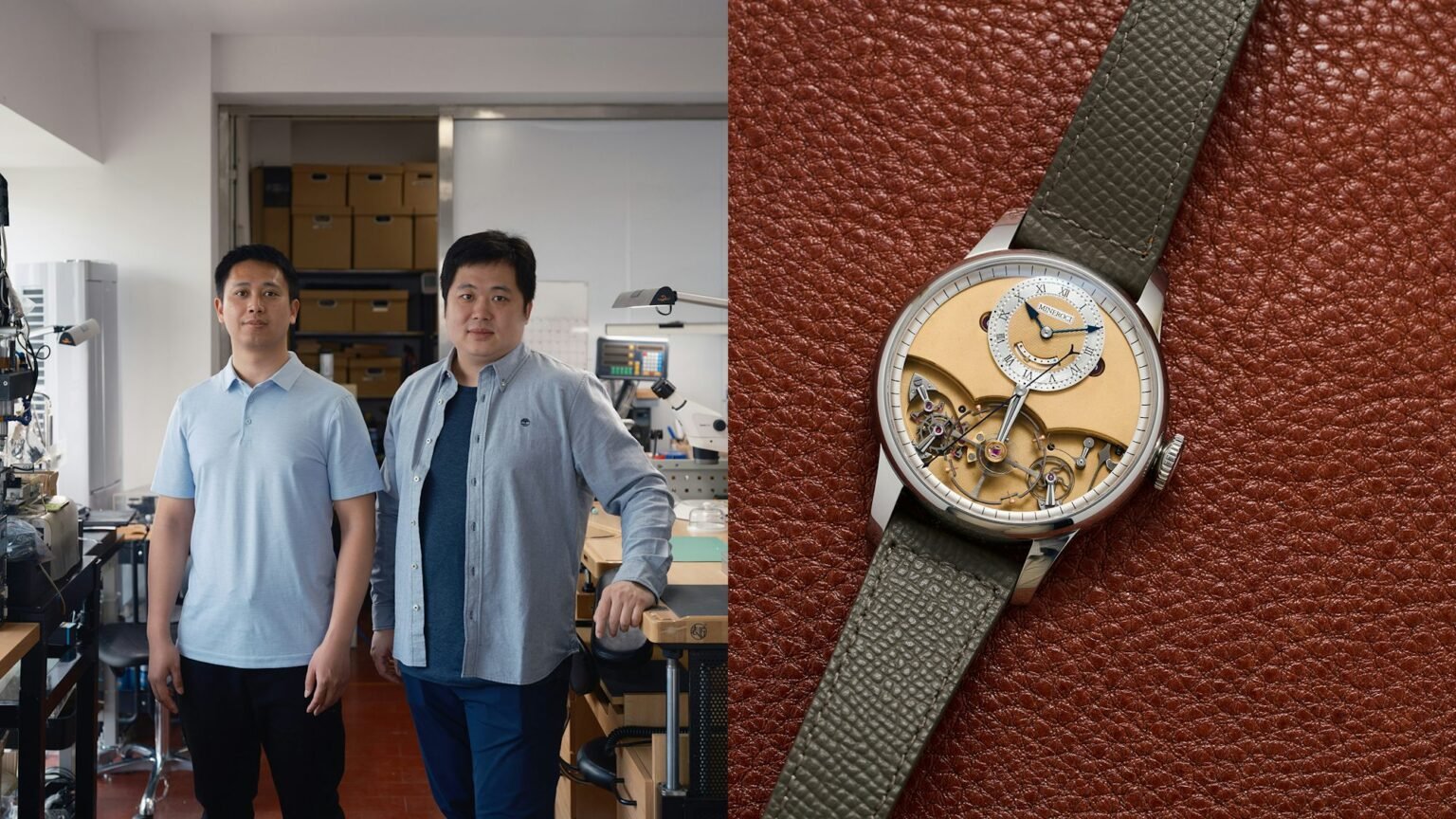
For a little while, I’ve been following Mineroci, a Beijing-based independent watchmaker that has shown some pretty remarkable talent for interpreting traditional Swiss inspiration into a new, pretty impressive watch. That piece, the RD002, recently found the spotlight because Mineroci was one of the 20 semi-finalists for the Louis Vuitton Watch Prize for Independent Creatives. And yet, far removed from the Swiss watchmaking scene, with only 2,300 Instagram followers and a language barrier between us, I was shocked to find out that founders Chang Qu and Zhengyang Pan, whom I finally was talking to via Zoom (thanks to collector-turned-interpreter Henry Li, who was visiting the team a few weeks ago), had already won plenty of big awards. Just not for watchmaking (yet).

No, the minds behind this attractive, impressive, and expensive classically inspired watch were the founders of Roci Design, which has won eight Red Dot and iF Design Awards for its work in electric consumer goods. A shaver, a hair dryer, a smart planter—designing these was (and still is) Qu and Pa’s playground. So how did they go from the Nüburgring remote-control racing car toy to a watch inspired by Ferdinand Berthoud and George Daniels?

Photo courtesy Mineroci.

Photo courtesy Mineroci.

Photo courtesy Mineroci.
“We liked watches and started to get into the watch space, where we got introduced to a few watchmakers,” said Chang Qu through Henry Li’s interpretation. “While the industry in China looks large, it feels like there’s essentially only two watch types being made: three-hand watches and tourbillons. We liked pocket watches, as do many Chinese collectors. There are a lot of interesting architectures, complications, the watches are more affordable, and the movements are bigger, so they’re easier to look at.” That inspired their work, but as people who had never made a watch before, they had to start somewhere.

Photo courtesy Mineroci.
So, like many others, they started with a simpler watch based on an external gear train (the ETA 6498) on their inaugural RD001, to prove to themselves that they actually could build a watch and to train themselves (and their team, who still start on that model while training) to build and finish a quality watch. “Their training is working on what is basically a school watch.” Both founders are still working to finish and haven’t fully handed everything over to their team, choosing to stay hands-on. In fact, they offer buyers four finishing options for their RD001, which adds to the complexity and excitement surrounding the watch.
And yet, doing something that way wasn’t enough for the team. “With movement design, there’s a lot of mathematical equations,” says Qu. “We started to think some of these things could be solved by programs, so we leveraged our own proprietary design software to design a watch. We designed a chiming function, a jump hour. A lot of things that didn’t make it to the prototype. What we did decide to make is the RD002.”
Why We Like Them
Mineroci’s RD002 is pretty remarkable, even though the example that I saw was just a prototype with somewhat rough finishing. But the promise of what the watch could be is there, especially from the technical perspective. The watch features a prominent central balance with a small time-telling dial at 12 o’clock and a large central seconds hand that evokes vintage marine chronometers. In fact, that’s the point. The team was inspired by George Daniels’ work and Ferdinand Berthoud, but more specifically, Daniels’ watch, the “Hornby II.” That watch featured a large lower central balance wheel on the movement side, which Mineroci has placed on the dial side (plus a remontoir and “following wheel”).

In June 2024, Chang Qu visited the Patek Philippe Museum in Geneva and was captivated by a Ferdinand Berthoud and Jean Martin marine chronometer from 1804 with two-tone guilloché and other finishing, plus a prominent central seconds hand. Back in the 1800s, the central second hand was key to quick, precise navigation, so it played an integral role in the watch’s function. Here, Mineroci has leveraged it (and its finishing) for aesthetic purposes.
For starters, the watch has an interesting mix of guilloché on the time-telling dial (with blued hands) and brushing on the ring around it, plus a contrasting grained finishing on the main plate at the front. There is also a power reserve indicator in a recess on that dial. As I said, it’s a prototype, but it looks quite nice.


The large balance wheel is more roughly finished on the prototype, and there’s some spotting on the mainplates, but the key here is the movement design. On the left, you have the escapement with a Reuleaux triangle and a remontoir d’égalité, which manages torque and provides deadbeat seconds. The escapement also uses 18 teeth instead of the 15 or 20 usually used. To balance the symmetry (which is core to the aesthetic that Mineroci was going for), the brand added a stop-seconds mechanism to the right of the balance and a following wheel that spins, connected to the gear train, but there only for aesthetics.
The movement side is beautiful and evocative as well. They asked me what the movement reminded me of, and after a little thought, I saw the inspiration: the face of a lion in a lion dance costume, with two large eyes and a mustache bridge running across the center, making the shape of a mouth. Mineroci has done a good job of blending the founder’s Chinese culture and Swiss-inspired watchmaking into something impressive.


“We want to do things a little bit different, but we also want to prove right now they can do what Swiss can do,” says Qu. “This is difficult, as was making a watch with a remontoir. In theory, we thought it would be a bit easier than it was in practice. We don’t want to always be playing catch-up with the Swiss, so we just need to show our progress through our product. Maybe it will take five to ten years to see they are actually making progress. We need to show new product, but also have innovation. It will just take time to change the perception of Chinese watchmaking, but we will continue to make better product to show people the potential.”

Photo courtesy Mineroci.

Photo courtesy Mineroci.

Photo courtesy Mineroci.
I do see the potential in Mineroci. While I mentioned that the finishing isn’t perfect, it is a lot better than many watchmakers’ first or second outings. And I have confidence that the brand won’t put out anything but the best finished product, so I don’t fault them for getting out the word with a prototype. The watch itself has a pretty weak power reserve (only 38 hours), and the large 13mm balance beats at a reasonable 3Hz.

Photo courtesy Mineroci.
On the wrist, the Mineroci RD002 is really captivating and enjoyable. You can see how the brand has pulled from Daniels, Berthoud, and even a bit of early F.P. Journe in aesthetic and horological inspiration. The watch, in platinum at the time of delivery (steel for the prototype), is only 38.5mm wide and 9.8mm thick, which makes it incredibly wearable and yet still legible. And it’s got 30m of water resistance, which is surprising for a watch that has such an antique aesthetic.


The RD002, however, doesn’t come cheap—it retails at CHF 78,000. This is the kind of watch that speaks more to the highest end of the independent collecting market. But with only a few being made—21 pieces numbered 1 to 22, excluding the number 14 (for cultural reasons in China—I can imagine that there will be plenty of people who will show interest in a brand that has already gained some international attention from a jury of smart watch industry insiders.
What’s Next
The team at Mineroci will likely attract much more interest after their semi-finalist placement at the LVMH Watch Prize this year. But they’re still a ways out from perfecting their watch and delivering the first examples, which will likely come in 2027. But what they’ve shown in their current work is that Chinese watchmaking can take many forms. And yet they are honest about the challenges that lie ahead for the entire industry.

Photo courtesy Mineroci.
“Our strength is our design capability,” says Qu. “If we want to design a new complication, there’s not much difficulty for us or the industry as a whole. We also have a strong supply chain in China, for the most part, so we can source what we need. Sometimes, yes, we still have to source from Switzerland, but that’s getting better. There is also a lack of traditional watchmaking training in the industry, but we have been hiring who we can and making sure we’re training them so we can keep doing interesting things in the future.”
The brand still sees that there’s a lot of room for Chinese watchmaking to grow in terms of complications, and they want to enrich the national industry’s space. They see they have a lot to offer, with more complicated watches with different functions, which will continue to push their skills and those of their colleagues.
For more on Mineroci, follow the brand’s Instagram.