
The Longines Hydroconquest, the Saint-Imier brand’s most prominent and forward-looking diver’s watch, made its debut in 2007 and has changed very little in its key features and elements — despite expanding during the nearly two decades since into a variety of sizes, colorways, and materials. That all changes this year, as Longines has introduced the next generation of the Hydroconquest, defined by a host of contemporary upgrades. Here’s what you need to know.
[toc-section heading=”Origin of the Hydroconquest”]

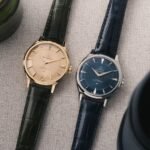
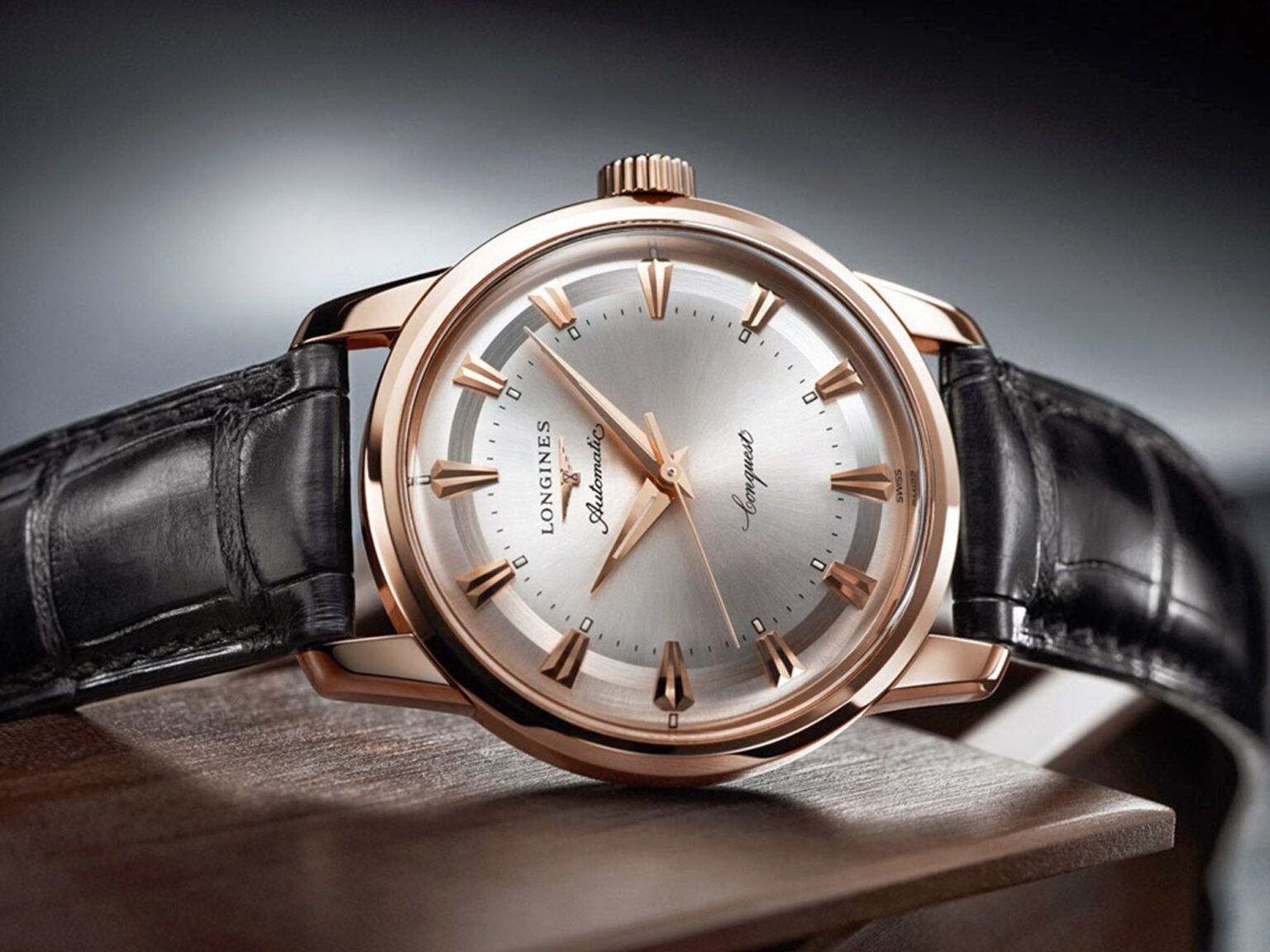
Before the Hydroconquest came the Conquest. Longines has been making timepieces since 1832, but it wasn’t until 1954 that the Swiss watchmaker began engaging in the modern marketing practice of introducing product families with distinctive names. “Conquest” was the first such name to be registered, on April 3, 1954, with the Swiss Register of Intellectual Property. The original Longines Conquest (reproduced above) was equipped with a highly accurate automatic movement and a water-resistant case that also protected the movement from magnetism and shocks. Despite these utilitarian elements, however, it was undeniably a dress watch, at a very modest 35mm and with a clean, minimalist dial.

Longines introduced the bigger, sportier version of the Conquest, called the Hydroconquest, in 2007, during an era when large, rugged watches, particularly divers’ watches, were reaching new heights of popularity. The Hydroconquest, in contrast to its predecessor, was aimed squarely at recreational divers and those who wanted to emulate their look. The core Conquest model’s stationary, brushed steel bezel gave way to a unidirectionally ratcheting bezel with a 60-minute dive-scale insert, with the first 15-minute sector delineated by minute markers and Arabic numerals at each subsequent 10-minute interval. An applied Arabic numeral at 9 o’clock replaced the rectangular index on the most recent Conquest model, while the 3 o’clock date display was retained. The handset consisted of a short, faceted hour hand with a bulging luminous diamond, a baton minute hand; and a lollipop-style sweep seconds hand. Bigger, bolder round indexes were added at the non-numerical hour positions, and a generous coating of Super-LumiNova was applied to the hands, indexes, and the orientation dot at 12 o’clock on the bezel.

The watch’s 300-meter water resistance, more than sufficient to meet ISO requirements for a diving watch, was secured by a screw-down crown flanked by crown protectors. The screw-down casebacks featured a relief engraving of Longines’ historical winged hourglass logo. The cases were in three sizes — 39mm, 41mm, and 44mm — and equipped with the Longines-exclusive, ETA-based L888 automatic caliber. These versions of the Hydroconquest were offered almost exclusively on three-link steel bracelets and rubber straps. To lead off its new releases for 2026, Longines has revisited the Hydroconquest, adding and tweaking several elements that are sure to entice enthusiasts. Read on for the details.
[toc-section heading=”New Longines Hydroconquest Review”]
Case and Bezel

As of the latest generation in 2026, the Longines Hydroconquest is now available in two case sizes, and thus far all in stainless steel — 39mm and 42mm, both coming in at 11.07mm in thickness (just a mite thinner than the 41mm models of the current generation). Lug to lug, the 39mm watch measures 48.10mm while the 42mm model spans a slightly wider 51.20mm. The cases feature predominantly brushed finishing with polished details, and the water resistance remains the same, at 300 meters. The protectors flanking the screw-in crown are less prominent, while the unidirectional dive-scale bezel has been re-engineered so that its ratcheting motion has a more distinctive, audible ratcheting click, a satisfying sound for a dive watch enthusiast. (Longines has adopted this design from the Ultra-Chron model that it released back in 2022.)

Perhaps most notable are the bezel’s inserts, which are now made of ceramic in five colors — the existing black, blue, and slate gray, plus new “verdant” green and “luminous” blue. Each of these ceramic inserts features a new SuperLumiNova capsule at the zero position at 12 o’clock.
Dial and Hands

Along with the new color variety in the Hydroconquest bezels come an array of new colors for its dials, which have also been redesigned for a more streamlined and balanced appearance. The big, applied numerals at 12, 9, and 6 o’clock are gone, replaced by geometric applied indexes, of which there are 11 in all. An inverted triangle marks 12 o’clock, circles identify 6 and 9 o’clock, while the rest of the hour positions (formerly represented by circles) now feature rectangular indexes. As on the previous models, the only exception is the 3 o’clock position, occupied by a date window. These indexes have all been treated with Super-LumiNova. Four color options are available: blue, black, and green, all of which boast a polished, lacquered finish, and an eye-catching frosted blue with a sunray treatment. The dial-and-bezel colorways range from monochromatic (as in the predominantly blue and green models in the previous section) to high-contrast bicolor (like the frosted blue with black bezel directly above, and the black-dial/blue bezel reference below).

Movement
The Hydroconquest caseback, which in previous versions had an engraving of the brand’s venerable hourglass emblem, now hosts the “planisphere” engraving that Longines established a few years ago for its GMT-equipped models like the Spirit Zulu Time; it’s described as “connect[ing] this collection to Longines’ heritage of equipping explorers and adventurers.” Behind that solid, screwed caseback beats the movement, Longines Caliber L888.5, which is an upgrade from its predecessor, the L888, in a handful of technical areas. The L888.5 (also built exclusively for Longines by ETA, which shares corporate parentage with the watchmaker in the Swatch Group) incorporates a silicon balance spring, which renders the movement exceptionally resistant to magnetic interference. (In fact, it’s 10 times more magnetic resistant than the ISO standards for dive watches require.) The frequency is 25,200 vph, the jewel count is 21, and the power reserve is a respectable 72 hours, or three days.
Strap and Bracelet

Longines has ushered in a new crop of bracelets for these Hydroconquest models, including the first steel mesh Milanese style bracelets in the collection. These bracelets, which make their debut on three of the new references, combine fully brushed surfaces with polished sides. They have a tapered construction for ideal comfort, and a micro-adjustment clasp with a set of shortening links for easy fit adjustment. The other steel bracelet evokes the elegant, H-link style of those on the GMT models and include a double-folding safety clasp with micro-adjustments in four ranges.
Pricing:

Longines being Longines, all of these novel upgrades to the Hydroconquest have not translated to significant increases in price. Both the 39mm and 42mm models retail for $2,200 on the steel H-link bracelets. On the new steel-mesh bracelets, prices jump up to $2,400 for both sizes. That’s up from a base MSRP of $2,000 (in steel) for the current collection, and considering what you’re getting (better ergonomics, more efficient movement performance, an overall increase in aesthetic elegance), many will find these new Hydroconquests quite tempting as a value proposition. You can learn more at longines.com.