
[toc-section heading=”Squale Overview”]
Squale is a historic manufacture with a particular specialty in the realm of dive watches. The company’s heritage is deeper than you may realize, as it extends beyond its own footprint, touching an extensive list of partners that helped to shape the dive-watch genre as we know it today. The story of Squale is one of intrigue, and while it became a well known case supplier through the ‘60s and ‘70s, the Swiss brand also boasted a collection of its own designs that hold as well today as they did then. Understanding Squale means taking a step back into the era that birthed it, an era defined by the burgeoning sport of recreational diving as well as the advent of military diving operations.

If you’re a fan of dive watches and the history of their use, Squale is a brand that should be on your radar thanks to its plentiful contributions. Beyond that, collectors will find a vast array of designs in the brand’s modern catalog that both break new ground and preserve the best portions of its history. In this overview, we’ll connect all the dots from then to now.
[toc-section heading=”History and Heritage”]
Squale was founded by Charles von Büren in 1959 in the beautiful lakeside town of Neuchâtel, Switzerland. While that’s the official date, von Büren had been assembling watches under his own name for the prior decade, meaning he brought some pedigree to the name from the get-go. The modern dive watch genre was in its infancy in 1959, setting the tone for the coming decades of watches to be produced for divers, both recreational and professional. This was, of course, prior to any form of digital instrumentation that today’s divers rely upon, making the watch (and a dive table) a valuable piece of kit to track things like bottom time, air run rates, safety stops (or full decompression stops if needed), and time between dives.

Photo: Cousteau Society
After the second World War, the act of diving took on a new life thanks to the work of Jacques-Yves Cousteau and Émile Gagnan (above, l-r), who brought their Aqua-Lung (an open-circuit scuba system) to the masses. This made the sport more accessible than ever, and though it’s come a long way in the years since, the same basic principles still underpin modern diving. One indispensable tool that has also remained is the watch. Today, it takes the form of a dive computer that tracks vital information, but the humble mechanical dive watch long served this role. It wouldn’t be until the 1980s that the dive computer would emerge, and another decade for it to achieve widespread acceptance. That leaves an approximate 30-year window for the development of mechanical dive watches, and in the span, a strong foundation was put into place, and brands continue to build upon it today.

In the late 1950s, a good dive watch was a relatively simple thing, with features we might take for granted these days playing a big role. Details such as a rotating bezel, screw down crown, luminous elements on the dial and bezel, and, of course, a depth rating over 100 meters were all big selling points. Waterproof watches had been a thing since the 1920s, but pushing things to new depths became something of an arms race. In 1960, Jacques Piccard and Don Walsh piloted the bathyscaphe Trieste (above) to the ocean’s deepest point, nearly 11,000 meters deep, and did so with a Rolex Deep Sea Special strapped to its exterior. The sub, and the watch’s survival, were the stuff of legend, and it’s a game that continues with manufacturers today.
This is the context that informed the launch of Squale in 1959, by Charles von Büren, who was himself an avid diver. Squale is a French (and Italian) word for shark, the likeness of which is worked into the brand’s logo (as below). That same year, Squale would obtain patents for its case designs, allowing it to produce extraordinary 500-meter and 1,000-meter cases that would eventually be used in the brand’s Master series. These watches would feature screw-down crowns and rotating bi-color bezels within a straight-lug skin diver-style case.

Both then and now, watches with a depth rating north of 500 meters are considered deep divers capable of going well beyond what any typical diver might attempt. It’s important to note that Squale did not produce a watch under its own name until 1962. The firm was, and would remain, a case manufacturer. Though Squale would go on to develop a healthy range of its own watches, what earned the brand notoriety was its ability to produce a strong case — which brands like Blancpain, Doxa, Heuer, Eagle Star Genève, La Spirotechnique, and Sinn would all go on to use.
In 1968, Squale launched a new case design, the 2002, which used something of a cushion design, and moved the crown to the 4 o’clock position. This was Squale’s first case to guarantee a 1,000 meter depth rating, with 101 atmospheres labeled on the dial. A Bakelite bezel insert was used, and the bezel itself had to be pressed to rotate. This watch represented a big step for the brand in the public eye, with free divers Jacques Mayol and Enzo Maiorca both wearing it to set world records. The 2002 was an influential watch, and would serve as something of a benchmark for deep divers of the era.

By the 1970s, Squale’s case design language was ready for the next step, and the 1521 model would become just that. This is the famous “von Büren” asymmetric design that placed the crown at 4 o’clock, under a straight-cut section of the case wall only found on that side of the watch. This case brought a muscular presence unlike anything the brand had done previously, and would eventually see use as a formal bit of kit for the Italian Navy and for the “Folgore” Paratroopers Brigade. But that wouldn’t be the end of the 1521’s service record.
Blancpain also used the 1521 case for a Fifty Fathoms reference issued to the German Navy in the 1970s. This ‘Bund’ version of the watch set the shape’s place in history as one of the great military designs of the decade, which is saying quite a bit. This is a design Squale pays homage to in its current collection, but it’s a history that otherwise lives in the shadows. Squale’s cases through the 1960s and ‘70s are the stuff of legend, and their focus on practical features that could be easily deployed over fancy or gimmicky marketing made them a true tool of the generation.

Photo: Touch of Modern
By the 1980s, the structure of the company expanded to include the Italian Maggi family, as Charles von Büren prepared for his retirement. The new decade saw the introduction of new collections, such as the Rambo (with an integrated compass), and the extreme Tiger diver (above). It was clear that Squale had entered new territory, and the popularity of quartz watches and digital dive instruments effectively led to a quiet period for the brand.
A good history is hard to keep down, and in Squale it re-emerged, still controlled by the Maggi family out of Milan, with watchmaking being done in Chiasso, Switzerland. In 2020, the brand’s headquarters moved to Switzerland, as the company begin embracing many of its original dive watch designs.
[toc-section heading=”The Modern Collection”]
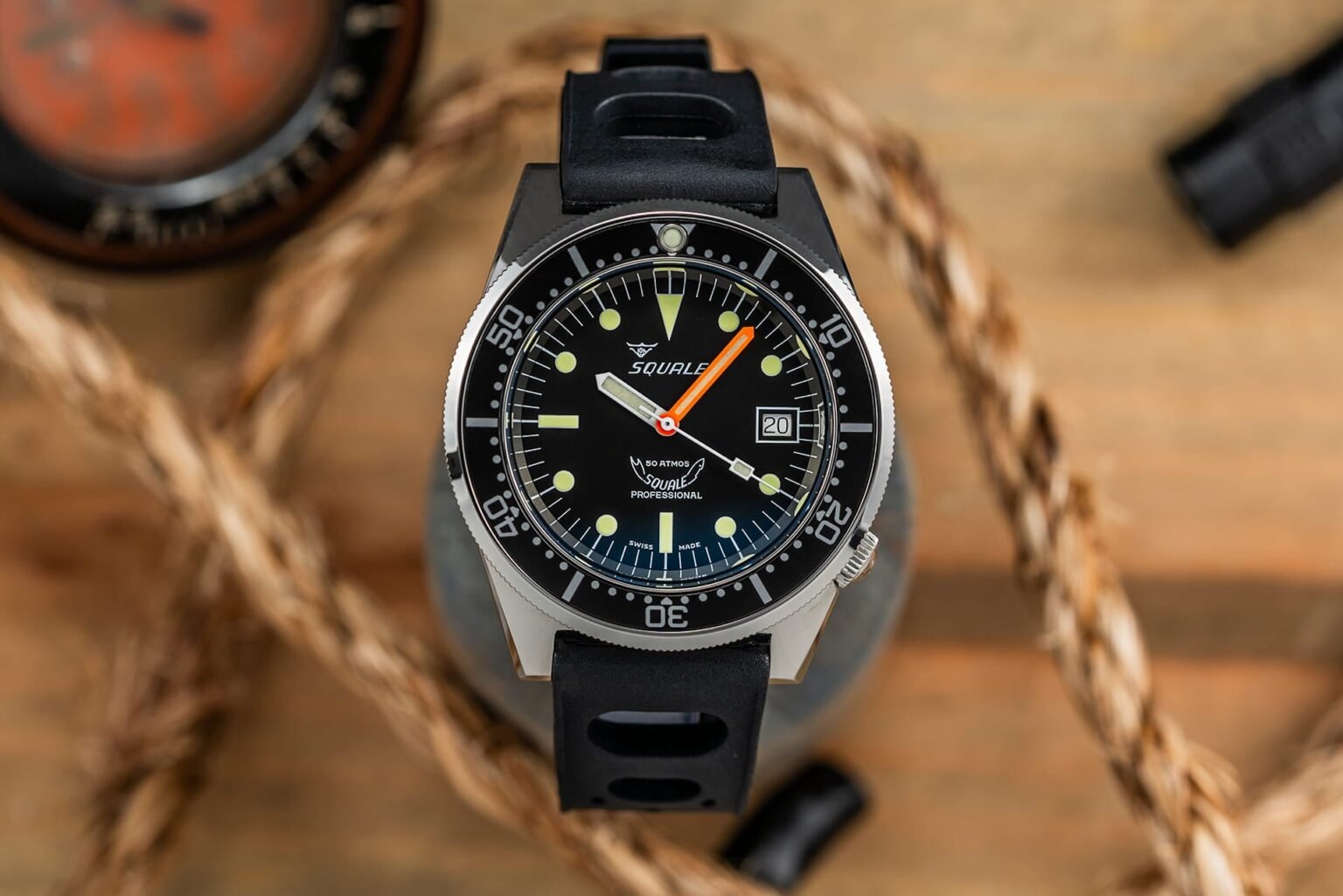
Today, Squale preserves much of the history with modern variations of its classic designs. In the true spirit of the brand, its designers don’t shy away from expression, with vibrant color schemes and textures appearing across nearly every collection. Make no mistake, these are still supremely capable dive watches, including a few ultra-deep divers in the mix.

The Master collection (Grand Vert edition above) carries that legacy forward with a 1,200-meter diver that now includes a flush helium-release valve and a flat crystal, making it a modern evolution of the original. Likewise, the modern 1521 (Militaire edition below) carries forth Squale’s most iconic case shape in a multitude of configurations, allowing it a whole new life within an enthusiast context. Most recently, the Sub 37 watch captures the original appeal of the skin diver in a 37mm form factor, honoring the charming beginnings of the hobby and the genre.

Squale boasts an enviable heritage that lives on in its modern catalog. These are watches that tell the story of a bygone era, and the role they played not just for Squale, but for a number of other important brands that played their own role in shaping the modern dive-watch landscape. For its part, Squale is forever a part of history. For more info, visit squale.ch.