

I’ve been doing this long enough to understand a basic truth about watch writing: most watches are pretty boring to write about. It’s not that the watches are bad or even uninteresting, but fundamentally, after writing about hundreds and hundreds of them over the years, you find less and less to say about any given new release that comes across the desk. The challenge of the job, and the thing that keeps it fun, is looking for angles to the story to make talking about a watch feel exciting.
For me, it’s always been hard to do that with the ubiquitous and derivative stainless steel sports watches that still take up most of the air space in watch enthusiasm. Again, it’s not that these watches aren’t good (I own a bunch that fall into this category) but there’s very little left to be said about them. Collectively, the watch industry has basically figured out how to make a dive watch, or a pilot’s watch, or a field watch. We know the shape of the case, the proportions, the dial furniture, and the movements that are likely to run it by rote. Sometimes a brand will take a new approach and we always take notice and try to highlight whatever is genuinely interesting, but the watch world is filled with very well made predictable watches that don’t necessarily inspire the most interesting writing.
And of course, watches don’t exist to inspire me or anyone else to write. They exist to be worn and enjoyed and to tell the time. I might not be a tool watch guy, but there’s no denying these are purpose built objects.
Review: the Anoma A2
stainless steel
La Joux-Perret D100
Blue
None
Sapphire
Leather
50 meters
41.5 x 35.7mm
9.8mm
16mm
Push/Pull
Yes
$3130
But then there are watches that are something else. For as long as watches have been made, talented people have used them as a canvas to create stunning works of art and craft. Andrew Canter has been writing about this for us for years, and I encourage you to dig through the archives for examples dating back to the 18th century. And just like encountering a painting or sculpture in a museum that makes you think, and provokes conversation, there are watches that do the same. Those are the ones I increasingly want to find space to write about in these pages.

Luckily, we’re in something of a boom time for experimentalism in independent and microbrand watchmaking. The new A2 from Anoma is a great example of a watch that is not just a watch. It’s also a sculpture, and maybe a little bit of a provocation. It’s one of my favorite new watches introduced this year, and one that I was particularly excited to sit down and write about as soon as it hit my desk.
Anoma is still a relatively new brand, founded in 2024 by Matteo Violet Vianello. The A1, his first watch, has a triangular shape that many initially commented seemed to be riffing on Cartier, but was actually inspired by a free-form table designed by Charlotte Perriand in the 1950s. The key, I think, to understanding what Anoma is doing is to understand that the watches Vianello is making are not, like almost every other watch produced, inspired by the design of other watches. They are inspired by art in many mediums, objects of all kinds, and abstract ideas.

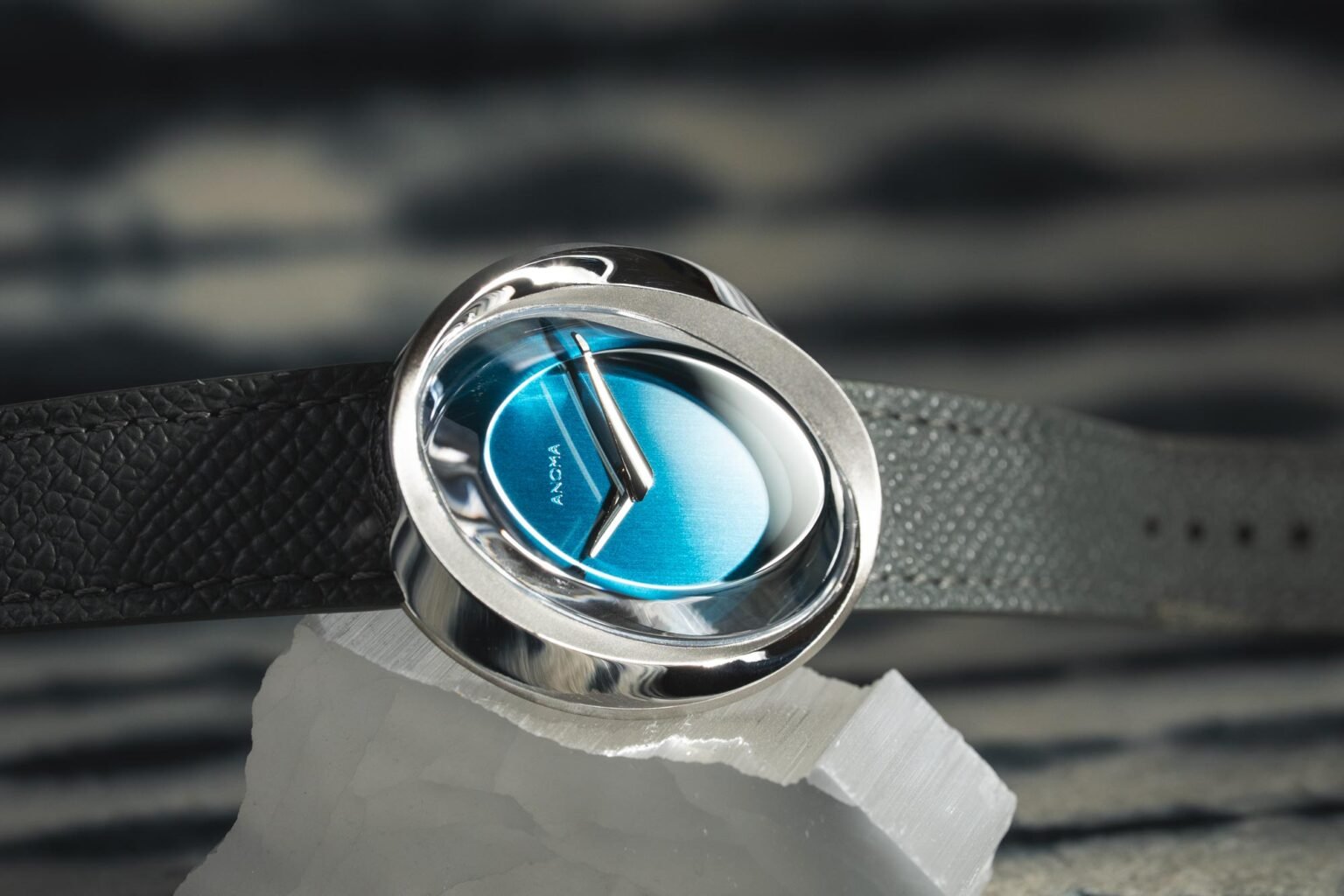
The A2 feels more like a sculpture than the A1, and I’ll do my best to describe it, but it really is something that has to be seen and felt in three dimensions to fully appreciate. The case has an oval shape and measures 41.5mm by 31.7mm. Its architecture is inspired by the Mobius strip, with case lines that circle each other, twisting and turning into themselves. It’s machined from a single block of steel, and has alternating mirror polished and sandblasted finishing elements, which highlight the wide, twisting facets.
Looking at the watch from a distance, the entire package (case, dial, crystal) appears remarkably coherent, like a single intentionally formed abstract object. Pulling apart each element reveals a bit of the intention and also what is surely a high degree of difficulty in the actual making of the thing. The case itself appears to twist clockwise, while the crystal twists in the opposite direction, creating an infinite loop effect. What’s really special about the design is that because the case and crystal seem to knot into one another, from certain angles it’s difficult to tell where the case ends and the crystal begins. The crystal itself is a crazy thing to observe – it’s 4mm thick and has unusual and wide facets. I love it when a brand pays particular attention to the design of the crystal and attempts something like this.

The dial is a bright metallic blue with an extremely subtle brushed finish. There are no markers for the hours or minutes, just an Anoma wordmark etched into the dial’s surface. It’s a saturated, tropical shade of blue that is probably a little summery for my own personal taste, but if Anoma’s work on the A1 is any predictor at all, we’re sure to see a variety of dial variants for the A2 to come. There’s of course a lot of possibility here – the A1 went in some genuinely unexpected directions – but I think a simple, solid color is the right choice for the first version of the A2 to hit the market. The dial does its job here of allowing the case and crystal to be the centerpiece of the project.

It’s difficult to describe exactly how the watch wears, because as with any unusually shaped watch, there are few comparison points. Wearing the A2 is a unique and enjoyable experience, and in the time I’ve had with it I’ve enjoyed showing it to friends and colleagues and talking about their impressions of it. It truly is a conversation piece in the best way, and invites discussion in a way your more traditional watches simply don’t. Although the watch has real heft and presence (it’s 9.8mm tall at its thickest point – a meaningless number given the unusual undulations throughout the case which give it real volume) there’s a slightness to it thanks to the very narrow strap. This does feel like a throwback to a certain type of design oriented watch from the midcentury period. I think this watch would be hard to wear on a larger wrist because of the way the (hidden) lugs are designed, even though in terms of the actual dimensions, the watch should work for a variety of wrist sizes. Personally, I’m excited that I can actually wear the A2 – I had difficulty with the A1 because of the triangular shape and being a lefty who wears his watch on the right wrist. No such issues with the A2.

Just as the A1 was modeled on a specific piece of art, Vianello has cited specific points of inspiration for the new piece. The Mobius strip, a mathematical concept that describes a non-orientable surface, is the key reference point here. This has been a jumping off point for artists for centuries, and Vianello references sculptures by Barbara Hapsworth (“Pelagos”) and Max Bill (“Endless Ribbon”) as works that he was thinking about while working on the A2. He also points to M.C. Escher, and Richard Serra’s spirals. “The fun thing is that once you start looking,” Vianello told me, “spirals are absolutely everywhere, in both the natural world and the built world.”
The hands are basically two small sculptures within a sculpture, and inspired by Constantin Brancusi’s “Bird in Space,” a series of modernist sculptures first conceived in 1923. While the first examples of “Bird in Space” were made in marble, later sculptures were made in highly polished bronze. The work is meant to conjure the movement of a bird, rather than a bird’s physical characteristics, and is seen as a landmark in abstract sculpture. Like all watch hands, they overlap in different ways throughout the day, and at 10:10 they form the abstract form of a bird. According to Anoma, the hands are four times thicker than conventional watch hands, and are both domed and mirror polished. The attention to detail here is impressive as the hands are small by necessity, and their specific form can really only be fully appreciated under magnification, at least by my aging eyes.

The Museum of Modern Art currently has a Brancusi retrospective on exhibit that has not only a dizzying number of sculptures on display, but artifacts from Brancusi’s life. The tools from his workshop, for instance, and even part of his record collection, are all on display. I walked through the exhibit recently and thought about how his art is a product of the way he lived his life, which of course is true of all art if you step back far enough from the work itself. Seeing “Bird in Space” in person, and looking down at the A2, you realize that the watch is a synthesis of many other works, an interpretation of ideas and concepts that is both literal in some ways and quite poetic in others. As an aesthetic object, the A2 is fascinating and enjoyable in my opinion purely because of its unique form. It’s also, naturally, a commentary on the elliptical nature of time.
I found it even more interesting as yet another example of an art focused watch. I caught myself thinking about the recent release from Hublot and Jeff Koons while wearing the A2. That watch was ostensibly inspired by a very famous piece of pop art, but it doesn’t feel to me like it was actually created by an artist. It might as well have been the product of a ChatGPT prompt to turn Balloon Dog into a watch. Did Koons design the watch, or just sign off on it? I suspect it was closer to the latter.

By contrast, the A2 itself feels inspired in the way it takes bits and pieces of other things and builds them into something unique and new. This is what all art does, it is not, however, how most watches are designed.
The A2 will be part of the Anoma core collection. An ordering window opens to day for one week, with deliveries expected in April of next year. The retail price is about $3,130 after currency conversion. While not an inexpensive watch, this strikes me as a reasonable price point for something with so many highly customized and likely hard to fabricate components. The crystal alone must have gone through several rounds of prototyping to get exactly right. While the movement isn’t exotic (it’s a simple manually wound La Joux-Perret D100) just about everything else is.

More information on the Anoma A2 can be found on the Anoma website here.
The post Review: the Anoma A2 appeared first on Worn & Wound.