

When Blancpain brought the relatively obscure and largely forgotten carrousel back to life in 2008, they did so with a series of firsts that made the tourbillon alternative useful again. Now, in 2026, the Carrousel is back in its latest iteration, and Blancpain has taken it even further, adding some technical improvements in the pursuit of chronometry while using materials and finishing that feel like a shot across the bow of smaller independents.

What you view as the quintessential Blancpain complication depends on the era. The early revival period had the “six masterpieces,” —the Complete Calendar Moonphase, Ultra-Thin, Perpetual Calendar, Minute Repeater, Split-Seconds Chronograph, and Flying Tourbillon. For me, the minute repeater was the standout.
I also want to mention an incredible flying tourbillon ref. 0023, designed by Vincent Calabrese, had an unusually bird-shaped or anchor-shaped cage that rotated off-center from its axis, with the balance and escape wheel sitting on either side of the bridge. That unusual design led some people to mistakenly call it a Carrousel. Close, but no cigar. So, what is the Carrousel?

Photo courtesy Watch Brothers of London.
The History and Benefits of The Carrousel
By definition, a tourbillon rotates the balance wheel and escapement to adjust for and counter the effects of gravity, and the carrousel does the same. In hindsight, it shows the impact that the watch internet has had over the last few decades—no one would argue that fact today. The carrousel—invented by Danish watchmaker Bahne Bonniksen, who presented the first “karussel” watch in 1892 with a patent in England—also rotates, but its rotation is driven by a different power source than the one giving impulse to the escapement. In theory, you could stop the carrousel and the watch would still run.

Bahne Bonniksen / Sharman D. Neill Ltd. “By Appointment to the King” Belfast, Movement No. 57601, Case No. 43247, 51 mm, 132 g, circa 1905. Photo courtesy Dr. Crott Auctions.
The use of the carrousel died off in favor of the tourbillon. One factor might have been that the tourbillon, while certainly complicated, was simpler and more elegant at accomplishing the same thing. Another is that, until 2008, the carrousel had a rotational period of about 30 to 45 minutes, depending on execution, which was detrimental to rate stabilization. But there are benefits.
In a tourbillon, the fourth wheel (normally the seconds wheel) is fixed to the movement. Its pinion is not driven by the train. Instead, the fourth wheel pinion drives the cage, and the escape wheel carried by the cage meshes back with that fixed fourth wheel. The escape wheel therefore “walks” around the fixed wheel, and that walking motion is what turns the cage. Power reaches the cage and the escapement through a single path, which has a consequence. The escapement receives only the torque left over after the train overcomes the cage’s inertia and friction, so part of the train’s energy is continuously consumed by the cage. Stopping the cage in a tourbillon would stop the escapement.
However, in 2008, Blancpain created the Carrousel Volant Une Minute (Caliber 225), the world’s first flying carrousel in any watch, the first one-minute carrousel, and the first carrousel to achieve a 100-hour power reserve. Almost comically, it also looked more like a tourbillon cage than the brand’s original tourbillon.

The Carrousel Volant Une Minute (Caliber 225). Photo courtesy Sotheby’s.
Blancpain’s carrousel removes the fixed wheel. The seconds wheel turns freely inside the cage. The patent calls this wheel a “false seconds” or intermediate wheel, because it is not strictly a seconds wheel. The intermediate wheel splits power into two routes:
- The intermediate wheel engages the pinion of the free-turning wheel in the cage, which feeds the escape wheel directly.
- In Blancpain’s own description, the intermediate wheel also drives the cage through its exterior teeth, then an intermediate reducer gear, then a second intermediate gear, which engages the cage. Blancpain has previously described this as similar to a differential. Their original patent says the cage turns at one revolution per minute. The reduction ratio is what sets that period. Also, if the cage was stopped, the escapement could still continue running.
In a random aside, Bonniksen, as a brand, was revived last year, and they are working on the Naissance d’une Montre 4, which is also planned as a carrousel. Blancpain would later combine both the tourbillon and carrousel into one watch, but if your era is the late 2000’s and your brand is Blancpain, this is probably the watch you think of as their quintessential complication (semantics about a regulating organ being a complication aside).
The Blancpain Carrousel Incliné, In The Metal

Today’s launch combines the innovation of the original Carrousel Volant Une Minute with the established aesthetics of the brand’s skeleton watches into something that might be a bit anachronistically a Blancpain of a different era. However, the brand has improved on the aesthetic qualities and technicality in a way that blends the neo-vintage with modernization. It also has chronometric bona fides to back it up. The 4Hz carrousel itself is set at a 30-degree angle, not just for show; each watch will be given a certificate documenting its performance across all six positions over its power reserve, to a tolerance of -0/+2 seconds per day.
For the first time, Blancpain takes that bird-shaped carriage, with a pointing indication to help track seconds, and applies the shape to the carrousel cage in the new caliber 222ISQ. You can see that, due to the incline, you can track the seconds only for part of the rotation.


Above, you can start to see the drive from the mainspring to the fourth wheel, where the mainspring splits. At the far right is the gear that drives the periphery of the carrousel to move it, while the gear hidden under the carrousel sets the rate of rotation. Meanwhile, the fourth-wheel pinion engages the escape wheel, which delivers energy to the balance in impulses and keeps the regulating organ running.
According to Blancpain, the original idea from Marc A. Hayek, President & CEO of Blancpain, was an inclinable carrousel whose angle could be adjusted at the wearer’s discretion. But as they refined the idea, the brand ran chronometry tests at various balance inclinations (at 5-degree intervals between 0 and 35) and settled on 30° after four years of development. More than that, over a 100-hour power reserve, the rate stays incredibly stable, even when subjected to other tests to simulate wear (rather than just settled changes in angle on a Witschi or similar timegrapher).

A view of the second mainspring barrel into the gear train powering the carrousel cage and escapement.
As for the cage itself, its overall mass is down by 8.5%, and its rotational inertia has been cut by 30%. The balance wheel, which sits at the center, has grown to 8mm in diameter yet maintains the same balance inertia, thanks to inset adjustment screws and a silicon hairspring. As a result, the cage wheel now measures 9mm across, with the gear ratios of the previous generation left unchanged. Supporting the cage on a double ball bearing lowers its height and removes the bridges that formerly concealed the transmission. This patent-pending arrangement shows both drive inputs: the meshing at the fourth-wheel pinion and the gear train that rotates the cage. Lastly, a three-arm friction system on the cannon pinion keeps the movement radially compact while still allowing the hands to be set. In total, the movement is only 5.3mm thick, not accounting for the incline, but a relatively thin 6.98mm where the cage projects above the movement plane.

Each point represents the rate measured over one minute in each of the six standard watchmaking positions represented by the pictograms (two horizontal positions and four vertical positions).The six-position measurement cycle is repeated continuously throughout the entire running time of the watch (100 hours), making it possible to establish the complete chronometric signature of the timepiece, including the effects of position, state of wind, isochronism. Illustration courtesy Blancpain.
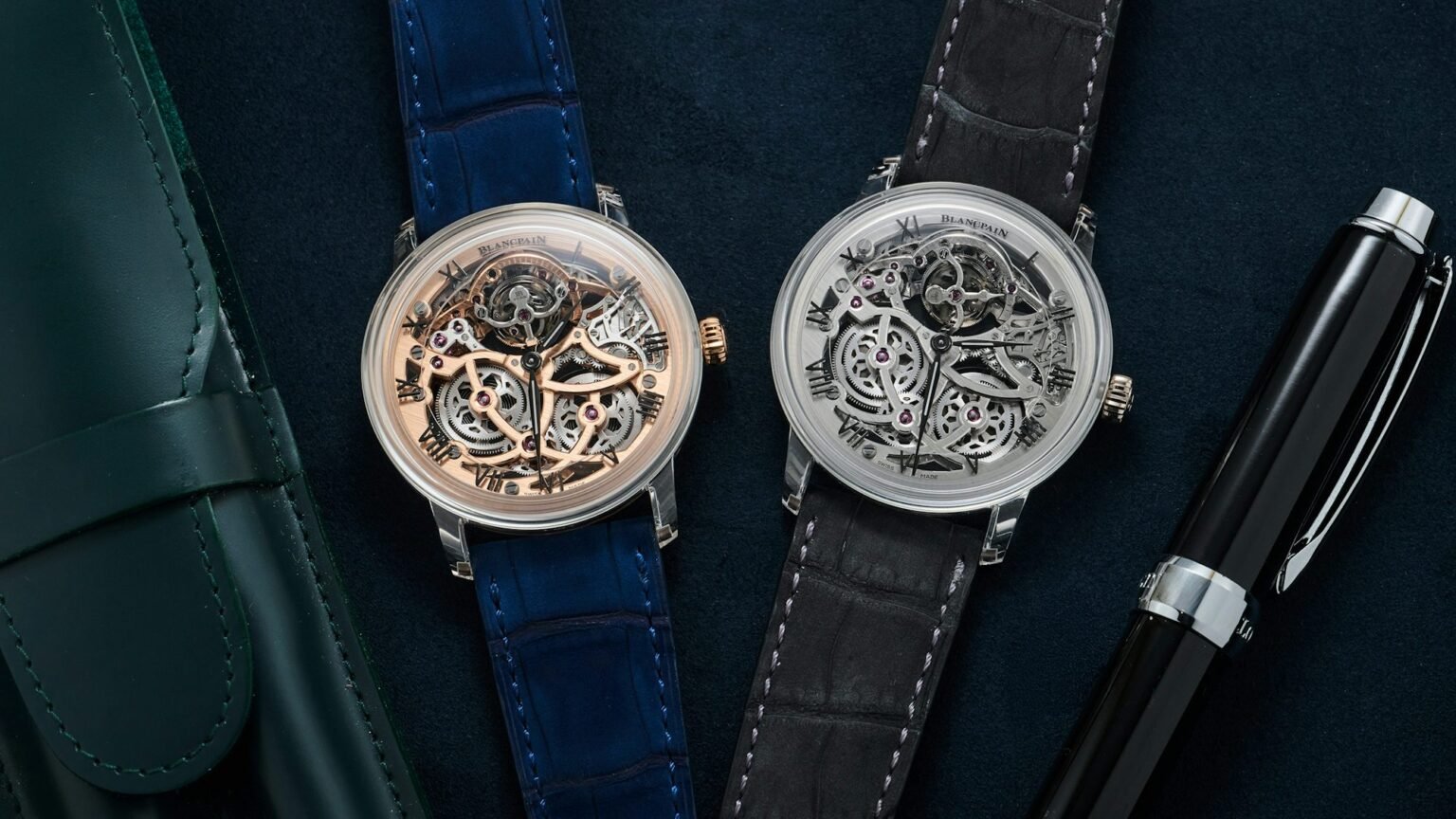
Aesthetically, the quintessential Blancpain skeleton design remains, but taken to a level somewhat inspired by the brand’s GPHG Mechanical Exception-winning Grande Double Sonnerie. This seems to be an increasing emphasis from Blancpain, likely taking note of the “finished to within an inch of its life” qualities people are admiring in younger watchmakers these days. The watch has a caliber in 18k rhodium-plated 5N gold or 5N red gold.
The bridges are all brushed in the same direction, while every other part, including the countersinks for jewels and screws, is highly chamfered at an angle chosen to maximize shadow and create depth and contrast. Even the underside of each skeletonized bridge and plate, which you can’t see (no matter how hard I tried to photograph), has the same brushing and chamfering, though at a different angle. Upper bevels are executed at 30 degrees, while lower bevels are cut at 45 degrees.

In total, there are (according to Blancpain) “253 sharp inward angles found throughout the movement’s components, excluding the stamped angles of the lower cage wheel.” The team responsible for this work is based at Blancpain’s Decoration Workshop in Le Brassus, and the watch requires 210 hours of finishing.
Actually, the rear of the movement is far more reserved. The bridges and what remains of the plates are a bit larger, with the angled portion of the movement supported in the top quarter by angled and bent plates. From the back, you can more easily see that the dual mainsprings, also skeletonized, can operate as power reserve indicators. You can see how tightly wound the barrels are, or aren’t, and roughly judge how much power you’ve got left.


We haven’t even gotten to the most modern component of the watch yet, though you probably noticed. Both versions (with rose and white gold plates) are cased in sapphire. While the original Carrousel from Blancpain was thinner, this version still measures only 40.3mm by 11.3mm thick, despite having that 30º inclined balance. Greubel Forsey’s inclined balance models start around 15.5mm in thickness. The water resistance is stated at 30m.

The wearability of the new Carrousel Incliné is quite impressive, though I haven’t spent much time wearing a sapphire case in general (certainly never for more than a few minutes), so I’d be hesitant to really give it much of a beating. That said, this is about as far as you can get from a beater watch anyway. The case feels like a shot at brands like Richard Mille and Greubel Forsey, while the movement feels far more “modern indie.” There are certainly benefits to being part of a big conglomerate like the Swatch Group (things like production capabilities and shared patents)—probably far more than there are detriments—but groups can often be sluggish to adapt. The combination of modern case and high-end finishing feels like Blancpain is saying, “we’re a part of a big group, but we can pivot to play against what is hot.” The main question is how it will land with clients.
On the legibility side, the blackened hands with luminescent material stand out better against the rose gold and white gold bridges than some alternatives, but they also get a bit lost against the copious chamfering and high-polish surfaces that add shadow and contrast to the dial-side display. The indices at the edge, done on a floating sapphire ring, are a bit more legible.


While the watch certainly won’t be as limited as the two or so Grande Double Sonneries they plan to produce, I expect it won’t be highly available either. The Carrousel Incliné is basically a $502,600 masterpiece of finishing and chronometry. Until the creation of the first watch from the upcoming Bonniksen brand (which is certainly more than a few years out, I’d have to imagine), Blancpain is the name on the market for the carrousel, and it has reaffirmed that fact with a top-to-bottom impressive release.

For more on the Blancpain Carrousel Incliné, visit the brand’s website.