

In the quiet Swiss town of Saint-Imier, a thirty-minute drive from Neuchâtel and passed through the Jura mountains, sits Longines’ headquarters. While the buildings themselves have long since been modernized, the site has served as its home base for almost 160 years. Saint-Imier is Longines, and Longines is Saint-Imier.

While most of the discussion these days centers on Longines’ sharp resurgence in popularity, driven by an evolution of its modern product that seems to resonate across the board, tucked away in one of these connected buildings on the Saint-Imier campus sits the crown jewel of Longines—the World Heritage Workshop.
This August, on my way to Geneva Watch Days, I went on a detour and spent a few days at Longines Headquarters. With Neuchâtel as my home base and the campus only a short drive away, it was a few incredibly memorable days immersed in the brand’s unbelievably rich history. Yes, we saw a few modern Longines watches along the way, but this time the focus was all about the past.

The Longines History, As Told Through Parts
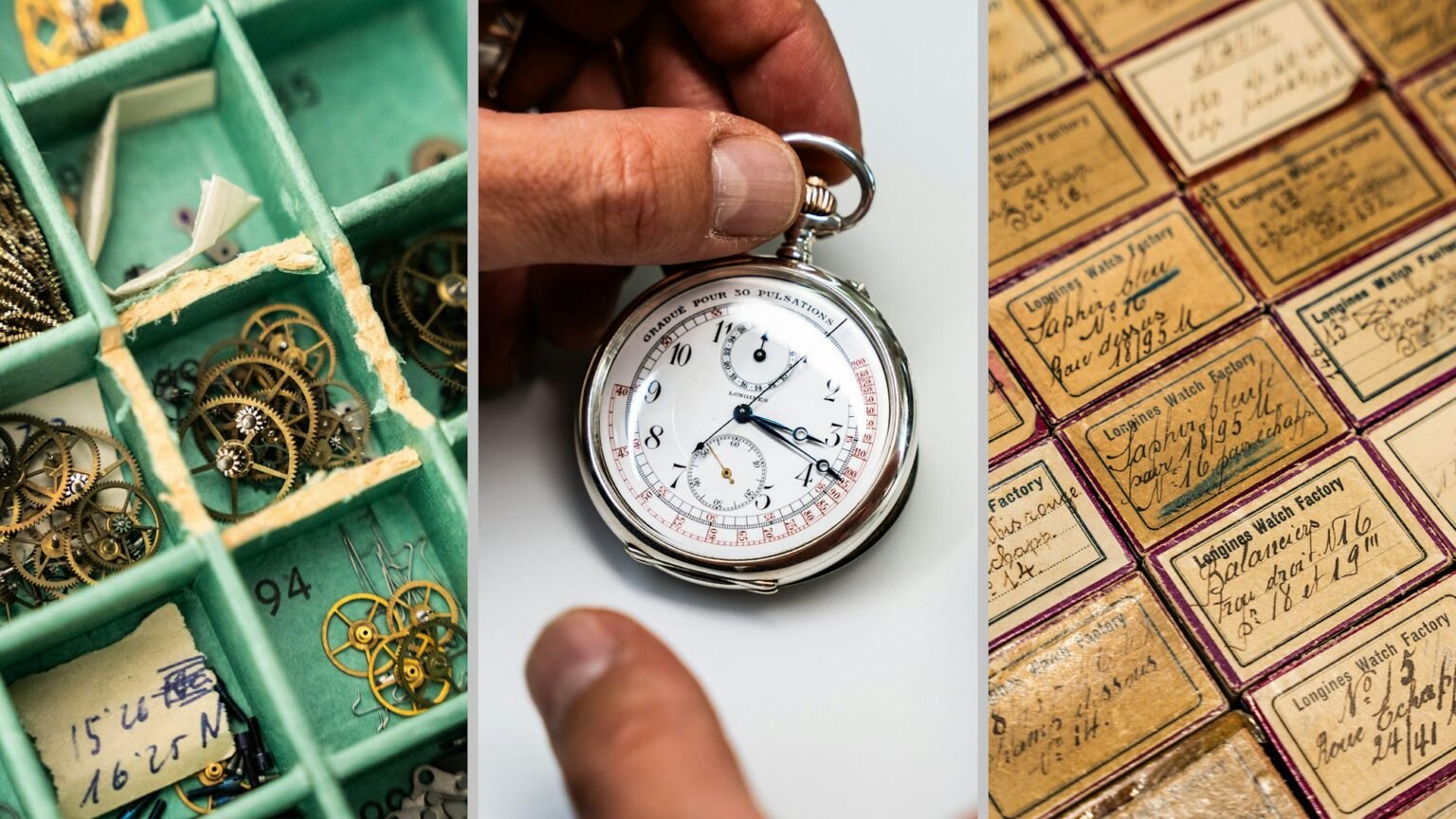
So how does a workshop position itself to support over a century and a half of legacy watchmaking? The answer first lies in the workshop’s stockroom. It is a surprisingly small space, dimly lit by a few small windows on the building’s upper floor, and rather warm in the summer heat (air conditioning is not the Swiss way). But the density of watchmaking history packed into these drawers felt almost inconceivable.
These drawers are mostly arranged by their parts—cadran, remontoire, balancier. However, a closer look at some sections reveals some numbers and letters Longines nerds would immediately smile at—13ZN, 30CH, and more. From boxes upon boxes of minuscule parts like jewels, screws, and more, to complete dials, crowns, and even whole movements, this is a dream for any watchmaker or collector who loves Longines.

It’s helpful that Longines has operated continuously here since the sixties—eighteen sixties, to be exact—which means much of this original inventory has been preserved. But maintaining and expanding this inventory takes a lot of work, as so many watches are serviced each year. One method, for example, is buying old parts stock from all over the world. Jestin and his team procured an expansive collection of vintage Longines crystals, neatly organized in a drawer, from a retiring Argentinian watchmaker. So much of this stuff could be lost in its entirety once these aging businesses close their doors, and part of Jestin’s job is to try to save them before they’re ever thrown out.


Where The Magic Happens

Right next to the stockroom, through a hallway filled with old books and schematics from Longines’ past, sits the actual workshop. Jestin tells me the brand can service or restore any Longines watch or pocket watch made from 1867 through 1985 (just a few years after Longines was acquired by what is now the Swatch Group in 1983). Later watches go through the more conventional servicing department elsewhere at the headquarters. Though Longines no longer manufactures its own movements, relying instead on Swatch Group partner ETA, the workshop has to support the approximately three hundred different calibers Longines created in the past.
Between the thirteen people on Jestin’s team, consisting of eleven watchmakers and two jewelers, around 1,700 watches go through these doors each year out of the almost three thousand quotes submitted by Longines owners. When a watch is delivered for restoration, a single watchmaker oversees it from start to finish—whether consulting the brand’s ledgers, which record every watch produced since 1867, or conducting the final quality inspection before returning it to its eagerly awaiting owner.

The space is quiet and peaceful as I step through its doors, with none of the industrial chatter heard in other parts of the Longines factory. I notice there are quite a few empty desks. Jestin tells me that to dodge the summer heat (air conditioning is not the Swiss way of life), many of the watchmakers on the team choose to come to the workshop very early in the morning so that they can finish their work much earlier in the day before the afternoon intensity of the sun makes it uncomfortable.
Jestin also explains to me that the priority in the workshop is on restoring, rather than replacing. This makes sense, for both creative and practical reasons. For any parts needed for the watch that aren’t available in the stockroom, however, the Heritage team drafts plans to replicate them, and those plans are then sent to a supplier for production. But quite a bit is done in-house—the two jewelers on the team produce replacement parts for anything on the exterior of a wrist or pocket watch—think clasps, crowns, cases, and more.


The work coming out of this space is mighty impressive. During my time at Longines, I also spent an hour touring the modern production lines, which, at Saint-Imier, involve T2-level assembly for many of its products. Here, ETA movements are assembled with cases, hands, dials, and more. That scene was much more in line with what I expected from a brand of Longines’ price point and scale, and though no photos were allowed, T2-level assembly looks similar at any brand.
But the Longines Heritage Workshop and its gold mine of a stockroom felt like a stark contrast to the modern, industrial processes happening elsewhere on campus. One doesn’t invalidate the other. Seeing the watchmakers at work on so many incredible watches from the brand’s past provides the historical context the brand can reinterpret in its watches today. Preserving brand history in this way is a never-ending quest, and seeing it in action was an absolute treat.
For more, visit Longines.