

Now that we’ve barely caught our breath from the Geneva auction season, we’re off to Hong Kong for Phillips and Christie’s. Sotheby’s held its Hong Kong auctions before the Geneva sales, which we also previewed, so it’s only fair to look at the other two big auctions (and then brace ourselves for New York to wrap up the year). Phillips is first, running November 21 and 22, while Christie’s opens with a 40-piece sale of some high-impact watches on November 25, and their standard sale starts November 26.

Three watches in my budget at Christie’s.
I’m going to try to keep this preview to a few trends I’ll be watching and a few wishful pieces I’d buy if I fell into a Scrooge McDuck-sized pool of gold. Why the top-end lots? Well, regardless of my personal budget, these are the ones driving the overall rise in interest in the market outside our enthusiast space, and most of the real news is at the top. At the Phillips Geneva sale, the top 17 lots (about 8% of the sale by lot count) all went for over CHF 1 million and made up roughly 40% of the total value. Sotheby’s and Christie’s sales had a flatter distribution. That said, my secret for finding deals? Go to the auction, sort the sale by low to high, and find things like this really cool two-tone Eberhard or cushion-cased Movado chronograph starting around $2,500 or this platinum Patek 3796 starting around $7,500.
The Trends
1. Classic Patek Still Hits The Spot, But Will It Perform?

The top estimates in Hong Kong still go to Patek, which feels somewhat comforting. It’s a space and type of collecting that I at least feel has some historical grounding. But we live in a brave new world, so I’ll be watching to see if the former blue chips remain the same way. That means watching the first-series 2499 and nice 1518R at Phillips. I don’t expect them to outperform estimates like Journes might, but I hope they perform better than this 1518J where someone put luminous dots and hands on relatively recently. Or maybe neo-vintage and modern pieces will start rising in price alongside those early indies, things like this 5002P Sky Moon Tourbillon offered on the heels of a yellow gold one selling for CHF 3 million at Sotheby’s in Geneva. Rarer still is the 6002G Rare Handcrafts Sky Moon Tourbillon at Christie’s, with an estimate starting around $3.4 million. Somehow that’s just still a bit easier to understand (in the world of imaginary prices I’ll never afford).

Ref. 3990P-011. Photos courtesy Christie’s.
Then there’s the weird stuff that happens where you get two Advanced Research perpetual calendar 5550Ps up for sale, at Phillips and at Christie’s, which is a bit like the twin films phenomenon except instead of watching both The Illusionist and The Prestige, you get to watch someone spend $100,000. Similarly, there are two of the gem-set versions of the 3970—the ref. 3990—up for sale. One, offered at Phillips, is possibly unique with a platinum case and salmon dial. It’s a known watch that traded hands in Italy over the last few years, shared on Instagram by folks like Davide Parmegiani. That made it funnier to me when I posted a photo a few months after seeing it on the wrist of a dealer and got an angry message from the owner, who said I wasn’t allowed to post it anymore. Odd (and not how that works). Phillips has this at $1,500,000 to $3,000,000, but at that price, I’d rather take their patina’d first series 1518. If you like pink gold, Christie’s has theirs (one of four known) for a fraction of that, starting around $315,000.

Photo courtesy Christie’s.
Even this Patek observatory “Extra” tourbillon pocket watch with two cases—which won first prize in a timing contest in 1931—well, it feels like a watch where the result should tell us how active old-school collectors are and, in my mind, how stable the market will be. I think this type of collecting has more trickle-down impact on stuff us “normal” collectors would buy. There are only so many watches available from indies—not only because of low production, but because they haven’t been around that long. If vintage scholarship-driven stuff is strong, then the Vacheron 4072s, Patek 130s and 96s, and random dress watches and chronographs worldwide are probably doing well too.
2. Continued Boom Or Possible Bust For Journe?
As I mentioned in my Geneva recap, there’s definitely some concern about how the Journe market is doing right now. Scholarship is sometimes a mess, dealers sometimes don’t know as much about what they have as they think and are asking massive prices. Unless it sells at auction, no one is paying near record-breaking prices. That’s led some sellers to believe they can demand auction prices, and then they end up shocked that things aren’t moving fast. My guess is that the gap between auction prices and the rest of the market will start to close, and prices will plateau. There are also fewer earth-shattering pieces in Hong Kong, though New York will be more of a test.

One special watch is worth a positive shout-out, however. Mark Cho of The Armoury is selling one of five “parking meter” Chronomètre à Résonance models with blue dials that were made for that retail store. He’s said that the timing was right to sell the special watch and reinvest the proceeds back into The Armoury, which (alongside some of his watch projects) is his sole menswear focus after selling his stake in Drake’s. The RT (as it’s known) is one of the least common to see on the market and, while I’m aware that it’s not my favorite dial layout, I do think this denim-ish blue dial is maybe my favorite I’ve seen. I wouldn’t be surprised to see it achieve a pretty substantial number against a $770,000 low estimate. Heck, Mark will make you a custom suit if you buy it, according to Phillips.
3. Will Other Indies Crack The Million Dollar Mark?
I made a big deal about this in my Geneva auction recap, but I do think it’s wild now that we have a reasonably big club of living watchmakers with pieces that have sold over $1 million. F.P. Journe, Roger Smith, Philippe Dufour, Rexhep Rexhepi/Akrivia, Kari Voutilainen, and now Sylvain Pinaud. I was actually reminded that a Simon Brette traded privately for over $1 million, and a Romain Gauthier Logical One is being offered for the same price.

A rising tide doesn’t necessarily lift all boats, but there’s a decent chance that the club could keep growing in Hong Kong. First, I expect this possibly unique Vingt-8 (with Kari’s signature on the dial) to break that million-dollar mark, despite the low estimate. But the bigger deal would be if Theo Auffret’s Tourbillon à Paris Souscription piece could join the club. I think we’re starting to see a delineation between brands founded by a living watchmaker or designer and ones where there’s a sense that the watchmaker has (or had) a more hands-on involvement in making the watches. This feels like a carry-on effect from the Journe boom, but I’m happy with that. My hope is that, even if the watchmaker themselves isn’t benefiting from the sale, the increased interest in their work means that we won’t have stories like back when Philippe Dufour was barely making a cent on his Simplicity. A healthy indie space requires a balance of fair prices for buyers and sustainable living for the makers, and more eyeballs mean more customers and, hopefully, slightly more sustainable growth.
With all that in mind, here are six watches I’d actually want to buy if money were no object…
What would I buy? Well, the real me really wants (and has wanted) a first-generation platinum Datograph for years, and this one is in incredibly good condition. But that answer isn’t any fun. I’m giving myself an unlimited budget to go shopping. Let’s start with the Pateks. The two that jump out at me are the 2481 “Tropics” dial and one of my favorite configurations of one of my favorite references, the 5004P-032.

The 5004 is on a bit of a rollercoaster, with a record set earlier this year when Clapton’s salmon dial went for $5.2 million at Phillips in New York. The previous record was set last fall at around $1.8 million for a Michael Ovitz unique black dial at Christie’s Hong Kong. So the market started to get hot. Dealers were starting to ask big bucks for unusual (but not unique) dials. Now it seems to have cooled a bit, though standard variants are maybe 15% up over last year (if I had to guess). Special dials still command a premium, and this (in my opinion) is one of the best dial variations, with a matte dial (not sunburst as with some others) and seven baguette diamonds.

Phillips says three have been sold publicly, and this is fresh to market. I actually know the location of five examples (including this one), plus a sixth that has a later dial done by Patek. My best guess is that five to ten were made. The estimate of $308,000 to $615,000 feels incredibly conservative, but if that’s the case, someone will get a really good deal.

The rose gold 2481 is far more classic and romantic. It’s the most beautiful way to “flex” a deep-cut Patek: cloisonné enamel and a “King-sized” Calatrava. I spent some time with this watch and the 2481 in yellow gold that sold for €900,000 at Monaco Legend Auctions last fall. There are 12 known examples of these rainforest motifs, evenly split between yellow and pink gold, and the dials also vary in vibrance and saturation depending on how well they were preserved (for instance, one, not this example, accidentally took a dip in a pool once) and seemingly on what dial plate color was used. This one isn’t quite as bright as the example in Monaco, but lacks the cracks in the enamel that sometimes happen around the indices (like at 6 o’clock on the watch MLG sold). That might be why the estimate is a bit higher at $641,000–1,280,000. In short, you’re getting what is essentially a pretty phenomenal pink-on-pink Patek, capped with beautiful cloisonné, that’s much rarer than a standard 1518. Tracking this lot will help track the Patek market pretty well.

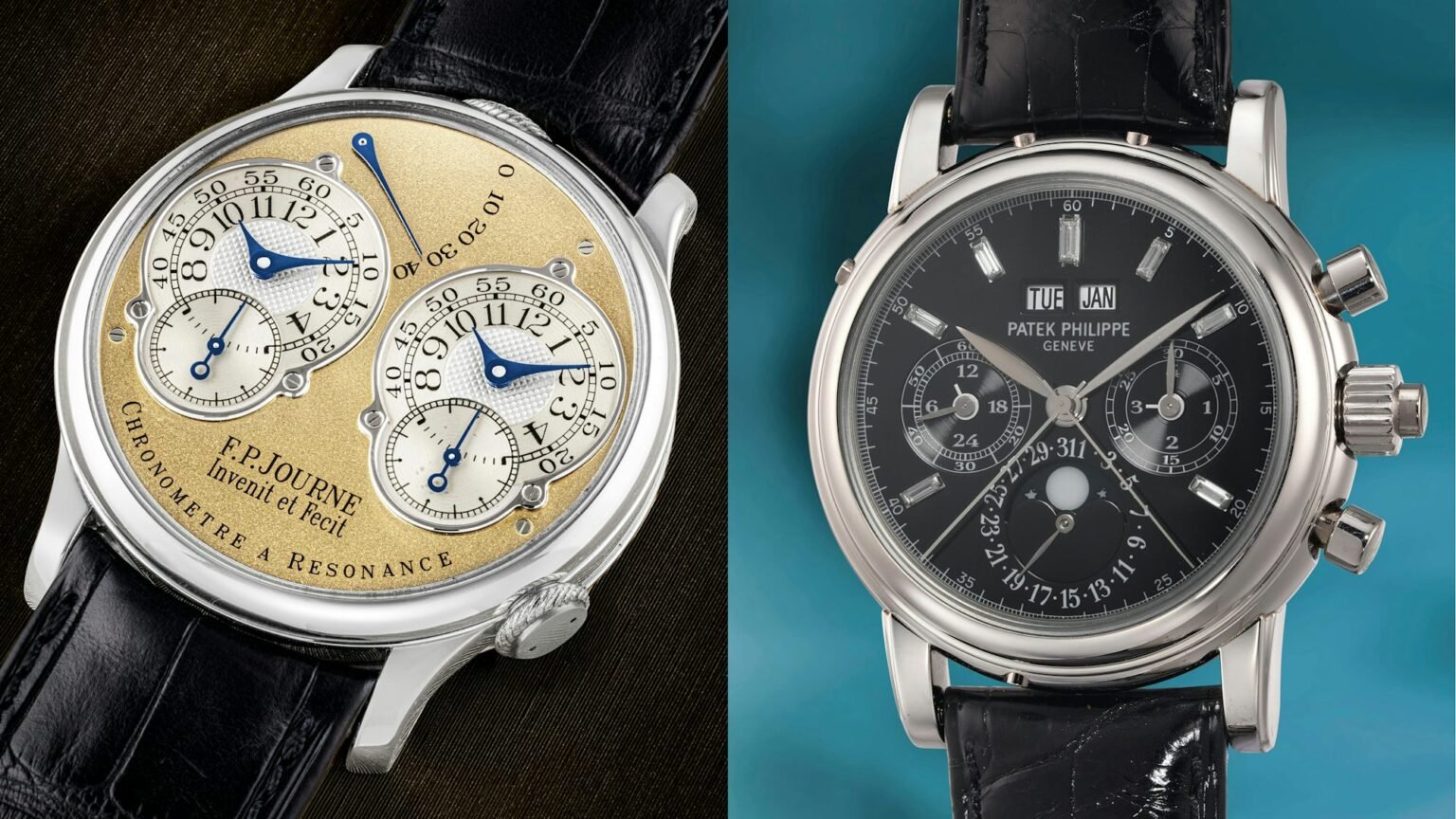
Next, despite my resistance to the current market hype, I’d still probably be looking at one of the F.P. Journe 38mm brass-movement Résonance models that are being offered in Hong Kong. I’m no Journe scholar, so don’t expect deep insight here, but my personal aesthetic taste is gravitating toward the “shiny” dial 056/00R at Christie’s with the shallow engravings on the caseback, if only because that more yellow gold-toned dial is what I picture in my head when I think of early Résonance. If I wanted something that went more in line with the modern hype of the market, I have to say this ruby heart dial TN (one of 20 made to celebrate the end of the Tourbillon Souverain) is just so eye-catching I can’t deny that it looks pretty special.

Finally, I’d gladly take Phillips offerings from Kari Voutilainen and Theo Auffret, for the very reasons that make them watches with the potential to deliver big results (though not because I want watches that have high prices… frankly, I’d be too afraid to wear them). But I really have enjoyed getting to know Kari over the years—he was the first real “indie” I ever met, and getting to know indies has become one of my favorite parts about this job. Owning a watch with his actual signature on the dial feels that much more personal. Meanwhile, I really like Auffret’s tourbillon, and the two-tone impact of the charbonnage and the more raw appearance are unlike much else on the market.