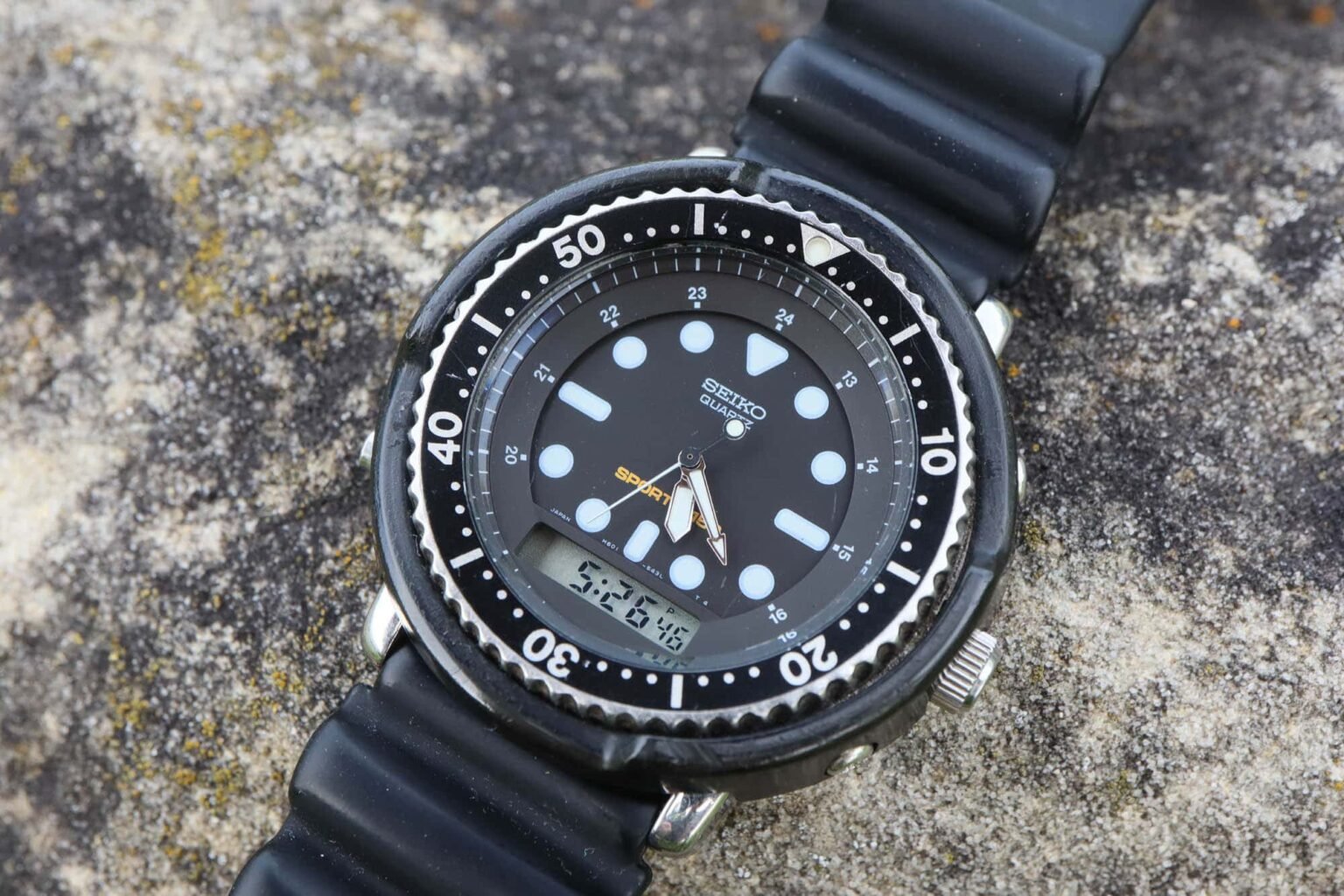


I was never one for weightlifting until I saw Arnold Schwarzenegger pull off the Seiko H558-5009 in Commando. I used to own a Seiko SNJ025 Arnie Reissue some years ago when they first came out, but quickly sold it after realizing how massive it looked on my 7” wrist. I originally couldn’t believe how well the watch fit on Arnold’s wrist in the movies, chalking it up to his peak male physique and years of competitive bodybuilding. It was only when I realized the original Arnie models were over 2mm smaller in diameter that I decided to start the hunt for an example of my own. Having fully hopped down the Arnie rabbit hole, I first encountered the elusive “Upside-Down Arnie” that had been entirely overshadowed by its Hollywood brother. After years of searching––and a H601 movement replacement courtesy of my friend Dave Gronlund––I had nailed down an example of my own in overall excellent cosmetic condition. What makes the Upside-Down Arnie a good watch in its own right, regardless of its star-studded counterpart? Let’s find out.

The Brief History of the H601-5480
Documentation regarding the design and release of the Upside-Down Arnie is scarce. From the sources I was able to find and examine, it appears this model was released in 1985 or 1986, 3-4 years after the original Arnie in 1982. Both the H558 and H601 models seemed to fare relatively well within general consumer circles during their time on the market. However, the military and professional diving communities really took a liking to the Arnie lineup because of their impressive specs (which we’ll come back to shortly). The H558 is often considered the first ana-digi hybrid diving watch, though I haven’t been able to concretely confirm this with the information I’ve found. I know brands like Citizen and Chronosport produced watches of a similar design language during this era, but I can only assume that these were released after the 1982 Arnie. Seiko ceased the production of both the H558 and H601 variants by 1991, though it’s uncertain as to why. The “Baby Arnie” models powered by the H556 movement had also been discontinued alongside their bigger counterparts, so I could only assume Seiko wished to take their design catalog in an entirely new direction once the new decade rolled around.

Design and Aesthetics
Both the Original and Upside-Down Arnies measure in at 45mm in diameter with 22mm lugs and a black resin shroud surrounding the stainless steel case. Both are water-resistant to 100m, sturdily shock-resistant, and chemical/gas resistant; picture a G-Shock with a little less water resistance but a lot more refined, classic aesthetics. The H558 and H601 are virtually identical apart from a few very minor technical differences––oh, and of course, the screen position. It’s entirely a matter of personal preference whether the top or bottom LCD screen position looks better. Because I’ve owned several H601 Seikos in my time, I’m accustomed to the screen being at the bottom of the dial, but that doesn’t mean I like that layout better.
Examining the overall design reveals just how rugged and utilitarian the Upside-Down Arnie is made out to look and feel. The resin shroud adds a layer of protection and bulk unlike many other divers of its kind. The classic Seiko indices are bold and contrast well against the recessed dial. The depth between the crystal and dial is dramatic, for lack of a better term; I’ve never really seen another watch with this much space between the two. The watch occupies a decent amount of real estate on my 7” wrist, but it never becomes overbearing like the modern reissues did for me. It’s a bulky watch that definitely won’t look at home paired with a dress shirt and slacks, but it manages to offer just the right amount of macho to any leisure or athletic outfit.

Buyer’s Guide
If you’re looking to pick up an Upside Down Arnie of your own, you’ve come to the right consultant. First and foremost, pay close attention to the movement and how the listing documents its operational condition. If it’s been tested and isn’t working, I would steer clear. This unfortunately isn’t a straightforward H601 movement replacement because of the dial’s unconventionally increased height from the movement itself, so several smaller gears and fragile components must be swapped during the process. The H601 and H558 are not equal when it comes to quality, with the H601 containing numerous plastic alternatives to the H558’s metal components. With this in mind, it’s important to keep your eyes peeled for tested and running movements that can be upkept rather than a project that may require lots of time, parts, and potentially even money. Another aspect to note regarding condition is in relation to the resin shroud. They can become incredibly brittle with age and can crack and warp over time; be attentive to any visible damage shown in the listing unless you plan on investing in an aftermarket shroud (which are thankfully prevalent online).
Lastly, parts for these watches overall can be rather pricey because of their collectibility, so if there are any cosmetic issues you may dislike about a particular example (bezel insert fading/damage, crystal scuffs, non-original strap, warped shroud, etc.), keep this in mind before adding it to your cart. Pricing-wise, overall figures vary for the H601, but these models can typically be found for between $400-550 compared to the $550-700 range of the H558 original.

Conclusion
With a far more niche cult following and generally lower price of admission, I think the Upside-Down Arnie offers an interesting bang-for-buck opportunity for collectors. It’s an aesthetically interesting and physically capable watch that can captivate a variety of collectors. If you’re looking for a conversation piece, the H601 can spark even more dinner party discussion than the original Arnie because of its off-the-beaten-path collectibility and charm. Let’s face it: I’ll never have the looks nor muscle mass of Arnold, and I don’t think I’ll become governor of California anytime soon. Nevertheless, I do own an iconic watch that harkens back to the cinematic era of training montages and back-turned explosions––and hey, so can you.