

Just 18 mph. The pace of a pygmy hippopotamus at full chat, a sidewinder snake late for a meeting, a badger sprinting for the bus or, apparently, a Tyrannosaurus Rex in pursuit of a YJ Jeep Wrangler. That’s how fast, or rather slow, I’m trying to drive down this narrow lane in the heat of competition.
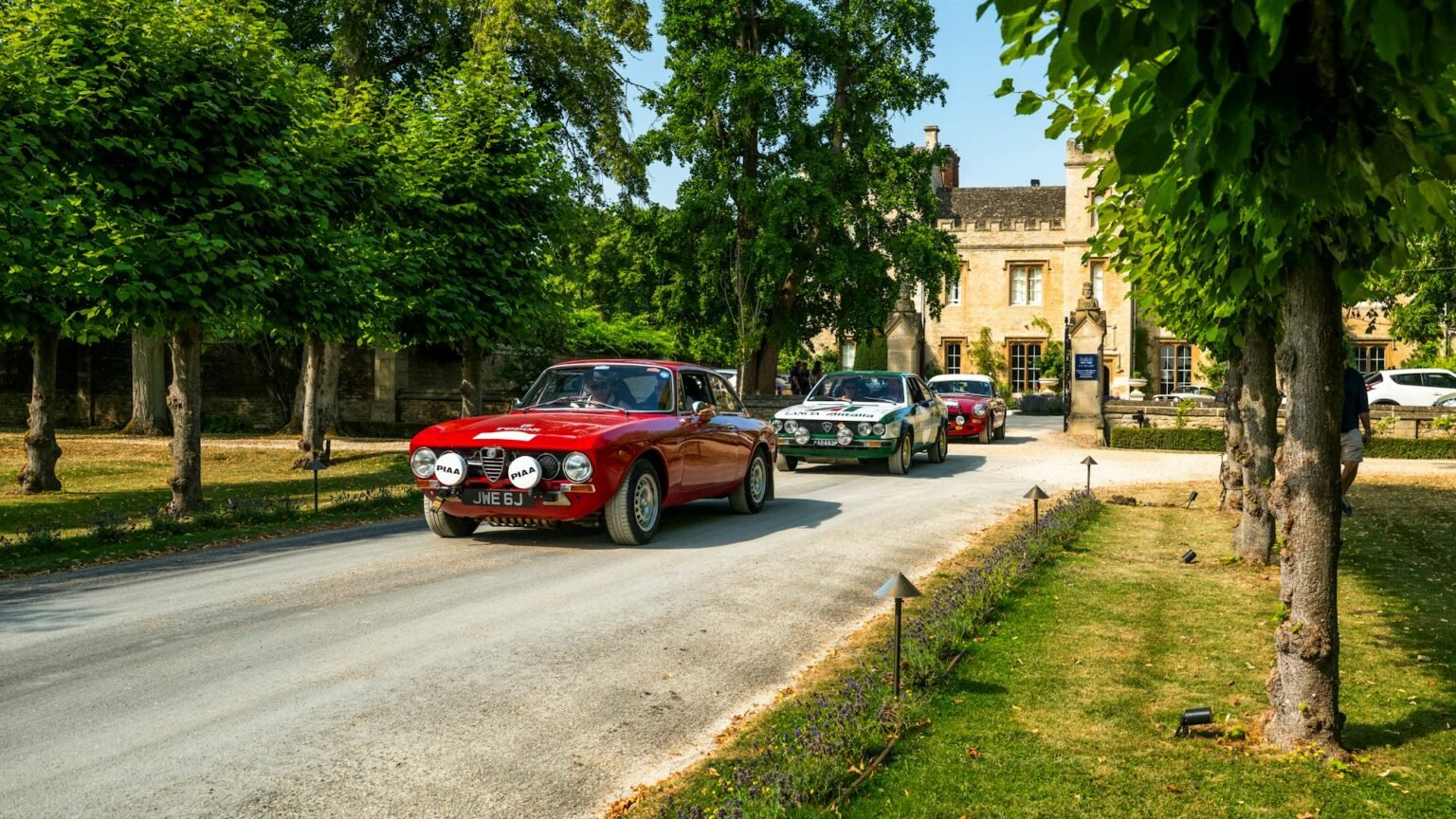
Yet, as the little red Alfa Romeo meticulously meanders its way through a calm corner of Cotswolds countryside, a drop of blood trickling along a grey artery between yellow sun-baked wheat fields, there is real tension inside the car. It might not be fast and furious, but this is not slow and soporific either. The concentration is palpable in the cabin. Sweat is forming on brows, and it’s only partly because of a lack of air conditioning.


In the navigator’s seat is Matt Dereve (@SoulSpec), who is doing a valiant job of juggling directional diagrams, distances, and a stopwatch, while I try to heed his instructions and match them to the needle on the Veglia dial. This is genuinely tricky and, what’s more, it’s Matt’s first ever rally. There’s also a podium place on the line. Welcome to the HERO-ERA Rally for the Ages; a rather brilliant first rung on the historic motorsport ladder…
Browsing a rack of greeting cards in a local shop the other day, I picked up one that said something along the lines of: ‘Money can’t buy you happiness. But it can get you a 288 GTO and a 3970, which is close enough for me’
Droll (and, like I say, the wording may have differed a smidgen), but I think we can all appreciate the deep layers of sentiment that the folded paper purveyor was going for. Social media, sometimes even normal media, can all too often give the impression that the most expensive things really are where ultimate happiness lies. And if you’re always having the pinnacle paraded in front of you, it’s easy to be lulled into accepting that the lower rungs of a ladder must provide less joy.


I love driving around in my scruffy hot hatch and get a kick out of a Casio Calculator Watch, so by and large I don’t think I could be accused of having lost sight of this. And yet… in motorsport terms, perhaps I had. Because I don’t think I would have done something like the HERO-ERA regularity rally had it not been for a certain Cole Pennington at Tudor calling me up and asking if I’d like to take part.
A regularity rally is pretty much the entry point for motorsport in the UK. Not so much grassroots as opening the packet of seeds. Given that I’ve been lucky enough to compete a little further up the rallying ladder in the past, I’ll admit that part of me thought Rally for the Ages wasn’t really my bag. Not enough speed, not enough skidding around, not enough thrill. But that’s like owning a Daytona and then being myopic enough to dismiss a DWC Terra as having no worth for you. Silly me.

Tudor, as you might have guessed, is a sponsor of the event, and that was, in a similar way, a surprise to me. This is an enormous brand with its name on the side of F1 cars and the timing partner for the crown jewel of endurance off-road motorsport, the Dakar Rally. Why is it promoting a small fixture like Rally for the Ages? Given that Tudor also sponsors UTMB and Inter Miami, should we expect partnerships with Park Run and Accrington Stanley FC as well?

I jest. HERO-ERA also organizes automotive events with epic scope such as Peking to Paris. Nevertheless, it is genuinely pleasing to see a company as big as Tudor associated with and drawing attention to events across the whole motorsport spectrum, not just cherry-picking the headliners.
This particular day is designed to introduce people to the world of regularity rallies. Certain rules are relaxed, and entry is even free if the sum of the crew’s ages is less than 70. The eventual winning co-driver had turned 13 just the week before.

The basic idea is that the cars set off at minute intervals and (hopefully) follow a prescribed route using a road book with distances, descriptions, and simple ball-and-arrow or Tulip diagrams (Tulip comes from the Tulip Rally in the Netherlands, where the style was first popularised). Along the route, stages require you not only to navigate but also to travel at specific average speeds that vary depending on the roads. It’s all marshaled and recorded on time cards, and the closer you are to the designated timings, the fewer penalties you accrue.
The Rally for the Ages also had four stages on the private grounds of the Bicester Heritage airfield, and although they were short and the average speeds were still relatively low, they allowed for a bit of the sort of driving you couldn’t get away with on public roads. There were even some gravel sections to negotiate, which was fun in the rear-wheel-drive Alfa.

There were three Tudor crews competing (numbers 26, 54 and 58…) using HERO-ERA arrive-and-drive cars that can be hired out – ‘our’ 1971 Alfa GTV 1750, a 1977 MG B Roadster and a 1975 Lancia Beta Coupe. However, a quick perusal of the paddock pre-event revealed a broad church of both cars and watches in attendance. Everything from a Volvo 340 to a Mazda MX-5 (NB) to a 1930s Lagonda and a Porsche 964 was parked up, while on wrists were Submariners, Swatches, a Rotary Greenwich, a lovely Omega Seamaster 1948 and a well-worn ’90s Seiko Kinetic Arctura, to name but a few.
If you’re wondering what watch I was wearing. Well, I turned up in my Aerospace (E65362) but was then ushered into a new Tudor Ranger. In fact, a full range of Rangers was sprinkled among the group I was with, and a few of us swapped and shared, so I got to experience all four combinations of size and shade. For me, the winner was the 36mm Dune dial. The pale hue makes it nicely distinct from an Explorer, and the smaller amount of real estate on the face ensures there’s not too much empty space. As someone who generally likes a bezel to fiddle with or a bit of complication, I was surprised by how much I fell for the simple, cream-toned Ranger and, by the end of the rally, didn’t want to give it back.


The effortless, vaguely adventurous nature of the watch was a good fit for the rally in some ways, and you could certainly see it being a good companion on something like the Classic Safari rally or the Sahara Challenge. However, there was another category of watch on display that I haven’t mentioned yet, and it’s one that got me thinking…
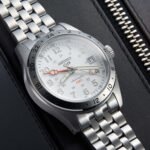
You might be surprised to learn that watches are made specifically for rally co-drivers. A company called AST in England is the go-to, with the Fastime Clubman (shown below) offering a sort of Fisher-Price, easy-to-operate entry point, and the Fastime RW3 letting world-championship drivers store a plethora of stage times and additional data.
I messaged Elliott Edmonson, who co-drives for Oliver Solberg in the Toyota World Rally Team, and he confirmed that the RW3 is really the only option. Some have started using smartwatches with apps as well, but all use the RW3. Some, including Elliott, wear two, partly for redundancy and partly to help them stay on top of the vast amount of information they need to track.


This dual setup mimics history in some ways: in the past, there were sets of mechanical rally timers, such as Heuer’s Rally Master series, that paired a Master Time clock with a Monte Carlo stopwatch. Baltic has produced its own versions recently to go with its sponsorship of the Tour Auto rally in France. These would usually be mounted on a car’s dashboard, and they’re a jolly lovely addition, too.
However, with Tudor’s newfound association with rallies, I think it should consider going down the wristwatch route for something special. A flyback chronograph would seem to be the minimum requirement, and although there isn’t one in the current Tudor catalog, you don’t have to look too far into the past to find one: the Grantour Fly-Back (Ref 20550N and 20551N), which was on sale until 2019.


However, if we’re dreaming, why not go for the whole nine yards and Tudor’s first-ever split-seconds chronograph (or rattrapante, if you prefer)? Add in a pop of color on the standard seconds subdial to help you count down to the start of stages, a tachymetre scale (with the option of miles or kilometers), and I think you’d have a winner. Essentially, a Rolex 4113 for the modern era. Could be fun. Perhaps HERO-ERA could organize an event where all digital timing methods are banned?
But back to the Alfa, where Matt is using a digital trip and a Fastime Clubman while looking for a gate on the left, then a signpost on the right, then a humpback bridge, followed by a stone wall and a junction leading to Hosgmeade or Rivendell or somewhere equally unlikely. It’s relentless, and yet the risk levels are very low. The designated averages range from 18 to 28 mph, and obviously at times we’re traveling faster to ‘catch up’ after stopping at a junction, halting at time control, or correcting a mistake.


And if you think low risk and low speeds mean a casual, almost flippant air with the competition, you’d be wrong. Matt and I are both quietly competitive, so we have agreed to stay nonchalant out of the car and take it far too seriously when we’re in it. As neither of us has done a regularity rally before, we have no idea whether our times are good, bad, or indifferent, but at the lunch stop we find out we’re third in our class and hovering around the top ten overall.
Sadly, tearing into a pizza and some fizzy pop clearly does us no good. I get far too engrossed in pretending to be Sandro Munari and, as we oversteer out of the last airfield hairpin of the day (twin-cam barking, rear wheels spraying gravel, dust dancing in the afternoon light, car floating in a lovely slide all the way to the grass on the exit…) and promptly forget which cone we’re meant to go around next. Cue a minor kerfuffle of ‘Over there! No, THAT one!’, a couple of precious seconds lost, and two places dropped with the finish line in sight. Curses.
But what fun was had. And that really is what it’s all about. Despite the name of the company running the event, sometimes it’s good to remember that not everything has to be heroic. You really don’t have to climb K2, learn an entire concerto, or compete at the highest level to enjoy yourself. You don’t have to get out of bed every morning feeling like you were born to dare, even if the watch on your wrist was.