
The Polaris plays a different role in Jaeger-LeCoultre‘s catalog than the famed Reverso, complicated calendars, and many dress watches for which the manufacture is best known. It is, in essence, the brand’s one true sports watch—a dive watch in heritage and modern execution, complete with an internally rotating bezel and a design that leans more casual than most of the brand’s work. The modern collection arrived in 2018, drawing on the 1968 Memovox Polaris while taking the design well beyond a straightforward revival. The model we’re focusing on today is the Polaris Date 40mm, the ref. Q9128981, introduced earlier this year in June. Familiar in looks to the current DNA of the line, the watch brings the blue lacquer-dial Date into a smaller case. It measures two millimeters less in diameter and roughly one millimeter less in thickness than the existing 42mm model, while retaining 200 meters of water resistance and the automatic Caliber 899. It comes on a matching blue canvas strap and costs $10,400.
[toc-section heading=”From Diving Alarm to Modern Sports Watch”]

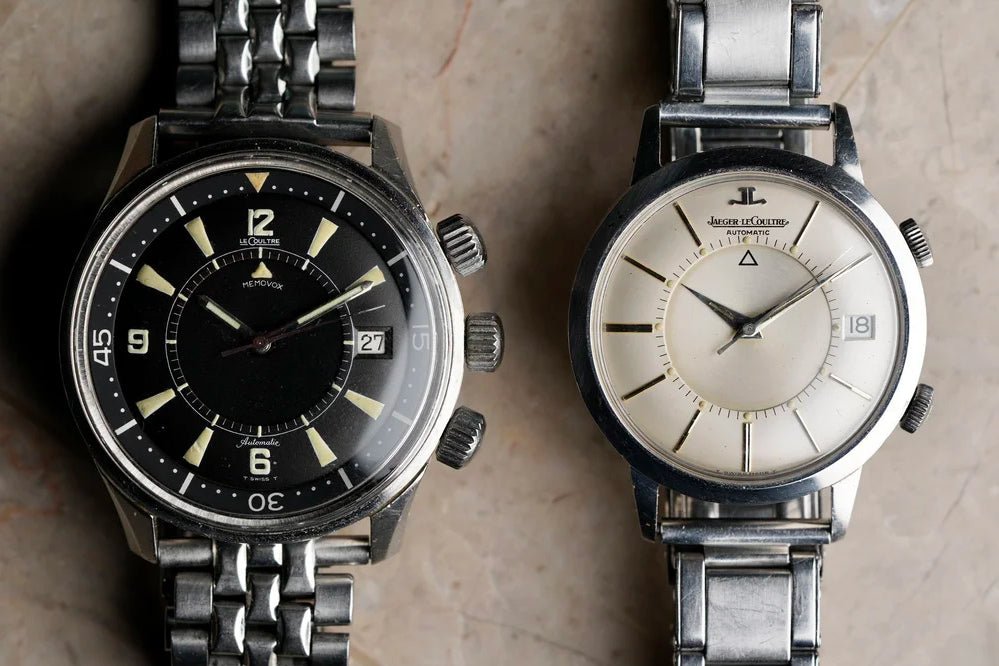
LeCoultre Polaris Memovox reference E 859 next to Memovox reference E 855 via Wind Vintage
The Polaris story begins long ago, almost a decade before the 1968 model most closely associated with the name hit the market. Jaeger-LeCoultre first explored the concept of a diving alarm with the Memovox Deep Sea in 1959, using a mechanical alarm to remind divers when it was time to return to the surface. The Memovox Polaris, the Ref. E859, followed in 1965, with the better-known 1968 iteration introducing the bold luminous markers and Arabic numerals that remain recognizable in the collection today.
Recreational scuba diving was growing in popularity during the period, and watchmakers were approaching underwater timekeeping in different ways. Rolex had its Submariner, Omega its Seamaster 300, and Longines its twin-crown Super-Compressor divers, the predecessors of today’s Legend Diver. The Polaris distinguished itself by combining an internally rotating timing bezel with a mechanical alarm, using three crowns to operate the different functions.

Jaeger-LeCoultre 1967 Memovox Polaris, Ref E859 via Christie’s
The case was similarly unusual. Its compressor construction used increasing water pressure to reinforce the caseback seal as the watch descended, while a layered caseback helped transmit the sound of the alarm. At 42mm, the Polaris was also quite large for its era, though its dimensions owed as much to the mechanics within as to the needs of diving. The Memovox Polaris II arrived around 1970, bringing a broad, shaped case and a selection of colorful dials. Neither generation remained in production for very long, and the Polaris never became the continuous catalog fixture that the Submariner or Seamaster did. From there, Jaeger-LeCoultre would revisit the original design with limited Tribute to Polaris editions in 2008, before establishing the modern Polaris collection a decade later.

The 2018 revival brought back the familiar dial design and internal bezel, though the collection expanded considerably beyond the original diving alarm. Alongside Memovox models came simpler automatics and chronographs, with more complicated watches joining the lineup in the years since. These days, the Polaris is a full-fledged sports-watch collection, with its diving heritage nonetheless remaining central to its identity.
[toc-section heading=”Smaller Case, Same Polaris Identity”]

The latest Polaris Date addition measures 40mm in diameter and 12.9mm thick, compared with 42mm and 13.92mm for the larger blue lacquer-dial version. Jaeger-LeCoultre has offered smaller Polaris watches before, notably the 41mm time-only Automatic, but this is the first time the blue lacquer-dial Date has appeared in the smaller format.
I’m partial to the revised dimensions; the internal timing bezel gives the Polaris a fairly broad dial opening, making the watch a bit more legible than its diameter might suggest, while still wearing nimbly and close to the wrist. At 40mm, the proportions feel a little more contained, while the thickness remains relatively modest for a 200-meter sports watch with an exhibition caseback.
The steel case features brushed surfaces alongside polished accents, with sharply defined lugs and a narrow bezel framing the glass-box sapphire crystal. Two crowns sit at 2 and 4 o’clock, the upper operating the internal timing bezel and the lower handling winding and time setting. Jaeger-LeCoultre notably opted for conventional signed crowns rather than the distinctive cross-hatched, or waffle, pattern found on the original Memovox Polaris and later Tribute editions. The newer crowns suit the contemporary look well enough, though I think the original pattern would have added a welcome bit of vintage character.
The overall design is familiar to the larger Polaris Date, only now in a more compact package. Water resistance remains 200 meters despite the smaller proportions and sapphire exhibition back, a respectable rating for a modern sports watch and more than enough for most swimming and diving needs. The watch comes standard on a blue canvas strap, which may not be to everyone’s taste, but with quick-release fittings, a steel double-folding clasp, and a standard 20mm lug width, finding an alternative should be relatively easy.
[toc-section heading=”Blue Lacquer, Three Different Finishes”]

The dial is arguably the most distinctive element of the Polaris Date, with its large Arabic numerals, trapezoidal markers, and skeletonized hands drawing on the original Memovox Polaris. The blue gradient lacquer, however, gives the modern watch a considerably different appearance, with a lighter shade in person than some darker photographs might suggest.
The dial itself is divided into three distinct surfaces. The internal rotating bezel has an opaline finish, the hour-marker ring is grained, and the center is sunray-brushed. Jaeger-LeCoultre applies seven layers of colored lacquer and another 35 translucent layers, polishing the surface by hand afterward. The result is a blue gradient that grows darker toward the edges, with the different textures adding some variation as the dial catches the light.

The large markers and skeletonized hands are treated with Super-LumiNova for visibility in low light, while the internal bezel features an orange triangle that adds a welcome bit of contrast against the blue. A date window sits at 3 o’clock, as it does on the larger model. Between the different finishes, gradient coloring, and orange accent, there’s quite a lot happening on the dial, though the various elements remain easy to distinguish.
[toc-section heading=”Automatic Caliber 899″]

Inside the Polaris Date is Jaeger-LeCoultre’s manufacture Caliber 899, the same automatic movement found in the larger blue Date. It runs at 4 Hz, offers a 70-hour power reserve, and features an instantaneous date change.
Measuring 4.64mm thick, the movement consists of 218 components and 32 jewels, with Côtes de Genève and perlage decoration visible through the sapphire exhibition back alongside an openworked winding rotor. The movement’s relatively slim construction helps keep the case under 13mm thick, while its just-about-three-day power reserve adds some weekly practicality.
[toc-section heading=”Final Thoughts And Pricing”]

At $10,400, the Polaris Date 40mm is $2,700 less expensive than the larger 42mm blue lacquer-dial version, currently priced at $13,100. That’s a significant difference for two watches with much of the same design and technical capabilities, and it gives the smaller model an advantage beyond its more compact proportions. Of course, there are less expensive ways to get a compressor-style watch with an internal timing bezel. But Jaeger-LeCoultre makes its case through its heritage, distinct design, and the quality of its finishing—from the steel case and glass-box sapphire crystal to the lacquered dial and decorated manufacture movement. Whether those details justify the five-figure price is another question, though there’s plenty here to appreciate.
Personally, I prefer the smaller dimensions of the 40mm, and the Caliber 899 is a capable movement for a modern sports watch. The blue dial has its appeal, particularly in person, though I’d be interested to see a simpler black version in this size. I’d also prefer a steel bracelet or rubber strap over the supplied canvas, but that’s a small gripe in today’s age of readily available aftermarket straps. Overall, the Polaris Date 40mm is a welcome addition to the collection, offering the capabilities of its larger counterpart in a more compact and less expensive package.
For more information, visit the brand’s website here.